9 Best Chainsaws in 2026 – Expert Picks Reviewed
The 9 best chainsaws of 2026 are the DEWALT DCCS623B 8-Inch Pruning Chainsaw (Editor’s Choice), the DEJUNPIOOL Mini Chainsaw 6″ & 8″ (Best Budget), the tietoc Mini Chainsaw 6 & 8 Inch (Best Battery Life), the DEWALT 20V MAX Chainsaw 12 in. (Best for Heavy Pruning), the EGO Power+ CS1611 Chain Saw 16″ (Best Overall), the tietoc 6 Inch Mini Chainsaw (Best for Beginners), the VEVOR Gas Chainsaw 12 Inch (Best Gas-Powered), the Seesii Mini Chainsaw 6-inch (Best Lightweight), and the Seesii Mini Chainsaw 8 & 6 Inch (Best Quiet Option).
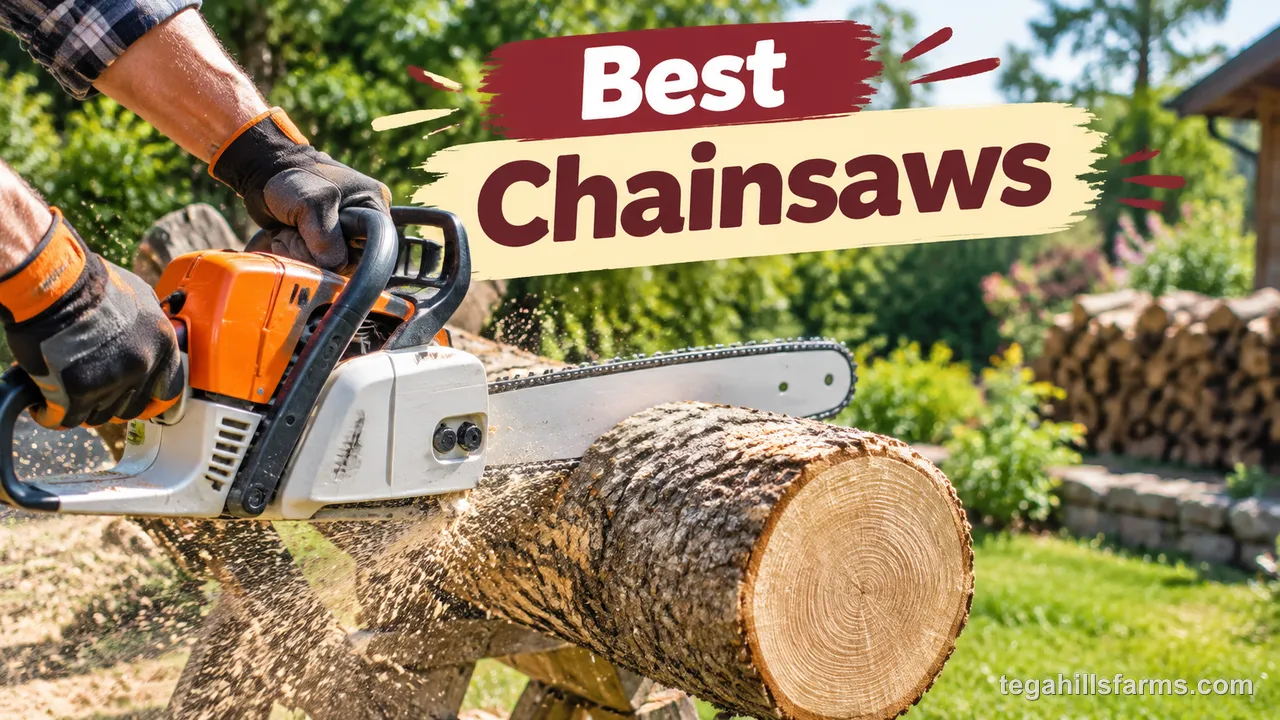
They differ mainly in bar length, power source, and weight and handling, which is how you match a saw to your yard size, storage, and how often you cut. A 6-inch one-hander excels on branches up to a few inches, while a 16-inch full-size saw handles small trees and larger rounds.
The real friction for first-time buyers is not cutting power but upkeep and noise — gas needs fuel mix, chain oil, and winter storage, battery needs charging habits and oiling, and neighbors notice the difference on early weekend cuts.




Below, you get a clear way to read specs, pick a power source, and match each of the 9 picks to your most common job without overspending on size you do not need.
How Do You Choose the Right Chainsaw for Your Yard in 2026?
Choosing the right chainsaw in 2026 means matching bar length and power to your typical cut and upkeep and noise to how you want to live with the tool. If you want a step-by-step sizing and power checklist, see our guide on how to choose a chainsaw before comparing models.
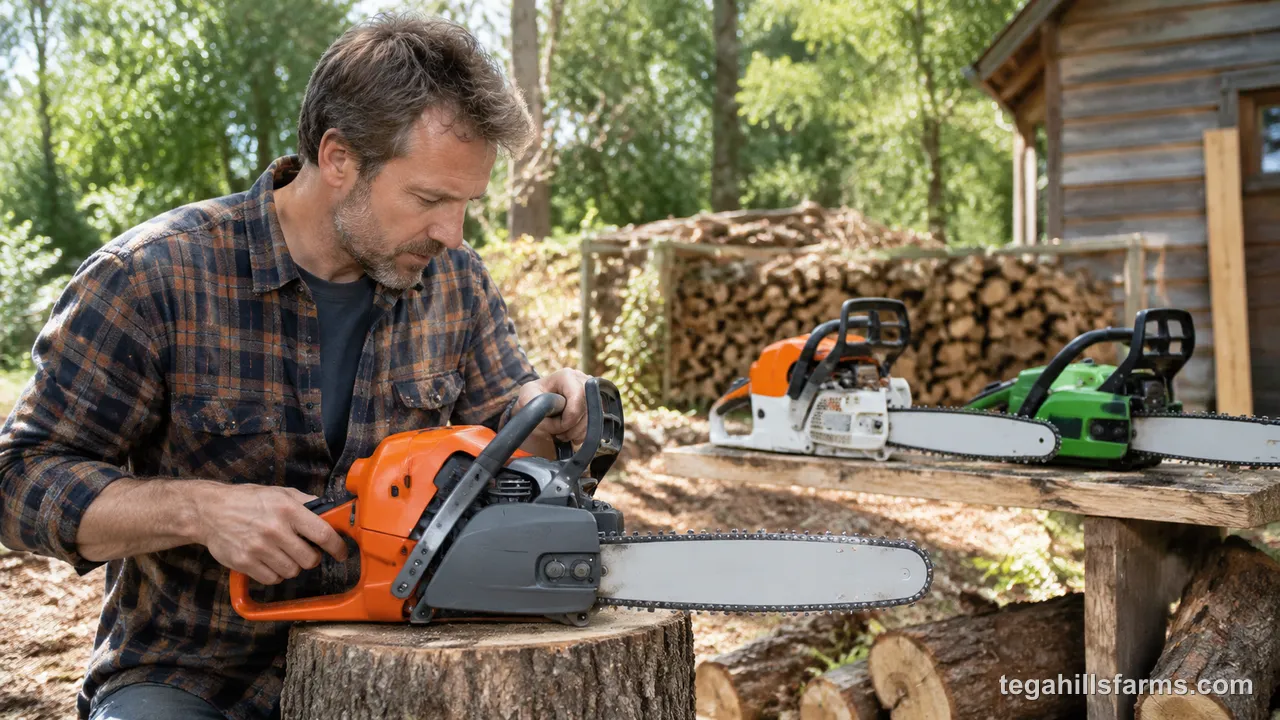
That balance keeps you from buying too much saw for occasional pruning or too little for regular firewood. For new owners, our notes on best chainsaws for beginners can also help you focus on lighter, easier-to-control options while you learn handling and chain tension.
What Do Bar Length, CC, and Volts Mean in Real Use?
A chainsaw’s bar length sets the diameter you can cut in one pass, while CC shows gas engine displacement and volts plus amp-hours show battery platform power and runtime.
Think of specs as yard outcomes. A 6- to 8-inch bar clears branches, vines, and 4×4 posts with one hand and stores in a tote; a 12-inch bar steps up to heavy pruning and small-tree limbing without the weight of a ranch saw; a 16-inch bar crosses into bucking and felling small trees. CC tracks how hard a gas engine pulls under load — higher CC holds chain speed in hardwood. On battery, voltage is the platform and amp-hours are the fuel tank — more amp-hours means more cuts per charge on the same voltage.
How Do Upkeep and Noise Differ Between Gas and Battery?
Battery chainsaws trade lower daily upkeep and lower noise for charging while gas chainsaws keep continuous runtime at the cost of fuel mixing, air filters, and louder operation.
In practice, battery means check chain oil and tension, charge after use, and store batteries indoors for winter — no mixed fuel sitting in the tank. Gas means you gain no outlet tether and steady power in the field, but you add ethanol fuel care, spark plug and filter checks, and hearing protection every time. If you cut near the house, early mornings, or inside a garage shop, the quieter start-up and idle of battery is a deciding factor.
Which Power Source Fits You Best: Battery, Gas, or Corded?
Battery fits most yards with convenience and low upkeep, while gas or corded still make sense for untethered runtime or continuous outlet power.
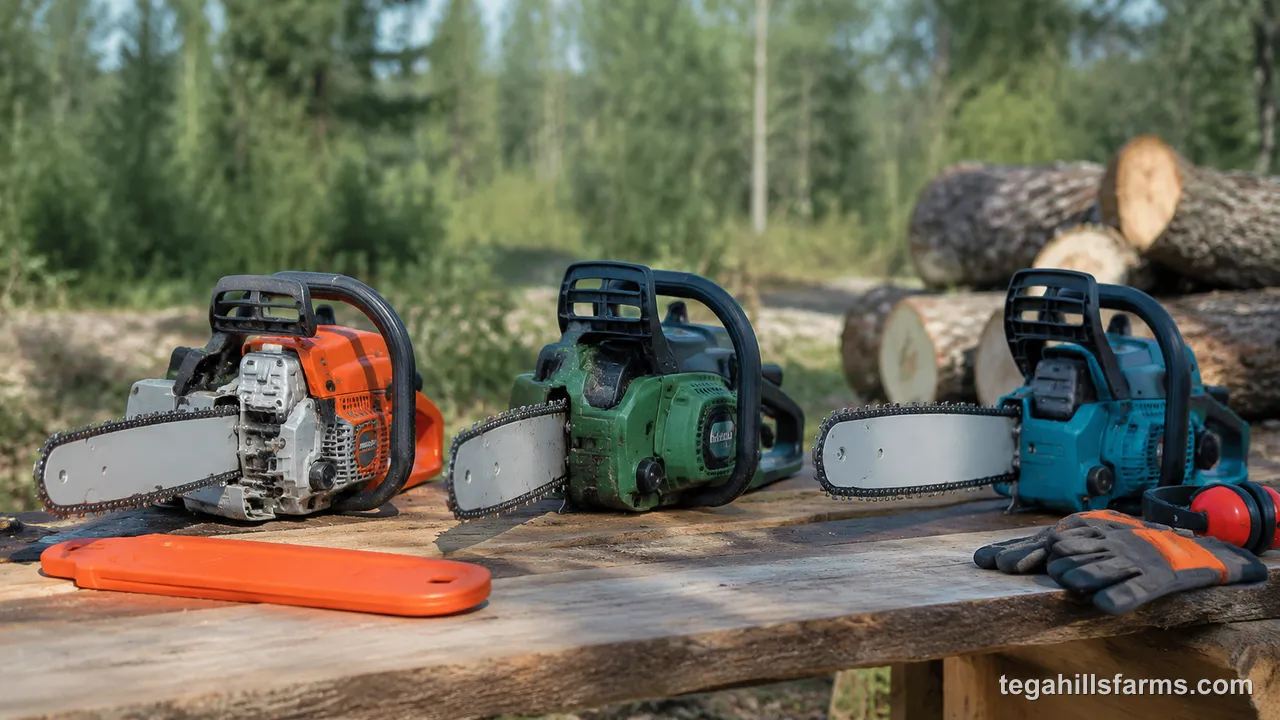
That choice decides your daily routine more than your cut quality. Use the two scenarios below to place yourself quickly.
When Is a Battery Chainsaw the Smarter Pick?
A battery chainsaw is the smarter pick when you want easy starts, low maintenance, and quieter cuts for pruning, limbing, and storm cleanup around the house.
Most homeowners in suburban lots cut in short sessions — trim a few limbs, cut a fallen branch, then put the saw away. Battery fits that rhythm: push-button start, no fuel to age, and you can check chain tension and oil in a minute. If you already live on a 20V or 56V platform, shared batteries stretch value, and indoor battery storage beats winterizing a fuel tank. For a closer look at cordless options across brands and voltages, see our roundup of best battery chainsaws. By contrast, gas asks for more prep for the same short job, which is why so many people leave it in the shed.
When Do Gas or Corded Electric Still Make Sense?
Gas or corded still make sense when you need nonstop runtime far from outlets or steady wall power without battery swaps.
Gas earns its keep on larger properties, ranch fencing, or all-day cutting where you cannot pause to charge — you refuel and keep cutting. A small 12-inch gas saw like the VEVOR in this list covers that niche without a 50cc+ weight penalty. Corded electric makes sense only if your cut zone stays within extension-cord reach of the house, such as deck and patio cleanup or backyard trees near the garage, where it delivers consistent power without fuel or battery management. If you lean toward fuel power for those jobs, compare the field-oriented models in our guide to best gas chainsaws.
The 9 Best Chainsaws of 2026 Ranked and Reviewed
The 9 best chainsaws of 2026 are DEWALT DCCS623B 8-Inch Pruning Chainsaw, DEJUNPIOOL Mini Chainsaw 6″ & 8″, tietoc Mini Chainsaw 6 & 8 Inch, DEWALT 20V MAX Chainsaw 12 in., EGO Power+ CS1611 Chain Saw 16″, tietoc 6 Inch Mini Chainsaw, VEVOR Gas Chainsaw 12 Inch, Seesii Mini Chainsaw 6-inch, and Seesii Mini Chainsaw 8 & 6 Inch. They differ mainly in bar length, power type, and one-handed control versus two-handed felling stability.
Use the labels below to jump to your job — pruning in tight crowns, budget entry, long sessions, or full-size bucking — rather than reading in rank order.
#1 DEWALT DCCS623B 8-Inch Pruning Chainsaw — Editor’s Choice
Most pruning saws feel like shrunken felling saws; this one was designed as a true pruner. Ideal for tight crowns and overhead limbs where a 6-inch mini stalls, it offers controlled one-hand maneuverability with an 8-inch bar on the DEWALT 20V platform.
Key Specs:
- Bar Length: 8 inches
- Power Source: Battery (DEWALT 20V MAX battery system, battery not included)
- Tool Weight: Compact pruning form factor
- Chain Type: Pruning chain with tool-free tensioning on many kits
Detailed Review:
The DCCS623B centers on pruning ergonomics rather than raw bar length. The short bar and in-line handle keep the tip visible when you reach into a crowded canopy or cut at chest height on a ladder-rated stance, which reduces the need to reposition around the branch. On battery, it starts instantly, idles quietly, and asks only for bar oil and tension checks — a practical edge for homeowners who prune a few times a season and store the saw between jobs. Compared to the DEJUNPIOOL Mini Chainsaw 6″ & 8″ in this article, the DEWALT trades dual bar sizes for a more refined balance and DEWALT ecosystem support, so you benefit if you already own 20V batteries and chargers. I’d lean toward this one for suburban pruning where accuracy and easy storage outweigh the desire for the longest cut.
Pros:
- Purpose-built pruning geometry makes angled cuts in tight branching easier than with general mini saws
- 8-inch bar adds reach over 6-inch minis without moving to a heavier 12-inch saw
- Battery start eliminates pull-cord and fuel-mix steps for quick cleanup jobs
- Fits DEWALT 20V MAX system for buyers already invested in the platform
- Compact storage footprint for small garages and garden sheds
Cons:
- Battery and charger not included in bare-tool kits, so first-time DEWALT buyers need to factor that in
- 8-inch bar still limits bucking and small-tree felling compared to 12- and 16-inch picks in this list
Who It’s For:
Homeowners who prune fruit trees, ornamentals, and storm-snapped limbs a few times a year and want a light, precise saw that stores easily. Skip it if your main job is bucking firewood rounds or felling — step up to the 12-inch DEWALT or 16-inch EGO instead.
Editor’s Verdict:
For controlled pruning with minimal upkeep, this 8-inch DEWALT hits the sweet spot between mini-saw agility and full-size capability. It is the pruning pick I would recommend first.
#2 DEJUNPIOOL Mini Chainsaw 6″ & 8″ — Best Budget
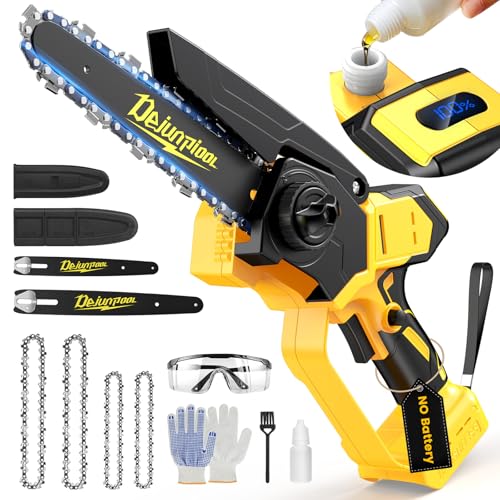
A budget mini that does not lock you into a new battery system, this kit ships with two bar sizes and runs on standard DEWALT 20V batteries. It is a budget-friendly entry that still covers pruning and light bucking by swapping bars instead of buying two saws.
Key Specs:
- Bar Length: 6 inches and 8 inches (interchangeable)
- Power Source: Battery (compatible with DEWALT 20V MAX batteries)
- Kit Contents: Two bars/chains included in many bundles
- Design: One-handed mini saw format
Detailed Review:
The DEJUNPIOOL leans into versatility for its tier. The 6-inch bar keeps weight down for one-handed cuts on branches and small saplings, while the 8-inch option adds diameter for slightly larger limbs without moving to a mid-size saw. Compatibility with DEWALT 20V batteries is the practical win — you reuse batteries you already own and avoid a proprietary pack that ages out. In use, the brushless-style motor in this class keeps chain speed reasonable for softwood and dry hardwood, but you will feel the difference versus the 12-inch DEWALT or 16-inch EGO on rounds wider than the bar. Compared to the tietoc Mini Chainsaw 6 & 8 Inch, it offers the same dual-bar idea at a more accessible tier, trading some battery count for DEWALT compatibility.
Pros:
- Two bar lengths in one kit replace the need for separate 6- and 8-inch tools
- DEWALT 20V compatibility lowers long-term battery cost if you own DEWALT tools
- One-handed form factor suits ladder-adjacent pruning and fence-line clearing
- Compact enough for apartment or townhouse storage
- Good starter path before committing to a premium full-size saw
Cons:
- Build and chain quality reflect the tier — expect more frequent tension checks than premium minis
- Limited runtime on a single small battery during continuous cutting
Who It’s For:
Budget-conscious buyers who want to try a mini saw without buying into a new battery platform, especially if they already own DEWALT 20V packs. Skip if you need all-day runtime — the dual-battery tietoc or full-size EGO fits that better.
Editor’s Verdict:
For the price, swapping bars and borrowing DEWALT batteries is a smart way to learn what size you actually use. Check current availability and confirm the battery compatibility in your kit.
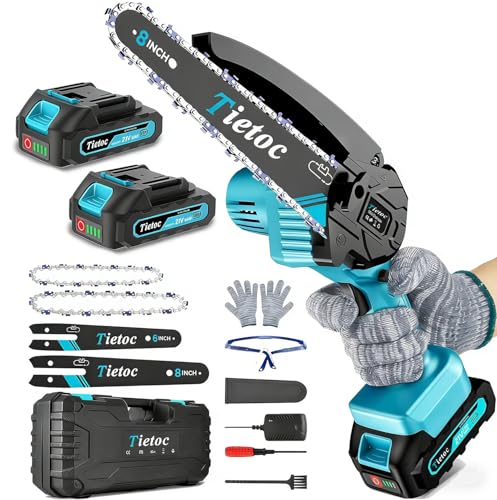
#3 tietoc Mini Chainsaw 6 & 8 Inch — Best Battery Life
Built around longer sessions, this tietoc ships with two batteries and two bars so you cut and charge in rotation. It is the dual-battery mini that stretches cordless work without a second trip to the charger.
Key Specs:
- Bar Length: 6 inches and 8 inches (interchangeable)
- Power Source: Battery (includes two batteries in most kits)
- Motor: Brushless motor in this generation
- Kit Contents: Two chains, two bars, charger included
Detailed Review:
Runtime is the differentiator here. Two packs mean you keep one on the saw and one on the charger, which matters when you batch-cut a pile of limbs after a storm or clear a fenceline in one outing. The 6-inch bar handles most homeowner pruning with better control, while the 8-inch covers the occasional thicker limb that would force a second tool otherwise. The brushless drivetrain helps efficiency and keeps heat down during repeated cuts, translating into steadier chain speed through dry branches. Compared to the Seesii Mini Chainsaw 8 & 6 Inch, the tietoc emphasizes battery quantity over ultra-low weight, so you gain continuity at the cost of a slightly heavier tote. I would pick this one for weekend cleanup where you want to finish without hunting for an outlet.
Pros:
- Two batteries extend real-world session time versus single-battery minis
- Dual bars cover both fine pruning and larger branch work
- Brushless efficiency supports more cuts per charge on yard wood
- Kit is ready to cut out of the box with charger included
- Still stores as a mini — fits a shelf rather than a floor stand
Cons:
- Carrying two bars adds clutter if you only prune small ornamentals
- Heavier than the lightest 6-inch-only minis in this list
Who It’s For:
Homeowners who batch their cutting — storm cleanup, seasonal pruning, brush piles — and want battery life without stepping to a 12- or 16-inch saw. Not for those who prioritize the lightest possible one-hander.
Editor’s Verdict:
If your yard work comes in bursts and you hate pausing to charge, the extra battery in this kit is worth the upgrade. It keeps a mini saw useful longer per session.
#4 DEWALT 20V MAX Chainsaw 12 in. — Best for Heavy Pruning
A step up from minis without jumping to ranch size, the 12-inch DEWALT adds leverage and stability for thicker limbs. It is the cordless bridge between pruning agility and small-tree capability on the familiar 20V MAX platform.
Key Specs:
- Bar Length: 12 inches
- Power Source: Battery (DEWALT 20V MAX system)
- Design: Compact mid-size with two-handed control
- Use Case: Heavy pruning, limbing, light bucking
Detailed Review:
Twelve inches changes how you approach a branch. You can limb a small tree from one side, cut through a 10-inch round with a two-pass technique, and keep the saw steadier than a one-handed mini. The DEWALT 20V MAX system gives you tool-free chain tensioning and bar oil checks typical of battery saws, so upkeep stays simple. In the yard, that means you handle that overgrown maple limb or the fallen pine top that overwhelms a 6- or 8-inch bar, yet the saw still hangs on a wall hook. Compared to the EGO Power+ CS1611 16″, the DEWALT is more maneuverable in tight yards and lighter to carry, but gives up some felling depth on larger rounds. I would choose this one for properties where heavy pruning is the ceiling, not regular firewood production.
Pros:
- 12-inch bar handles heavy pruning and small-tree work that minis cannot finish cleanly
- Two-handed grip improves control on thicker hardwood
- Stays on the DEWALT 20V battery platform many homeowners already use
- Easier to store and carry than 16-inch full-size saws
- Quiet starts suit neighborhood use
Cons:
- Needs larger 20V packs for best runtime — small compact batteries run down faster
- Not a substitute for a 16-inch saw if you regularly buck larger logs
Who It’s For:
Owners with mature trees and periodic heavy pruning who want more than a mini but do not need a ranch saw. Skip if your main job is fine one-handed pruning — the 8-inch DEWALT or lighter minis are handier.
Editor’s Verdict:
This is the right middle ground for yards that outgrew a mini. It adds real cutting depth without demanding gas maintenance.
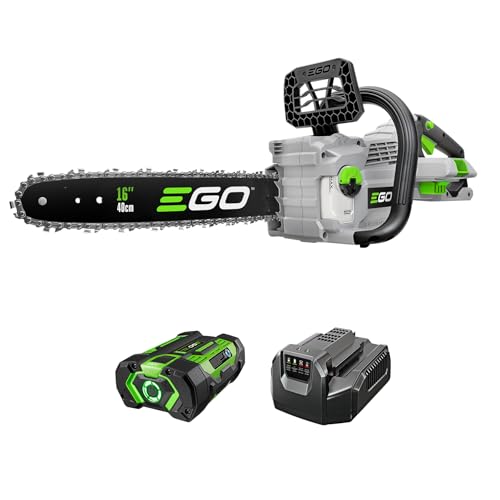
#5 EGO Power+ CS1611 Chain Saw 16″ — Best Overall
The only full-size saw in this roundup, the 16-inch EGO brings real felling and bucking depth to a battery platform with the 56V ARC Lithium system. It is the most capable all-around homeowner saw here for mixed tasks.
Key Specs:
- Bar Length: 16 inches
- Power Source: Battery (EGO 56V ARC Lithium)
- Voltage Platform: 56V
- Chain: Full-size homeowner chain with automatic oiling
Detailed Review:
Sixteen inches redefines what you can finish without switching tools. You can buck firewood rounds, limb a small tree without rolling the log, and fell modest trunks within the bar’s safe capacity — all with push-button start and no fuel mixing. The 56V platform supplies the torque to hold chain speed in hardwood better than compact 20V minis, and the larger chassis adds stability for two-handed cuts. Maintenance stays battery-simple: oil and tension, plus indoor battery storage in winter. Compared to the DEWALT 20V MAX 12 in., the EGO cuts wider in one pass and feels planted on larger wood, but it is heavier and needs more storage space. For mixed homeowner to large-property use, this balance of power and low upkeep is why it leads the list.
Pros:
- 16-inch bar covers pruning through small-tree felling in one tool
- 56V system holds speed better in hardwood than compact battery minis
- Full-size handling improves safety and control on larger cuts
- No fuel mixing or winter fuel storage routine
- Cuts firewood without the noise and upkeep of gas
Cons:
- Heavier and longer than mini and 12-inch picks — less agile in dense shrubs
- Benefits from higher amp-hour 56V batteries for extended sessions
Who It’s For:
Owners from suburban lots with mature trees to several acres who want one saw for pruning, limbing, and firewood. Skip if you only prune small ornamentals or need the lightest one-hander — a 6-inch mini fits better.
Editor’s Verdict:
For the widest range of homeowner jobs with the least hassle, the 16-inch EGO is the most complete package here. It is the one I would keep by the garage door.
#6 tietoc 6 Inch Mini Chainsaw — Best for Beginners
Stripped to the essentials, this single-bar tietoc focuses on light weight and simple handling. It is the easiest saw in this list to control for first-time users learning chain tension and cut angles.
Key Specs:
- Bar Length: 6 inches
- Power Source: Battery (includes battery and charger in most kits)
- Weight Class: Ultra-light mini
- Safety: Hand guard and chain brake on current kits
Detailed Review:
A 6-inch bar lowers the stakes while you learn. The short bar reduces kickback leverage, keeps the tip easy to see, and lets you make small, deliberate cuts on branches up to about 4 to 5 inches with a two-pass approach. The one-handed format is intuitive for pruning at chest height, yet the guard and brake keep control familiar for beginners moving up from hand pruners and loppers. Upkeep is minimal — oil, tension, charge — so you focus on technique, not carburetor care. Compared to the DEWALT DCCS623B 8-Inch, this tietoc trades some reach for the lightest handling and a more forgiving learning curve. If you are new to chainsaws, that tradeoff builds confidence faster.
Pros:
- Lightest handling in the mini group — easier to start, aim, and stop
- Short bar is forgiving for learning proper stance and tension checks
- Simple battery upkeep suits first-time owners
- Compact storage — fits in a toolbox or utility shelf
- Ready-to-cut kit reduces buying confusion
Cons:
- 6-inch bar limits diameter — you will need a larger saw for thicker limbs
- Smaller battery means more frequent charging in extended sessions
Who It’s For:
First-time buyers, lighter users, and anyone who wants a practice-friendly pruner for ornamentals and small branches. Skip if you already handle heavy pruning — choose an 8- or 12-inch pick.
Editor’s Verdict:
For learning safely and getting pruning done without wrestling a bigger saw, this 6-inch tietoc is the right starting point. Master your cuts here, then size up if needed.
#7 VEVOR Gas Chainsaw 12 Inch — Best Gas-Powered
The lone gas option in this battery-heavy field, the VEVOR 12-inch keeps continuous runtime without batteries or cords for off-grid or all-day work. It is the pick when outlets and chargers cannot keep up.
Key Specs:
- Bar Length: 12 inches
- Power Source: Gas (2-cycle engine, mixed fuel)
- Displacement Class: Compact gas (small-cc class for 12-inch bar)
- Use Case: Continuous cutting, remote cleanup
Detailed Review:
Gas still matters where battery logistics fail — fence lines far from the house, storm cleanup away from power, or a day of cutting where you would rather refuel than recharge. The 12-inch bar covers heavy pruning and light bucking while staying manageable for transport in a truck bed or tool rack. You trade push-button ease for pull-start and fuel discipline — mix ratio, fresh fuel, air filter checks — but you gain the ability to keep cutting as long as you have fuel and bar oil. Noise and exhaust are higher, so hearing and eye protection are non-negotiable every time. Compared to the EGO Power+ 16″ battery saw, the VEVOR is lighter to carry into the back lot and never waits on a charger, yet it asks for more routine care. I would pick gas for remote, frequent-use days and battery for quick house-adjacent jobs.
Pros:
- Continuous runtime with fuel can — no charging pauses
- 12-inch size balances capability and portability for field work
- Works far from outlets where corded or battery charging is impractical
- Simple to transport for ranch and large-property circuits
- Familiar gas power for buyers who already maintain small engines
Cons:
- Requires fuel mixing, filter care, and seasonal fuel storage
- Louder operation and exhaust versus battery picks in this list
Who It’s For:
Large-yard, farm, and remote users who cut far from power or for long stretches. Skip if you cut only near the house and prefer low upkeep — battery will be easier to live with.
Editor’s Verdict:
When the job leaves the yard and the outlet behind, this compact gas saw earns its place. Keep fuel fresh and it keeps cutting.
#8 Seesii Mini Chainsaw 6-inch — Best Lightweight
Built for one-handed control, this 6-inch Seesii emphasizes minimal weight and compact balance for overhead reaches and quick snips. It is the lightest pruning feel in this roundup for users who prioritize ease over diameter.
Key Specs:
- Bar Length: 6 inches
- Power Source: Battery (includes battery and charger)
- Design: One-handed mini with hand guard
- Weight Class: Lightweight mini
Detailed Review:
Weight determines whether you actually enjoy pruning. The Seesii 6-inch keeps the saw close to the body, so you can reach into shrubs, trim along a fence, and cut at shoulder height without arm fatigue setting in early. The short bar excels on branches and saplings up to a few inches, and the battery platform keeps upkeep to oil and tension checks between charges. Noise is modest, which helps for early-morning neighborhood work. Compared to the tietoc 6 Inch Mini, the Seesii leans even lighter for all-day comfort, trading a bit of battery depth for handiness. For seniors, smaller users, or anyone who values a saw that stores in a drawer and deploys in seconds, that lightness matters more than an extra inch of bar.
Pros:
- Lightest in-hand feel — easiest to maneuver overhead and in dense shrubs
- One-handed control suits quick pruning and small storm limbs
- Low noise and simple battery upkeep
- Compact storage in tight garages or garden cabinets
- Guard design keeps handling intuitive for lighter-duty users
Cons:
- 6-inch bar cannot finish thicker limbs without multiple passes
- Not suited for bucking or felling tasks beyond pruning
Who It’s For:
Light-duty pruners who want the easiest carry and the simplest storage, including older users and those with small lots. Choose an 8- or 12-inch saw if you regularly face thicker branches.
Editor’s Verdict:
If you judge a saw by how often you reach for it, this featherweight 6-inch Seesii will get grabbed first for quick cuts. It makes light pruning effortless.
#9 Seesii Mini Chainsaw 8 & 6 Inch — Best Quiet Option
A dual-size kit that leans into low noise and smooth control, this brushless Seesii ships with two bars for quiet neighborhood use. It offers quiet brushless operation with 6- and 8-inch flexibility for early mornings and close neighbors.
Key Specs:
- Bar Length: 6 inches and 8 inches (interchangeable)
- Power Source: Battery (brushless motor)
- Kit Contents: Two bars/chains, batteries and charger in most bundles
- Noise Profile: Lower noise versus brushed minis and gas
Detailed Review:
Brushless drive helps here in two ways: steadier chain speed under load and a smoother, lower-pitched sound that carries less across the yard. The 6-inch bar keeps cuts precise in ornamentals, while the 8-inch reaches for thicker limbs without swapping to a heavier 12-inch saw. In a suburban setting, that quiet start-up and the lack of exhaust make early or evening pruning more neighbor-friendly than gas. Upkeep stays battery-simple, and swapping bars is quicker than maintaining a second tool. Compared to the tietoc Mini 6 & 8 Inch with its dual batteries, this Seesii prioritizes refinement and noise over maximum runtime, so you trade a bit of session length for a more pleasant experience. For noise-sensitive lots, that is the right trade.
Pros:
- Brushless motor runs quieter and more efficiently than brushed minis
- Two bar sizes handle both fine pruning and slightly larger branches
- Battery convenience with no fuel or cord tether
- Good control for fence-line and patio trees near neighbors
- Compact storage despite dual-bar capability
Cons:
- Quieter does not mean silent — hearing protection is still wise for extended use
- Needs battery rotation for long continuous sessions versus the dual-battery tietoc
Who It’s For:
Suburban owners who prune near neighbors and want a refined, quieter mini with size flexibility. Skip if you need all-day runtime — a higher-capacity battery kit or 16-inch saw fits better.
Editor’s Verdict:
For quiet, low-disturbance pruning with options, this Seesii kit is the most neighbor-friendly pick in the list. It trades a little runtime for a noticeably calmer cut.
Which Chainsaw Matches Your Most Common Cutting Job?
Your most common cutting job decides bar length and power: pruning and light yard work suit 6- to 8-inch minis, regular wood supply and larger logs need 12 to 16 inches, and tight shrubs and DIY builds reward one-handed control.
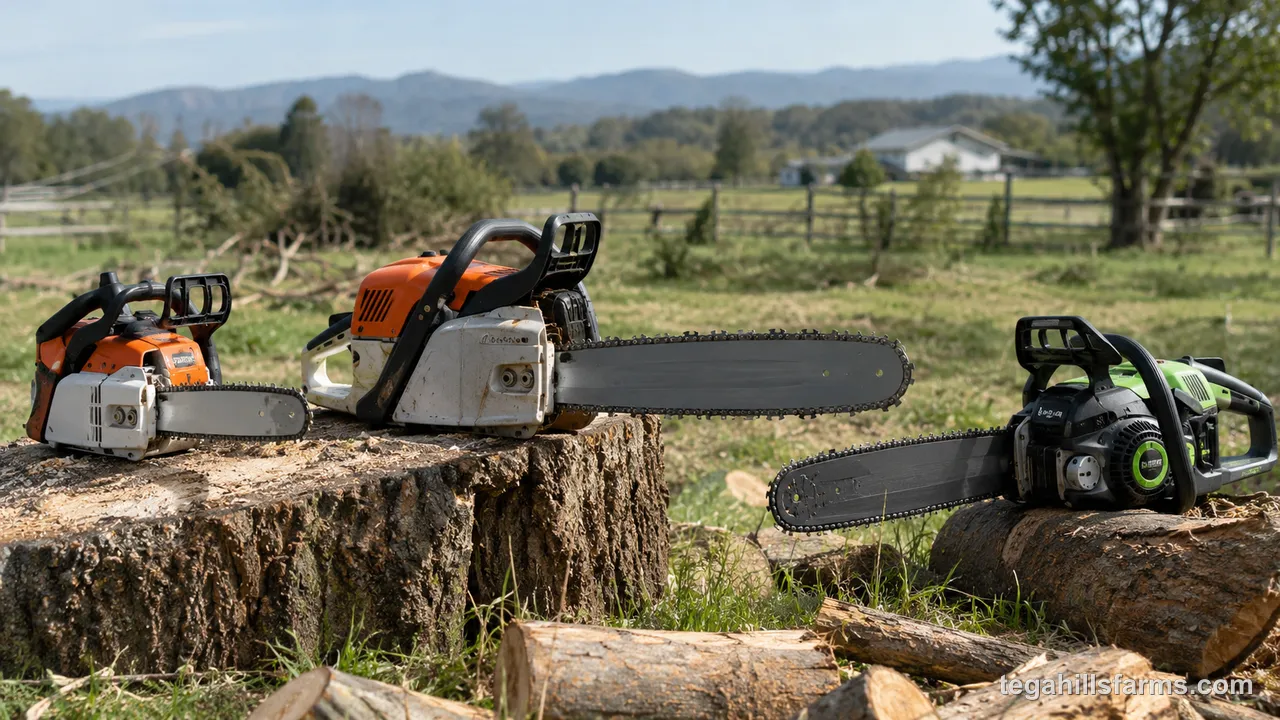
Match the tool to the task you do weekly, not the one you do once a year, and the right size becomes obvious.
What Works Best for Homeowners and Small Yards?
For homeowners and small yards, 6- to 12-inch battery saws win on maneuverability and storage.
A 6-inch mini like the Seesii or tietoc stores in a tote and handles ornamentals and storm twigs with one hand. An 8-inch pruning saw like the DEWALT DCCS623B adds reach for low limbs without blocking a garage path. A 12-inch DEWALT covers heavy pruning on mature trees yet still hangs on a wall. For more suburban-focused picks, see our guide to best chainsaws for homeowners. That mix keeps upkeep simple — oil, tension, charge — and keeps the saw where you will actually grab it.
What Do Farm, Ranch, and Frequent-Use Jobs Demand?
Farm, ranch, and frequent-use jobs demand longer bars and repeatable power without tethering to an outlet.
On several acres, you limb, buck, and clear fence lines in one circuit — a 16-inch EGO holds depth for bucking, while a compact gas 12-inch VEVOR refuels in the field when batteries would need a charger. Longer bars reduce repositioning on larger rounds, and larger battery packs or fuel extend sessions without extra trips. That is where buying too small costs time.
Which Saws Handle Limbing, Trimming, and DIY Projects Best?
Limbing, trimming, and DIY projects favor light, one-handed minis with precise tip control.
When you cut pergola posts, clear vines, or limb at chest height, a 6- or 8-inch mini lets you see the cut line and steer the tip around hardware and branches. One-handed balance matters more than raw depth here, and battery start keeps setup quick between measuring and cutting. For rounds wider than the bar, rotate the log and make a matching cut — no need for a ranch saw on furniture-scale lumber, and for heavier log prep you can explore our notes on best chainsaws for cutting logs.
How Do Size and Budget Change What You Should Pay?
Size and budget change what you should pay by tying bar length to log diameter and price tier to how often you cut.
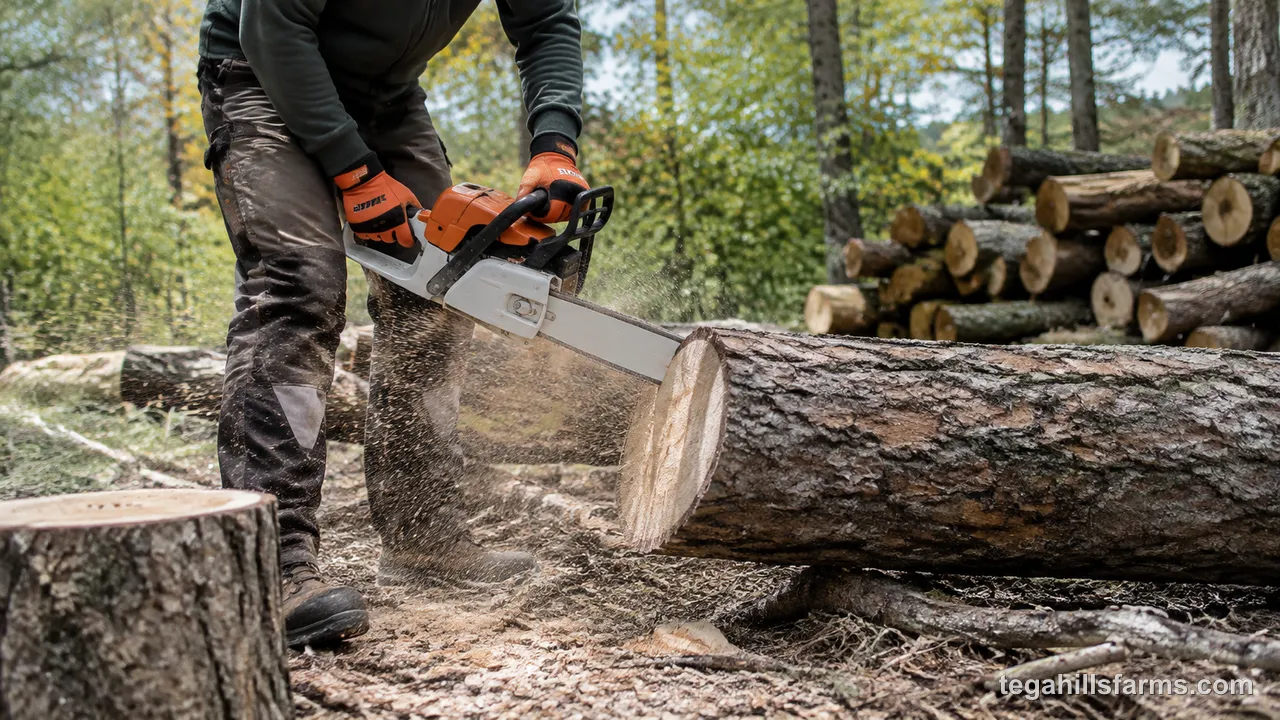
Once you know your typical diameter, the price tier decision is about frequency — occasional pruning tolerates a budget tier, regular wood supply justifies a mid-range or premium saw.
What Bar Length Do You Actually Need?
You need 6 inches for branches to about 4 inches, 12 inches for heavy pruning and small trees, and 16 inches for bucking and small-tree felling.
A 6-inch bar finishes most suburban pruning with best control; an 8-inch adds margin for thicker limbs without adding much weight. A 12-inch bar handles larger garden trees and light bucking with two-handed stability. A 16-inch bar, like the EGO in this list, lets you buck rounds near its bar length and fell modest trees within safe limits. If you routinely cut wider, compare longer-bar options in our guide to best 16 inch chainsaws rather than forcing a small saw through oversized wood.
How Far Does a Tight Budget Stretch Without Regret?
A tight budget stretches fine for pruning, but under $100 and under $200 tiers trade long-run convenience for entry savings, while closer to $300 buys durability and runtime you feel every session.
Under $100 generally means a single small battery and a basic chain that needs more frequent tensioning — fine for very light pruning. Up to $200 adds brushless efficiency or an extra bar size, which extends session time. Near $300 reaches mid-range battery platforms or more complete kits with better chains and chargers. For value-focused comparisons across those tradeoffs, see our roundup of best affordable chainsaws. Spend where your frequency lives — daily or weekly cutting deserves the step up.
You have seen how bar length, power source, and weight shape the top picks above, from lightweight 6-inch pruners to the 16-inch EGO workhorse.
Choosing the right size gets you cutting, but keeping the chain sharp, oiled, and properly tensioned is what decides long-term reliability, safety, and cost per cut.
The next sections zoom in on those micro-details most roundups skip, so you can avoid fake parts, clogs, and early wear after you buy.
What Rare Ownership Details Make a Cheap Saw Expensive Over Time?
Cheap ownership costs come from dull chains, poor oiling, and loose tension, plus off-brand bars and chains that do not match pitch and gauge.
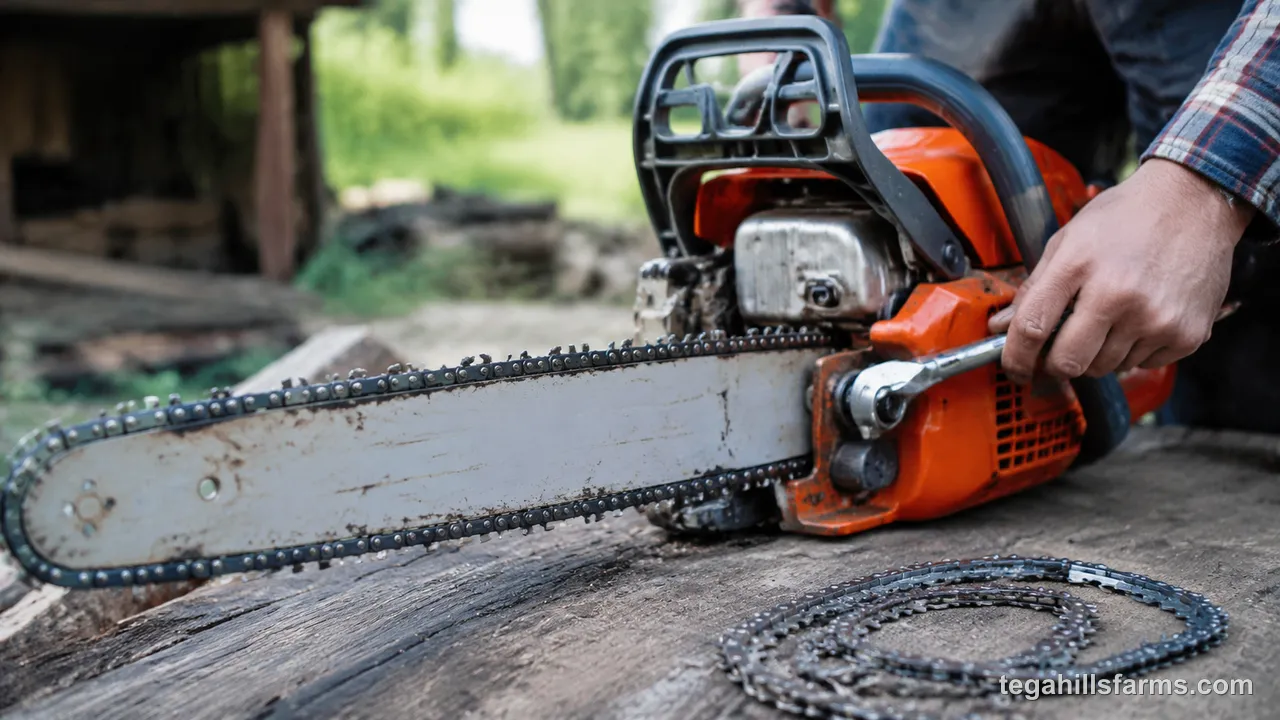
A chain that is filed unevenly or run dry heats fast, stretches, and cuts slow, which tempts you to push harder — that accelerates wear on the bar rails and sprocket. Check tension when the chain is cool, oil every tank or charge, and clean the bar groove and oiler port after dusty cuts. Buy replacement loops by exact pitch, gauge, and drive-link count, and prefer OEM or reputable aftermarket to avoid binding or throwing the chain. For vetted loops, bars, and sprockets that keep the cut true, see our list of best chainsaws replacement parts. Those small habits decide whether a budget saw stays budget or turns expensive.
Quick Answers for First-Time Chainsaw Buyers
What maintenance does a chainsaw need between cuts?
Keep chain sharpness, bar oil, and tension in check, then clean the bar groove. A sharp chain pulls itself through wood; a dull one forces you to push and overheats the bar. Check tension cold and keep a little snap but no sag.
How do I know when the chain is dull?
A dull chain makes fine dust instead of chips and needs downward pressure to move. Sharpen with the correct file size and angle for your chain, or swap to a matching replacement loop if teeth are damaged or uneven.
Is a battery saw enough for firewood?
For small rounds and occasional firewood, a 12- to 16-inch battery saw is enough and far simpler to live with. Large rounds and all-day bucking still favor longer bars, larger batteries, or gas for continuous runtime.
How loud are mini battery saws compared to gas?
Mini battery saws run noticeably quieter than gas and have no exhaust, but hearing protection is still wise for sessions longer than a few minutes. Gas needs it every time without exception.
What safety gear should a new owner budget for?
Plan for eye protection, hearing protection, gloves, and sturdy boots. Add chaps for larger logs and two-handed saws, and always check the chain brake and hand guard before the first cut.
How do I store a battery chainsaw over winter?
Store batteries indoors at partial charge and keep the saw clean, oiled, and dry. Drain or stabilize gas if you also own a fuel saw, but battery storage skips fuel aging entirely.
More Guides on Best Chainsaws
- Best Chainsaws for Deck and Patio Cleanup
- Best Chainsaws for Backyard Maintenance
- Best Chainsaws for Fence Post Cutting
- Best Chainsaws for Cutting Firewood
- Best Chainsaws for Large Properties
- Best Chainsaws for Garden Projects
- Best Chainsaws for Brush Clearing
- Best Chainsaws for Wet Conditions
- Best Chainsaws for Land Clearing
- Best Chainsaws for Storm Cleanup
- Best Chainsaws for Tree Trimming
- Best Chainsaws for DIY Projects
- Best Chainsaws for Frequent Use
- Best Chainsaws for Small Trees
- Best Chainsaws for Landscaping
- Best Chainsaws for Small Yards
- Best Chainsaws for Summer Use
- Best Chainsaws for Winter Use
- Best Chainsaws for Ranch Use
- Best Chainsaws for Arborists
- Best Professional Chainsaws
- Best Chainsaws for Farm Use
- Best Chainsaws for Bucking
- Best Chainsaws for Limbing
- Best Chainsaws for Milling
- Best Chainsaws for Seniors
- Best Chainsaws Under $100
- Best Chainsaws Under $200
- Best Chainsaws Under $300
- Best Top-Handle Chainsaws
- Best Chainsaws for Women
- Best Electric Pole Saws
- Best 14-Inch Chainsaws
- Best 18-Inch Chainsaws
- Best 20-Inch Chainsaws
- Best Chainsaws Brands
- Best Corded Chainsaws
- Best Mini Chainsaws
- Best 50cc Chainsaws
- Best 60cc Chainsaws
- Best 70cc Chainsaws
- Best 40v Chainsaws
- Best 56v Chainsaws
- Best 60v Chainsaws
- Best 80v Chainsaws
- Best Pole Saws