9 Best Pressure Washers: 2026 Top Picks Compared and Reviewed
Our top picks for the best pressure washers in 2026 are the Westinghouse ePX3500 (Best Overall), Sun Joe SPX3000 (Best Lightweight), Greenworks 3000 PSI Brushless Electric (Best Kink-Free Hose), Westinghouse WPX3400 (Best Gas-Powered), Greenworks 1800 PSI Electric (Best Budget), Active 2.0 GPM 1800 PSI Electric (Best Compact), Simpson PowerShot 3300 PSI Gas (Best for Professionals), DeWalt DXPW3300-S (Best Premium), and 1800 PSI Electric Pressure Washer (Best Value). The plug-in models cover cars, siding and patio furniture with almost no upkeep, while the gas machines bring the water volume that wide, stained concrete demands.
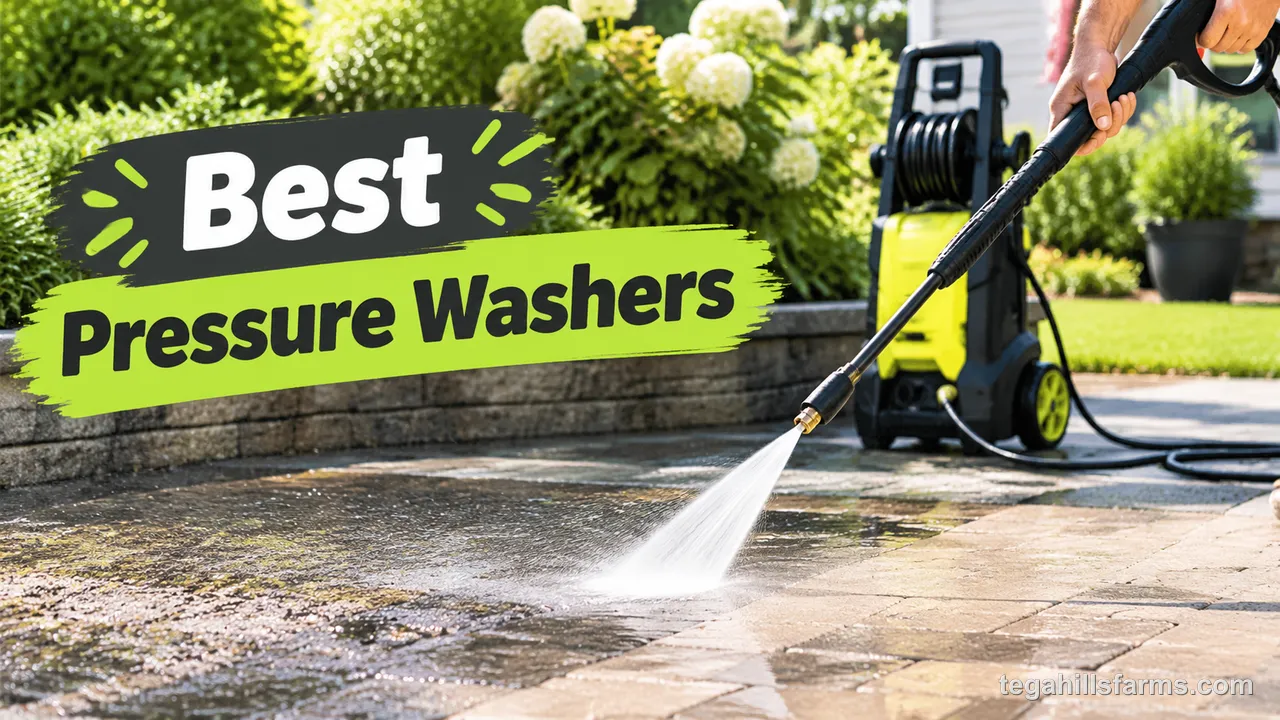
What separates them in the yard is rated pressure and flow working together, the power source behind them, and the hardware you handle every session: the hose, the nozzle set, the wheels and the soap system. A washer with strong numbers but a stiff, kinking hose or a top-heavy frame turns a quick rinse into a chore.



The real risk for most buyers is a mismatch. Too little flow and a driveway eats the whole afternoon; too much pressure through the wrong tip and a cedar deck or a car’s clear coat carries the marks long after the job. Matching the machine to the surfaces around your house matters more than chasing a high PSI figure on the box.
Gas, Electric or Battery: Which Power Source Fits Your Home?
For most homes a plug-in model is the practical choice, while an engine-driven washer pays off on wide, stained concrete and a cordless unit suits quick rinses far from an outlet.
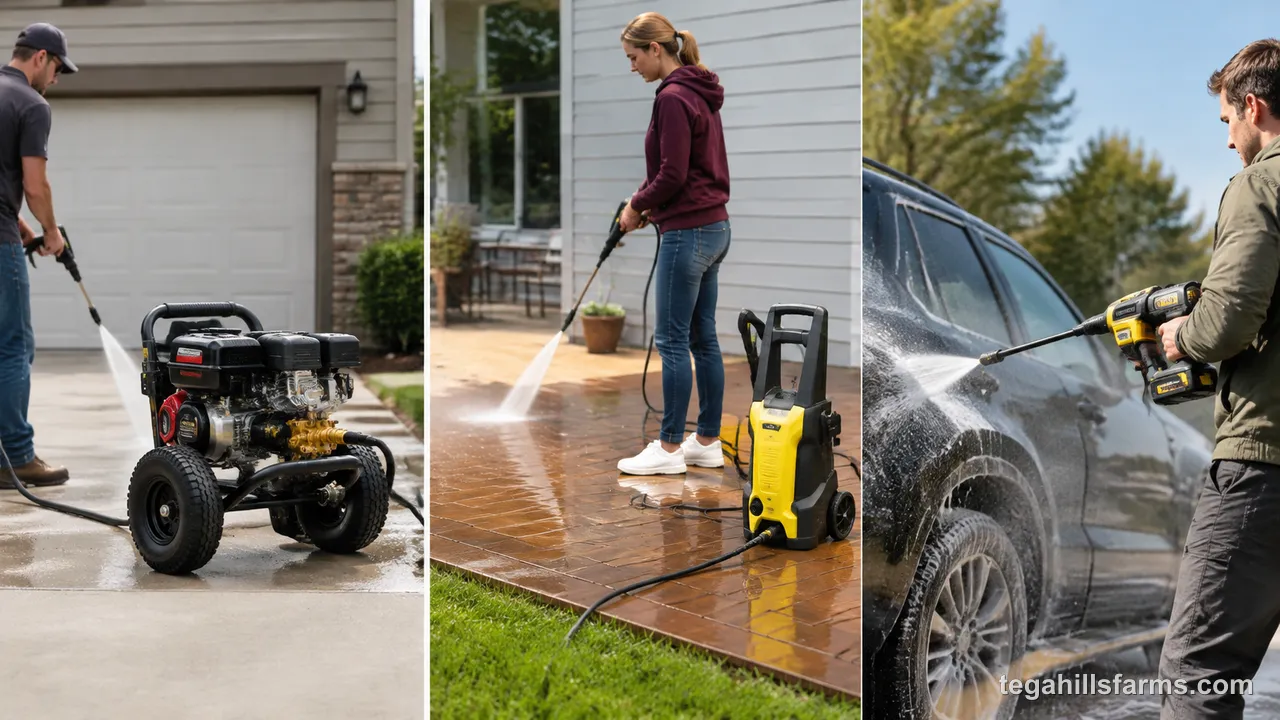
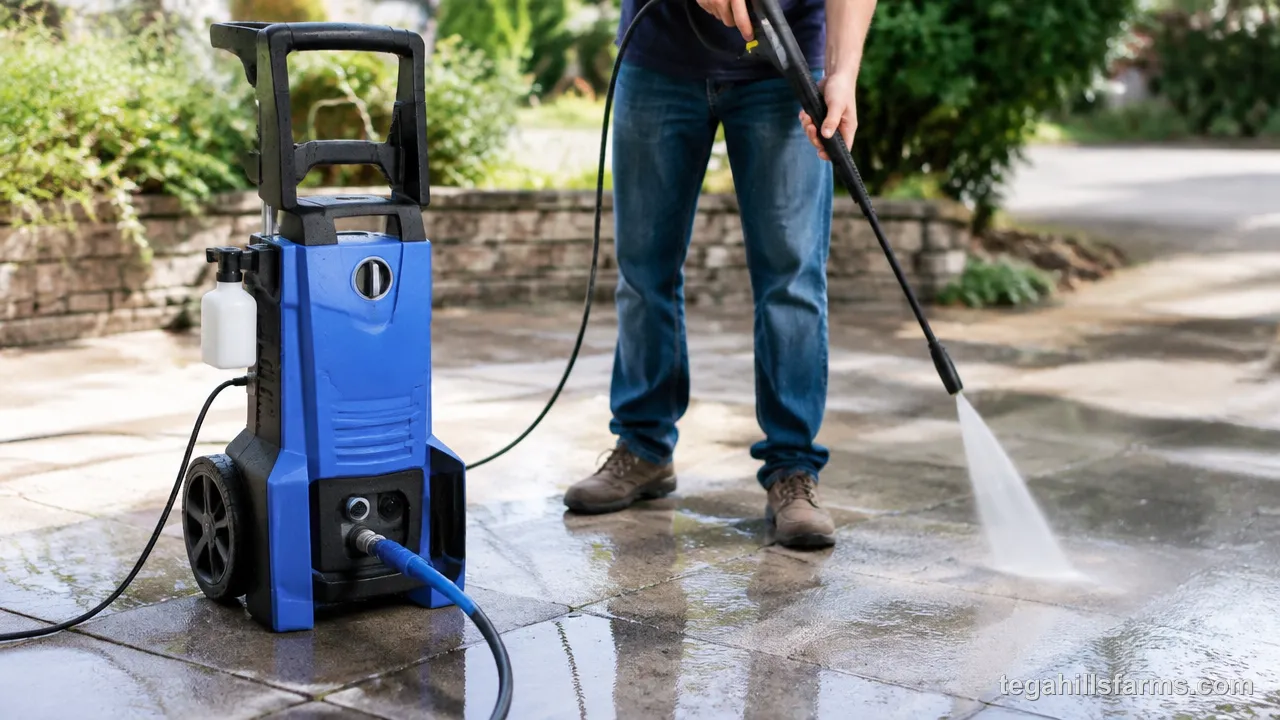
Corded machines start with a switch, need no oil or fuel, and run quietly enough that a weekday car wash won’t bother the neighbors. The trade-off is flow: a motor limited by a household circuit moves less water than an engine, so big slabs take longer, and you work within reach of an outlet. For cars, siding, decks and patio furniture, the best electric pressure washers handle the work and store in a garage corner.
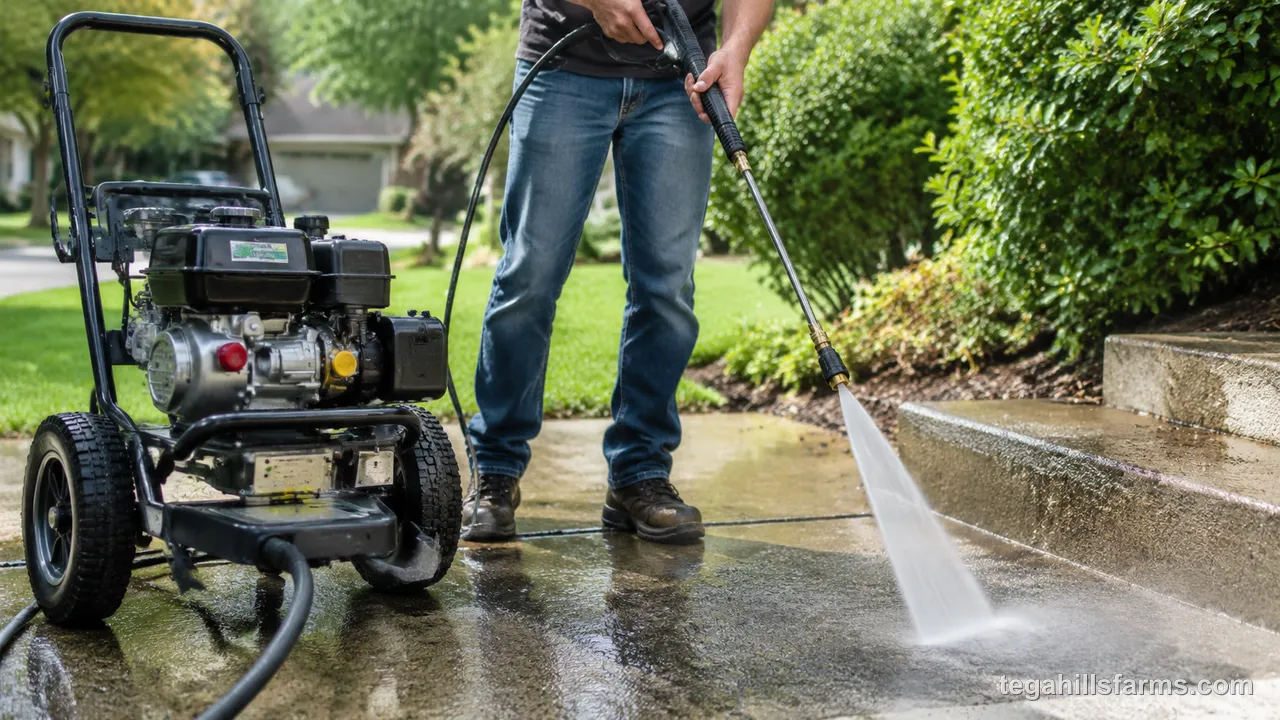
Gas engines push more water at higher pressure with no cord, which is why they clear driveways and prep exterior paint faster. They also bring oil changes, fuel that goes stale over winter, a recoil pull and a heavier frame, and they must run outdoors because of carbon monoxide. If your property has long drives or heavy grime, the best gas pressure washers earn that upkeep.
Battery washers trade pressure and runtime for freedom from both cord and fuel, which suits bikes, kayaks and patio chairs away from the house. Plug-in and gas washers cover the full range of home cleaning.
What Do PSI and GPM Really Tell You About Cleaning Power?
Pounds per square inch measure the force that breaks dirt loose, and gallons per minute measure the water that carries it away, so the pair together decides how fast a surface comes clean. Manufacturers sometimes multiply the two into cleaning units, a single figure for comparing machines. High pressure with thin flow leaves you etching at grime one strip at a time, while strong flow at modest pressure rinses fast but leaves bonded stains behind. Reading both numbers is the core of how to choose a pressure washer for the jobs you actually have.
Max Ratings vs. Rated Ratings
The figure printed large on the box is usually a peak, while the rated figure reflects steady operation, and the rated one is what you feel at the nozzle. The Westinghouse ePX3500 shows the gap clearly: 2500 max PSI and 1.76 max GPM on paper, but 2000 rated PSI and 1.2 rated GPM in use.
Those two maximums never happen together. Max pressure is a pump peak, and max flow is measured at the lowest pressure setting, so pairing them inflates the machine’s real output. Rated numbers come from steady spraying, which makes them the fair basis for comparison.
The Pressure Washer Manufacturers’ Association (PWMA) sets a standard test for rated figures, and some brands print a PWMA-rated value, such as the 2030 PSI working pressure on the Sun Joe SPX3000. When you compare spec sheets, line up rated against rated and treat max values as a ceiling the pump only touches briefly.
How Much Pressure Does Each Surface Need?
Concrete, brick and stone can take the full output of a high-pressure machine, while softwood, painted surfaces and car finishes need lower pressure and a wider spray. The difference comes down to the material: dense masonry shrugs off a narrow jet, but wood fibers tear, paint lifts at its weakest edge, and clear coat scars where the stream lingers.
That split maps onto the machines. The gas Westinghouse WPX3400, Simpson PowerShot 3300 PSI Gas and DeWalt DXPW3300-S, along with the Greenworks 3000 PSI Brushless Electric, belong on oil-stained driveways, weathered stone and exterior paint prep. The 1800 PSI electrics from Greenworks, Active and RYOBI suit light residential work such as cars, boats, windows and patio furniture.
The mid-range electrics sit between those groups, with enough output for decks and siding when you choose a wider tip. Paint is the special case, since the pressure that ruins a sound finish is exactly what you want when stripping a flaking one before repainting.
What Matters Most When Choosing Pressure Washers?
Power source, rated pressure and flow, and the included hardware decide most of how a washer performs, with portability and your usual jobs settling the rest. The power source sets your upkeep and noise, while rated pressure and flow set how fast stains lift. Nozzle sets, soap tanks and kink-resistant hoses shape every session, and weight plus wheel design decide whether the washer rolls out easily or stays parked. Typical home use anchors it all: a washer sized for cars and patio chairs feels underpowered on a stained driveway, and a contractor machine is wasted on a weekly car rinse. Parts and service support also vary between pressure washer brands, which matters when a seal or trigger wears out a few seasons in.
The 9 Best Pressure Washers for Home Use, Ranked
Our top picks are the Westinghouse ePX3500, Sun Joe SPX3000, Greenworks 3000 PSI Brushless Electric, Westinghouse WPX3400, Greenworks 1800 PSI Electric, Active 2.0 GPM 1800 PSI Electric, Simpson PowerShot 3300 PSI Gas, DeWalt DXPW3300-S and 1800 PSI Electric Pressure Washer. The electric models give up flow for quiet starts and almost no maintenance, while the gas machines add the water volume that clears wide concrete in exchange for engine care and storage space, so the surfaces around your house decide which side of that line you belong on.
#1 Westinghouse ePX3500 — Best Overall
Homeowners who want one washer for the car, deck and driveway get a balanced electric here. At 19 pounds, with a low center of gravity built to resist tipping and a 20-ounce onboard soap tank, it rolls anywhere in the yard and handles detergent jobs without a separate bottle.
Key Specs:
- Pressure: 2500 max PSI / 2000 rated PSI
- Flow: 1.76 max GPM / 1.2 rated GPM
- Wand: 17.5-in extendable steel with 0°, 15°, 25°, turbo and soap nozzles
- Hose: 25-ft easy-coil nylon braided
- Size: 16.5 in tall, 19 lb
- Warranty: 3-year limited
Detailed Review:
Rated output of 2000 PSI at 1.2 GPM is a moderate setup, aimed squarely at the jobs most homes face: decks, driveways, garage floors, stairs, fencing, patio furniture and vehicles. The pro-style steel wand extends to 17.5 inches, and the quick-connect tips run from a pinpoint 0° jet to a turbo tip, so you can go from loosening a stain on the steps to rinsing the car without hunting for tools.
Handling is where this machine stands out. Four quick-lock wheels steer through 360°, and the low center of gravity keeps it upright when you tug the hose around a corner, which saves walking back to stand it up mid-job. Its 16.5-inch height also makes it easy to tuck into a corner of the garage.
The pump stops automatically when you release the trigger, saving energy and reducing wear on the pump and motor during the pauses that fill any real cleaning session. The easy-coil braided hose packs away neatly, and 3-year limited service, labor and parts coverage backs the whole unit.
Staying electric is the trade-off. A rated 1.2 GPM moves far less water than any of the gas picks, so a wide, stained driveway takes noticeably longer than it would with an engine-driven machine.
Pros:
- Low center of gravity resists tipping when you pull the hose.
- Extendable steel wand with five quick-connect nozzles.
- Pump shuts off when the trigger is released.
- Compact frame stores easily in a garage corner.
- 3-year limited service, labor and parts coverage.
Cons:
- Rated flow makes wide driveways a slow job.
- 20-ounce soap tank needs refilling on big washes.
- Corded design keeps you near an outlet.
Who It’s For:
If your weekend list runs from washing the car to brightening patio furniture and a stretch of fence, this washer covers it without engine upkeep. Anyone who drags a hose around corners will appreciate how steadily it stays upright. Owners facing large, oil-stained concrete every season need the extra flow of a gas model.
Editor’s Verdict:
Pick this washer for capable, low-fuss electric cleaning across the car, deck and patio, with a frame that stays upright and stores small.
#2 Sun Joe SPX3000 — Best Lightweight
Weekend washers who clean several surfaces in one session get real flexibility here. At 24.3 pounds it carries easily around the house, and its two 30 fl oz onboard detergent tanks keep separate cleaners ready, so you can switch from siding wash to car soap without draining anything.
Key Specs:
- Pressure: 2500 max PSI / 2030 PSI PWMA-rated working pressure
- Flow: 1.2 GPM
- Lance: 34-in stainless steel with brass fittings
- Hose: 20-ft high-pressure
- Spray tips: 0°, 15°, 25°, 40° and soap
- Weight: 24.3 lb
Detailed Review:
The 34-inch stainless steel lance changes how this washer feels in use. It puts the spray farther from your hands and lets you reach upper siding, the underside of an RV or the back of a boat trailer without stooping or stretching. The Westinghouse ePX3500 uses a shorter 17.5-inch extendable wand that packs away smaller, so the choice between them comes down to reach versus storage room.
The detergent system is the other strength. Two 30 fl oz tanks let you load a car-safe soap in one and a stronger deck or siding cleaner in the other, while the ePX3500 carries a single 20-ounce tank that needs emptying when you change cleaners. Five quick-connect tips, including a wide 40° fan, cover everything from pinpoint blasting to gentle rinsing.
Working pressure of 2030 PSI at 1.2 GPM handles routine cleaning on homes, driveways, vehicles, RVs and outdoor equipment. Its limit shows on deep, set-in concrete stains, where the modest flow means slow passes, and the 20-foot hose means repositioning the unit more often than the 25-foot hoses on several other picks.
Pros:
- Long stainless steel lance keeps you clear of the spray.
- Separate detergent tanks hold two different cleaners.
- Five quick-connect tips, including a gentle 40° fan.
- PWMA-rated working pressure gives an honest figure.
Cons:
- 20-foot hose means moving the unit often.
- Long lance takes up more storage space.
- Modest flow slows work on stained concrete.
Who It’s For:
Homeowners who wash a car, an RV and the siding in the same afternoon get plenty of use from the separate cleaner tanks and long reach. It also suits anyone who wants a machine they can lift and carry without strain. Owners with deeply stained concrete will be better served by a higher-flow gas washer.
Editor’s Verdict:
Choose the SPX3000 when reach and quick cleaner changes matter more than raw flow; it handles routine house, vehicle and RV washing with very little setup.
#3 Greenworks 3000 PSI Brushless Electric — Best Kink-Free Hose
If a twisting hose has cut short past wash days, start here. A 25-ft Uberflex kink-resistant hose pairs with a 14-amp TruBrushless motor rated for 3000 PSI and 2.0 GPM, giving you enough flow to rinse patios and walkways quickly while staying electric.
Key Specs:
- Motor: 14-amp TruBrushless
- Output: 3000 PSI, 2.0 GPM (3300 cleaning units)
- Hose: 25-ft Uberflex kink-resistant
- Gun: rugged metal
- Nozzles: 15°, 25°, 40°, soap and turbo
- Weight: about 51 lb
Detailed Review:
The Uberflex hose is why this machine is easy to live with. A kink cuts flow at the nozzle and sends you back to straighten it, so a hose that resists folding lets you work around planters, steps and porch posts without stopping. The gun itself is rugged metal, which pairs well with a hose meant to be dragged around hard surfaces.
Output is strong for a plug-in machine: 3000 PSI at 2.0 GPM from a brushless motor, with JettFlow technology adding flow for reaching higher areas and fast power rinsing. Greenworks backs the pressure and flow figures with independent lab verification, so the spec sheet reflects what reaches the nozzle. Next to the Westinghouse ePX3500’s rated 1.2 GPM, that extra water clears suds and loosened grime off a patio noticeably faster.
Weight is the cost. At about 51 pounds this is a roll-it, don’t-carry-it machine, and lifting it into a truck bed or up porch steps takes two hands and some effort. It also remains corded, so the outlet sets your range.
For a homeowner who cleans hard surfaces often, I’d call that a fair trade for electric quiet and no engine care. The included turbo and soap nozzles round out a kit that covers stubborn spots and detergent work.
Pros:
- Kink-resistant Uberflex hose keeps water flowing.
- Brushless motor delivers 3000 PSI and 2.0 GPM.
- Lab-verified pressure and flow figures.
- Rugged metal spray gun.
- Turbo and soap nozzles included.
Cons:
- Heavy to lift into a vehicle or up steps.
- Corded power ties it to an outlet.
- High pressure needs care on softwood and paint.
Who It’s For:
Owners who clean patios, walkways and siding often and are tired of straightening hoses fit this washer well. It also suits anyone who wants faster rinsing without taking on an engine. Someone who carries a washer up stairs or into a car trunk will find the Westinghouse ePX3500 far easier to lift.
Editor’s Verdict:
Expect strong electric cleaning with a hose that stays out of your way; plan on rolling this one rather than carrying it.
#4 Westinghouse WPX3400 — Best Gas-Powered
Big concrete and siding jobs go faster with this engine-driven washer. Its 212cc Westinghouse OHV engine drives a maintenance-free axial cam pump at 3400 PSI and 2.6 GPM, and a half-gallon onboard soap tank keeps detergent flowing through long sessions.
Key Specs:
- Engine: 212cc 4-stroke OHV, recoil start
- Output: 3400 PSI, 2.6 GPM
- Pump: maintenance-free axial cam
- Tanks: 1-gallon fuel, half-gallon soap
- Hose: 25-ft abrasion-resistant Super-Flex
- Warranty: 3-year limited
Detailed Review:
Flow is the reason to step up to this machine. At 2.6 GPM and 3400 PSI it pushes enough water to sweep loosened grime off driveways, sidewalks, exterior walls and garage floors instead of stirring it around, and the five quick-connect nozzles (0°, 15°, 25°, 40° and soap) cover stripping work through gentle rinsing.
The M22 fittings open up the accessory world: surface cleaners, undercarriage cleaners and foam cannons all thread on. That compatibility matters most on a washer with this much flow, since water volume is what keeps a surface cleaner spinning evenly across a wide slab.
The steel frame rides on 12-inch high-profile never-flat wheels, so a season in the shed won’t leave you pumping up tires. At about 63 pounds it’s heavy but rolls well, and it arrives with engine oil, tools and a quick start guide.
Gas brings its own chores. The recoil start, oil changes and fuel care before winter are part of owning it, and it needs to run outdoors with storage room for fuel. The 3-year limited service, labor and parts coverage takes some of the sting out of that commitment.
Pros:
- High flow clears wide concrete quickly.
- Maintenance-free axial cam pump.
- Never-flat wheels on a steel frame.
- M22 fittings accept surface cleaners and foam cannons.
- Arrives with engine oil and tools.
Cons:
- Engine needs oil changes and fuel care.
- Recoil start takes a firm pull.
- Must run outdoors, away from windows and doors.
Who It’s For:
For yards where stained driveways, decks and exterior walls all need attention each spring, this machine has the flow to work through them steadily. You’ll want space for fuel storage and comfort with basic engine care. Anyone who only washes cars and patio chairs will be happier with a lighter electric.
Editor’s Verdict:
Buy it for the flow, the accessory-ready fittings and the sturdy wheeled frame, then set aside a little time each season for engine care.
#5 Greenworks 1800 PSI Electric — Best Budget
For washing cars, patio furniture and windows without engine fuss, this entry-level electric keeps everything simple and affordable. It starts with a push button and weighs 16 pounds.
Key Specs:
- Output: 1800 PSI, 1.1 GPM
- Weight: 16 lb
- Power cord: 35-ft with GFCI plug
- Hose: 20-ft tangle-free
- Nozzles: 40°, turbo and soap applicator on a 1/4-in quick connect
- Warranty: 3-year limited
Detailed Review:
At 1800 PSI and 1.1 GPM, this is a light-duty washer built for residential cleaning: cars, trucks, motorcycles, boats, RVs, patio furniture, windows and decks. That gentle output works in its favor on painted and finished surfaces, where a stronger machine demands more care to avoid marks.
Upkeep barely exists. With no gas, oil, spark plugs, air filter or pull cord, it starts with a push button, and the 35-foot power cord carries an integrated GFCI that cuts power when it detects a fault, a sensible layer of protection when water and electricity share a patio. The long cord also reduces the temptation to reach for an extension cord.
The accessory kit is practical: a 40° nozzle for gentle cleaning, a turbo nozzle for stubborn spots and a soap applicator, all on a 1/4-inch universal quick connect. The Active 2.0 GPM 1800 PSI Electric runs at the same pressure with considerably more flow, so it rinses a soapy surface faster.
Tough jobs expose the limits, since old oil stains, weathered gray decking and wide driveways take slow, patient passes. If you’re shopping on a tight budget, the best pressure washers under $200 are worth comparing against it.
Pros:
- Push-button start with no engine maintenance.
- 35-foot cord with built-in GFCI protection.
- Light enough to carry easily between jobs.
- Turbo nozzle adds punch for stubborn spots.
- 3-year limited warranty.
Cons:
- Low flow makes concrete cleaning slow.
- Light-duty output struggles with set-in grime.
- 20-foot hose keeps you close to the unit.
Who It’s For:
Car owners and first-time buyers who mostly rinse vehicles, outdoor chairs and windows will find it easy to live with. The GFCI plug adds peace of mind when you’re working right beside the house. Anyone facing seasons of built-up driveway stains needs much more flow than this offers.
Editor’s Verdict:
Count on it for light, regular home washing at a friendly price; it won’t strip stubborn stains, but its simplicity is the point.
#6 Active 2.0 GPM 1800 PSI Electric — Best Compact
Car detailers and patio cleaners get a complete, ready-to-use kit in a light body that stores easily. Its 2.0 GPM flow at 1800 peak PSI rinses suds away quickly while staying gentle on paint, and it tucks into a garage corner once the wash is done.
Key Specs:
- Output: 1800 peak PSI, 2.0 GPM
- Pump: patented 5-piston design
- Inlet: 3/4-in GHA garden hose thread
- Outlet: M22-14mm pressure side
- Warranty: 2-year residential use
Detailed Review:
This washer leans on water volume rather than force. At 2.0 GPM and 1800 peak PSI it floods foam off a car and rinses patio stone quickly without the cutting edge that marks paint. The Greenworks 1800 PSI Electric runs at the same pressure with 1.1 GPM, so this Active clears a soapy surface faster with each pass.
The connections are built with the future in mind. A standard 3/4-inch GHA garden hose inlet and an M22-14mm pressure-side outlet accept aftermarket hoses, foam cannons and other add-ons, so the kit can grow as your cleaning does. Everything needed to start, including hoses, nozzles and accessories, comes in the box.
Inside, a patented 5-piston pump and premium internals are designed for years of service rather than a single season, and the pump design makes part swaps straightforward when something wears. The 2-year residential use warranty supports repair or replacement through regular home upkeep.
Its light, compact build moves easily between the driveway and backyard and stores without claiming much shelf space. The trade-off is pressure, which limits how much set-in staining it can lift from old concrete.
Pros:
- High flow rinses fast at paint-safe pressure.
- Standard GHA and M22 threads accept accessories.
- Pump design allows easy part swaps.
- Complete kit ready out of the box.
- 2-year warranty supports repair or replacement.
Cons:
- Peak pressure limits stubborn stain removal.
- Warranty is written for residential use.
Who It’s For:
People who wash cars on a schedule and tidy a patio between seasons will like the quick rinsing and easy storage. Tinkerers who plan to add a foam cannon or longer hose later get standard threads to build on. Heavy concrete restoration calls for more pressure than this kit delivers.
Editor’s Verdict:
Consider it a tidy, expandable electric for vehicle and patio care that won’t crowd the garage.
#7 Simpson PowerShot 3300 PSI Gas — Best for Professionals
Contractors and owners who clean decks, siding, equipment and graffiti week after week get a cold-water washer designed for a long service life. A Honda GX200 engine with low-oil shutdown drives its AAA triplex plunger pump.
Key Specs:
- Engine: Honda GX200 with low-oil shutdown
- Output: 3300 PSI, 2.5 GPM
- Pump: AAA triplex plunger with integrated unloader and thermal relief
- Hose: 25-ft MorFlex, threaded M22 connection
- Tires: 10-in pneumatic
- Dimensions: 21 x 24 x 34 in (L x W x H)
Detailed Review:
The pump is the heart of this purchase. The maintenance-free AAA triplex plunger pump delivers 3300 PSI at 2.5 GPM, and its integrated unloader and thermal relief protect it from overheating while the trigger sits idle between passes. The DeWalt DXPW3300-S uses an axial cam pump and weighs less, so the Simpson asks you to accept extra weight in exchange for a pump type aimed at long, frequent use.
The Honda GX200 starts easily, and low-oil shutdown stops the engine before it runs short of oil, a safeguard that matters when a busy crew skips a check. Five quick-connect tips (0°, 15°, 25°, 40° and soap) cover stripping paint through washing cars, delivered through a rear-load M22 gun and 16-inch wand.
The MorFlex hose resists kinks and abrasion, and its non-marring polyurethane jacket protects finished surfaces you drag it across. Pneumatic tires roll over gravel, grass and curbs, and the powder-coated welded steel frame resists corrosion.
Size is the cost of that build. It claims real floor space and takes muscle to load into a truck. It’s 49-state compliant and not sold in California.
Pros:
- AAA triplex pump built for long service life.
- Honda engine with low-oil shutdown.
- Non-marring MorFlex hose resists kinks and abrasion.
- Pneumatic tires handle gravel, grass and curbs.
Cons:
- Heavy and bulky to load or store.
- Not available for sale in California.
- Gas engine adds fuel and oil chores.
Who It’s For:
Crews and serious property owners who run a washer often, over rough ground, need this level of build. It also fits anyone cleaning equipment or graffiti where downtime costs real work. Casual users who mostly wash cars would haul around weight and bulk they never use.
Editor’s Verdict:
Invest here when the washer is a work tool rather than an occasional helper; the engine safeguards and triplex pump are built to keep going.
#8 DeWalt DXPW3300-S — Best Premium
Prepping exterior walls for paint or restoring a big deck is where this residential gas washer feels at home. A DeWalt 208cc engine drives 3300 PSI at 2.4 GPM.
Key Specs:
- Engine: DeWalt 208cc
- Output: 3300 PSI, 2.4 GPM
- Pump: OEM Technologies axial cam with thermal relief valve
- Tires: 10-in pneumatic
- Hose and wand: 25-ft abrasion-resistant hose, 16-in steel wand
- Weight: 64 lb
Detailed Review:
The premium step shows in the build. A welded steel frame with a powder-coated finish, an ergonomic spray gun and a thermal relief valve that keeps the pump from overheating during pauses all point to a machine made for long-lasting homeowner use. The engine starts easily, and assembly is simple.
Against the Westinghouse WPX3400, the trade-offs are clear. Both use axial cam pumps, and the Westinghouse lists more pressure and flow, while the DeWalt rides on 10-inch pneumatic tires rather than 12-inch never-flat wheels. Pneumatic tires roll more smoothly over uneven ground, though they need an occasional air check after storage.
The Simpson PowerShot 3300 PSI Gas matches it on pressure with a triplex pump built for contractor use, but the Simpson weighs more, so the DeWalt is the easier of the two to roll out and load. For a homeowner, I’d lean toward that lighter handling over a pump built for daily crew work.
The 25-foot abrasion-resistant hose, 16-inch steel wand and five quick-connect nozzles (0°, 15°, 25°, 40° and soap) round out a complete kit. Fill the fuel tank no higher than 1/2 inch below the filler neck to prevent spills.
Pros:
- Thermal relief valve protects the pump during pauses.
- Pneumatic tires roll smoothly over uneven ground.
- Powder-coated welded steel frame.
- Ergonomic gun with a 16-inch steel wand.
- Five quick-connect nozzles included.
Cons:
- Rated flow trails the Westinghouse WPX3400.
- Pneumatic tires need occasional air checks.
- Gas engine adds fuel and oil upkeep.
Who It’s For:
Buyers who want a gas washer that feels finished and solid, with comfortable controls for long siding and deck sessions, are the audience here. Anyone chasing more flow for wide concrete may prefer the Westinghouse WPX3400, which lists higher output.
Editor’s Verdict:
Treat it as a homeowner machine with a polished build, a protected pump and easy rolling, plus enough output for exterior paint prep.
#9 1800 PSI Electric Pressure Washer — Best Value
Straightforward everyday cleaning is the job here, from patio chairs to the family car. The trigger handle uses M22 connections, so this RYOBI 1800 PSI washer can grow with standard accessories when you want a foam cannon or a longer hose later.
Key Specs:
- Pressure: 1800 PSI
- Power: electric
- Gun: trigger handle with M22 connections
- Nozzles: 15°, soap and turbo
- Model: RY141820VNM
Detailed Review:
Simplicity is the appeal here. The kit is lean, made up of a trigger handle, a spray wand, three nozzles and the operator’s manual, so there’s little to assemble and little to lose on a garage shelf. Being electric, it starts without fuel or oil, which keeps ownership as simple as the kit.
The M22 connections on the trigger handle are its most useful detail. M22 is the common thread size for pressure washer accessories, so foam cannons, replacement hoses and other add-ons from different brands can connect, extending what a basic electric can do as your needs change.
The nozzle set leans toward cleaning power. The 15° and turbo nozzles are aimed at grime on concrete steps and walkways, and the soap nozzle applies detergent. The Greenworks 1800 PSI Electric runs at the same pressure but includes a 40° tip, the gentler choice for cars and soft surfaces out of the box.
That narrow nozzle selection is the honest limit, since wood decks and painted siding call for adding a wider fan tip. If you’d like to see what a larger budget adds, the best pressure washers under $300 make a useful comparison.
Pros:
- M22 connections fit standard accessories.
- Turbo nozzle helps on stubborn spots.
- Soap nozzle handles detergent application.
- Lean kit with little to assemble.
- Electric power means no fuel or oil chores.
Cons:
- Narrow nozzle set limits gentle cleaning options.
- Light-duty pressure slows heavy concrete work.
- Small accessory kit means extra purchases for some jobs.
Who It’s For:
Shoppers who want an uncomplicated plug-in washer for routine car, patio and furniture cleaning, without paying for extras they may never use, fit this machine. Anyone who mainly washes cars or soft surfaces may prefer the Greenworks 1800 PSI Electric, whose kit includes a wider fan tip.
Editor’s Verdict:
Go with it if you prefer standard fittings and a no-frills setup for everyday washing over a large accessory bundle.
Which Pressure Washer Fits Each Cleaning Job?
Surface hardness and the size of the area decide the match more than headline pressure, because tough masonry rewards flow while wood and paint reward restraint. The same machine can be ideal on one surface and risky on the next, so the tip you choose and the water volume behind it matter as much as the model name.
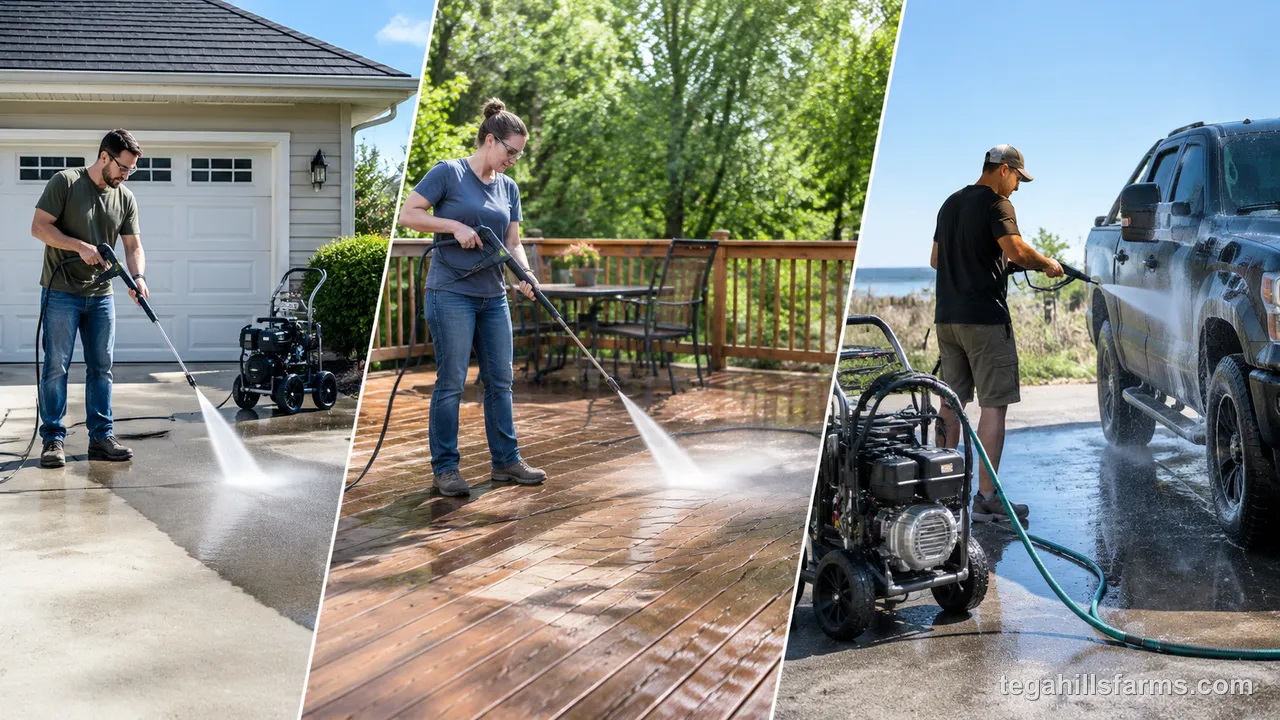
Driveways, Walkways and Patios
Concrete and stone take high pressure well, but flow decides how quickly the job ends, which is why the Westinghouse WPX3400, Simpson PowerShot 3300 PSI Gas and DeWalt DXPW3300-S are the natural matches for large driveways. Among the electrics, the Greenworks 3000 PSI Brushless Electric comes closest, and the Active 2.0 GPM 1800 PSI Electric’s flow helps on smaller patios.
Lighter electrics such as the Greenworks 1800 PSI Electric and the RYOBI 1800 PSI washer rinse walkways and spot-clean pavers, but a stained, wide slab turns into a long afternoon of slow passes with them.
A surface cleaner attachment changes the job on wide flats. Its spinning bar under a round hood cleans an even path without the stripes a wand leaves and keeps spray off your shoes and siding. It works best on the higher-flow machines, which is why the best pressure washers for driveways pair that flow with fittings that accept one.
Decks, Fences and Outdoor Furniture
Wood rewards a gentle approach because its soft surface fibers tear and fuzz under a narrow jet, leaving a rough deck that grays again quickly. A 25° or 40° tip, held back from the surface and moved along the grain, cleans without carving lines.
Several picks give that control: the Westinghouse ePX3500 has a 25° tip, the Sun Joe SPX3000 and Greenworks 3000 PSI Brushless Electric include both 25° and 40°, and the Greenworks 1800 PSI Electric’s 40° nozzle suits fences and resin chairs. The gas machines can clean wood too, provided you stay on the wide tips and keep the wand moving. For outdoor furniture, a pass with the soap tip first loosens grime so a light rinse finishes the job. The best pressure washers for decks balance enough pressure for mildew with the control to protect the boards.
Cars, Boats and Outdoor Gear
Vehicles, RVs and outdoor equipment need low pressure, a wide spray and plenty of soap, which puts the light-duty electrics in front. The Greenworks 1800 PSI Electric’s 40° nozzle and the Active 2.0 GPM 1800 PSI Electric’s high-flow rinse both suit painted panels, and the RYOBI 1800 PSI washer’s M22 handle accepts a foam cannon.
Soap handling matters as much as pressure here. The Sun Joe SPX3000’s separate tanks keep car shampoo apart from a stronger cleaner, and the Westinghouse ePX3500 carries its soap onboard. Keep the 0° and turbo tips away from paint, trim and decals.
What Features Matter Besides Pressure?
Nozzles, hoses and pump design shape how a washer feels week after week, because they decide your reach, your comfort and the machine’s lifespan. Two washers with matching pressure can feel completely different in the yard when one kinks, tips or needs constant refills and the other simply works.
Nozzles, Wands and Spray Patterns
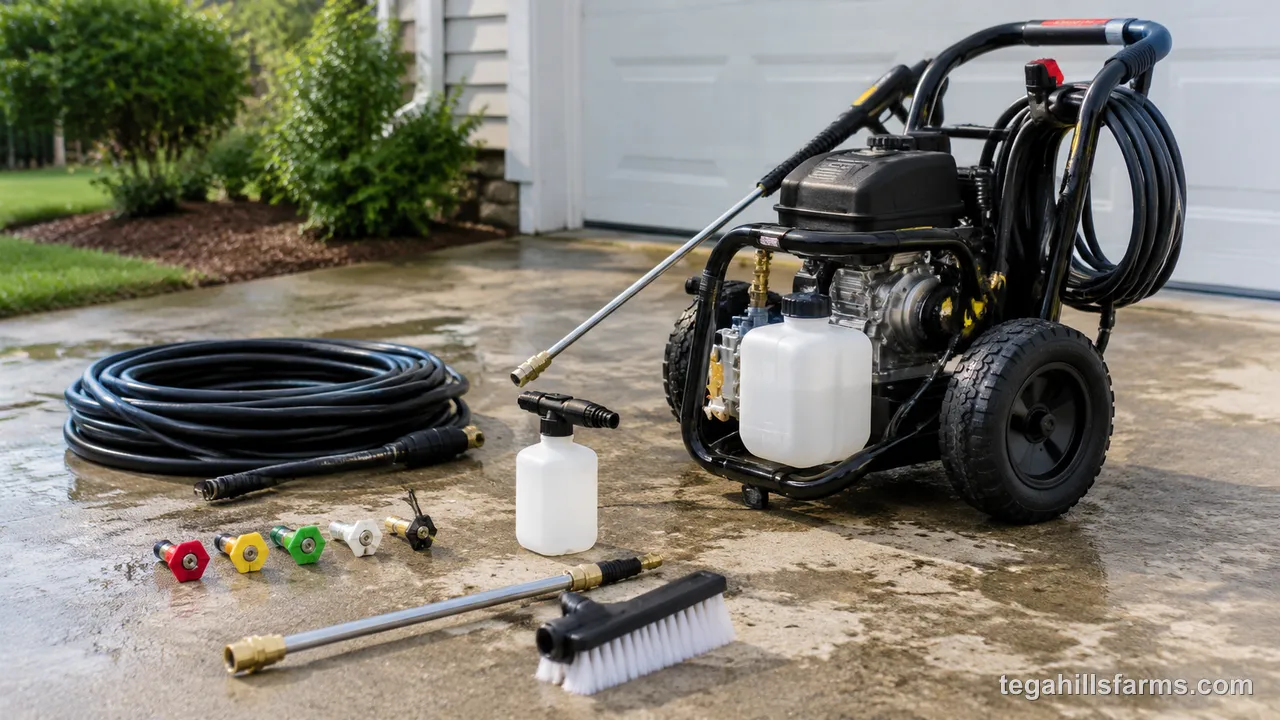
Each nozzle angle trades force for coverage. The 0° tip makes a pinpoint jet for spot-blasting stains on concrete, 15° chisels grime and loose paint off hard surfaces, 25° handles general cleaning on decks and siding, and 40° spreads a gentle fan for cars, windows and furniture. The soap tip opens wide and drops pressure so the machine can draw detergent, while a turbo nozzle spins a narrow jet in a cone for fast cutting over a wider area.
Wand length changes comfort. The Sun Joe SPX3000’s long stainless lance keeps you back from the spray and reaches upper siding, while the extendable Westinghouse ePX3500 wand packs down for storage. Quick-connect fittings swap tips without tools. When a tip wears or you want a different angle, the best pressure washer nozzles and the best pressure washer wands are simple upgrades.
Hoses, Power Cords and Mobility
Hose length and type set your working radius: several picks ship with a 25-foot hose, while the Sun Joe SPX3000 and Greenworks 1800 PSI Electric use 20-foot hoses that mean moving the machine more often. Kink resistance matters as much as length, which is why the Greenworks Uberflex and Simpson MorFlex hoses keep flow steady around corners.
On electric models, cord length decides how far the machine sits from the outlet, and the Greenworks 1800 PSI Electric’s long GFCI cord is a good example. Check the manual before adding an extension cord, since a longer garden hose on the inlet side is usually the safer way to gain reach. Wheels finish the picture: the ePX3500’s 360° steering suits patios, never-flat wheels on the WPX3400 skip air checks, and pneumatic tires on the Simpson and DeWalt ride over gravel and grass. If reach is your limit, the best pressure washer hoses solve it without a new machine.
Pump Type and Onboard Detergent Tanks
Triplex plunger pumps outlast axial cam pumps under heavy use, while axial cam pumps keep a home washer lighter, more compact and simpler to own. An axial cam pump drives its pistons from an angled plate on the motor shaft; it’s sealed, needs no oil changes and is typically replaced rather than rebuilt, and it’s the design inside the Westinghouse WPX3400 and DeWalt DXPW3300-S. A triplex pump, like the one on the Simpson PowerShot 3300 PSI Gas, uses a crankshaft and plungers that run at lower speed, so wear spreads out and seals can be rebuilt, at the cost of weight and size.
Onboard detergent tanks on the Westinghouse ePX3500, Sun Joe SPX3000 and WPX3400 feed soap through the low-pressure soap tip without a separate bottle. A foam cannon applies thicker, clinging foam instead, which suits car washing but adds a step.
Can a Pressure Washer Damage Your Car, Siding or Deck?
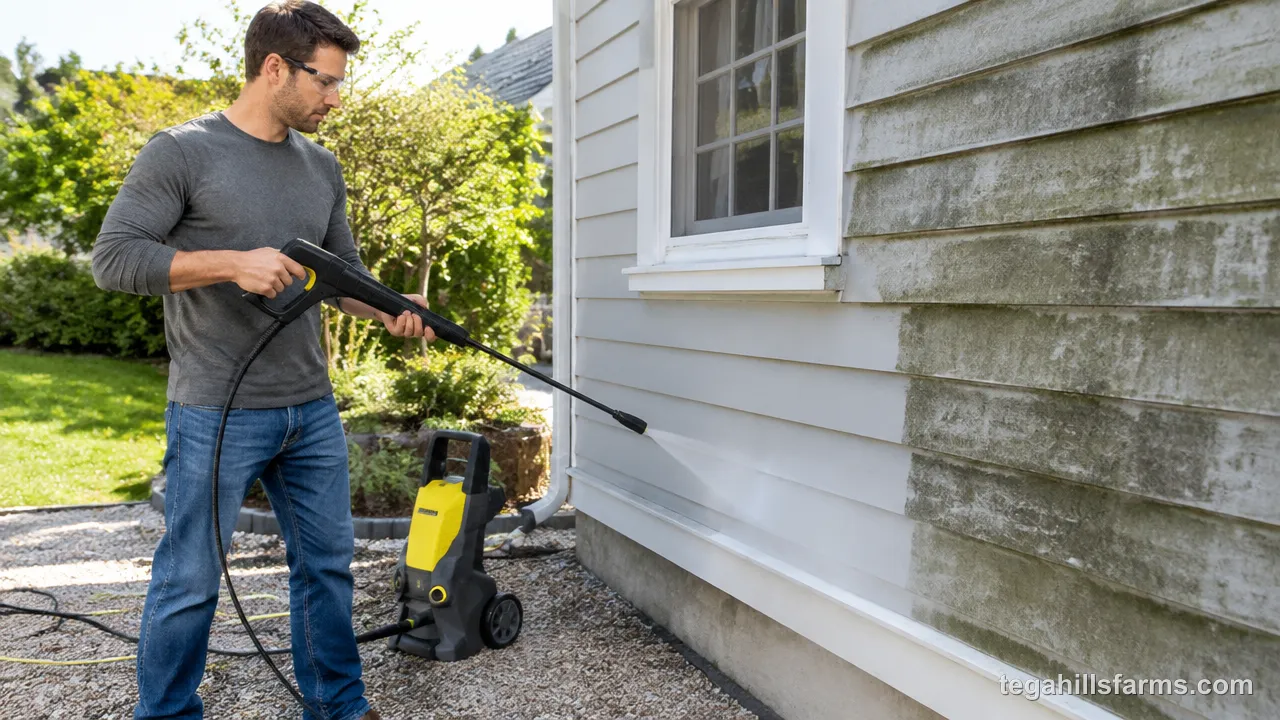
Yes: too much pressure, a narrow nozzle or too little distance can strip paint, gouge wood and push water behind siding. On a car, a tight jet can lift clear coat, peel decals and cut into tire sidewalls. On wood, it furs and scars the grain, and on siding, spraying upward drives water past the laps into the wall cavity, where it feeds mold and rot long before you see it.
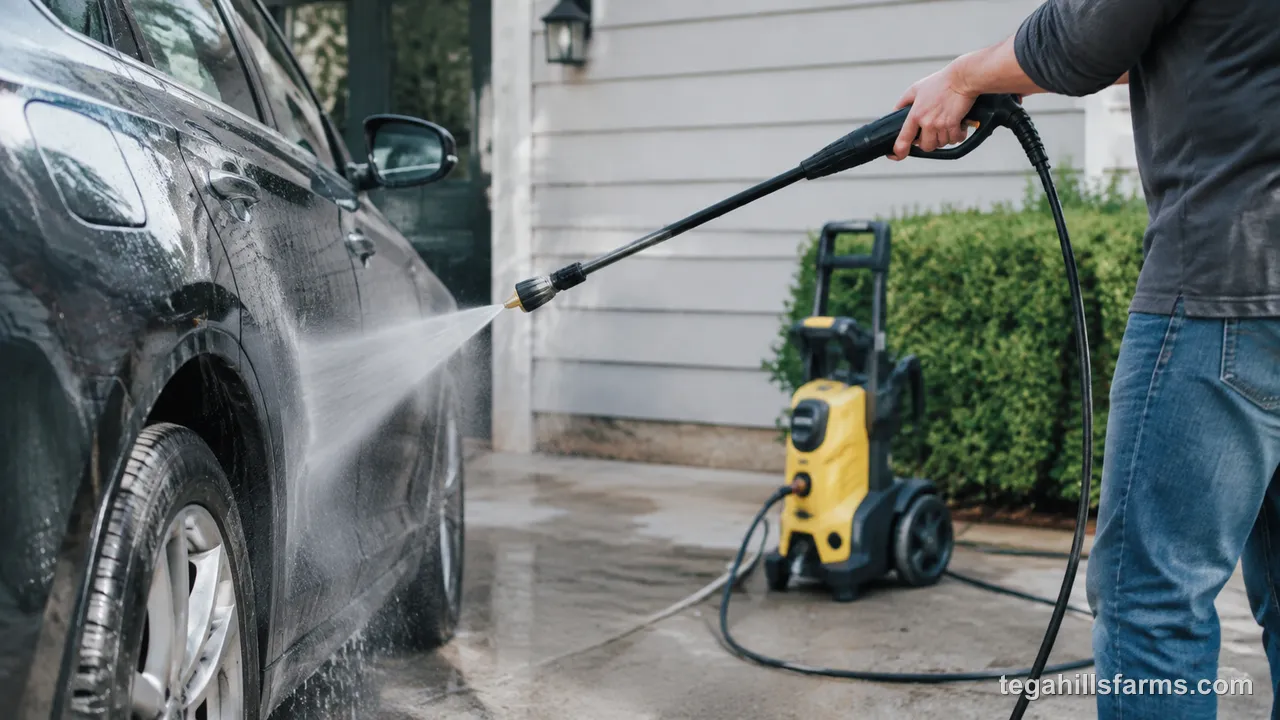
The safe approach starts gentle. Begin with a 40° fan, test a hidden spot, and start well back from the surface, moving closer only until dirt lifts. Spray siding at a downward angle and keep the wand moving so no spot takes the full stream for long. The best pressure washers for house siding pair moderate pressure with wide tips for exactly this reason.
Protect yourself too. Never aim the spray at people, pets or bare skin, because a high-pressure jet can cut and force water under the skin, an injury that needs prompt medical care even when the wound looks small. Wear eye protection and closed-toe shoes, and run gas machines outdoors only.
Water left sitting in a pump through a cold snap expands as it freezes, cracking seals and housings that look perfectly fine from the outside. The damage stays hidden until spring, when the first driveway job turns into a dribble, a leak at the pump or a washer that won’t build pressure at all.
How Do You Store and Maintain a Pressure Washer So It Lasts?
A pressure washer lasts when no water sits in the pump through freezing weather, the pump seals stay lubricated between seasons, and gas models get fresh oil and properly stored fuel. Skipping those steps rarely shows at once; it shows as a slow failure the following season.
Watch for the signs of a worn pump: pressure that surges and drops, water dripping from the pump body, a pulsing hose, or a motor that runs without building pressure. Leaking seals and a sticky unloader are usually repairable, while a cracked housing on an axial cam pump generally means a replacement pump or a new washer.
Storing Electric Models Through Winter
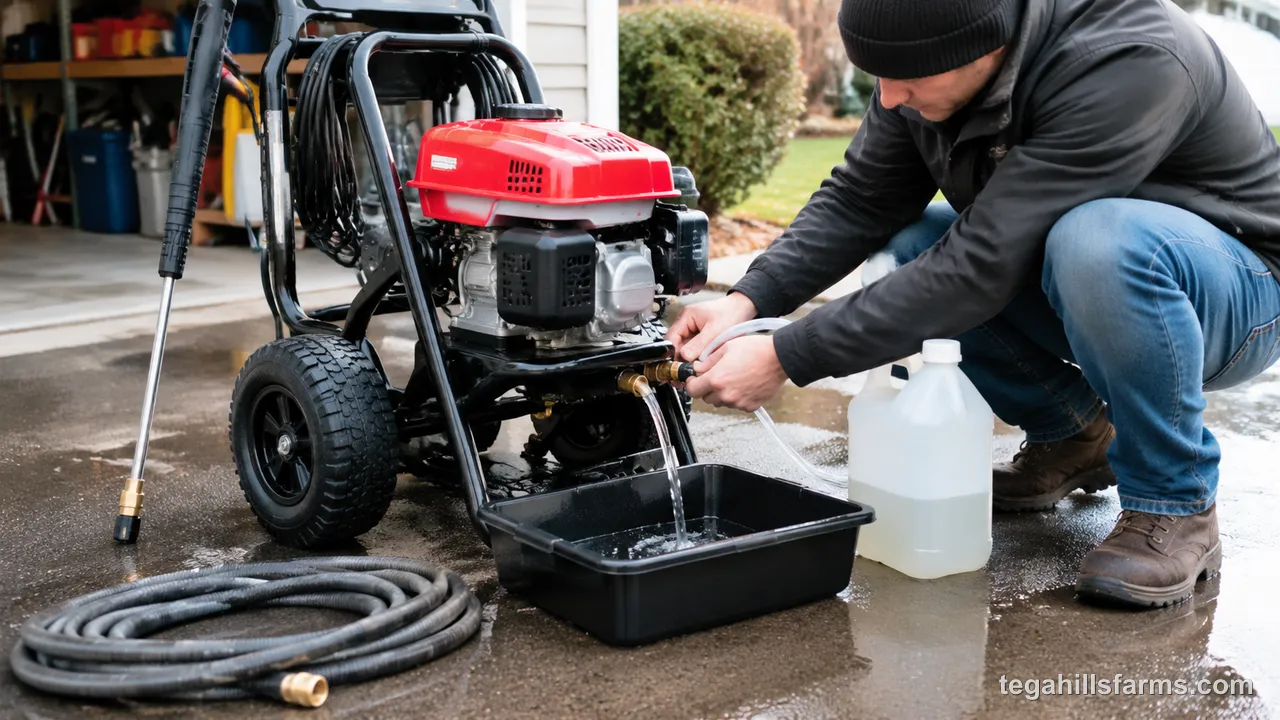
Before cold weather, an electric washer needs every drop of water out of the pump and hoses, a dose of pump protector, and a storage spot that stays above freezing. Unplug it, shut off the water and squeeze the trigger to release trapped pressure. Disconnect the hose and gun, then let them drain fully before coiling the hose loosely.
Pump protector threads onto the inlet and pushes out remaining water while coating the seals and pistons with antifreeze and lubricant. Without it, seals can dry out over winter and tear on the first start in spring. Keep the unit in a heated garage, basement or utility room rather than an unheated shed, because even a protected pump does best away from hard freezes. Check the O-rings on the quick-connects before storage so cracked ones get replaced early instead of leaking on the first job of the year.
Gas Engine and Pump Upkeep
On a gas washer, the engine needs the regular attention: oil changes at the intervals in the manual, fuel that is stabilized or drained before storage, and a short checklist before the first start of the season. Old fuel leaves varnish in the carburetor, which is the usual reason a gas washer refuses to start in spring, so either add stabilizer and run it through the system or run the tank dry.
Before the first start, check the oil level, look over the spark plug and air filter, inspect the hose and O-rings, and clean the inlet screen. Connect the water and squeeze the trigger to purge air before pulling the cord, because running the pump dry damages it quickly.
Pumps sold as maintenance-free, like the axial cam on the Westinghouse WPX3400 and the triplex on the Simpson PowerShot, need no oil changes, but they still need draining and pump protector before winter. The Simpson’s low-oil shutdown also guards the engine side if you forget a check.
Are Foam Cannons and Surface Cleaners Worth Adding?
Both are worth it when they match a job you do often: a foam cannon pays off for regular car washing, and a surface cleaner pays off on large driveways and patios, while occasional light cleaning needs neither. A foam cannon mixes soap, air and water into thick foam that clings to paint and loosens grime before you rinse, something the thin spray of a standard soap tip can’t do. On lower-flow machines the foam comes out wetter, so the higher-GPM picks get more from one.
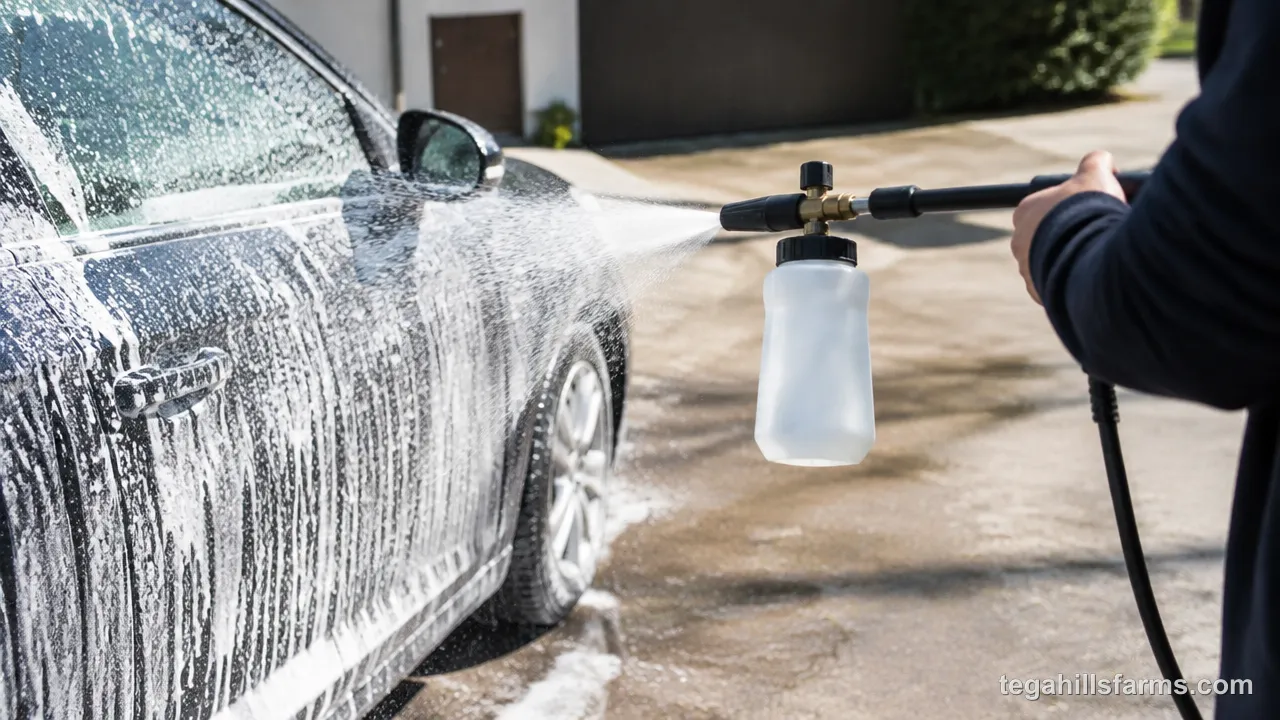
Most pressure washer surface cleaners spin a bar under a hood to clean concrete evenly and quickly, without wand stripes, but they need enough flow to spin properly, so size one to your washer’s GPM. Fit matters before either purchase. The Westinghouse WPX3400, Simpson PowerShot 3300 PSI Gas, Active 2.0 GPM 1800 PSI Electric and RYOBI 1800 PSI washer all use M22 connections, so check the accessory’s thread against your machine before ordering.
When Is a Home Pressure Washer Not Enough?
A home washer has reached its limit when the job involves grease, heavy buildup across large commercial areas, or daily use. Cold water pushes oil and grease around rather than lifting it, so restaurant pads, shop floors and equipment yards call for a hot water machine that heats the flow with its own burner. Home units take cold or warm inlet water only; the Greenworks 3000 PSI Brushless Electric, for example, accepts inlet water up to 104°F, which helps loosen grime but isn’t a hot water system.
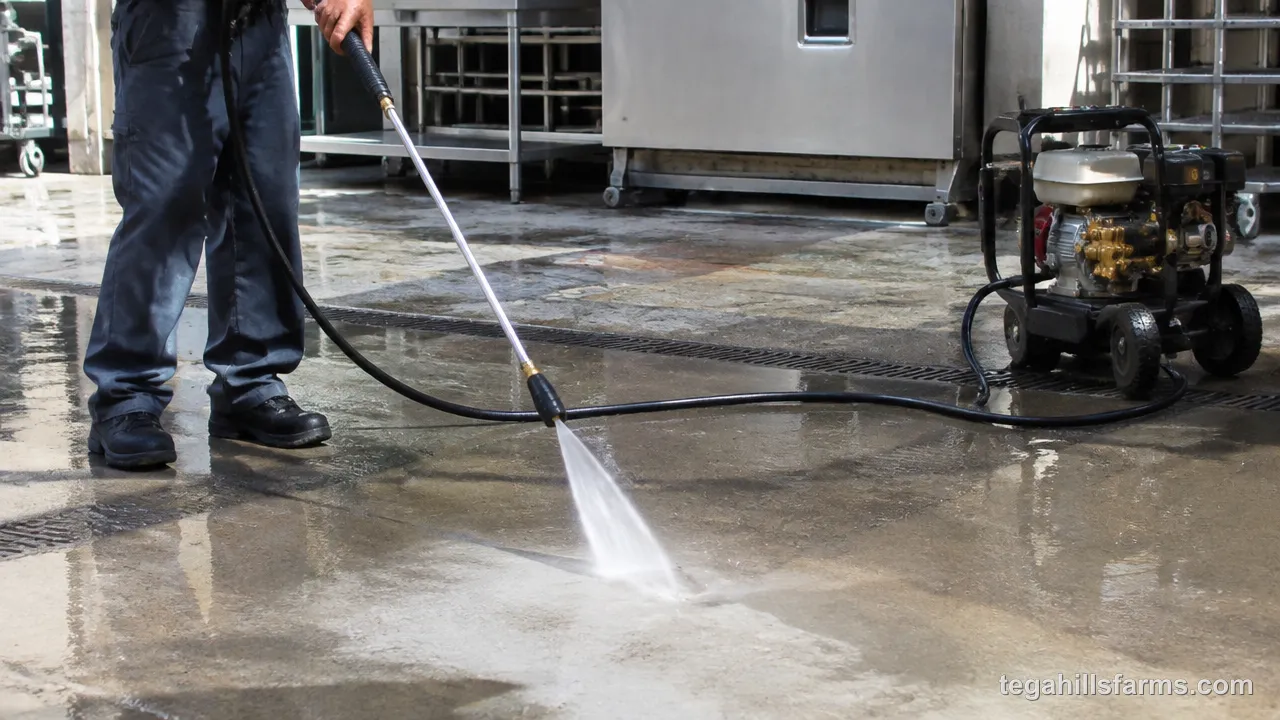
Daily use is the other line. Consumer axial cam pumps and residential warranties, such as the Active’s coverage for residential use, are designed around regular home upkeep. Commercial washers add triplex pumps, belt drives that let the pump run slower, higher flow for faster cleaning and frames built for constant transport. The Simpson PowerShot 3300 PSI Gas sits at the edge of that world as a contractor-oriented cold-water machine, but sustained grease work still calls for a dedicated hot water unit.
Can a Battery Pressure Washer Replace a Plug-In Model?
For most home cleaning it can’t: battery washers give up pressure, flow and runtime in exchange for cordless portability, so driveways, siding and decks still belong to plug-in or gas machines. A battery pack drains quickly at full output, though many cordless units can draw water from a bucket, which is handy at a campsite or boat slip.
That makes them good companions rather than replacements, suited to rinsing bikes, kayaks, muddy boots, patio chairs and a car parked far from an outlet. Owners already invested in a cordless tool platform get the most from one, since a shared battery keeps cost and clutter down. None of the washers recommended here run on battery, because plug-in power covers more of the work around a house; if portability tops your list, the best battery pressure washers are a separate category worth comparing.
Pressure Washer Questions Answered
How much pressure does a home pressure washer need?
For cars, windows and patio furniture, a light-duty electric like the Greenworks 1800 PSI Electric is plenty. Decks, siding and patios go better with a mid-range electric that adds flow, and wide, stained driveways or paint prep justify a gas machine. Compare rated GPM alongside PSI, because flow sets how fast the work goes.
Is a gas or electric pressure washer better for a homeowner?
Electric suits most homes: it starts with a switch, runs quietly and needs no oil or fuel care. Gas is better when you clean large concrete areas, prep siding for paint or work far from an outlet, and you’re comfortable with seasonal engine upkeep and running the machine outdoors only.
Can you pressure wash a car without damaging the paint?
Yes, with a 40° or soap nozzle, a light-duty or high-flow electric and steady distance from the panel. Apply soap first, let it dwell, then rinse from the top down. Keep 0° and turbo tips away from paint, trim, decals and tire sidewalls, and never spray straight into door seals.
Can you trust max PSI and GPM ratings?
Treat them as peaks rather than working numbers. Max pressure and max flow are measured under different conditions and never occur together, so pairing them overstates real output. Rated or PWMA-certified figures reflect steady spraying, which makes them the fair way to compare one washer against another before you buy.
Do you need detergent with a pressure washer?
Not always, but detergent shortens most jobs. Soap loosens mildew, road film and algae so the rinse lifts them at lower pressure, which protects wood and paint. Use cleaners made for pressure washers, since some household products can harm pump seals, and apply them through the soap tip or a foam cannon.
Can you run hot water through a home pressure washer?
Only within the inlet temperature limit in the manual, and most home units are built for cold or warm water. Hotter supply water can damage pump seals and shorten pump life. For greasy work that needs real heat, a hot water pressure washer with its own burner is the right tool.
More Guides on Best Pressure Washers
- Best Pressure Washers Under $100
- Best Pressure Washers Under $500
- Best Pressure Washer Wands