5 Best Rain Barrels: Expert Picks Worth Buying in 2026
Our top picks for the best rain barrels in 2026 are RTS Home Accents 50-Gallon ECO Rain Barrel (Best Overall), RTS Home Accents 50-Gallon Rain Barrel Walnut (Best Lightweight), YYLXTEX 100-Gallon Collapsible Rain Barrel (Best Budget), FCMP Outdoor 50-Gallon Flat-Back Rain Barrel (Best Premium), and Good Ideas Rain Wizard 50-Gallon Barrel (Best Durability). Every one of them takes water from a downspout for your beds and containers. They differ in their fittings, in how much ground they take up, and in how they get through winter.
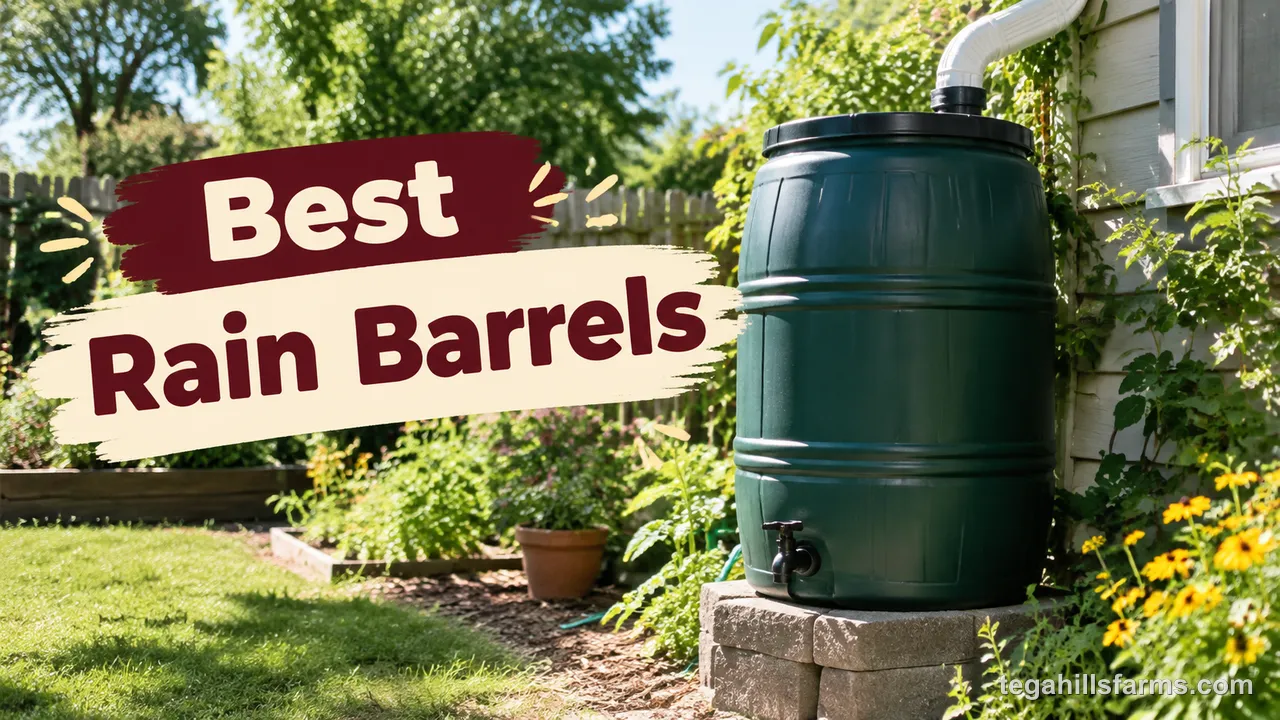
Shoppers usually look at gallon capacity first. Daily use depends more on other details: the spigot you open every morning, where the water goes once the barrel is full, how flat the back sits against siding, and whether the plastic holds up in the sun.


A rain barrel usually fails in one of three ways. It breeds mosquitoes, it spills against the foundation, or it cracks during its first winter. A screen, an overflow path and a fall drain-down prevent those problems, so the fittings deserve as much attention as the gallon number.
How Do You Choose a Rain Barrel for Your Garden?
A dependable rain barrel matches your roof’s runoff, your garden’s demand and the spot beside your house. When one of those doesn’t fit, you get overflow at the foundation, a dribbling spigot or a barrel that tips once full.
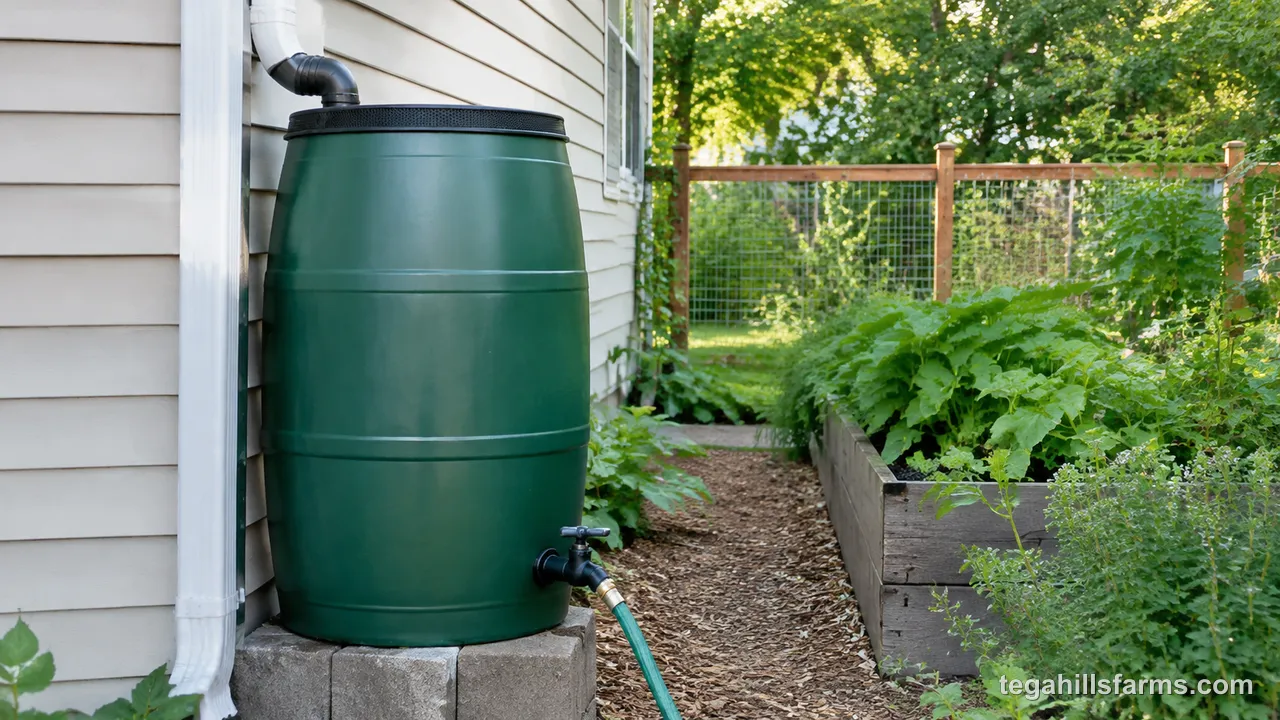
Capacity gets most of the attention. Fittings and footprint decide whether you actually use the barrel every morning or go back to the outdoor faucet. If you’re setting one up for the first time, the primer on how to choose a rain barrel also covers installation steps beyond the buying decision.
How Much Capacity Does Your Garden Need?
Size the barrel to how much your beds use between storms rather than to the size of your roof. Even a small section of roof can fill a barrel faster than you can empty it, and once the barrel is full, every extra gallon from that downspout goes out the overflow.
A single 50 gallon rain barrel suits a few raised beds or a patio of containers in a region with regular summer rain, because showers refill it before it runs dry. Long dry spells change that. If your summers bring weeks without rain, the stored water has to carry the garden through, so capacity counts for more.
Linking barrels is the usual way to expand. The overflow from the first barrel feeds the next, so you can add storage as the garden grows instead of guessing up front. I’d rather start with one barrel and add more once I see how fast the beds empty it than buy a large system that sits half full.
Which Spigot, Overflow and Screen Features Matter?
Three fittings decide how easy a barrel is to live with: a spigot you can reach and connect a hose to, an overflow port that sends excess water somewhere safe, and a screen that keeps out debris and insects.
A spigot set low on the barrel lets gravity drain more of the water. Brass or metal threads also handle repeated hose connections better than plastic, which can strip if you overtighten it.
The overflow port matters as much as the spigot. A full barrel has to send water somewhere, and with no hose on the overflow it spills over the rim and soaks the soil against your foundation. Look for a port that accepts a hose you can route toward a bed or into another barrel.
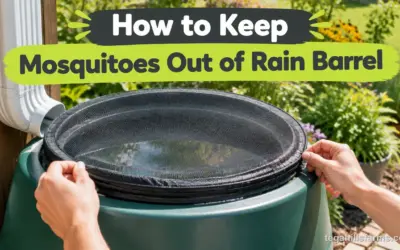
A fine mesh screen over the inlet catches leaves and shingle grit and stops mosquitoes from reaching the water. It only works if it seals tightly to the lid, because insects get in through any gap at the edge.
How Much Space Does the Barrel Need Beside Your House?
Measure the spot under your downspout before buying, because shape and footprint decide what fits more often than capacity does. Flat-back barrels sit flush against siding or a fence and leave the walkway clear. Round barrels stick out farther and leave wasted space behind them.
Empty weight affects how easily you can carry and level a barrel. The base, though, has to handle the full weight. Water weighs a little over 8 pounds per gallon, so a full barrel puts several hundred pounds on whatever it sits on, and on soft soil it settles unevenly and can tip.
Set the barrel on compacted gravel, pavers or a sturdy stand, and check it with a level. Then cut the downspout so it drops straight into the inlet.
Plastic, Wood or Metal: Which Rain Barrel Material Should You Buy?
UV-resistant polyethylene is the practical default for most gardens. Wood and metal cost you extra upkeep or weight in exchange for looks, and collapsible PVC wins on storage and budget but gives up rigidity.
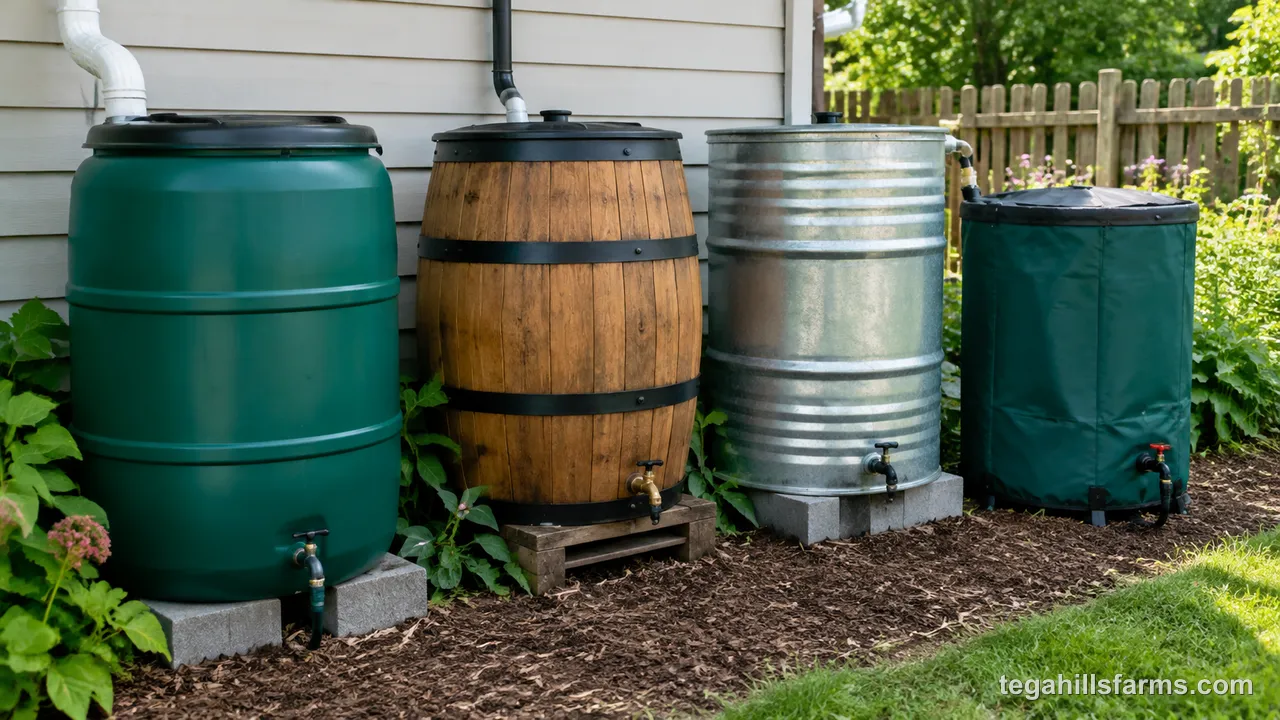
Molded polyethylene doesn’t rot or rust, it’s light when empty, and it can be textured to look like wood or stone. Its weak point is cheap plastic made without UV stabilizers, which turns brittle after a few summers in full sun.
Wood barrels are usually oak, and they look at home on a patio. The staves have to stay damp, though, or they shrink and leak, and exposed wood eventually rots if you don’t care for it. If you want that look anyway, the best wood rain barrels sit firmly in the premium tier.
Galvanized steel is stiff, keeps rodents out and suits a farmhouse setting. It’s heavy to move and can rust at seams and scratches over time, so metal rain barrels call for a bit more upkeep than plastic ones.
Collapsible PVC barrels on a frame are the budget route, and they pack away for winter. Their soft walls are easier to puncture, and they need flat ground.
Here is how the four materials compare on the points that drive most purchases:
| Material | Outdoor durability | Upkeep | Looks | Price tier |
|---|---|---|---|---|
| UV-resistant polyethylene | Resists rot, rust and sun damage | Low; rinse once a year | Plain, or faux wood and stone | Budget to mid-range |
| Wood (oak) | Rots without care | High; keep staves damp and sealed | Natural, rustic | Premium |
| Galvanized metal | Strong, but can rust at seams | Moderate; watch for rust | Farmhouse, industrial | Mid-range to premium |
| Collapsible PVC | Tear-resistant, but puncture-prone | Low; fold away for winter | Utilitarian | Budget |
The 5 Best Rain Barrels for Home Gardens in 2026
Our top picks for the best rain barrels for home gardens in 2026 are RTS Home Accents 50-Gallon ECO Rain Barrel, RTS Home Accents 50-Gallon Rain Barrel Walnut, YYLXTEX 100-Gallon Collapsible Rain Barrel, FCMP Outdoor 50-Gallon Flat-Back Rain Barrel and Good Ideas Rain Wizard 50-Gallon Barrel. The two RTS barrels differ mainly in spigot material and finish. The FCMP comes with the hoses and linking parts for a multi-barrel setup, and the Good Ideas pairs a metal spigot with plain cold-weather instructions. The YYLXTEX gives up a rigid shell but holds the most water and folds away when the season ends.
#1 RTS Home Accents 50-Gallon ECO Rain Barrel — Best Overall
Gardeners who want a dependable barrel tucked against a wall will get the most from this one. Its flat back, built-in overflow valve and UV-resistant recycled polyethylene shell cover the basics that keep water flowing and the foundation dry, and at 18 pounds it’s easy to set in place.
Key Specs:
- Capacity: 50 gallons
- Weight: 18 pounds
- Material: UV-resistant polyethylene made entirely from recycled plastic
- Spigot: plastic
- Overflow: built-in overflow valve, with the option to link barrels
- Made in the USA
Detailed Review:
The flat back is what makes this barrel easy to live with. It sits snug against siding or a fence instead of jutting into a side path, and the textured black finish looks like part of the garden rather than a utility drum. The shell is molded from UV-resistant polyethylene, so it holds up through summers in full sun without turning brittle the way unprotected plastic does.
The built-in overflow valve takes care of the moment the barrel fills mid-storm. You can run a hose from it away from the foundation or into another barrel, so adding storage later never means replacing this one. The plastic spigot opens easily for filling a watering can. Tighten hose fittings by hand rather than with pliers so you don’t strip the threads.
The Walnut model from the same maker is the natural comparison, and the difference is the spigot. That barrel uses brass, which handles daily hose connections better. This one keeps a plastic spigot and builds its shell entirely from recycled plastic. Both are light enough empty to carry into position alone.
It’s made in the USA. A stand is sold separately if you want the spigot raised for easier can filling.
Pros:
- Flat back sits tight against walls and fences.
- Built-in overflow valve lets you link more barrels later.
- UV-resistant polyethylene holds up to full sun.
- Made from recycled plastic in the USA.
- Light enough to position without help.
Cons:
- Plastic spigot threads need careful hand-tightening.
- Raising it requires a separately sold stand.
Who It’s For:
First-time rain catchers with a downspout beside a wall or fence will find this barrel simple to set up and forget. If you connect and disconnect a hose every day, the RTS Home Accents 50-Gallon Rain Barrel Walnut may suit you better, because its brass spigot handles that wear well.
Editor’s Verdict:
Choose it when you want a tidy, low-fuss barrel with overflow handled from day one, and treat the plastic spigot gently.
#2 RTS Home Accents 50-Gallon Rain Barrel Walnut — Best Lightweight
At 18 pounds empty, this barrel is easy to carry and level on your own. The walnut-colored textured finish and brass spigot suit a patio or front-yard downspout, where you want the setup to look planned and the hose connection to stay secure and leak-free through daily use.
Key Specs:
- Capacity: 50 gallons
- Weight: 18 pounds
- Material: UV-resistant polyethylene
- Spigot: brass
- Overflow: built-in overflow valve, with the option to link barrels
- Color: walnut; made in the USA
Detailed Review:
The light empty weight pays off on installation day. You can carry this barrel through a side gate, hold it against the wall while you mark where to cut the downspout, and nudge it until it sits level, all without help. That ease ends once water goes in, so settle the base before the first rain.
The brass spigot is a practical upgrade. Brass threads handle repeated hose connections without wearing down, and the spigot seals securely, so water stays in the barrel instead of dripping onto your shoes every time you fill a can. The built-in overflow valve sends excess water where you direct it and lets you link more barrels later.
The textured walnut color blends with mulch, wood fencing and brown trim better than a black drum does, and the flat back keeps the barrel tucked against the house. If appearance drives your choice, the best looking rain barrels include more styles worth comparing.
The UV-resistant polyethylene shell is built for full sun, and the barrel is produced in the USA. The optional stand lifts the spigot to watering-can height.
Pros:
- Brass spigot handles daily hose connections without leaking.
- Light enough to carry and level single-handed.
- Walnut finish blends with wood fences and mulch.
- Overflow valve lets you add barrels later.
Cons:
- Stand for extra height is sold separately.
- Walnut color can clash with gray or white trim.
Who It’s For:
If you install alone or find heavy lifting hard, you’ll appreciate how easily this barrel moves into place. Its warm color also suits front-yard and patio downspouts where looks count. If your downspout sits against gray stone or modern siding, a darker barrel may blend in better.
Editor’s Verdict:
Pick it if you want a barrel you can handle alone and a brass spigot that keeps the hose connection tight.
#3 YYLXTEX 100-Gallon Collapsible Rain Barrel — Best Budget
Large gardens that need plenty of stored water on a modest budget get it here. The 100-gallon PVC body stands on a frame of thickened support poles, and the included quick-connect hose, collapsible bucket and mesh screen mean you can unbox it, set it up and start collecting the same afternoon.
Key Specs:
- Capacity: 100 gallons (380 L)
- Body: three-layer PVC, 0.02 in (0.6 mm) thick, with a high-density woven liner
- Frame: thickened support poles, 0.1 in (2 mm)
- Screen: 0.2 in (5 mm) mesh
- Included: quick-connect hose, collapsible bucket, plant labels
- Setup: under 5 minutes
Detailed Review:
Capacity is the main appeal. This barrel holds more water than the RTS, FCMP or Good Ideas barrels, which suits a vegetable plot that goes through water quickly in midsummer. Because the walls are PVC on a frame rather than molded plastic, all that volume ships and stores in a compact package.
The frame carries the load. Thickened support poles keep the walls upright at full capacity, and the three-layer PVC body with its woven liner resists tearing better than a single thin sheet. Fabric walls still can’t take a stray garden fork the way rigid polyethylene can, so set the barrel away from paths where tools and mowers pass.
A fine mesh screen filters debris where water enters, and the seams and quick-connect spigot have reinforced sealing against leaks. The included hose and collapsible bucket make setup quick, and the plant labels are handy for marking beds.
The real payoff in cold zones is that it folds down for winter storage, and an empty, packed-away barrel can’t crack. If keeping costs low is your priority, compare rain barrels under $100 as well.
Pros:
- Holds more water than the rigid barrels listed alongside it.
- Folds down for off-season storage.
- Kit includes hose, collapsible bucket and plant labels.
- Mesh screen filters debris at the inlet.
Cons:
- Soft walls are more vulnerable to sharp tools than rigid plastic.
- Needs flat, debris-free ground to stay stable.
Who It’s For:
Vegetable growers with thirsty beds and little money to spare get a lot of storage here. Renters, or anyone who wants to pack the barrel away for winter, will like that it folds down. A spot beside a busy walkway where tools and mowers pass close is better served by a rigid barrel.
Editor’s Verdict:
Buy it when stored volume matters more than looks, and give it level ground away from sharp tools.
#4 FCMP Outdoor 50-Gallon Flat-Back Rain Barrel — Best Premium
Everything for a linked system comes in the box. The kit includes an aluminum mesh screen, a garden hose, a shut-off thumb valve, hanging hose clips, an overflow hose and parts for multiple barrels, which suits gardeners who want a complete setup without hunting down fittings.
Key Specs:
- Capacity: 50 gallons
- Dimensions (L x W x H): 24 x 24 x 32 inches
- Weight: 25 pounds
- Material: polyethylene
- Screen: aluminum mesh
- Spigots: side-mounted, for linking barrels
Detailed Review:
The bundled kit is the reason to spend more on this barrel. The garden hose, shut-off thumb valve and hanging hose clips handle daily watering, and the overflow hose and multi-barrel kit let the system grow from the first install. The spigots on the side of the barrel are placed for connecting more barrels, so expanding storage doesn’t start with a shopping list.
The aluminum mesh screen holds up better than plastic mesh against twigs and shingle grit, which matters under a roof that sheds a lot. The Good Ideas Rain Wizard 50-Gallon Barrel uses a plastic mesh screen instead, but it weighs less empty and takes up a slightly smaller footprint.
The large openings and flat back keep installation simple. The downspout drops into a wide inlet, and the barrel sits flush against the house. The polyethylene body takes more effort to shift into place than lighter barrels, though that weight is minor compared with what it holds once full.
I’d steer anyone who already knows they’ll want more storage toward this barrel, since the linking parts are in hand from day one.
Pros:
- Kit includes hose, thumb valve, clips and overflow hose.
- Multi-barrel kit and side spigots are ready for linking.
- Aluminum mesh screen stands up to twigs and grit.
- Flat back and large openings simplify installation.
Cons:
- Heavier empty than the RTS barrels.
- Bundled extras add to what you pay beyond the barrel itself.
Who It’s For:
If you’re planning a linked system from the start and would rather open the box and install than shop for fittings, this complete setup fits. If you only want a basic barrel or need something easy to lift, you can skip the bundled extras and choose a lighter RTS Home Accents barrel.
Editor’s Verdict:
Expect a complete, expandable setup straight out of the box, with fittings and a screen suited to a system meant to grow.
#5 Good Ideas Rain Wizard 50-Gallon Barrel — Best Durability
Cold-climate gardeners who leave barrels outside get clear winter guidance with this one. The plastic shell resists weather and UV damage, the metal spigot takes a garden hose directly, and the faux-wood finish gives a plain downspout a more finished look.
Key Specs:
- Capacity: 50 gallons
- Dimensions (L x W x H): 23 x 22 x 30 inches
- Weight: 19 pounds empty
- Material: weather- and UV-resistant plastic, faux-wood design
- Spigot: metal, garden hose compatible
- Screen: plastic mesh, included
Detailed Review:
This barrel is designed around weather resistance. The plastic shell resists weather and UV damage, so long summers in full sun don’t leave it brittle, and you can leave the barrel outdoors through winter. If temperatures drop below freezing and you can’t store it inside, drain it completely and turn it upside down so no water sits in it to freeze.
The metal spigot takes a garden hose directly. I’d rather thread a hose onto metal than plastic on a barrel I use every watering day. You can connect it to other Good Ideas barrels for a larger collection system, though that connection kit is sold separately.
The compact footprint and flat back fit narrow side yards, and the barrel is light enough empty to carry into place without help. Its gray faux-wood texture looks like weathered boards, so it blends with fences and decks better than a smooth drum.
The included plastic mesh screen keeps leaves and debris out of the stored water, which keeps the spigot clear between cleanings.
Pros:
- Weather- and UV-resistant plastic is built to stay outside.
- Metal spigot connects a garden hose directly.
- Compact flat-back shape fits narrow side yards.
- Faux-wood finish blends with fences and decks.
Cons:
- Connection kit for linking barrels is sold separately.
- Freezing weather requires draining and flipping it over.
- Plastic mesh screen is less rugged than metal mesh.
Who It’s For:
In northern zones where barrels stay outside through hard freezes, this is a sensible pick. It also suits anyone who wants a wood look without the upkeep of real wood. If you’d rather have linking parts included from the start, the FCMP Outdoor 50-Gallon Flat-Back Rain Barrel bundles them.
Editor’s Verdict:
Rely on it outdoors through the seasons, as long as you drain and flip it before hard freezes.
Which Rain Barrel Fits Your Situation Best?
Tight side yards call for a flat-back barrel like the RTS or FCMP models. Large vegetable gardens call for the YYLXTEX collapsible, and hard-freeze climates for the Good Ideas Rain Wizard.
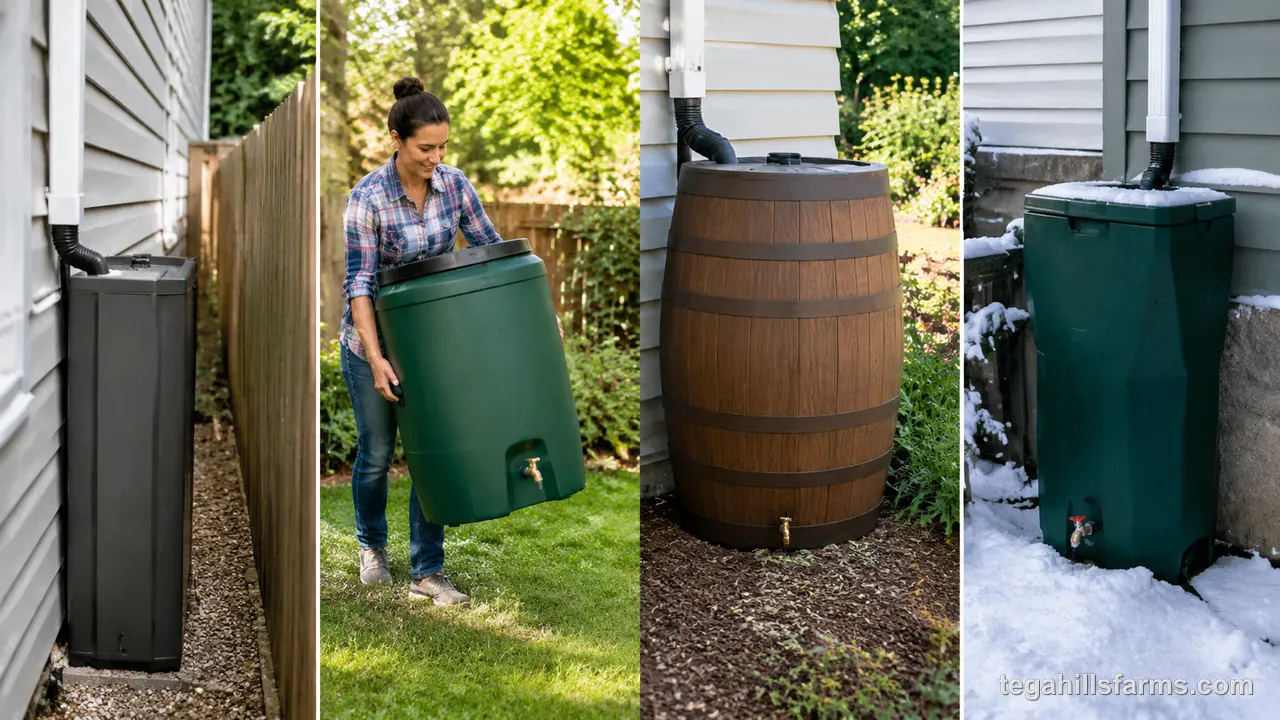
- Narrow side yards: Both RTS barrels and the FCMP sit flat against the wall, and the Good Ideas has a compact footprint for tight corners.
- Limited lifting: The RTS ECO and Walnut barrels are light enough empty to carry and level alone, which matters more than any spec if you’re installing by yourself.
- Large gardens: The YYLXTEX holds the most water in one unit. The FCMP suits a rigid, linked system because its kit already includes the linking parts.
- Cold climates: The Good Ideas comes with clear drain-and-flip guidance for freezing weather, and the YYLXTEX folds down to store indoors.
- Front-yard downspouts: The Walnut’s warm finish and the Good Ideas faux-wood texture blend in where neighbors can see them.
If none of these fits your spot or your spending plan, rain barrels under $200 and the best rain barrels under $300 offer more options.
Is Rain Barrel Water Safe for Vegetables and Herbs?
Yes, with care. Rain barrel water is fine for ornamentals and safe for vegetables and herbs when you water at the soil line rather than over the leaves, but it is not drinking water unless it’s treated.
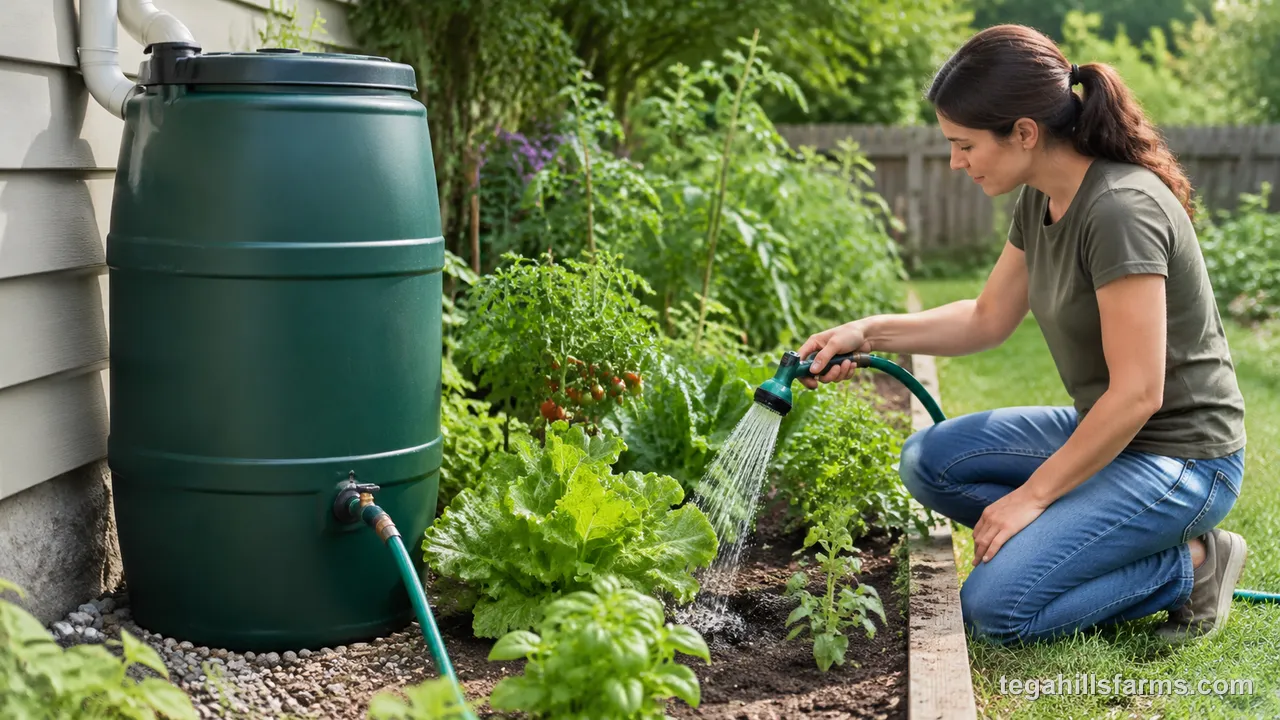
Roof runoff picks up bird droppings, dust and pollen, plus traces of whatever the roof is made of. Asphalt shingles, treated wood shakes and copper or zinc flashing can all add residues. Watering at the base keeps those residues off the parts you eat, which matters most for leafy greens and herbs eaten raw. Don’t use barrel water on those crops right before harvest, and wash everything you pick.
I water my own raised beds from barrels I set up myself, and watering at the soil line is the one habit I’d never skip. If edibles are your main use, the best rain barrels for gardening make soil-level watering easy.
Drinking rainwater is a separate project. It needs filtration, disinfection, a food-grade storage tank and a check of local health rules, and the best rain barrels for drinking water are built for that setup.
A barrel left full through a warm, still week can have mosquito larvae wriggling under the lid and a green film spreading across the water. Left alone, that water turns sour, and the slime it carries clogs the spigot and the emitters on your drip lines just when the beds need watering most.
How Do You Keep Rain Barrel Water Fresh and Mosquito-Free?
Keeping barrel water fresh comes down to blocking light and insects and using the water regularly. A tight-fitting fine-mesh screen, a first-flush device on the downspout and a yearly cleaning cover most of the work.
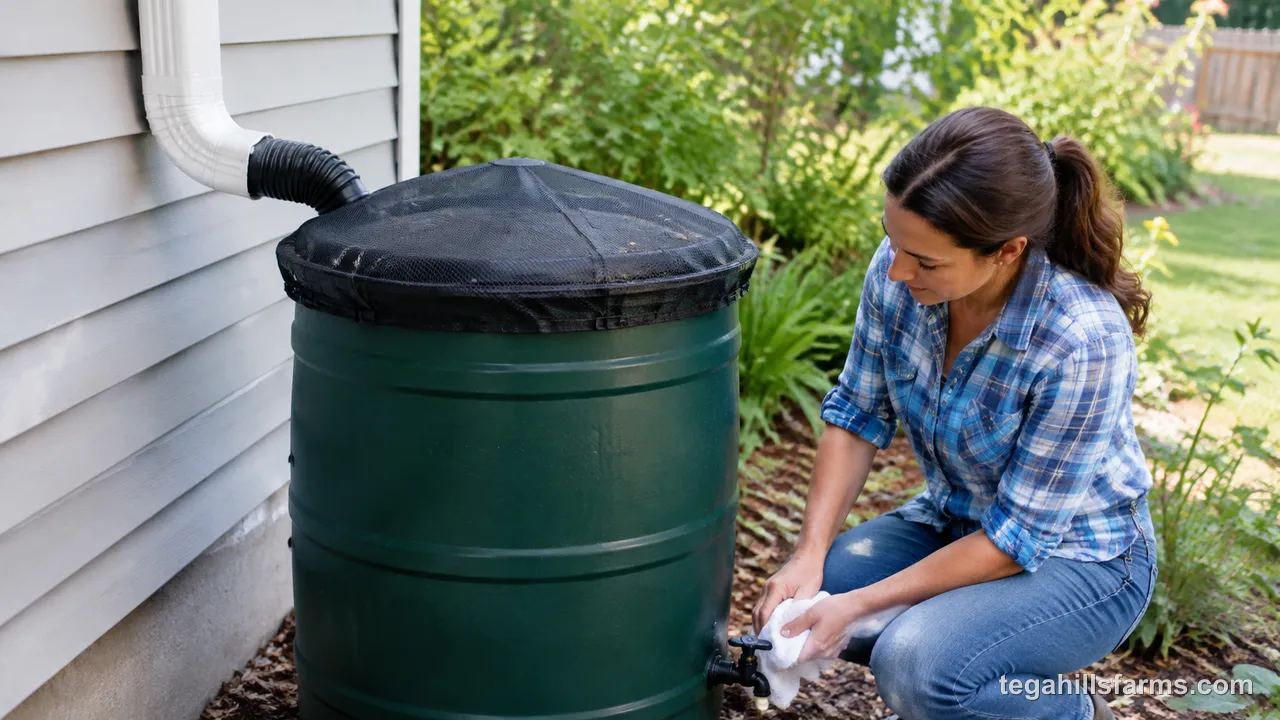
Mosquitoes lay eggs on still water and can go from egg to biting adult in about a week in warm weather, so any gap around the lid or screen edge matters. If you can’t seal a gap, a mosquito dunk containing Bti (Bacillus thuringiensis israelensis) kills larvae without harming plants. Follow the label for how often to replace it.
The first runoff from a roof carries the most pollen, grit and bird droppings. A first-flush device or a rain barrel diverter with a debris trap sends that early water past the barrel, which stops sediment from building up around the spigot.
You can tell when water has gone stale: it smells like rotten eggs, looks green, leaves slime on the walls or settles as dark sludge at the bottom. Drain it onto the lawn or ornamentals, scrub the inside with a mild vinegar solution, rinse and refill. An opaque barrel in partial shade slows algae between cleanings.
What Happens to a Rain Barrel in Freezing Weather?
Water expands as it freezes, so a barrel left full through a hard freeze can split along a seam, crack around the spigot or bulge out of shape. Draining, disconnecting and storing the barrel before the first hard freeze prevents all three.
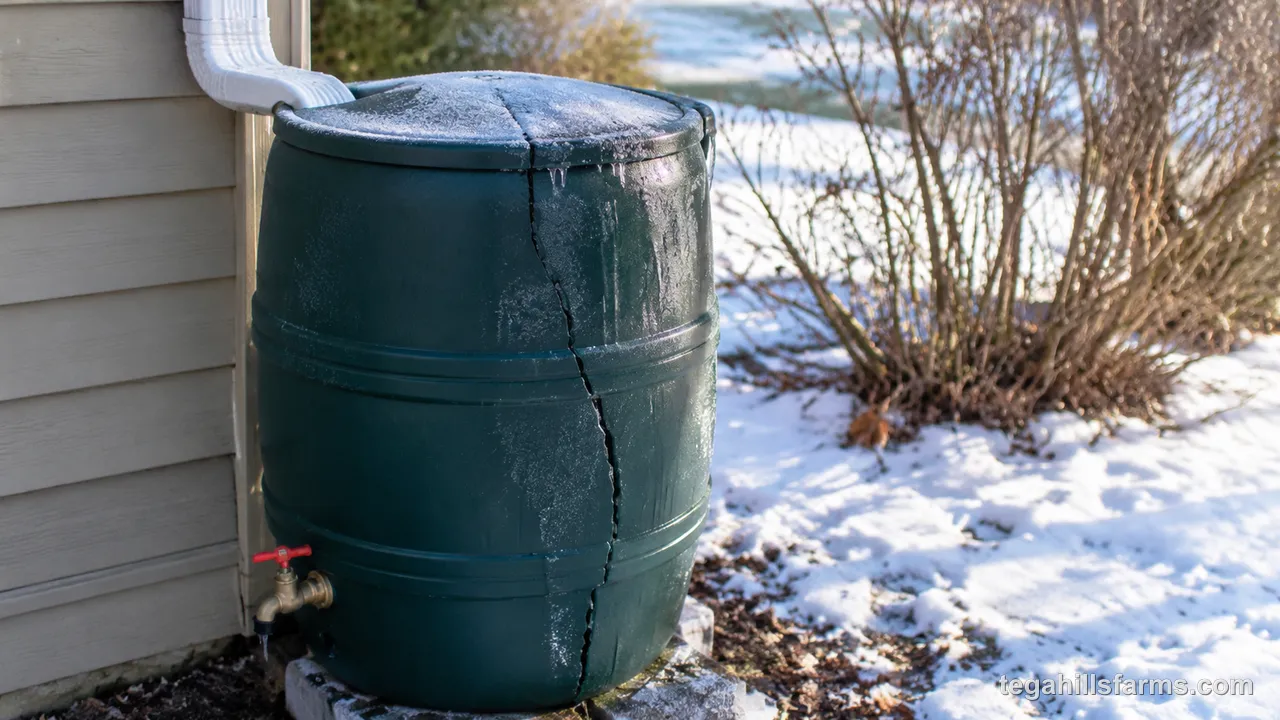
The end-of-season routine is simple. Empty the barrel completely through the spigot, disconnect it from the downspout, and reattach a downspout extension so winter runoff flows away from the foundation. Then store the barrel indoors, or turn it upside down outside so rain and snowmelt can’t collect inside.
Your USDA zone sets the timing. In colder zones where freezes arrive early and stay, drain in fall and reconnect after your last spring frost. In mild southern zones you can often keep collecting through winter, opening the spigot to lower the water level before a rare hard freeze. Middle zones are the hardest to judge, because a warm stretch tempts you to leave the barrel connected until a sudden freeze catches it full.
Before refilling in spring, check for hairline cracks near the fittings, a warped lid or a spigot that drips when closed.
Can You Link Several Rain Barrels Together?
Yes. If you run a hose or connector from the overflow port of the first barrel to the next, a single downspout can fill several barrels, because water moves on once the first barrel is full instead of spilling over the rim.
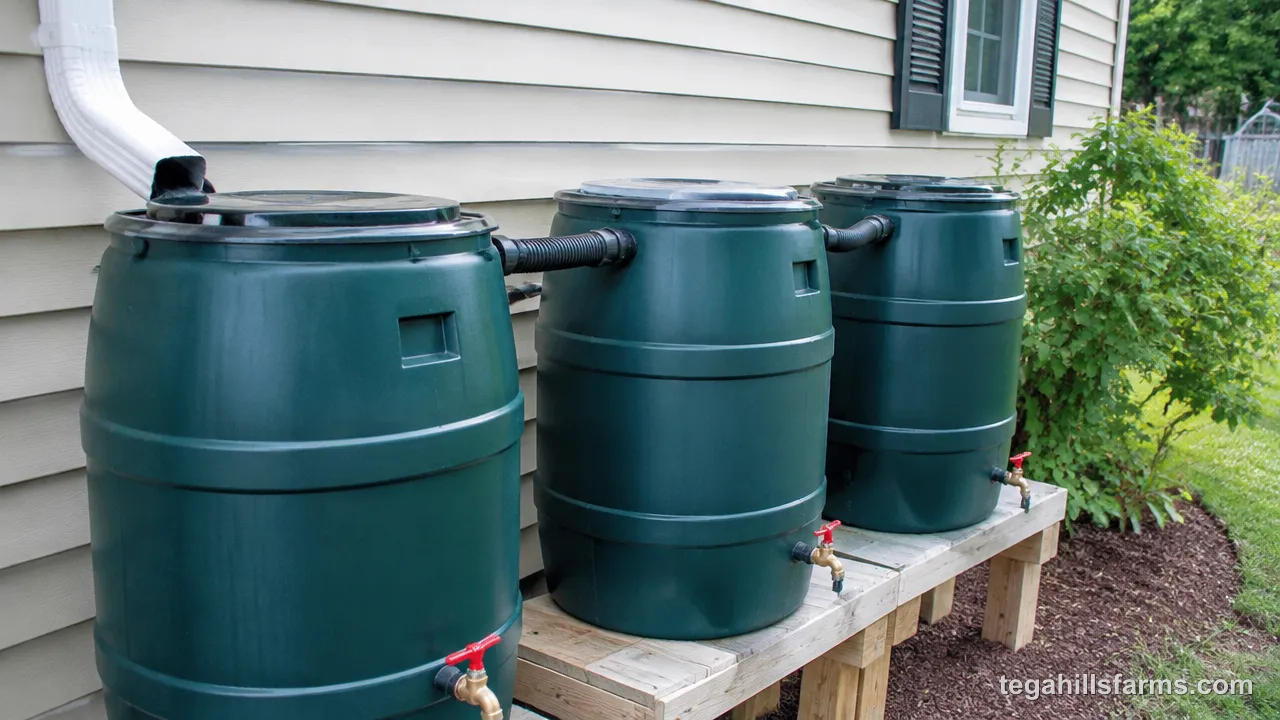
There are two common setups. Overflow-to-inlet chaining fills the barrels one after another. Connecting barrels near the base lets the water level even out across all of them, so any spigot draws from the whole supply. Some barrels ship with linking parts and others need a separate connection kit, so check before you plan the layout.
The last barrel in the chain still needs its own overflow path, routed away from the foundation or toward a bed that can take the extra water. Without one, a linked system just moves the spill to a new spot.
Raising barrels on a level base adds gravity pressure at the spigot, which helps a hose reach beds farther away, and the best stands for rain barrels are built to carry that full weight. If you’d rather keep connections to a minimum, a 100 gallon rain barrel gives you more storage in one footprint.
Are Rain Barrels Legal Where You Live?
Collecting rainwater from your roof is legal in most of the US, but the rules vary widely. Some places offer rebate programs to encourage barrels, while others limit how much you can store or how you can use it, especially in parts of the arid West where water rights are tightly managed.
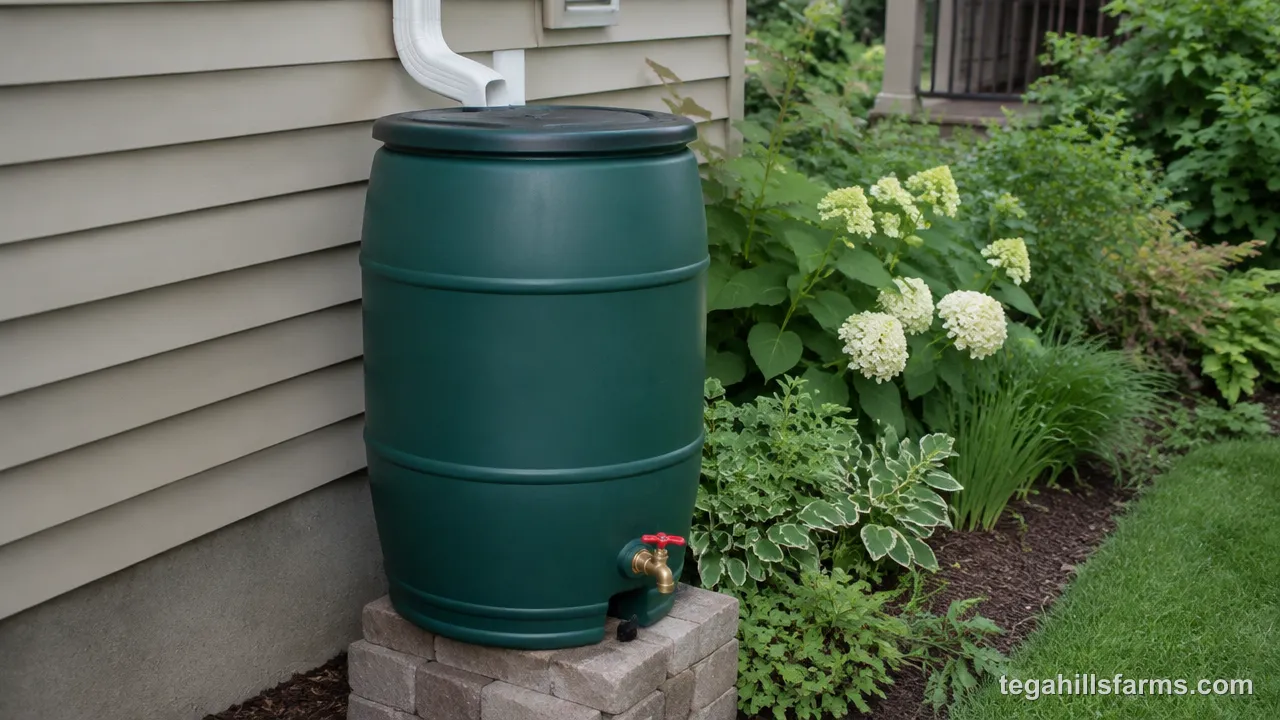
Several layers of rules can apply to the same backyard. Your state water agency sets the broad limits, and your city or county may add rules on placement, overflow drainage or connecting a barrel to household plumbing. Homeowners associations often regulate appearance and location, and a faux-wood or flat-back barrel can make approval easier.
Check with your state agency, your local building or water department and your HOA before installing. Rules change over time, so confirm the current requirements rather than relying on what a neighbor did years ago.
Rain Barrel FAQs
How much water can a roof send to a rain barrel?
Each inch of rain on 1,000 square feet of roof sheds roughly 600 gallons. How much reaches your barrel depends on how much of the roof drains to that particular downspout. That’s why linking barrels or routing the overflow carefully pays off in wet climates, where even a modest storm can top off a barrel.
How long does rainwater keep in a barrel?
There’s no fixed shelf life for garden use. Water in a sealed, opaque barrel stays usable for much of a season if you draw on it regularly. If the water smells sour or shows slime, pour it onto ornamentals or the lawn, then rinse the barrel and start fresh.
Can you use a rain barrel without a gutter?
Yes. Place the barrel under a roof valley or a stretch of drip edge where water already pours off. You can also hang a rain chain to guide water into the inlet, or add a short section of gutter just above the barrel. A wide-topped collapsible barrel can catch rain directly in an open bed.
Where can you find a rain barrel cheaply?
Start with your water utility, county or local conservation district, since many offer rebates or seasonal barrel sales to residents. Garden centers mark down barrels at the end of the season. A food-grade drum fitted with a spigot and screen also works well, as long as it never held chemicals.
Do you need a pump for a rain barrel?
Not for filling watering cans or running a hose to beds below the barrel, because gravity handles that. A pump is worth adding when you want to run a sprinkler, push water uphill or feed a long drip line. The best pumps for rain barrels are sized for exactly those jobs.
More Guides on Best Rain Barrels
- Best Rain Barrels Under $50