

Our top picks for the best telescoping pole saws in 2026 are WEN 4019 Electric Pole Saw 8in (Best Overall), LAANPOLE Telescoping Pole Saw 26ft (Runner Up), AgiiMan 26ft Reach Manual Pole Saw (Best for Heavy Pruning), Karveden 26ft Reach Pole Saw (Also Great), Karveden 18ft Reach Manual Pole Saw (Best Budget), SKGPOLE 26ft Reach Pole Saw (Also Great), TONYINGO 30ft Reach Pole Saw (Also Great), and TONYINGO 26ft Reach Manual Pole Saw (Also Great). The WEN runs a corded motor that does the cutting for you. The manual saws reach far higher and need nothing but a sharp blade and your arms.
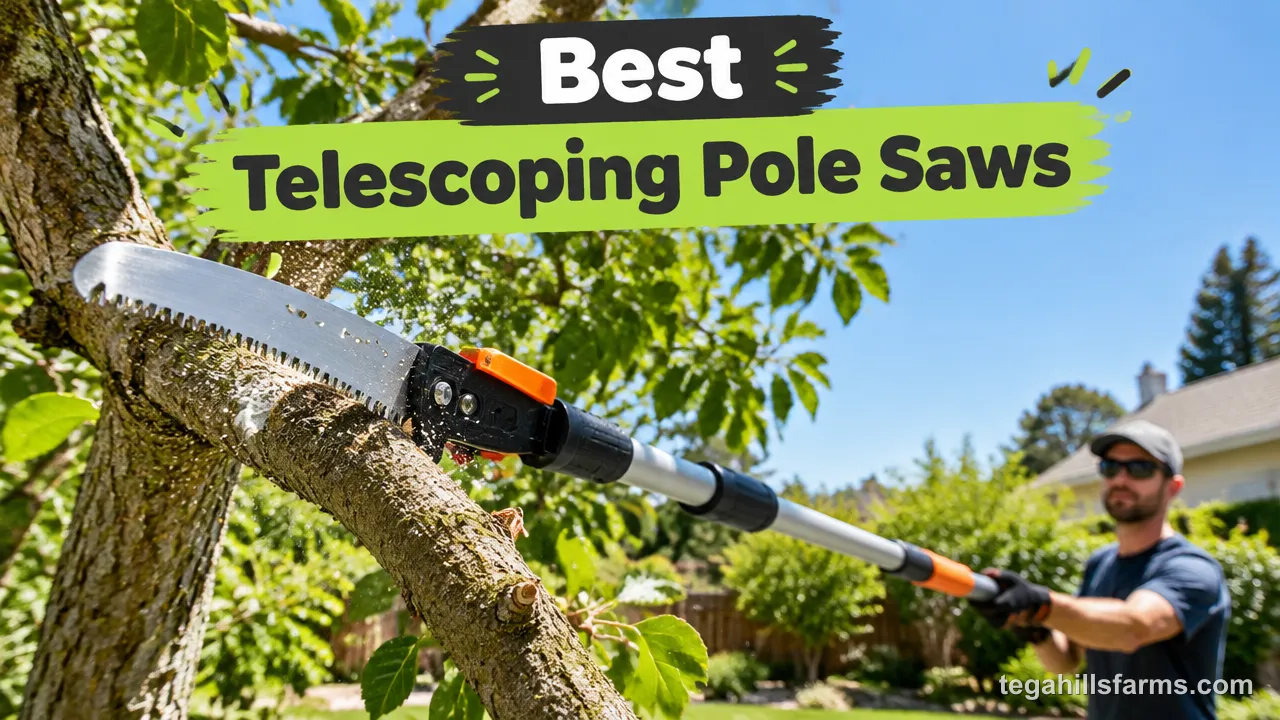
Reach decides whether you can get to the limb at all. The pole lock, the blade design and the weight decide whether the cut goes well once you get there. A lock that creeps under load shortens the pole in the middle of a stroke. A hooked blade stays on the limb instead of skating across the bark. And any weight at the tip feels heavier the farther out it sits.
The real worry with a long pole is a tip that bends and shakes at full extension, or a saw head working loose above your face. Most of the manual saws deal with this by using a screw to fasten the head to the pole. The corded WEN deals with it by staying short and letting the motor pull the chain through the wood.


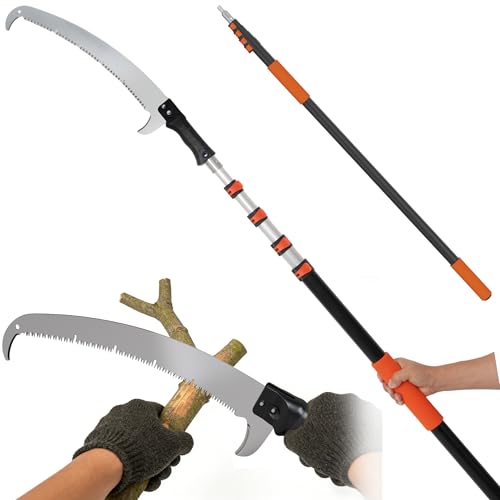
Before you pick a length, stand a few steps back from your highest problem limb and judge how high it really sits. Buying more pole than that only adds wobble and weight, and you’ll fight both on every cut.
What Is a Telescoping Pole Saw?
It’s a pruning saw head on an extendable pole that locks at the length you set, so you can cut high limbs with your feet on the ground. The sliding sections are what set it apart from a fixed-length pole saw. You collapse the pole for low branches and for storage, then extend it section by section when a limb sits higher. With a fixed pole you own one length, and it’s too long for some jobs and too short for others. The same design comes as a manual saw you pull by hand and as a corded electric saw with a motor-driven chain. Which one fits depends on how thick your limbs are and how far the tree stands from an outlet. To compare telescoping models with fixed-length and powered designs, look at the best pole saws across every style.
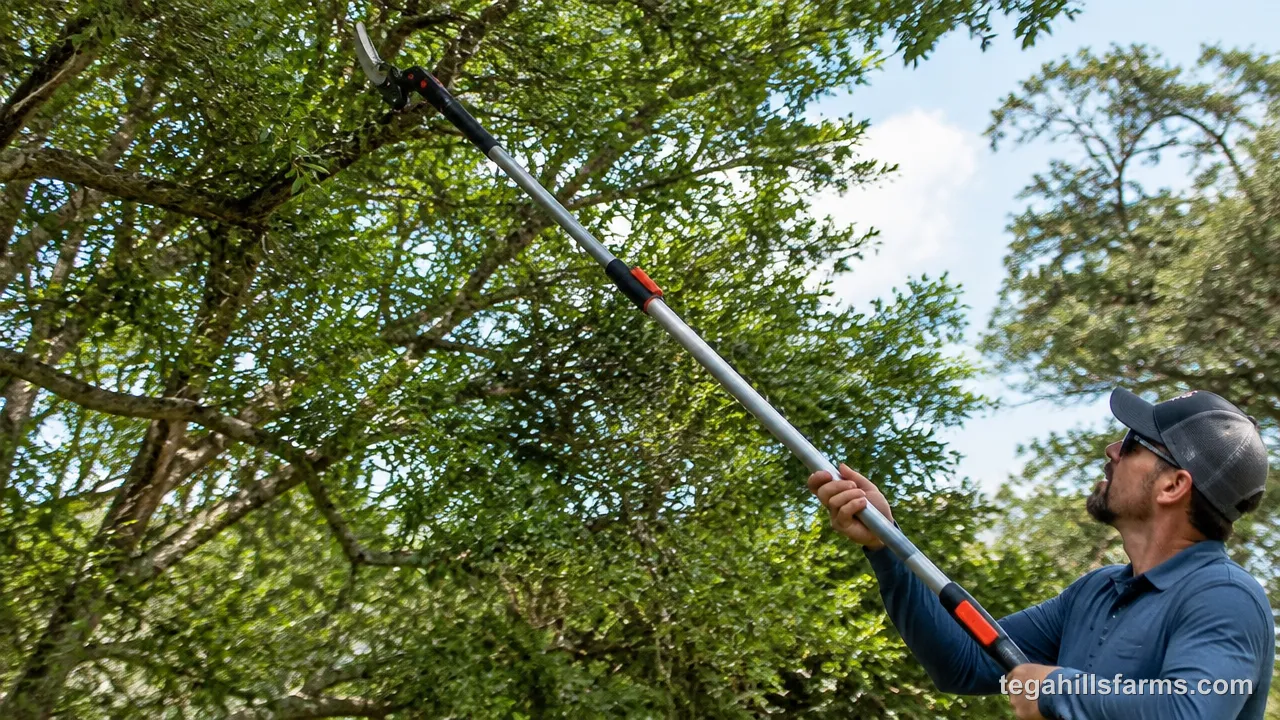
The 8 Best Telescoping Pole Saws of 2026
The telescoping pole saws I’d point you toward are WEN 4019 Electric Pole Saw 8in, LAANPOLE Telescoping Pole Saw 26ft, AgiiMan 26ft Reach Manual Pole Saw, Karveden 26ft Reach Pole Saw, Karveden 18ft Reach Manual Pole Saw, SKGPOLE 26ft Reach Pole Saw, TONYINGO 30ft Reach Pole Saw, and TONYINGO 26ft Reach Manual Pole Saw. The manual saws reach far higher, carry no motor at the tip and need almost no upkeep beyond a clean blade. The corded WEN gives up height for a motor that spares your arms on every cut. That split serves three kinds of buyers: a homeowner with a few tall shade trees, someone keeping fruit trees in shape, and anyone facing thick limbs that need a blade that grips and pulls hard. If shaping live growth is the main job, the best pole saws for pruning focus on that work.
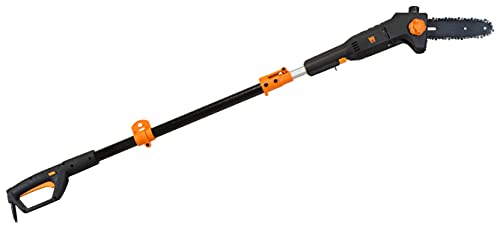
#1 WEN 4019 Electric Pole Saw 8in — Best Overall
If your problem limbs are thick enough to wear you out with a hand saw and sit within reach of an extension cord, this is the saw I’d hand you, because a 6-Amp motor drives the chain at up to 36 ft per second. You guide it; the motor cuts.
Key Specs:
- Motor: 6-Amp corded electric
- Chain speed: up to 36 ft per second
- Saw chain: 8 in
- Pole length: 5.3 to 7.3 ft
- Overhead reach: up to 12 ft
- Weight: 7.2 lb
Detailed Review:
With the motor pulling the chain, the teeth do the work that a manual blade asks of your shoulders. On a thick limb you hold the saw steady while it feeds through, instead of stroking back and forth until your arms give out.
The pole stops at 7.3 feet, so you’re working the lower and middle canopy, not the top of a tall shade tree. The cord sets a second boundary. Every cut happens within extension-cord distance of an outlet, so trees at the back of a large lot may be out of range.
It weighs more than the LAANPOLE Telescoping Pole Saw 26ft, and you feel that difference in your forearms during long overhead sessions. In exchange, the WEN’s motor does the cutting the LAANPOLE leaves to your arms. The included shoulder strap carries part of the load on your torso.
Chain tension adjusts without tools. The saw runs emission-free, so there’s no fuel to mix or store over winter. A blade cover comes in the box, and WEN backs the saw with a two-year warranty.
Pros:
- Motor-driven chain cuts thick limbs with little arm effort.
- Tool-free chain adjustment keeps tension changes quick.
- Shoulder strap shares the weight during overhead work.
- No fuel to mix or store between seasons.
Cons:
- Cord limits you to trees near an outlet.
- Shorter pole cannot reach the upper canopy.
- Weighs more than the LAANPOLE, so arms tire sooner overhead.
Who It’s For:
Homeowners with thick limbs on trees close to the house will lean on its motor, especially if a hand saw has left their shoulders sore after past cleanups. It also fits anyone who wants no fuel in the garage. If your trees stand far from an outlet or your limbs sit high in the canopy, a long manual pole suits the job better.
Editor’s Verdict:
Pick this saw when cutting effort matters more than reach. The motor turns thick limbs into steady, controlled cuts, as long as an outlet is close by.
#2 LAANPOLE Telescoping Pole Saw 26ft — Runner Up
For high limbs you want to reach without fighting a shaky pole, this saw pairs a 5–20 ft aluminum pole with a safety locking joint that keeps the sections from shaking while you cut. The hook blade grabs tangled growth instead of skating.
Key Specs:
- Reach: 26 ft
- Pole: 5–20 ft telescoping aluminum
- Weight: about 4.8 lb
- Blade: carbon steel hook-knife, precision ground and coated
- Grip: insulated, anti-slip
- Head fitting: universal, accepts other saw heads
Detailed Review:
The safety locking joint holds each telescoping section steady. The pole keeps its length under the push and pull of every stroke, so the blade stays in the cut instead of chattering. A reinforcing screw also fastens the saw head to the pole, which stops the head from working loose and dropping toward you.
The carbon steel blade is precision ground and coated against corrosion and wear. Its hook-knife profile catches tangled branches so you can pull them free instead of knocking them around. That hook helps most in a crowded crown, where one limb leans on another and a straight blade would only push the pile around.
At about 4.8 lb, it weighs noticeably less than the WEN 4019 Electric Pole Saw 8in, which makes it easier to hold up through a long pruning session. The cost of that lightness is effort, because every cut comes from your arms instead of a motor.
The insulated anti-slip grip stays secure even in wet conditions. The universal fitting accepts other saw heads, so the same pole can take on more overhead jobs as your needs change.
Pros:
- Locking joint keeps the pole steady at full extension.
- Hook-knife blade pulls tangled branches free.
- Reinforcing screw secures the head against loosening.
- Universal fitting accepts other saw heads.
Cons:
- Hand-powered cutting tires arms on thick limbs.
- Long aluminum pole must stay well clear of power lines.
Who It’s For:
Anyone with tall, crowded trees and limbs of modest thickness will appreciate how steady the locked pole feels overhead. Landscapers and homeowners who plan to add other saw heads later get room to grow. If your limbs are thick enough to make hand sawing a slog, a motor-driven saw will save your arms.
Editor’s Verdict:
Choose it for steady, controlled reach into tall trees. The blade grabs tangled growth, and the head stays fastened where you need it.
#3 AgiiMan 26ft Reach Manual Pole Saw — Best for Heavy Pruning
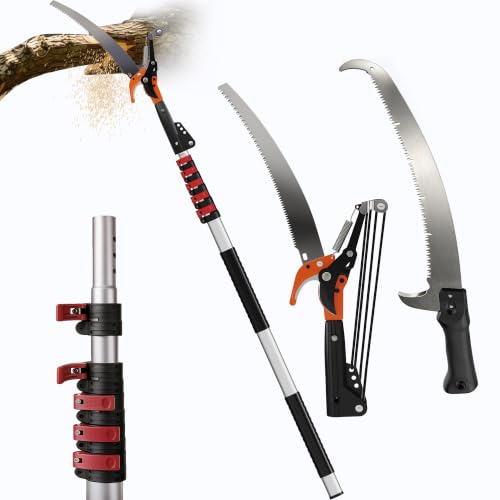
When your trees hold thick, dry limbs and thin suckers in the same crown, this saw covers both with a double-hooked blade and a bypass pruner driven by a 4:1 pulley. Its oval pole resists twisting.
Key Specs:
- Reach: 26 ft
- Pole: 5–20 ft oval telescoping
- Blade: 15 in double-hooked, triple-cut teeth, detachable
- Pruner: bypass, quad pulley
- Locks: quick-lock levers with adjustable tension
Detailed Review:
The quad pulley multiplies your pull on the rope, so the bypass pruner closes on a branch with less force from your hands. You can keep making clean cuts on thin growth long after a plain rope-and-lever pull would have worn your grip down.
For thicker wood, the 15-inch blade uses triple-cut teeth and double hooks that grip the limb and keep it from slipping. That pays on dry, hard branches, where a blade tends to skate. The blade is shorter than the 19-inch blade on the Karveden 26ft Reach Pole Saw, so you give up some stroke length per pull in exchange for the hooks’ hold.
The thick oval pole cuts down twisting and wobble, which keeps the blade on line at full extension. Quick-lock levers set each section. You can fine-tune the locking tension without tools, so the clamps stay snug as they wear.
The blade also detaches for handheld use on lower branches. Rubber grip areas give a non-slip hold through long sessions of overhead work.
Pros:
- Pulley-driven bypass pruner cuts thin branches with little hand force.
- Double-hooked blade holds dry limbs without slipping.
- Oval pole reduces twisting at full extension.
- Lock tension adjusts without tools.
- Blade detaches for handheld work.
Cons:
- Rope and pruner can snag in dense branches.
- Hand sawing still takes real effort on very thick limbs.
Who It’s For:
Owners of orchards, palms or mature yard trees with heavy, dry limbs get a saw that grips hard and a pruner that spares their hands. It suits gardeners who switch between thin shoots and thick wood in the same session. Someone doing only light trimming may find the rope and pruner more gear than the job asks for.
Editor’s Verdict:
For heavy pruning by hand, the pulley pruner and gripping blade make long sessions far less punishing on your hands and forearms.
#4 Karveden 26ft Reach Pole Saw — Also Great
Homeowners who want a single pole for high limbs and a handful of other overhead chores get a 4-stage, 5–20 ft pole with a standard 3/4-inch universal thread. Its long carbon steel blade also detaches for low branches and logs.
Key Specs:
- Reach: 26 ft
- Pole: 4-stage, 5–20 ft, flip-tab locks
- Blade: 19 in carbon steel, 3X sharpened teeth, non-stick coating
- Thread: standard 3/4 in universal
- Warranty: up to 1 year
Detailed Review:
The 19-inch blade gives each pull a long stroke, so more teeth pass through the wood on every pass. The 3X sharpened teeth are carbon steel and rust-resistant. The non-stick coating keeps sap from gumming the blade, which extends its life and keeps cuts smooth in green wood.
Four stages and flip-tab locks let you stop at any length within the pole’s range, so you set it for the branch in front of you instead of the nearest preset. Two blue foam grips give a padded, anti-skid hold. A screw fastens the saw to the pole so the head stays put overhead.
Its blade runs longer than the 15-inch blade on the AgiiMan 26ft Reach Manual Pole Saw, so each stroke removes more wood. The price of that length is a little more room needed to swing the blade in a crowded crown.
The universal thread lets the same pole take a paint roller, a feather duster or a light bulb changer, so it keeps earning its garage space between pruning jobs. Karveden backs it with up to 1 year of warranty service.
Pros:
- Long blade removes more wood per stroke.
- Non-stick coating resists sap buildup.
- Flip-tab locks set any length quickly.
- Universal thread accepts rollers, dusters and bulb changers.
Cons:
- Manual cutting means real effort on thick limbs.
- Long blade is harder to swing in tight crowns.
Who It’s For:
If you’d rather store a pole that also paints high siding or dusts ceiling corners, this saw earns its spot. It suits homeowners trimming tall shade trees with mostly straight saw cuts. Gardeners who need a pruner or a picker head for fruit trees should look at a kit built around those attachments.
Editor’s Verdict:
Buy it if you want a long-blade pruning saw that doubles as a general extension pole for chores around the house.
#5 Karveden 18ft Reach Manual Pole Saw — Best Budget
Smaller yards with ornamental trees and limbs in the low-to-middle canopy are a good match, because the shorter pole keeps the saw closer to your hands, where it’s easier to aim. It’s a budget-friendly way to skip the ladder.
Key Specs:
- Reach: 18 ft
- Pole: 4-stage, up to 12 ft, flip-tab locks
- Blade: 19 in carbon steel, 3X sharpened teeth, non-stick coating
- Thread: standard 3/4 in universal
- Warranty: up to 1 year
Detailed Review:
A shorter pole is easier to control because the blade sits closer to your hands. Small movements at the grip don’t swing the tip as far, and there’s less pole to flex between you and the cut. The Karveden 26ft Reach Pole Saw extends to 20 ft while this one stops at 12 ft, so you give up the upper branches of a tall tree for a pole that feels tighter in the lower canopy.
The blade is the same 19-inch carbon steel design with 3X sharpened teeth and a non-stick coating, so a shorter pole doesn’t mean a smaller saw head. The blade also comes free of the pole for handheld cuts on shrubs and logs.
The two foam grips and the screw that ties the saw to the pole carry over as well. So does the standard universal thread for rollers and dusters.
It stops being enough on a mature tree whose problem limbs sit above what the pole and your arms can cover. At that point you’re back on a ladder, which is exactly what a pole saw is meant to replace.
Pros:
- Shorter pole feels easier to aim and hold steady.
- Same long carbon steel blade as the larger Karveden.
- Blade detaches for shrubs and logs.
- Universal thread fits rollers and dusters.
Cons:
- Limited reach for upper limbs of tall trees.
- Manual cutting tires arms on thick branches.
Who It’s For:
Small-lot owners with young fruit trees, ornamentals or hedges get a saw that stays manageable in their hands. It’s also a sensible starter saw for a first-time homeowner who rarely prunes above the lower canopy. If your shade trees have grown tall, the Karveden 26ft Reach Pole Saw covers the higher limbs this pole can’t.
Editor’s Verdict:
A shorter pole and a full-size blade make this an easy-to-control, budget-friendly saw for low and mid-height limbs.
#6 SKGPOLE 26ft Reach Pole Saw — Also Great
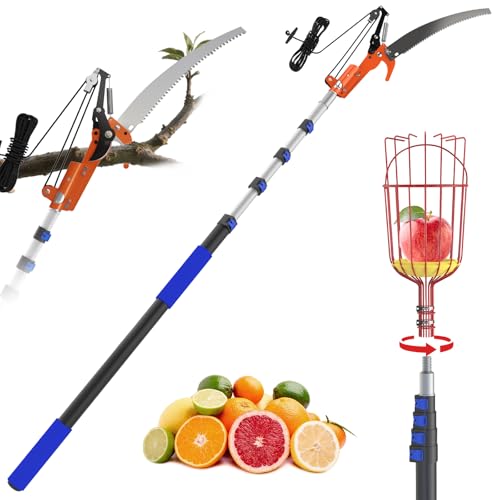
Fruit tree owners get a pruning kit and a harvest tool on the same pole. The 2-in-1 head pairs a carbon steel saw blade with scissors for thin shoots, and a fruit picker basket with a thick foam pad catches apples, pears and avocados without bruising them.
Key Specs:
- Reach: 26 ft
- Pole: 5–20 ft aluminum, four flap locks, two foam handles
- Head: 2-in-1, 13.8 in carbon steel blade plus scissors
- Fruit picker: 5.5 in metal basket with foam pad
- Thread: 3/4 in universal
Detailed Review:
You switch between the saw-and-scissor head and the fruit picker with a twist on the universal thread, so the same pole handles pruning one weekend and picking the next. The basket’s thick elastic foam pad gives fruit a soft landing, which keeps scratched and bruised fruit out of your bowl.
The scissors handle thin shoots and twigs, and the saw takes the thicker limbs. The sharpened carbon steel teeth deliver real cutting power, and a non-stick coating keeps cuts smooth.
The 13.8-inch blade is shorter than the 17-inch blade on the TONYINGO 26ft Reach Manual Pole Saw, so each stroke removes less wood. In return, a compact head is easier to work between fruiting branches without knocking fruit loose.
The pole is aluminum, with four flap locks for setting length and two non-slip foam handles for a secure grip. Assembly follows an easy-to-read manual, and SKGPOLE lists the kit for both residential and commercial gardening and landscaping.
Pros:
- Fruit picker basket cushions fruit with a foam pad.
- Scissors handle thin shoots without switching heads.
- Universal thread makes swapping attachments quick.
- Four flap locks adjust length easily.
Cons:
- Compact blade needs more strokes on thick limbs.
- More attachments mean more parts to store.
Who It’s For:
Backyard orchard keepers who prune and harvest the same trees will use every piece of this kit. Gardeners with citrus, mango or avocado trees can pick fruit from the ground instead of climbing. If your work is mostly heavy limbs on shade trees, a saw with a longer blade suits the cutting better.
Editor’s Verdict:
Get this kit if your trees bear fruit. The same pole that shapes them also brings the crop down without bruises.
#7 TONYINGO 30ft Reach Pole Saw — Also Great
Owners of tall pines, palms or shade trees get the extra height they need from a 4-stage telescoping pole built for the upper crown. The blade detaches for handheld work too.
Key Specs:
- Reach: 30 ft
- Pole: 4-stage, 5–24 ft, flip-tab lock
- Blade: 17 in carbon steel, 3X sharpened teeth, non-stick coating
- Grip: anti-slip handle
- Head mount: reinforcement screw
- Thread: fits standard thread tools
Detailed Review:
Its pole runs to 24 ft, against 20 ft on the TONYINGO 26ft Reach Manual Pole Saw, so the blade gets into the upper crown of a tall tree without a ladder. That height has a cost at full extension. A longer lever magnifies the blade’s weight and every wobble at the tip, so cuts call for a slower, more deliberate stroke.
The pole behaves better when you use only as much length as the branch needs. The flip-tab lock sets each stage, so you can stop short of full extension for mid-height limbs and save the full length for the high ones.
The 17-inch carbon steel blade has 3X sharpened teeth and a non-stick coating that keeps sap from dragging the stroke. It’s also rust-resistant, which matters for a saw stored in a damp shed. An anti-slip handle and an extra reinforcement screw keep your grip and the saw head secure when the blade is far overhead.
Beyond pruning, the pole fits standard thread tools such as a paint roller or duster. The blade comes free of the pole for lower branches, brush and logs.
Pros:
- Pole extends far enough for upper crowns of tall trees.
- Reinforcement screw keeps the head fastened overhead.
- Non-stick blade coating keeps strokes smooth.
- Detachable blade handles brush and logs by hand.
Cons:
- Full extension magnifies wobble and arm strain.
- Extra length is more than small trees need.
Who It’s For:
Tall trees near the house, like pines, palms and mature oaks, make the case for this saw, especially if your other options are hiring help or climbing a ladder. It suits a patient cutter who takes slow strokes at height. For ornamentals and young fruit trees, the extra pole mostly adds sway you don’t need.
Editor’s Verdict:
Reach for this saw when height is the problem. Its long pole gets a blade into the upper crown, provided you cut with patience.
#8 TONYINGO 26ft Reach Manual Pole Saw — Also Great
Yards with medium-height shade and fruit trees suit this TONYINGO better, since its 5–20 ft pole gives plenty of reach with less sway at the tip. The blade doubles as a hand saw.
Key Specs:
- Reach: 26 ft
- Pole: 4-stage, 5–20 ft, flip-tab lock
- Blade: 17 in carbon steel, 3X sharpened teeth, non-stick coating
- Grip: anti-slip handle
- Head mount: reinforcement screw
- Thread: fits standard thread tools
Detailed Review:
The TONYINGO 30ft Reach Pole Saw telescopes to 24 ft, and this pole stops at 20 ft. That shorter maximum is the reason to choose it for trees of ordinary height. Less pole at full extension means less leverage working against your wrists and a tip that holds its line, so each stroke goes where you aim it.
The saw head matches its sibling: a 17-inch carbon steel blade with 3X sharpened teeth and a non-stick coating, an anti-slip handle, and a reinforcement screw that holds the head to the pole. Because the head is identical, the choice between the two comes down to how tall your trees actually are.
A flip-tab lock sets each of the four stages. You can run the pole short for mid-height work and extend it only when a limb calls for it.
As a 2-in-1 tool, the blade works as a handheld saw for low branches, brush and logs, so you don’t need to drag the full pole out of the garage for small jobs. The pole also fits standard thread tools such as a paint roller or duster.
Pros:
- Shorter maximum length keeps the tip steadier.
- Reinforcement screw holds the saw head secure.
- Blade doubles as a handheld saw for brush.
- Pole fits standard thread tools like rollers.
Cons:
- Less reach than its longer TONYINGO sibling.
- Hand-powered cuts take effort on thick limbs.
Who It’s For:
Suburban homeowners with medium-height trees get TONYINGO’s blade and safety screw without carrying extra pole they’d rarely extend. It also suits anyone who wants the same pole for pruning and for painting or dusting high spots. If your problem limbs tower over the roofline, the TONYINGO 30ft Reach Pole Saw reaches higher.
Editor’s Verdict:
Expect a practical, everyday pole saw that stays steady at ordinary yard-tree heights, with a blade that pulls double duty by hand.
What Should You Look for in a Telescoping Pole Saw?
What matters is how steady and controllable the saw stays at full height, more than the biggest reach figure printed on the box. On a high cut the blade is far from your hands. Any slack in the pole, any slip of the teeth or any extra weight at the tip turns into wobble, a ragged cut or sore shoulders. Small flaws get amplified at the far end of the pole, and that is also where you have the least control over a falling limb.
How Long a Pole Do You Need for Your Branches?
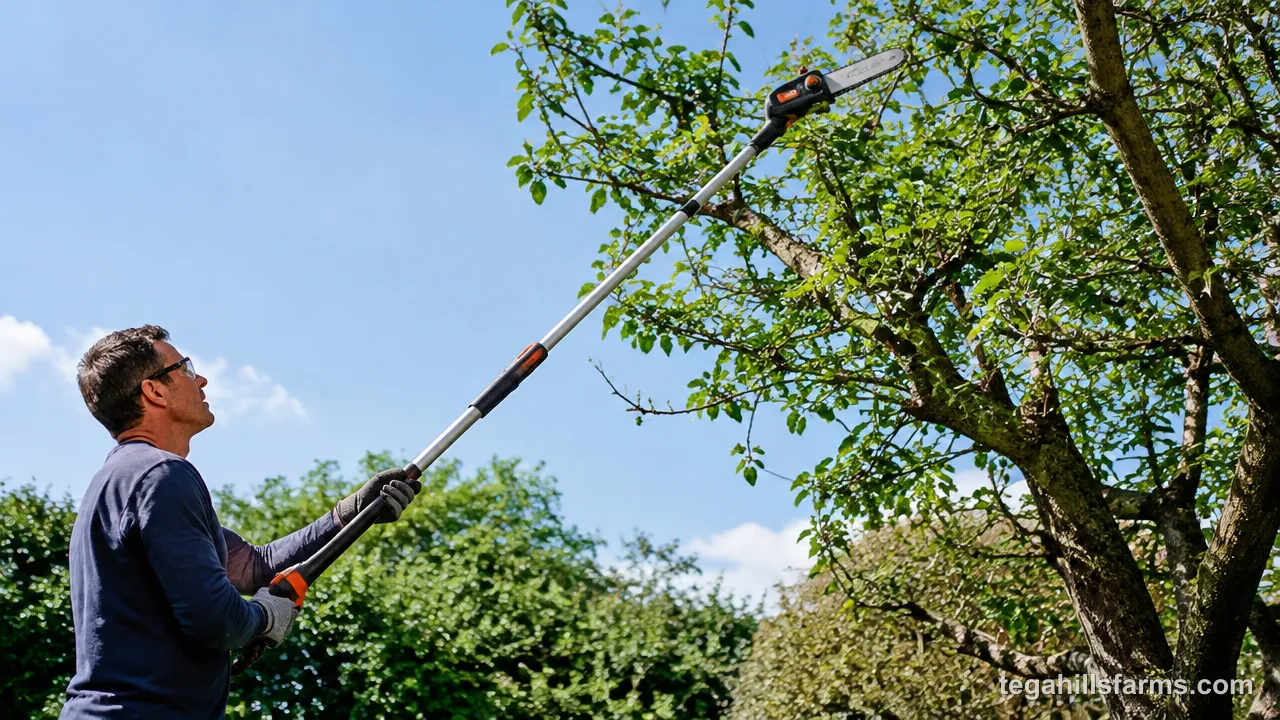
Buy enough pole to put the blade just above the limb while you stand back from it at a comfortable angle, and no more. The reach number on the box is not the pole length. It adds your height and raised arms to the extended pole, so the height you actually cut at depends on how tall you are and where you stand.
You’ll stand outside the drop zone and angle the pole, so a branch at a given height needs more pole than straight-up math suggests. Judge your problem limbs from a spot a few steps away, not from directly underneath.
A pole longer than the job needs costs you control. The tip flexes more and the blade’s weight sits farther from your hands, so cuts get slower and less accurate. For limbs that really do sit high in the crown, the best pole saws for tall branches are built around that kind of reach.
Why Do Some Telescoping Poles Wobble or Slip?
A pole slips when its lock doesn’t clamp the sections tightly enough to hold against the push of each stroke. It wobbles because every extended section adds a joint and more length that can flex. Flip-tab locks, lever locks and clamp collars all squeeze one tube around the next. When that grip loosens from wear, dirt or a worn tab, the pole can shorten mid-cut and pull the blade out of the kerf.
At full extension the pole becomes a long lever. A small sway at your hands turns into a wide swing at the tip, and the blade bounces instead of biting.
Pole shape changes how much it twists. An oval tube can’t rotate inside the lock as easily as a round one, which keeps the teeth square to the cut. Locks with adjustable tension let you tighten the clamp as parts wear, so a lock that grips firmly when new still grips years later.
Which Blade Design Cuts Better on High Branches?
On a manual pole saw, a curved blade with hooked tips and aggressive teeth works best overhead. The curve and hooks keep the blade pressed into the limb on the pull stroke instead of sliding along the bark.
Hooks matter more as wood gets drier. Green wood is soft and grabs the teeth on its own, while dry, hard limbs let a blade skate, and that is where hooked tips help most. Triple-cut teeth have three sharpened faces per tooth. They slice fibers faster and leave a cleaner cut than a single bevel.
Carbon steel holds a sharp edge. With a rust-resistant or non-stick coating it also sheds sap, which would otherwise gum the teeth and drag every stroke.
On a powered pole saw, bar length sets the limit. The bar should be longer than the branch is thick so the chain can pass through in one cut. Otherwise you have to work from both sides of the limb at height.
Does Pole Weight and Material Matter?
Yes. Weight at the tip of a long pole multiplies the strain on your arms, so a light head on a light pole lets you keep cutting long after a heavy setup would have worn you down. The pole’s material also decides how risky it is near power lines.
A pound at the end of a fully extended pole feels far heavier than a pound in your hand. The pole works as a long lever against your grip and shoulders, and aiming upward adds to the strain. If fatigue is your main concern, the best lightweight pole saws keep that load down.
Aluminum poles are light and stiff, but they conduct electricity. Fiberglass poles don’t conduct when clean and dry. Neither makes it safe to work near power lines, so keep the pole, the blade and the branch at least 10 feet from overhead lines, and call your utility about limbs touching wires.
An insulated grip improves your hold in wet conditions, but it doesn’t make an aluminum pole safe near lines. Check whether a grip is rated dielectric before you treat it as protection.
Is a Manual or Electric Telescoping Pole Saw Better?
Hand-powered saws win on reach, quiet and near-zero upkeep, while a corded saw wins on cutting speed and arm effort, so limb thickness and outlet distance decide which one fits you. Side by side, the two designs differ like this:
| Factor | Manual | Corded electric |
|---|---|---|
| Effort | Every cut comes from your arms and shoulders | Motor drives the chain; you guide and support the saw |
| Cutting speed | Slower, especially on thick or dry wood | Faster through thick limbs |
| Upkeep | Clean and sharpen the blade, keep locks clean | Chain tension, chain sharpening, bar and chain oil |
| Reach | Longer poles available | Shorter poles, since the motor adds weight at the tip |
| Range | Anywhere on the property | Limited by extension cord distance |
| Noise | Near silent | Motor noise, though quieter than gas |
Hand sawing is enough for thin to moderate branches on a few trees. The job is a short list of cuts, and a sharp blade gets through them without much strain. A motor is worth the cord and the extra weight when you face thick limbs, a lot of storm cleanup, or shoulders that don’t tolerate long overhead sawing.
I’d pick hand power for occasional pruning and a corded saw for anyone clearing heavy limbs near the house. If the cord is the sticking point, the best battery pole saws give you motor-driven cutting anywhere on the lot. For more plug-in options, the best corded pole saws go deeper.
Which Telescoping Pole Saw Should You Choose for Your Yard?
Start with limb thickness and outlet access. Thick limbs on trees near the house point to a motor, and every other situation comes down to matching a manual pole to your trees.
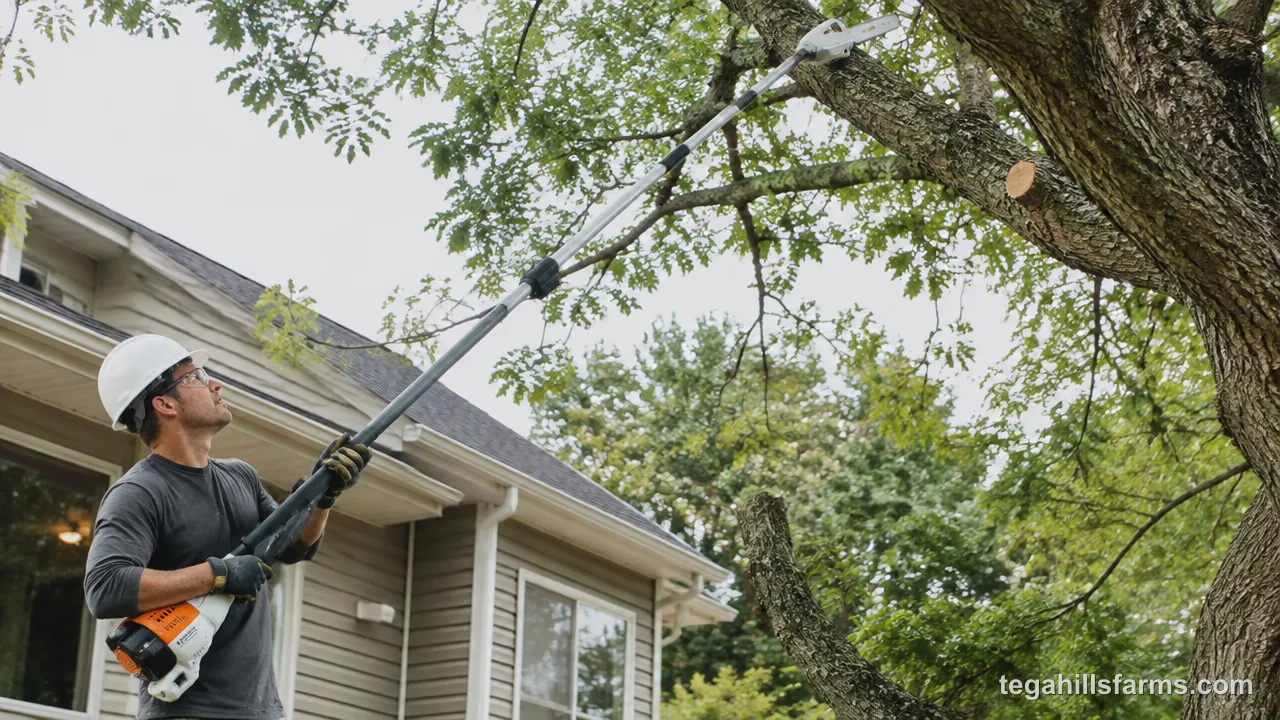
- A few tall backyard trees: the TONYINGO 30ft Reach Pole Saw gets into high crowns, and the LAANPOLE Telescoping Pole Saw 26ft gives up some height for a locking joint that holds the pole steady.
- Fruit trees: the SKGPOLE 26ft Reach Pole Saw adds scissors for thin shoots and a cushioned picker basket for harvest. The best pole saws for orchard care go further into that kind of work.
- Thick limbs: the WEN 4019 Electric Pole Saw 8in lets the motor do the cutting when an outlet is close. For trees out of cord range, the AgiiMan 26ft Reach Manual Pole Saw’s pulley pruner and hooked blade reduce the effort by hand.
- Smaller trees and tight storage: the Karveden 18ft Reach Manual Pole Saw keeps the pole short and the cost low. Before buying any pole, check its collapsed length against your shed or garage wall.
- Minimal upkeep: any manual model needs only a clean, sharp blade and clean locks, with no chain oil, cord or motor to look after. The Karveden 26ft Reach Pole Saw and the TONYINGO 26ft Reach Manual Pole Saw fit well if you also want the pole for painting or dusting.
If you need one general-purpose saw for a typical home lot, the best pole saws for homeowners cover every power type.
A lot of high growth, from water sprouts to fresh shoots on fruit trees, is thin enough that a saw blade is more tool than the job needs. Pulling a toothed blade back and forth through a pencil-thin shoot shakes the branch, tears the bark and adds weight to every reach, and across a whole tree that wasted effort turns a quick trim into a sore-shouldered afternoon.
When Is a Pole Pruner Better Than a Pole Saw?
Thin live branches, suckers and vines cut faster and cleaner with a bypass head. It closes like a pair of shears and severs the stem in one squeeze instead of a series of strokes.
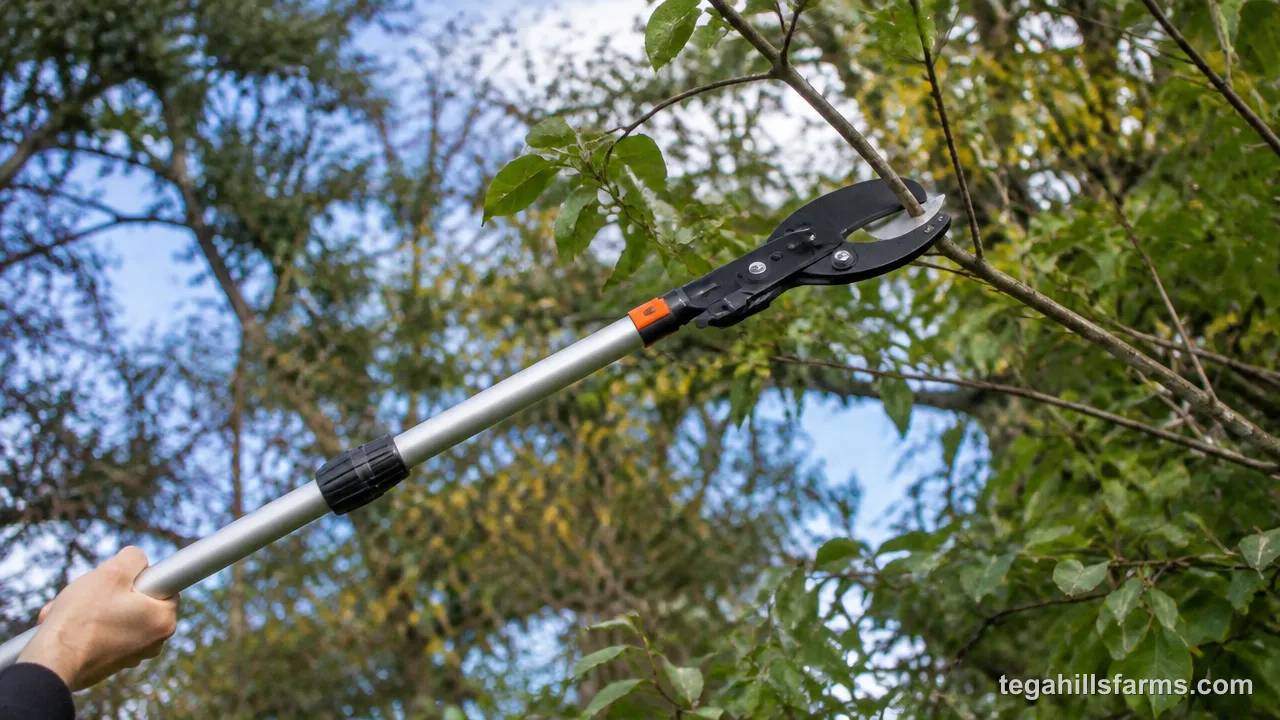
A bypass head only cuts what fits between its jaws, so a saw head takes over on thicker limbs. On thin growth, though, a saw is overkill. The teeth shake the branch, a springy shoot bends away from the blade, and the extra blade weight at the tip tires you for no gain.
Cut quality matters on live trees. The bypass action leaves a smooth surface the tree closes over cleanly. Saw teeth on thin wood can leave a ragged, torn edge that invites decay.
If your yard has both thin shoots and thick limbs, a 2-in-1 head that pairs a bypass pruner with a saw handles both without a head swap.
How Do You Cut High Branches Safely From the Ground?
Stand to the side of the limb, outside the spot where it will land, and take it down in stages starting with an undercut. That way the weight never pinches the blade or peels bark down the trunk.
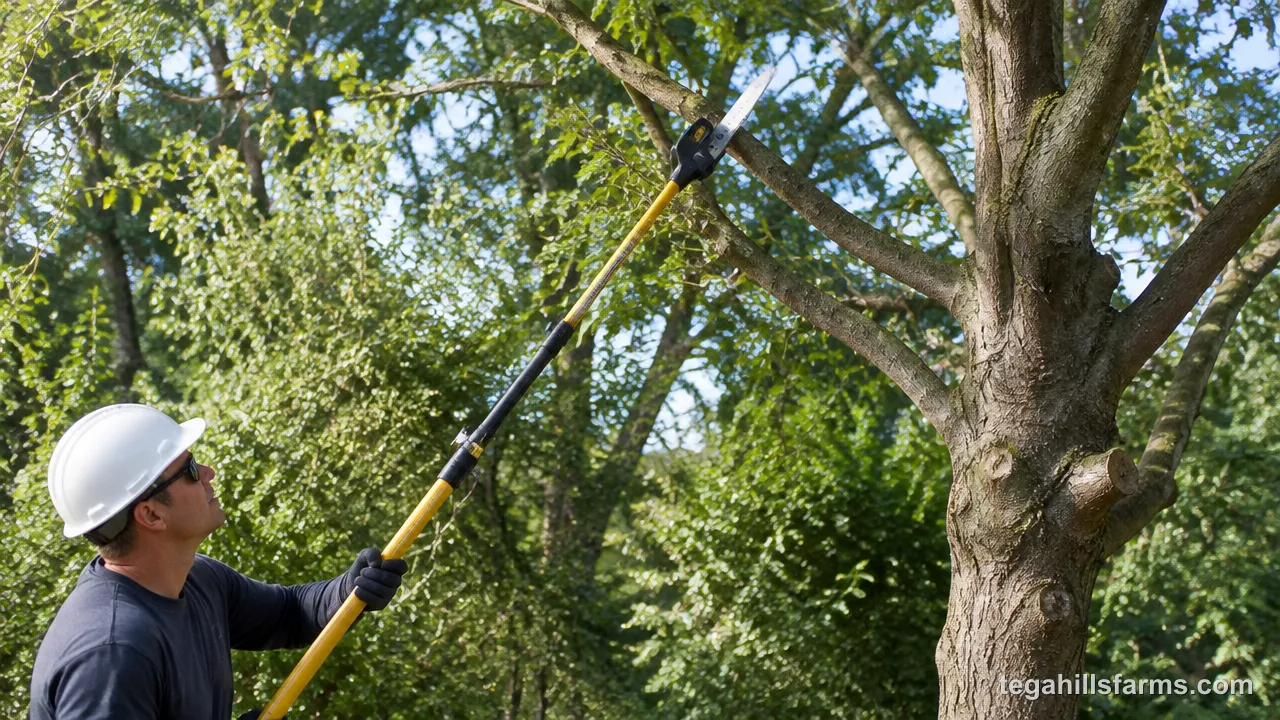
The drop zone is directly under the branch and slightly beyond it, and a cut limb can swing or bounce as it falls. Keep the pole at an angle you can control, roughly in front of you instead of straight overhead, so you can step back as the branch gives way.
For a heavy limb, make a shallow undercut on the underside a short distance out from your final cut. Then saw down from the top just beyond it, and the limb breaks between the two cuts without tearing. Once the weight is gone, finish with a clean cut just outside the branch collar.
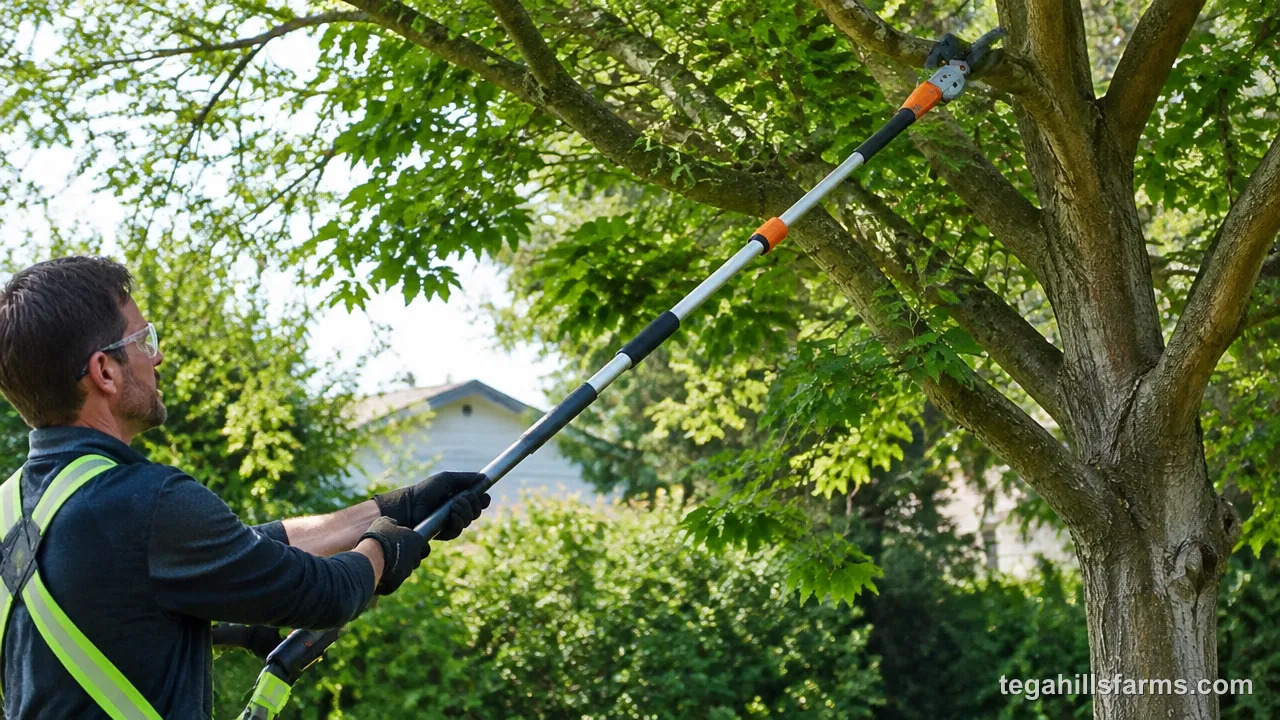
Sawdust and twigs fall toward you on every pull, so wear safety glasses and a hard hat. A face full of debris can make you flinch with a blade overhead. Gloves improve your grip on the pole, and a clear escape path keeps you from tripping as the limb comes down.
How Do You Maintain and Store a Telescoping Pole Saw?
After each session, wipe sap and sawdust from the blade, check the teeth for dull or bent points, and clean the telescoping sections. Then collapse the pole and hang it somewhere dry.
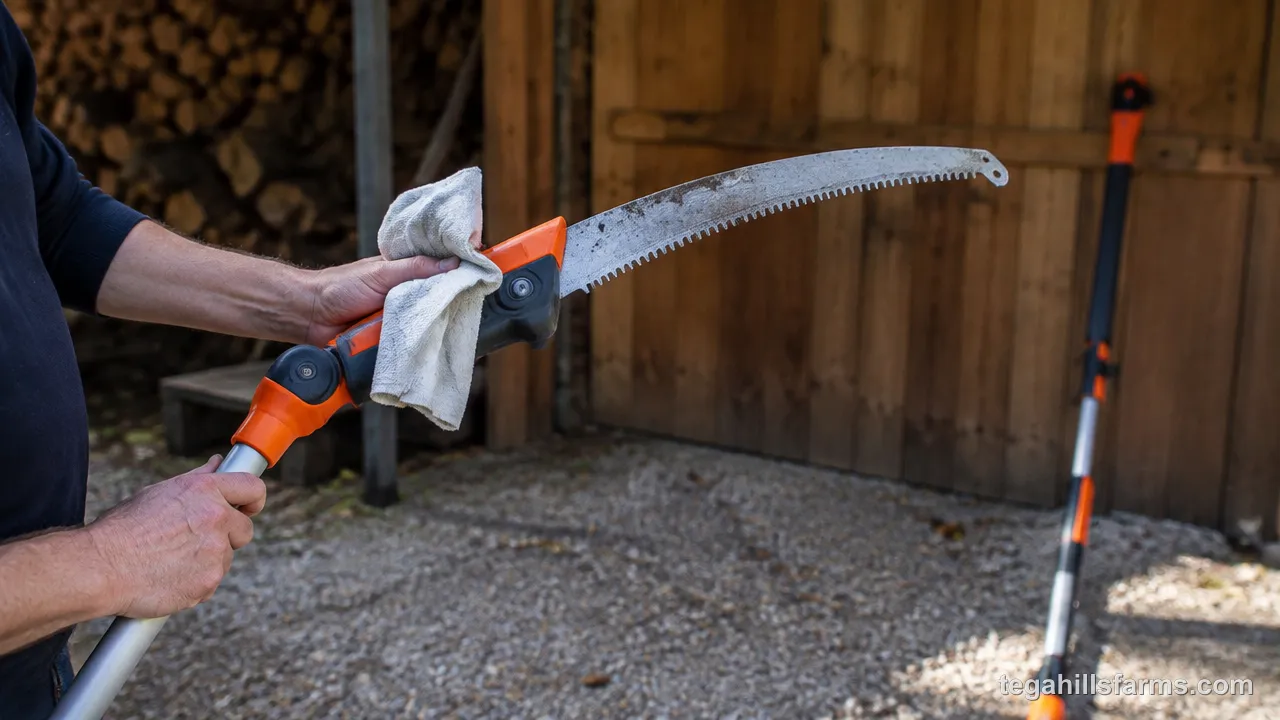
Sap hardens into a sticky film that drags every stroke. A rag with a little mineral spirits or blade cleaner keeps the blade cutting freely and stops rust from forming under the residue. Dull teeth crush fibers instead of slicing them. A file restores some blades, but blades with hardened teeth are meant to be replaced.
Grit inside the sections wears the locks and lets them slip. Wipe each section and add a light film of dry lubricant or silicone spray, not grease, which collects dirt. Store the pole collapsed, dry and out of direct sun so the locks and grips last.
Replace the blade when it binds, wanders or leaves rough cuts after cleaning. Replace a lock when it slips at normal tension. A corded saw’s chain needs more care: keep it sharp, check the tension before each use, keep the bar and chain lubricated as the manual directs, and inspect the cord for cuts before you plug in.
Can You Swap Blades or Heads on a Telescoping Pole?
Yes, as long as the pole and the head share the same thread. A universal threaded tip lets one extension pole take a saw, a bypass pruner, a fruit picker, a paint roller or a duster, so you buy the pole once and add heads as jobs come up.
The common standard is the 3/4-inch thread used on paint-roller extension poles, but a “universal” label doesn’t guarantee a fit across brands. Before you buy a replacement head, check the thread size and type, how far the threads engage, and whether the head has a locking screw or collar.
A mismatched thread may spin on but never seat fully, which leaves the head loose. Overhead, a loose head can rotate mid-cut, throw the blade sideways or drop toward you. If a head still wobbles after you tighten it, don’t use it.
Telescoping Pole Saw FAQ
Can I use a telescoping pole saw as a handheld saw?
Yes, on many manual models. The blade comes free of the pole and works as a pruning saw for low branches, shrubs and logs. The AgiiMan, Karveden and TONYINGO saws all support handheld use. A corded electric pole saw is a different tool, so use one only the way its manual allows.
How thick a branch can a manual telescoping pole saw cut?
It depends more on blade length and your stamina than on the pole. A branch should be comfortably narrower than the blade so the teeth have room to stroke and clear sawdust, and a thick, dry limb takes many tiring strokes overhead. When a limb leaves little blade to spare, a corded saw or an arborist is the safer route.



Write Your Review
No reviews yet. Be the first to share your experience!