

Our top picks for the best pole saws for homeowners in 2026 are BlumeTrec 14.5ft Pole Saw (Best Overall), BlumeTrec 8.5ft Pole Saw (Best Budget), VEVOR Manual Pole Saw 7.3-27ft (Editor’s Choice), Greenworks 40V 8in Pole Saw (Best Ergonomic Design), EGO Power+ Pole Saw PS1001 (Also Great), EGO Power+ Pole Saw PS1000 (Also Great), Likeem Manual Pole Pruner 27ft (Also Great) and Greenworks 80V 10in Cordless Pole Saw (Also Great). Half of them cut on arm power alone and half run on a battery, so the first decision is whether your limbs call for a motor at all.
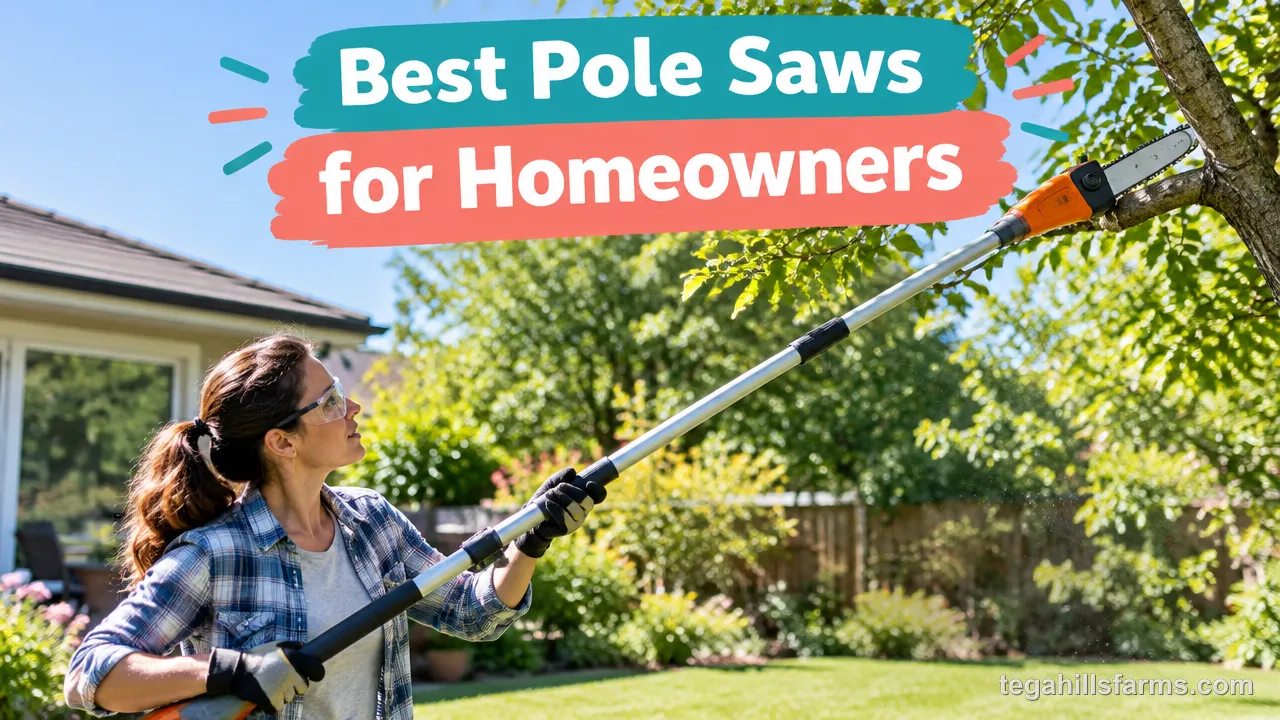
Four things separate these saws in a home yard: how high they reach while you stand on the ground, how thick a limb they cut before the blade binds, how much weight your shoulders carry overhead and, on cordless models, which battery they run on. The long manual poles reach high limbs with no upkeep beyond the blade, while the battery saws cut thicker wood with far less arm work.
The real risk in a home yard is buying the wrong amount of tool. That might be a long, heavy pole that sways above a small maple, or a battery saw whose pack goes flat in the garage between pruning seasons. Limbs near power lines or over the roof bring a second problem, because a long reach makes them look easier than they are.


Check your battery shelf before anything else. If EGO 56V or Greenworks 80V packs are already there, a bare tool on that platform saves you storing and charging a second pack and charger.
Which Type of Pole Saw Fits a Homeowner Yard?
For most home lots, the sensible choice is a manual model for occasional light limbs or a battery model for regular pruning, since neither brings the extension cord or fuel mixing that corded and gas units demand.
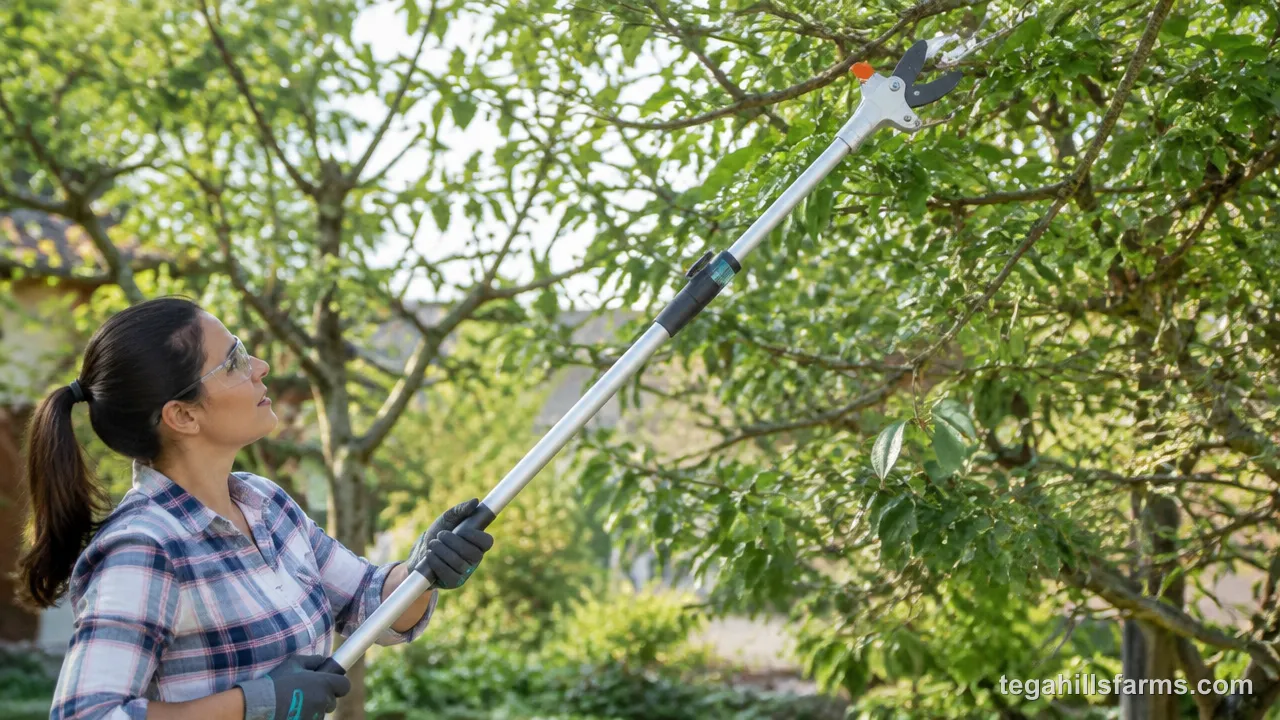
Each power source asks something different of you before, during and after the cut:
| Power type | Cutting effort | What you manage | Noise | Routine upkeep | Storage |
|---|---|---|---|---|---|
| Manual | Arm strokes do all the work | Nothing beyond the tool | Near silent | Blade teeth, rust, joint screws | Comes apart or collapses |
| Battery | Motor does the cutting | Charging and a pack to store | Quiet | Bar oil, chain tension, sharpening | Pack kept indoors off-season |
| Corded | Motor does the cutting | Extension cord and an outlet | Quiet | Bar oil, chain tension, sharpening | Saw plus cord |
| Gas | Engine does the cutting | Mixed fuel and a pull start | Loud | Spark plug, air filter, carburetor | Fuel drained before storage |
A manual saw suits a homeowner who trims some limbs and shrubs each season. There’s nothing to charge, fuel or oil, but every cut comes from your arms, so thick limbs and long sessions wear you down. A battery saw makes sense once limb work is regular, because the motor does the cutting. In exchange you hold a heavier head and keep a pack charged. Corded saws cut the same way without a pack, but the extension cord drags through beds and catches on shrubs, so they only work well for trees close to an outlet. If yours are, the best corded pole saws are worth a look. Gas saws handle acreage and heavy limbs, but fuel mixing, cold starts and carburetor upkeep are a lot to take on when you only prune a few weekends a year.
I’d steer most homeowners to a manual or battery saw, which is why all 8 picks are one or the other. A manual saw keeps upkeep near zero, and a battery saw keeps effort low without a cord or a fuel can. If you’ve already settled on cordless, the best battery pole saws cover that side in more depth.
To compare every power type side by side, gas and corded included, start with the best pole saws.
What Should You Look for in a Pole Saw?
A tool only earns its place in a home yard if it reaches the limb from the ground, cuts through it without binding and stays light enough to hold overhead for a whole session. On cordless models, the battery matters just as much, because it decides what else you have to buy and how long you can work before a recharge. Any of these mistakes shows up fast. A short saw sends you back up a ladder, an underpowered one stalls in green wood, and a heavy one gets set down after a handful of cuts.
How Much Reach Do You Actually Need?
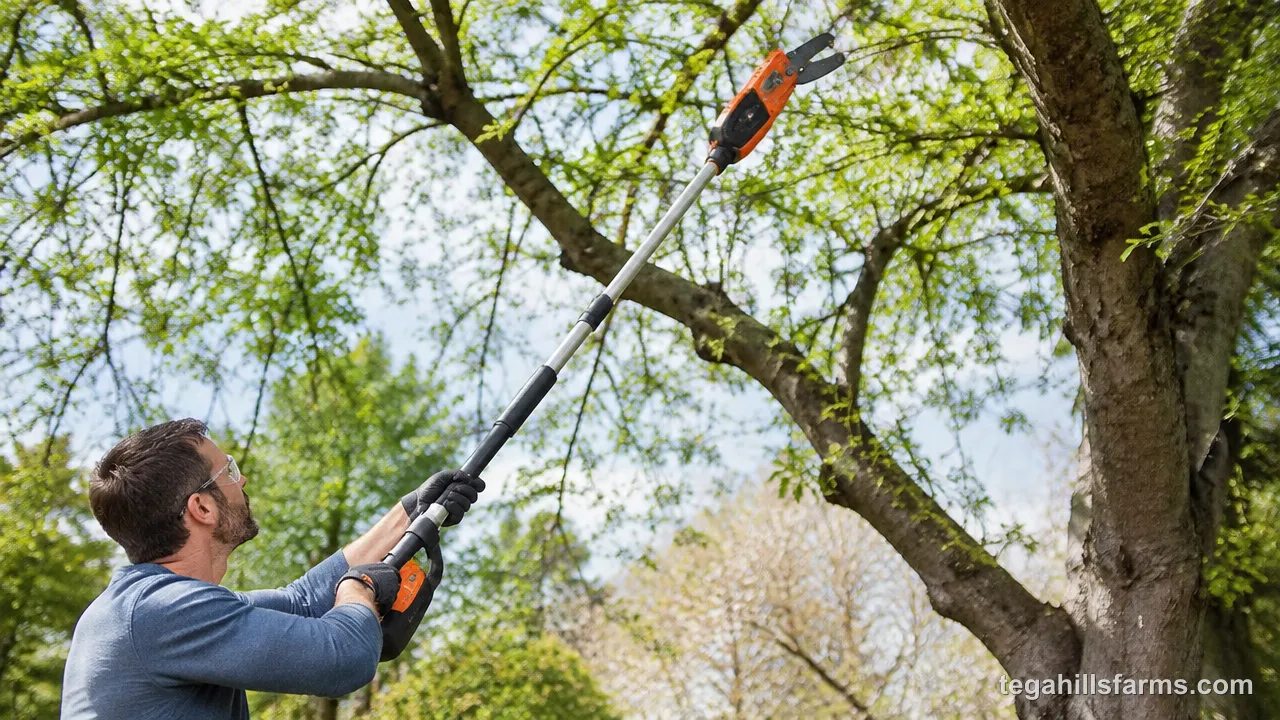
A saw’s listed reach and the height its head actually reaches can be two different numbers, because usable reach is the shaft length plus your own height and raised arms. Some makers quote that combined total and others quote the pole alone, so compare like with like before deciding a saw is long enough.
Design changes how you get to that length. Modular saws build the pole from sections you add or remove, which keeps each joint solid but means stopping to change length. Telescoping shafts slide and lock, so you can adjust between cuts. An extension pole adds height to a powered saw only on the days you need it.
The farther the head sits from your hands, the more its weight acts on a long lever. The tip also sways more, and it gets harder to set the blade exactly where you want it. That’s why a saw that reaches the limb with a little to spare cuts cleaner than one at full stretch. When most of your work sits high in mature trees, the best pole saws for tall branches are built around that kind of reach.
How Thick a Branch Can a Pole Saw Cut?
On a powered saw the bar length sets the limit; on a manual saw it’s the blade length and tooth pattern. Treat a limb nearly as wide as the bar as the practical ceiling, not a target.
A powered chain moves continuously, so steady pressure carries it through a thick limb quickly. A hand blade cuts only on the strokes you make, each one with your arms raised, so the effort grows with every bit of extra diameter. That’s why manual saws suit thin limbs, suckers and light shaping, and regular work on thicker wood belongs to a motor.
When a limb is too big for the tool, the blade pinches as the branch sags onto it. Each stroke pulls out little sawdust, and your arms give out before the cut is halfway through. A half-finished cut on a heavy limb can also tear loose and strip bark down the trunk, which leaves a worse wound than the one you meant to make.
How Much Weight Can You Hold Overhead?
Every pound at the head of a pole saw feels heavier than it would on a tool held at waist height, because the shaft acts as a lever. Your shoulders and wrists carry that load from the far end. A saw that feels fine in your hands at ground level can be hard to steady after a run of overhead cuts.
Light shaft materials such as aluminum, fiberglass and carbon fiber shed weight compared with steel. Balance matters as much as the number on the scale: a motor that sits closer to your hands loads your arms less than the same mass at the tip. A padded grip lets you hold on more loosely, and a shoulder strap hook moves part of the load onto your torso.
Manual saws are light, but every stroke is arm work done overhead. Battery models add a motor and a pack, yet the chain does the cutting, so you mostly hold and guide. If weight is what decides it for you, the best lightweight pole saws focus on that side of the trade.
Does Battery Platform and Runtime Matter?
Yes, if you’re going cordless. A saw that runs on a pack you already own can be bought as a bare tool, with no second battery and charger to buy, store and keep topped up. Starting a new platform means buying that first pack and charger, and later tools from the same brand will pull you toward the same battery. Packs only fit their own platform and voltage, so a 40V pack won’t run an 80V tool, even from the same brand.
Runtime per charge decides how much work fits into one session, whether it’s given as minutes of cutting or as a cut count. Recharge time decides whether a flat pack ends the job or only pauses it, and a spare pack closes that gap. A kit with a battery and charger is ready to cut out of the box. A bare tool only makes sense when a compatible pack is already charged in your garage.
The 8 Best Pole Saws for Homeowners of 2026
My picks are the BlumeTrec 14.5ft Pole Saw, the BlumeTrec 8.5ft Pole Saw, the VEVOR Manual Pole Saw 7.3-27ft, the Greenworks 40V 8in Pole Saw, the EGO Power+ Pole Saw PS1001, the EGO Power+ Pole Saw PS1000, the Likeem Manual Pole Pruner 27ft and the Greenworks 80V 10in Cordless Pole Saw. The manual saws ask more of your arms and cut slower, but they need no charging or chain oil. The BlumeTrec pair weighs only a few pounds, and the VEVOR and Likeem reach well into tall trees. The battery saws carry a motor and a pack that need a charging routine, and in return the chain does the cutting on thicker limbs. Light, occasional pruning points to the manual side and regular limb work to the battery side. If you already have an EGO 56V or Greenworks 80V pack, a bare tool is the obvious choice.
#1 BlumeTrec 14.5ft Pole Saw — Best Overall
For homeowners who prune a mix of shrubs and mid-height limbs now and then, this manual saw adapts to each job because its 11 detachable sections build an 8.5, 11 or 14.5 ft pole. At 5.2 lb, it stays easy to hold overhead.
Key Specs:
- Power: Manual
- Length options: 8.5 ft (6 sections), 11 ft (8 sections), 14.5 ft (11 sections)
- Blade: Mn steel, three-sided edge with double-sided barbs
- Pole: Stainless steel, powder-coated, rust-resistant
- Weight: 5.2 lb
- Model: POS-001-11
Detailed Review:
The Mn steel blade has a three-sided edge with a double-sided barb pattern, so it grips the limb from more than one angle instead of skating across the bark. That grip matters overhead, where you can’t lean your body weight into the cut and every stroke has to remove wood. Mn steel also resists rust, which suits a saw that hangs in a damp shed between pruning seasons.
The length comes from detachable stainless steel sections rather than a telescoping shaft, so you build the pole to suit the limb in front of you. There are no lock collars to slip, and an extra screw holds the saw head to the pole so it doesn’t work loose as you saw. With the sections off, it becomes a handheld saw for close work on shrubs and hedges.
The weight stays manageable even with every section attached, and the anti-slip grip keeps your hands from creeping down the pole between strokes. The limit is arm power. Thick, green limbs take many strokes, and that’s the point where a battery model earns its place in the shed.
Pros:
- Detachable sections set the length each job needs.
- Barbed Mn steel blade grips limbs from several angles.
- Extra screw keeps the saw head tight on the pole.
- Light enough to hold overhead without quick fatigue.
- Works handheld for close shrub and hedge pruning.
Cons:
- Manual cutting slows down on thick, green limbs.
- Changing length means stopping to add or remove sections.
Who It’s For:
Homeowners with a mix of hedges, shrubs and lower tree limbs get a tool that shortens for close work and extends for overhead cuts, with nothing to charge or fuel. If your pruning list includes thick limbs every season, a battery saw will spare your shoulders more than any manual blade can.
Editor’s Verdict:
Pick this one if you want a light, adjustable manual saw that covers shrubs through mid-height limbs and asks for little more than a dry place to hang.
#2 BlumeTrec 8.5ft Pole Saw — Best Budget
Small trees, ornamental shrubs and the lower limbs of fruit trees are where this shorter build fits, and its 3.4 lb weight lets you hold it up through a long trimming session without your shoulders giving out first. It needs no fuel, oil or charging.
Key Specs:
- Power: Manual
- Length: 8.5 ft (6 sections)
- Blade: Mn steel, three-sided edge with double-sided barbs
- Pole: Stainless steel, powder-coated, rust-resistant
- Weight: 3.4 lb
- Model: POS-001-06
Detailed Review:
This is the 6-section build of the BlumeTrec 14.5ft Pole Saw, with the same barbed Mn steel blade, anti-slip grip and extra screw holding the head to the pole. Fewer sections mean less reach and noticeably less weight than the longer kit. You feel that difference most when the saw is held straight up for a run of cuts.
Fully assembled, the head reaches the lower limbs of small trees, ornamentals and tall hedges, and your own height and raised arms add the rest. Upper canopy limbs on mature trees stay out of range. Pulling sections off turns it into a handheld saw for shrubs and close shaping.
Upkeep is close to nothing: no fuel, no battery, no chain oil, and the stainless poles have a rust-resistant powder coat. Wiping the blade and hanging it somewhere dry covers most of the routine. If your search started with pole saws under $100, this is the kind of tool that budget should buy: a plain manual saw for low growth, with no motor to look after.
Pros:
- Very light build is easy to hold overhead.
- Same barbed Mn steel blade as the longer BlumeTrec.
- No fuel, battery or chain oil to manage.
- Sections come off for handheld shrub pruning.
Cons:
- Shorter pole leaves upper canopy limbs out of range.
- Manual strokes make slow work of thick limbs.
Who It’s For:
Gardeners whose pruning stops at shrubs, hedges and young trees get a saw they can lift, use and hang back up without any fuel or charging routine. Anyone who needs to reach into mature trees will run out of pole quickly and is better served by a longer manual saw or a battery model.
Editor’s Verdict:
Buy it for low trees and shrubs, where a light manual saw with no upkeep does everything you need and anything bigger would sit unused.
#3 VEVOR Manual Pole Saw 7.3-27ft — Editor’s Choice
Homeowners with tall trees who want to stay off the ladder get a pole that extends from 7.3 to 27 ft, plus rope-pulled scissors for twigs the saw would only snag. Expect real weight at full height.
Key Specs:
- Power: Manual
- Length: 7.3–27 ft (2.24–8.24 m), 8 poles
- Blade: 0.05 in (1.2 mm) Teflon-coated carbon steel with top and bottom hook knives
- Extra cutter: Mn steel scissors with an 11.5 ft (3.5 m) nylon rope and pulley
- Weight: 14.8 lb
- Model: GZJDJZ-8m8
Detailed Review:
Eight fiberglass poles join with double-lock joints, which lock firmly with little effort and keep the pole from bending as you saw at height. The Teflon-coated carbon steel blade carries two hook knives. The top one strips twigs on the pull stroke, and the bottom one drags free a branch that hangs up mid-cut.
The rope-and-pulley scissors let you choose the cutter for each job. Leafy shoots and thin twigs shear off with a pull on the rope instead of flexing away from the saw teeth, and the saw takes over once a limb is too stiff for the blades. Take off most of the poles and it works as a handheld saw on low branches, brush and logs.
This is a two-handed tool, and you’ll rest between cuts once several poles are attached. Near full extension the head sways and placing the blade takes patience, so I’d attach only as many poles as the limb needs. A saw sleeve covers the blade when it’s idle, and the storage bag keeps the scissors, rope and hardware together.
Pros:
- Pole extends far enough for high limbs on tall trees.
- Rope-pulled scissors shear twigs the saw would snag.
- Hook knives clear twigs and free stuck branches.
- Double-lock joints hold the pole firm at height.
- Sleeve and storage bag keep the parts together.
Cons:
- Full-length pole is heavy to hold for long.
- Head sways near full extension, making aim harder.
Who It’s For:
If your yard has tall shade trees and you’d rather prune from the ground than climb, this kit covers both the high limbs and the twiggy growth. People who mainly trim shrubs and low branches will be carrying far more pole than they need for that work.
Editor’s Verdict:
Choose this saw when height is the problem, and use only as many poles as each limb needs to keep the head steady.
#4 Greenworks 40V 8in Pole Saw — Best Ergonomic Design
New battery users who want powered cuts without a heavy tool get a 7.8 lb saw with a big sponge grip and a two-step trigger start. Its short runtime per charge keeps it to smaller jobs.
Key Specs:
- Power: 40V battery, 2.0Ah battery and 2A charger included
- Bar: 8 in, chain speed 31.2 ft/s
- Reach: Up to 11 ft, 3-piece aluminum shaft
- Runtime: Up to 15 minutes continuous per charge; full recharge in 60 minutes
- Weight: 7.8 lb
- Warranty: 3 years on tool and battery
Detailed Review:
A balanced body, low vibration and a large sponge grip let you hold this saw loosely, which spreads the load across your hands during a run of overhead cuts. The two-step trigger start gets the chain moving without a pull cord or choke, so there’s nothing to learn before the first cut.
The 8-inch bar runs its chain at 31.2 ft/s, and a built-in auto chain oiler keeps it lubricated with no gas mixing involved. Compared with the EGO Power+ Pole Saw PS1001, it gives up bar length, chain speed and reach but weighs less. That trade favors light pruning over thick limbs.
The 3-piece aluminum shaft comes apart for storage on a shelf or in a closet. Runtime is the constraint: a full charge gives a short stretch of continuous cutting, and the included charger takes about an hour to refill the pack. That covers a session of trimming, not a full storm cleanup, and Greenworks covers both the tool and the battery for three years.
Pros:
- Sponge grip and balanced body ease strain overhead.
- Auto chain oiler lubricates the chain while you cut.
- Aluminum shaft breaks into three pieces for storage.
- Battery and charger come in the box.
- Tool and battery share a three-year warranty.
Cons:
- A charge covers only a short run of cutting.
- The 8-inch bar is sized for lighter pruning.
Who It’s For:
If you’re stepping up from a manual saw or new to powered tools, you get an easy start, a comfortable grip and everything needed to cut in the box. Long storm cleanups will outlast the battery, so heavier limb work suits a saw that delivers more cutting per charge.
Editor’s Verdict:
Go with this saw for short, regular pruning sessions where a comfortable grip and an easy start matter more than cutting time.
#5 EGO Power+ Pole Saw PS1001 — Also Great
Shaded limbs deep in a canopy are where this saw makes the most sense, because an LED cut line indicator lights the spot the 10-inch bar will land, so you aren’t guessing at the cut from the ground. It comes with a 56V 2.5Ah battery and charger.
Key Specs:
- Power: 56V, 2.5Ah battery and charger included; takes all EGO 56V ARC Lithium batteries
- Bar and chain: 10 in, ¼ in pitch, 0.043 in gauge, up to 66 ft/s
- Reach: Up to 13 ft (up to 17 ft with EP1000 extension pole, sold separately)
- Cuts per charge: Up to 100 with the included battery
- Shaft: Telescopic carbon fiber, limited lifetime warranty
- Weight: 9.4 lb
Detailed Review:
The LED cut line indicator lights the line the bar will follow. That helps when a limb sits in deep shade under a dense canopy or you’re finishing late in the day. From the ground, it makes placing the cut just outside the branch collar a matter of aim rather than guesswork.
A brushless motor drives the 10-inch bar with a ¼-inch pitch, 0.043-inch gauge chain at up to 66 ft/s, which gets through green limbs quickly. Tool-free chain tensioning means you adjust the chain by hand on the spot, without hunting for a wrench mid-job.
The telescopic carbon fiber shaft slides out to a total reach of up to 13 feet and carries a limited lifetime warranty. A quick-adjust handle and a shoulder strap hook let your torso take some of the load. For occasional higher work, the EP1000 extension pole stretches the reach to 17 feet. If a sliding shaft is the feature you care about, the best telescoping pole saws compare more designs built that way.
The included 2.5Ah battery is rated for up to 100 cuts per charge, which covers a solid pruning session. Because the saw takes any EGO 56V ARC Lithium battery, a larger pack from the same line stretches that session further.
Pros:
- LED cut line indicator helps aim in shade.
- Brushless motor drives a 10-inch bar quickly.
- Tool-free tensioning adjusts the chain by hand.
- Telescopic carbon fiber shaft adjusts reach between cuts.
- Battery and charger included, ready to cut.
Cons:
- Extra reach needs the separately sold extension pole.
- Heavier to hold overhead than the Greenworks 40V.
Who It’s For:
Buyers new to EGO get the saw, a 56V battery and a charger together, which suits regular limb work under shady trees. Owners who already have EGO 56V batteries can skip this kit and buy the bare-tool EGO Power+ Pole Saw PS1000 instead.
Editor’s Verdict:
Get this kit if you prune shaded limbs often and want a complete 56V setup from day one.
#6 EGO Power+ Pole Saw PS1000 — Also Great
Owners who already keep an EGO 56V ARC Lithium battery charged get the same LED-lit saw with a 10-inch bar as the kit version, without adding another pack and charger to the shelf. Without that battery, it won’t cut a thing.
Key Specs:
- Power: 56V, battery and charger sold separately; takes all EGO 56V ARC Lithium batteries
- Bar and chain: 10 in, ¼ in pitch, 0.043 in gauge, up to 66 ft/s
- Reach: Up to 13 ft (up to 17 ft with EP1000 extension pole, sold separately)
- Cuts per charge: Up to 100 with a 2.5Ah battery
- Shaft: Telescopic carbon fiber, limited lifetime warranty
- Model: PS1000
Detailed Review:
Mechanically this matches the EGO Power+ Pole Saw PS1001: the same brushless motor and 10-inch bar, LED cut line indicator, tool-free tensioning and telescopic carbon fiber shaft. The quick-adjust handle, shoulder strap hook and EP1000 extension pole option carry over as well. The difference is what’s in the box: the saw, with no battery or charger.
It runs on any EGO 56V ARC Lithium battery, so a pack you already charge for another EGO tool slots straight in. The rating of up to 100 cuts assumes a 2.5Ah pack; a smaller pack gives fewer cuts per charge, and a larger one makes the session longer. If you’re already on the platform, that means a full-featured saw added to the shed with nothing new to charge.
Without an EGO battery, you’d have to find a pack and charger before the first cut. In that case the PS1001 kit gets you the same saw in fewer steps, and the bare tool only makes sense once you already own a 56V pack.
Pros:
- Same LED cut line indicator and 10-inch bar as the kit.
- Takes any EGO 56V ARC Lithium battery you own.
- Tool-free tensioning and quick-adjust handle speed setup.
- Shoulder strap hook moves load off your arms.
Cons:
- Won’t run until you add a battery and charger.
- Cut count depends on the battery capacity you pair it with.
Who It’s For:
Anyone with EGO 56V batteries already in the garage gets the full saw and keeps the shelf clear of a duplicate charger. Without one, the EGO Power+ Pole Saw PS1001 is the simpler route, since it arrives with its battery and charger in the box.
Editor’s Verdict:
Add this to an existing EGO 56V setup, where the battery you already own turns it into a complete pole saw that works well in shade.
#7 Likeem Manual Pole Pruner 27ft — Also Great
A pulley-worked, spring-action pruning jaw makes this a strong fit for thin suckers and twiggy growth high in fruit or shade trees, with a thickened saw blade for stiffer limbs and an extension of up to 27 ft. Expect to rest your arms often at 16.3 lb.
Key Specs:
- Power: Manual
- Reach: Up to 27 ft
- Pruner: Pulley-operated, spring-action jaws in hardened carbon steel
- Saw blade: Thickened alloy steel, high hardness
- Pole: Aluminum telescopic rod; head fits any 1 in (25 mm) diameter telescopic rod
- Weight: 16.3 lb
Detailed Review:
Two cutters share one head. The pulley-operated, spring-action pruning jaws are hardened carbon steel and shear smaller branches with a pull on the rope. That suits suckers and twiggy growth that would flex away from saw teeth. For anything stiffer, the thickened alloy steel blade takes over, and its hardness keeps it from bending under a hard stroke.
An aluminum telescopic rod carries the head up to 27 feet, so high growth on tall trees is reachable from the ground, and you can trim at ground level without kneeling. The pruner head fits any 1-inch (25 mm) diameter telescopic rod, so you can swap in a replacement pole later.
That reach comes with weight, and holding this build overhead wears out your arms well before a long list is finished. The jaws are sized for small branches, and sawing a thick limb by hand at full extension is slow. This tool pays off on frequent light pruning rather than heavy limb removal.
Pros:
- Spring-action jaws shear thin branches with a rope pull.
- Thickened alloy steel blade resists bending.
- Telescopic rod reaches high limbs from the ground.
- Pruner head fits standard 1 in telescopic rods.
Cons:
- Heavy build tires your arms during long sessions.
- Jaws handle small branches only, not thick limbs.
Who It’s For:
Gardeners keeping fruit trees or tall ornamentals in shape, with lots of thin, twiggy growth, get clean shearing cuts from the ground plus a saw for the stiffer pieces. If heavy limbs fill most of your list, a powered bar will handle them with far less strain.
Editor’s Verdict:
Expect clean shears on thin growth and a workable saw for stiffer branches, as long as you accept the arm effort its heavy build demands.
#8 Greenworks 80V 10in Cordless Pole Saw — Also Great
Owners of Greenworks 80V batteries who face regular limb work get a brushless saw with a 10-inch bar and push-button start, with no carburetor, spark plug or starter rope to maintain. The box holds only the saw and its manual.
Key Specs:
- Power: 80V battery (battery and charger not included)
- Bar and chain: 10 in bar, ¼ in chain
- Cuts per charge: Up to 83
- Motor: Brushless, with automatic oiler
- Start: Push button; no carburetor, spark plug or starter rope
- Weight: 12.7 lb
Detailed Review:
The brushless motor puts out extra torque, which keeps the 10-inch bar and ¼-inch chain moving instead of bogging down when it sinks into a thick, green limb. It also runs quietly and is built for a long motor life, which matters on a saw you plan to keep for many seasons.
Starting it takes a button press: no gas, no fumes, no carburetor, no spark plug and no starter rope. The automatic oiler lubricates the chain as you cut, and tool-less tensioning lets you snug the chain by hand.
At 12.7 lb, it weighs noticeably more than the EGO Power+ Pole Saw PS1001, so long overhead sessions call for more breaks. It’s rated for up to 83 cuts per charge.
You’ll need a Greenworks 80V battery and charger, since neither comes in the box. That makes it a natural fit if you already own that platform and have storm limbs to clear.
Pros:
- Brushless motor adds torque for thicker green limbs.
- Automatic oiler keeps the chain lubricated.
- Tool-less tensioning makes chain adjustments quick.
- Push-button start with no pull cord or spark plug.
- Up to 83 cuts per charge.
Cons:
- Arrives as a bare tool, with no battery or charger.
- Extra weight on the pole tires shoulders sooner.
Who It’s For:
People already invested in Greenworks 80V tools, with storm limbs or a long list of trees to work through, get powered cutting without starting a new battery collection. Without an 80V pack on hand, a kit that ships with its own battery and charger makes more sense.
Editor’s Verdict:
Pair it with an 80V battery you already own and it handles regular limb work with no engine upkeep.
Which Pole Saw Should You Choose for Your Yard?
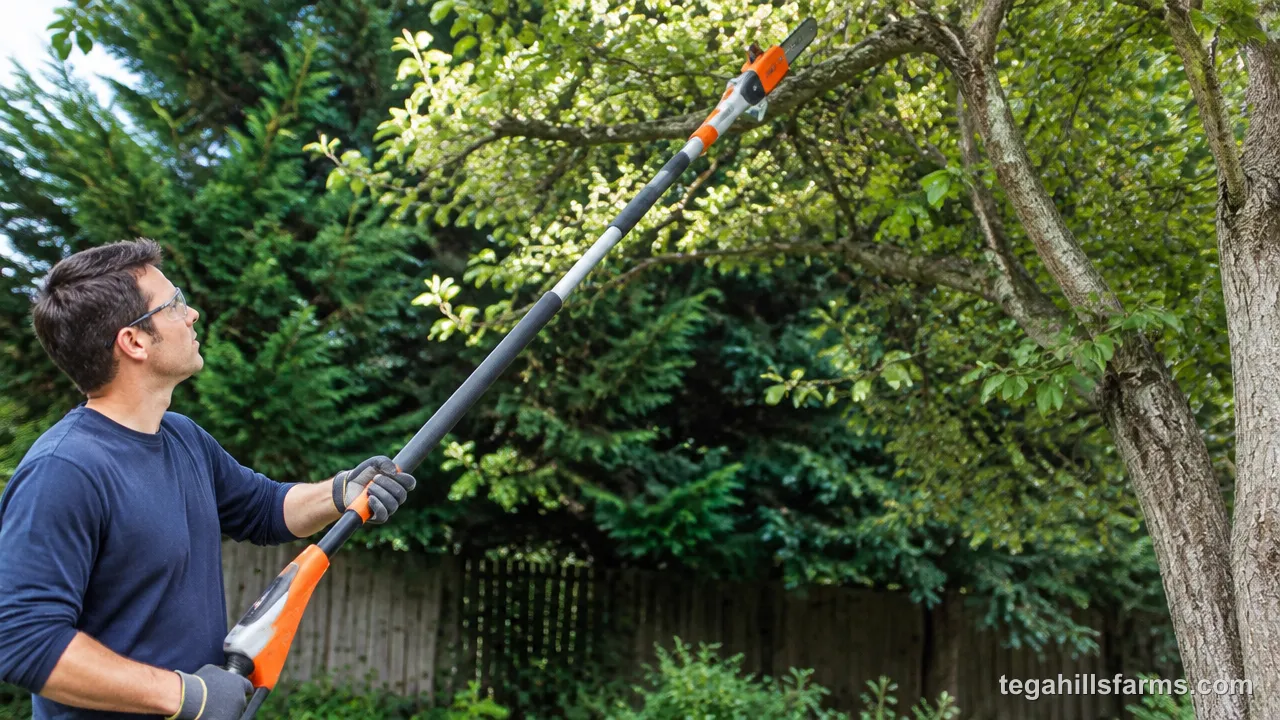
Occasional light pruning from the ground calls for a manual model, while regular or thicker limb work justifies a battery model and the charging routine that comes with it.
- Pick the BlumeTrec 14.5ft Pole Saw if you prune shrubs through mid-height limbs now and then and want a light tool with nothing to charge.
- Go with the BlumeTrec 8.5ft Pole Saw if your work stops at hedges, shrubs and young trees.
- Choose the VEVOR Manual Pole Saw 7.3-27ft or the Likeem Manual Pole Pruner 27ft if the limbs you need are high in tall trees and you’ll accept extra weight for height, plus a rope-pulled cutter for twigs.
- Pick the Greenworks 40V 8in Pole Saw if you want powered cuts in short sessions with the battery and charger in the box.
- Go with the EGO Power+ Pole Saw PS1001 if you’re starting fresh with cordless and often prune shaded limbs.
- Choose the EGO Power+ Pole Saw PS1000 if EGO 56V batteries already sit in your garage.
- Pick the Greenworks 80V 10in Cordless Pole Saw if you run Greenworks 80V packs and face regular limb work.
- Lean toward the Greenworks 40V or a BlumeTrec if storage space is tight, since the aluminum shaft breaks into three pieces and the BlumeTrec poles come apart in sections.
In my view, a manual saw is plenty when pruning is an occasional chore on young or small trees, because a few slow strokes are less trouble than keeping a battery charged for a tool you barely use. Once you’re cutting green limbs every season, or storms leave debris hanging in the canopy, a battery model is worth the charging routine. The motor does the work your shoulders would otherwise do. Light shaping and deadwood removal on smaller trees fall within the best pole saws for pruning. Yards that lose limbs to wind every year are a better match for the best pole saws for storm cleanup.
A limb resting against the line that runs to your house can carry current down whatever touches it, and stainless steel, aluminum, carbon fiber and even damp fiberglass shafts all give that current a path to your hands. One contact can be fatal, so a branch tangled near a line has to be handed to the utility company, no matter how well your saw reaches it.
Can You Use a Pole Saw Near Power Lines?
No. Keep yourself, the tool and the branch at least 10 feet from any overhead line, and leave anything closer to the utility company. Stainless steel and aluminum conduct electricity directly, which covers the BlumeTrec poles and the aluminum shafts on the Greenworks 40V and the Likeem. Carbon fiber, used on the EGO shafts, conducts too. Fiberglass, used on the VEVOR, stops being a reliable insulator once it’s wet or coated in dirt and sap.
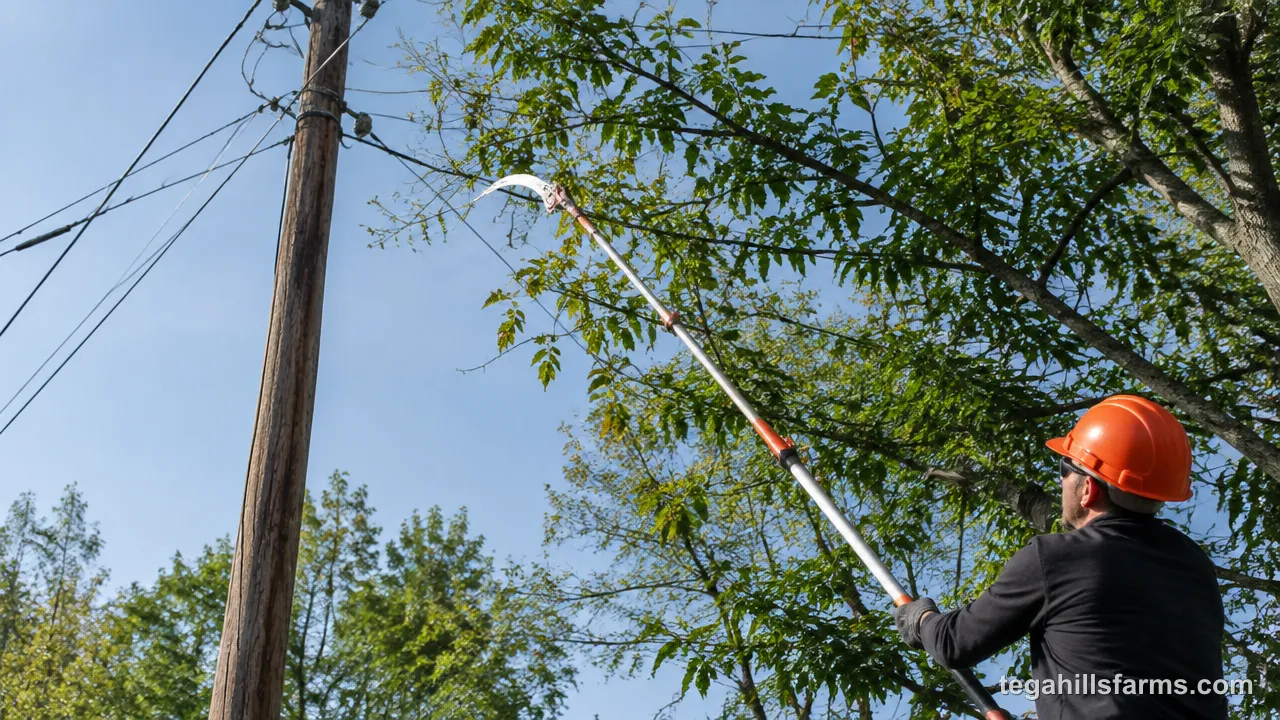
Homeowners tend to underestimate the service line running from the street to the house, but it carries enough current to kill. Judge a branch by where it will go after the cut, not just where it hangs. A limb that drops, swings on a strip of bark or springs upward can strike a line or pull it down even when the cut itself was well clear.
Utility crews clear limbs near their lines with insulated tools and the training to use them, so calling them is the safe fix. A longer saw only adds reach toward the hazard.
When Is a Branch Too Big to Cut Yourself?
Call an arborist when a limb is thicker than your bar or blade can pass through, hangs over the roof or a fence, is split or hanging under tension, or belongs to a tree with dead or diseased wood. In any of those cases the house, the tree or you can take the damage.
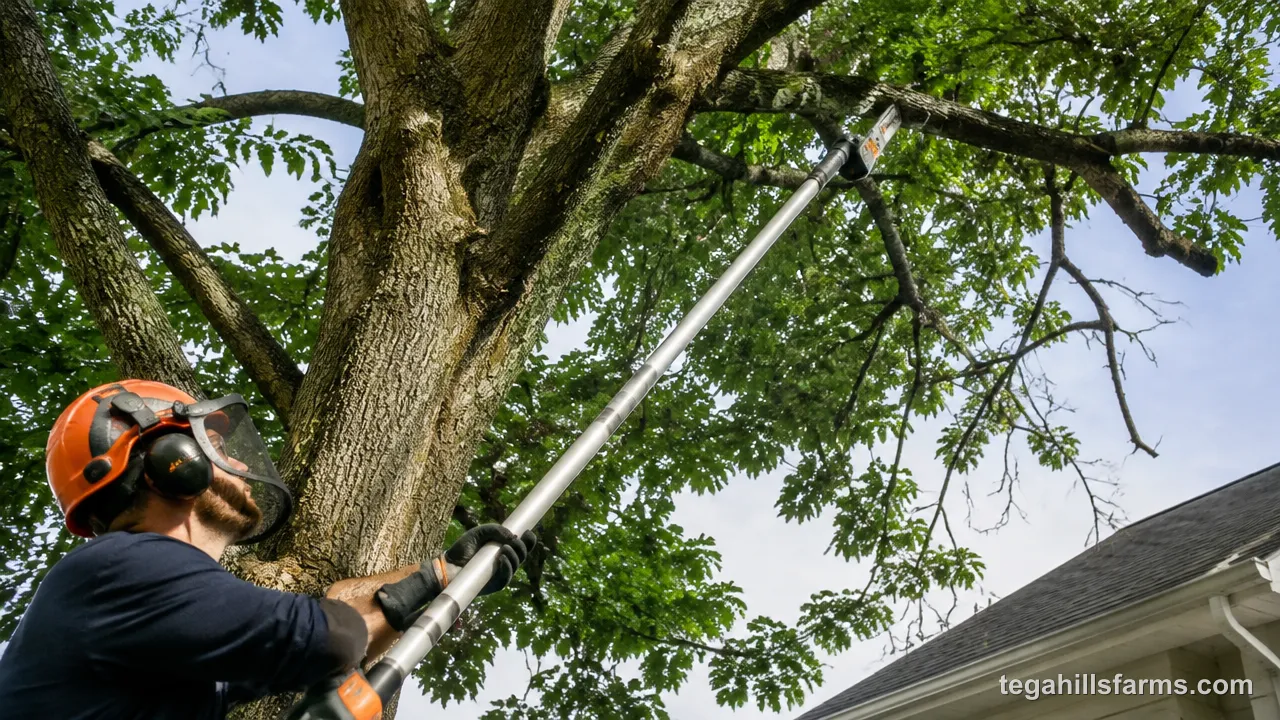
On a bent or hanging limb, one side of the wood is compressed and the other stretched. As you cut, the gap either closes and pinches the bar or springs open and kicks the limb back toward the pole. From the ground you can’t control that, and a limb landing on shingles or a fence turns pruning into a repair job. Dead or diseased wood snaps at its weak points rather than at your cut, sometimes dropping pieces from higher up while you’re still working.
A longer pole doesn’t make any of this safer. It puts you farther from the cut but still underneath it, with less control over the saw. Routine fruit-tree work is different, since small yearly cuts on limbs you can see clearly suit the best pole saws for orchard care.
How Do You Make a Clean Cut at the Branch Collar?
The tree seals a wound from the slightly swollen ring of bark where the limb meets the trunk. Make the final cut just outside that ring, neither flush against the trunk nor leaving a stub. A flush cut removes the tissue that does the sealing and leaves a larger open wound, while a stub dies back and gives rot a path into the trunk.
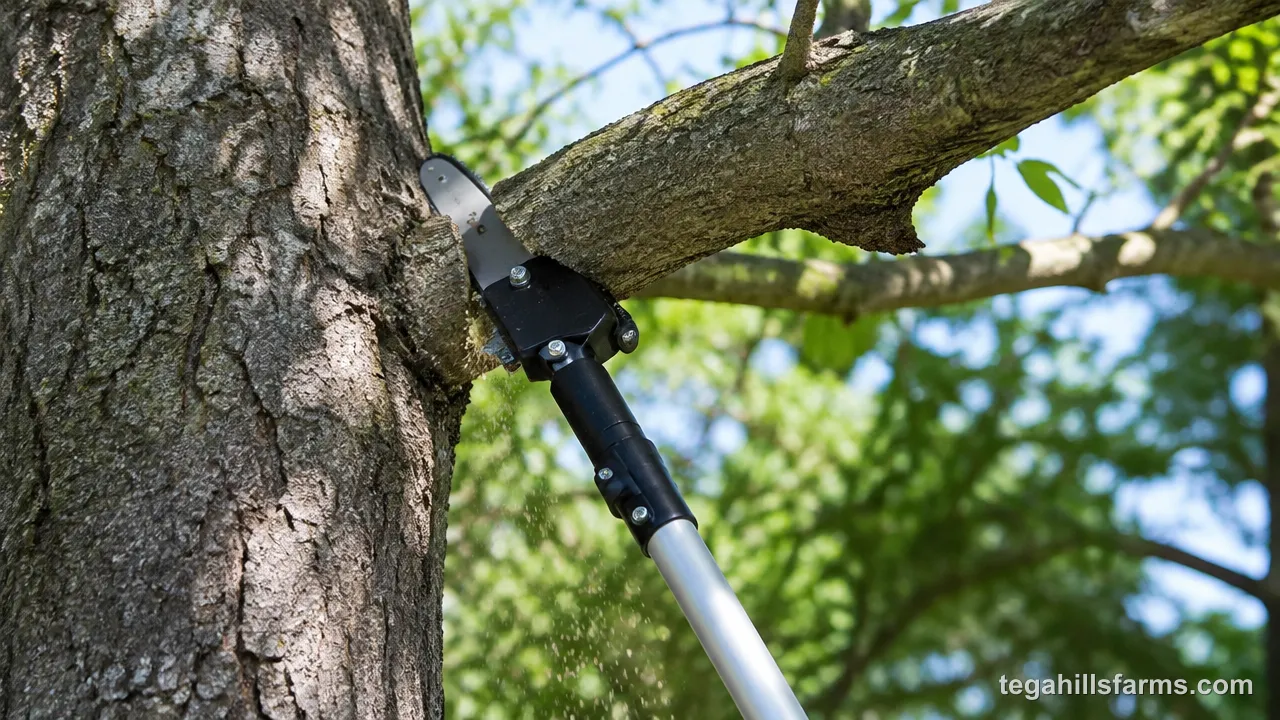
If you take a heavy limb off at the collar in a single cut, its weight peels a strip of bark down the trunk before the blade finishes. Take it down in sections instead. First shorten the limb from the outer end, then make a shallow undercut a little out from the collar. Cut down from the top just beyond that undercut, and once the weight is gone, finish at the collar.
Stand to the side of the limb rather than under it, because cut pieces drop and can swing along the pole. Blade condition shows in the wound too. Sharp teeth leave smooth edges that close cleanly, while dull ones crush and shred the bark.
How Do You Keep a Pole Saw Cutting Well?
A powered saw stays fast as long as the chain is sharp, oiled and snug on the bar. A manual saw stays fast when its teeth are clean and rust-free and every joint and screw is tight.
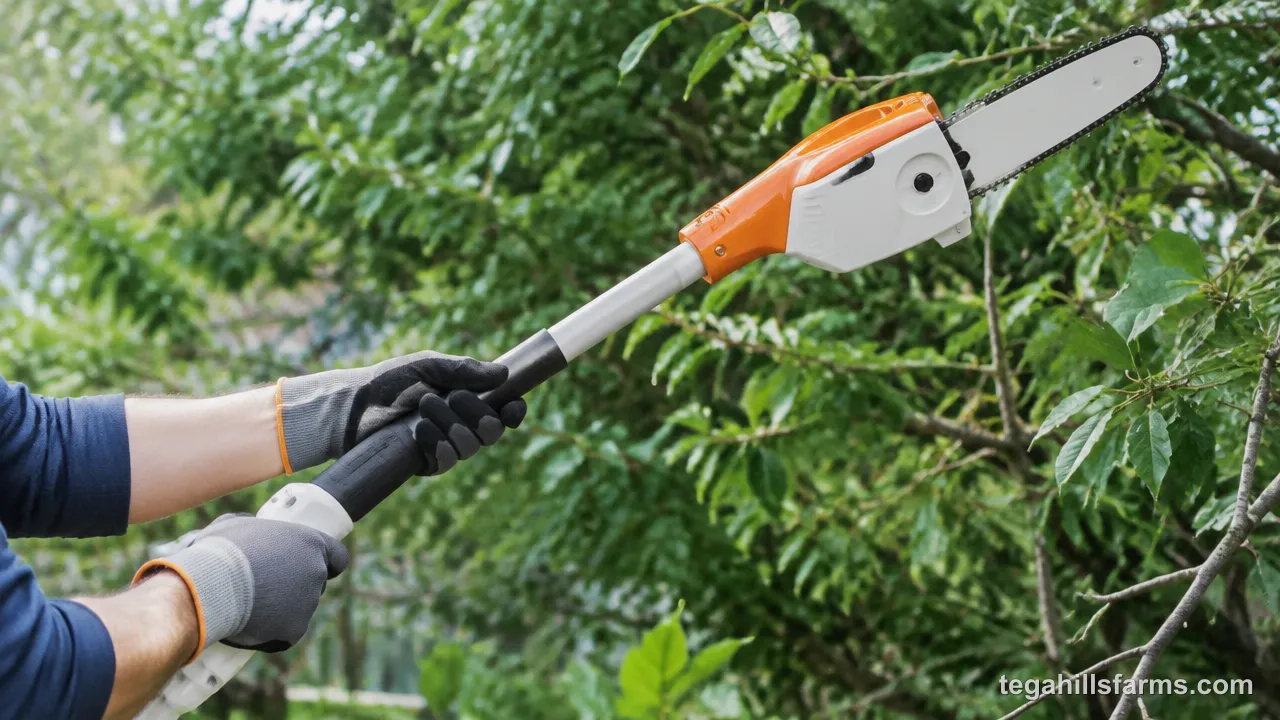
On battery models, the auto oiler draws from a bar oil reservoir, so check the level before each session; a dry chain heats up, smokes and wears the bar. With tool-free tensioning, set the chain snug against the bar but loose enough to pull around by hand. Check it again after the first few cuts, since a new chain stretches as it warms. Sharpen with a file sized to the chain pitch, or replace the chain once filing no longer restores the bite. After each job, clear sawdust from the bar groove and around the sprocket so oil keeps reaching the chain.
Manual saws need less. Brush sap and sawdust off the teeth, dry the blade before storage, wipe on a light coat of oil if rust spots appear, and tighten the joints and the screw that holds the head.
Store batteries indoors in a cool, dry spot between seasons, at the charge level the manufacturer recommends. If cuts stay slow after sharpening, you smell burning, or the head keeps working loose, a part is due for replacement.
Pole Saw FAQ
What is the difference between a pole saw and a pole pruner?
A pole saw cuts with a blade or chain that moves through the wood, while a pole pruner shears branches with rope-pulled jaws, like loppers on a long handle. Pruners make quick, clean cuts on thin growth, and saws handle stiffer limbs. The VEVOR Manual Pole Saw 7.3-27ft and Likeem Manual Pole Pruner 27ft combine both cutters on one pole.
When is the best time of year to trim tree branches?
Late winter, while most trees are dormant, is the usual time for structural pruning. The leaves are off, so you can see each limb, and the cuts have the whole growing season to close. Spring-flowering trees are often pruned right after they bloom instead. Timing varies by species and region, so check with your local cooperative extension office.
Can you use a pole saw without the extension pole?
Yes, with most of these designs. The BlumeTrec saws and the VEVOR break down far enough to work as handheld saws on shrubs, brush and low limbs, and the EGO’s telescopic shaft slides shorter for closer cuts. The EP1000 extension pole is an optional add-on for EGO owners who need extra height, not a required part.

Write Your Review
No reviews yet. Be the first to share your experience!