

Our top picks for the best chainsaws for storm cleanup in 2026 are the EGO Power+ CS2005 20 in (Best Overall), CRAFTSMAN V20 CMCCS620M1 12in Chainsaw (Best for Small Spaces), Husqvarna 450X Rancher (Best Gas-Powered), Greenworks 24V 10″ Chainsaw (Best Budget), Greenworks 80V 18 in Chainsaw (Best Performance), and Makita XCU04Z 18V X2 16″ (Best Value).
Choosing between them comes down to three things. The bar length has to match the debris you’ll actually cut. The weight has to be something you can control through hours of awkward angles. The safety features have to hold up when wood is tangled, shifting and under tension.
Reliability is the bigger worry for most homeowners. A storm saw can sit unused for months and then has to start the moment a tree comes down, often while the power is still out and batteries can’t be recharged.



I’d size the saw to the debris you’ll realistically cut yourself rather than to the largest tree on the property. Anything beyond that size usually calls for a tree service anyway.
What Makes a Chainsaw Right for Storm Cleanup?
A storm saw has to cut fallen limbs and downed trunks, keep working through dirty, tangled wood, and start reliably after months on a shelf.
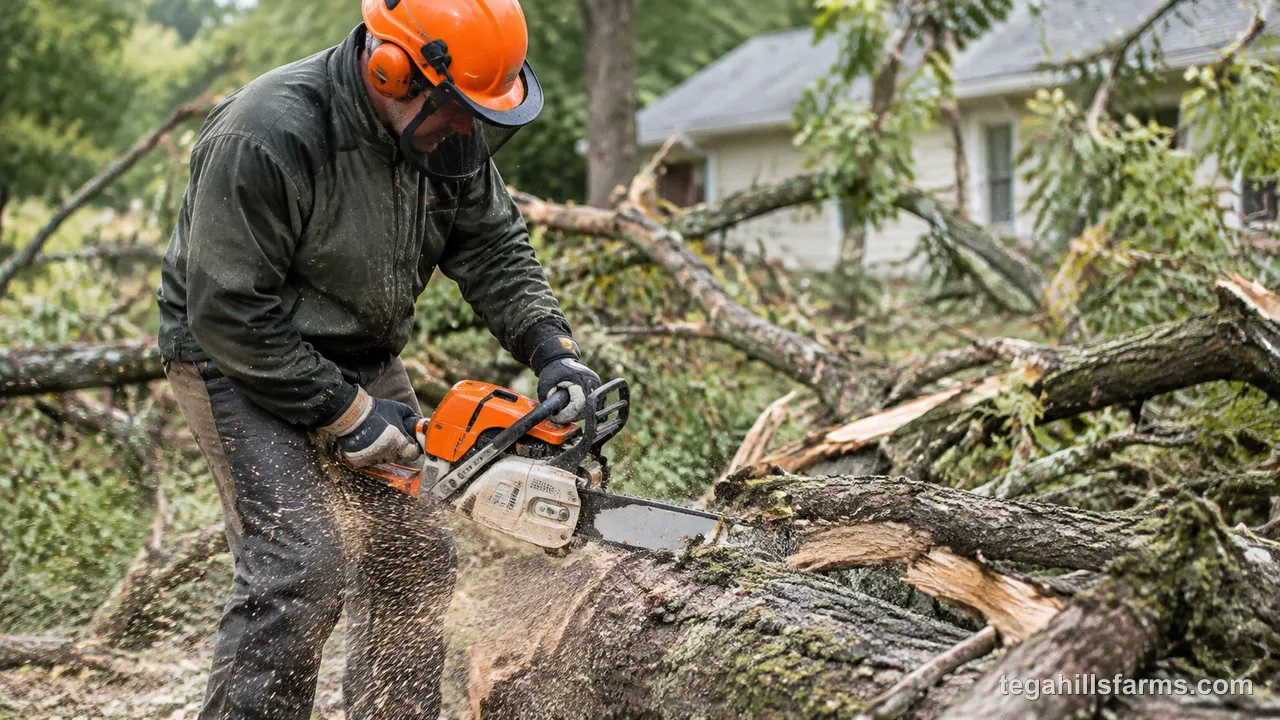
Storm wood behaves differently from a neat stack of firewood. It lies on the ground mixed with soil and grit, branches pin each other in heaps, and bent trunks hold tension that can pinch a bar. The basics of how to choose a chainsaw still apply here: power source, bar length, weight and safety features. Storm work simply weights them differently. Control and dependability count for more than peak cutting speed.
A storm saw is also an emergency tool. Gas left in a carburetor breaks down, and batteries drain while sitting, so the right saw is one you can keep ready with little effort. For general yard and property work beyond storms, see our guide to the best chainsaws.
6 Best Chainsaws for Storm Cleanup Jobs
In rank order, the picks are the EGO Power+ CS2005 20 in, CRAFTSMAN V20 CMCCS620M1 12in Chainsaw, Husqvarna 450X Rancher, Greenworks 24V 10″ Chainsaw, Greenworks 80V 18 in Chainsaw, and Makita XCU04Z 18V X2 16″.
The choice mostly comes down to size class. Light cordless saws handle limbs and small trunks around the house. The long-bar and gas-powered saws take on heavy downed trunks. If you already own batteries from one of these brands, that platform narrows the field before anything else does. If outages where you live tend to last for days, a gas saw keeps cutting long after the batteries in the house run dry.
#1 EGO Power+ CS2005 20 in — Best Overall
Homeowners facing big downed trunks get gas-saw cutting here without a pull cord. The brushless motor delivers power equivalent to a 55cc gas saw on a 20-inch full chisel chain, so thick storm wood that would bog a smaller cordless saw goes through in clean, steady passes.
Key Specs:
- Bar and chain: 20 in, full chisel, 3/8 in pitch, 0.050 in gauge, 69 drive links
- Motor: brushless, 55cc gas equivalent, chain speed up to 82 ft/s
- Battery: 56V ARC Lithium 6.0Ah, charger included
- Runtime: up to 135 cuts on a 6×6 per charge
- Weather resistance: IPX4
- Weight: 30 lb
Detailed Review:
The 20-inch bar with a full chisel chain is what sets this saw apart on storm wood. Full chisel teeth have square corners that slice wood fibers aggressively. Paired with chain speeds up to 82 ft/s, that lets the saw clear big branches and toppled trunks at a pace close to a mid-size gas saw.
The onboard display switches speed modes and shows battery charge and the safety brake indicator. That helps when you’re deciding whether to finish a trunk or swap packs. The front LED work light shows the cut line at dusk or when the whole street is without power. The IPX4 rating protects against splashing water when you’re working through wet brush.
The included 6.0Ah pack is good for up to 135 cuts on a 6×6. The saw runs on any EGO 56V ARC Lithium battery, so owners of EGO mowers or blowers can keep spare packs in rotation.
Size is the trade-off. At 30 lb, it puts real strain on your arms during overhead or awkward cuts. The Greenworks 80V 18 in Chainsaw gives up bar length and rated output but weighs far less, which matters if most of your work is limbs rather than trunks.
Pros:
- Brushless motor matches the output of a 55cc gas saw.
- Full chisel chain on a 20-inch bar handles big trunks.
- LED work light keeps cleanup going at dusk.
- Display shows battery charge and chain brake status.
- Runs on any EGO 56V ARC Lithium battery.
Cons:
- Its 30-lb weight tires arms quickly on overhead cuts.
- Long bar feels unwieldy in tight, cluttered debris piles.
- Full chisel teeth lose their edge fast in dirty wood.
Who It’s For:
Property owners with mature trees that come down in storms, and who want gas-class cutting without fuel cans or pull starts, fit this saw well. It also makes sense for anyone already running EGO 56V tools with spare packs on hand. Readers who mostly clear small limbs near the house will find it more saw than they need.
Editor’s Verdict:
Pick this saw when downed trunks, not twigs, define your storm damage. The weight is the cost of cordless power that keeps pace with gas.
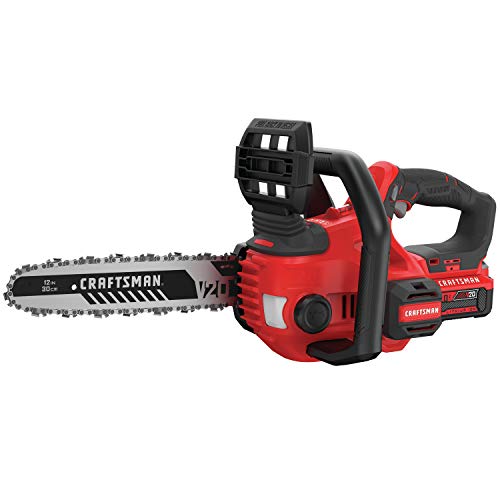
#2 CRAFTSMAN V20 CMCCS620M1 12in Chainsaw — Best for Small Spaces
On a tight lot where storm limbs land between fences, sheds and flower beds, a saw you can swing in close quarters matters more than raw reach. The 12-inch compact bar fits that work.
Key Specs:
- Bar: 12 in compact design
- Battery: V20 4.0Ah, charger included
- Weight: 9.9 lb
- Maintenance: auto oiling, tool-free chain tensioning
- Extras: bubble level, integrated hook for VERSATRACK wall storage
- Warranty: 3-year limited
Detailed Review:
The short bar keeps the tip close to your hands. That makes it easier to steer around fence posts, downspouts and piled branches without the nose catching wood you didn’t mean to cut. At 9.9 lb, the saw is light enough to hold in position for a string of limb cuts.
Upkeep stays minimal. Auto oiling keeps the bar and chain lubricated without stopping to pump oil. Tool-free tensioning lets you take up slack by hand as the chain warms and stretches. The bubble level helps keep cuts square when you’re trimming limbs into pieces that stack neatly. Replacement chain CMZCSC12 and bar CMZCSB12 are listed parts, so a chain worn down on gritty wood won’t sideline the saw.
The 4.0Ah pack gives extended runtime, and the V20 battery works across CRAFTSMAN’s cordless line. The integrated hook hangs the saw on a VERSATRACK wall system, which keeps it off the garage floor between storms.
Compared with the Greenworks 24V 10″ Chainsaw, this saw carries a longer bar and a larger pack (4.0Ah versus 2.0Ah), though it is heavier in the hand. The limit is still trunk size. The compact bar struggles with a large fallen trunk, so heavy wood belongs with a long-bar saw.
Pros:
- 12-inch bar steers easily between fences and outbuildings.
- Auto oiling removes manual lubrication from the routine.
- Tool-free tensioning adjusts the chain by hand.
- 4.0Ah pack gives extended runtime for limb work.
- Three-year limited warranty backs the saw.
Cons:
- Short bar can’t cross large trunks in one cut.
- VERSATRACK wall system for the hook costs extra.
Who It’s For:
Homeowners on compact suburban lots who mostly deal with limbs knocked onto lawns, patios and fence lines will get the most from it. Owners of CRAFTSMAN V20 drills and drivers can share batteries they already have. If downed trunks are your main job, a longer-bar saw is the better fit.
Editor’s Verdict:
Keep it on the wall for the limbs every storm brings. It handles close-quarters cleanup with very little upkeep.
#3 Husqvarna 450X Rancher — Best Gas-Powered
Long outages don’t slow a gas saw down. This one pairs a 50.2cc, 3.4-hp X-TORQ engine with AutoTune engine adjustment, so it keeps steady power through long sessions on heavy downed trunks whether or not anything nearby can be charged.
Key Specs:
- Engine: 50.2cc, 3.4 hp, 2-cycle X-TORQ
- Bar: 20 in
- Engine management: AutoTune automatic adjustment
- Vibration control: LowVib dampeners
- Weight: 14.9 lb
Detailed Review:
The X-TORQ engine produces strong power even at low RPM. When the bar sinks deep into a big trunk, the chain keeps pulling instead of bogging down. AutoTune adjusts engine settings on its own for best performance, so you aren’t turning carburetor screws to get it running right.
Starting is the first test of any storm saw, and Husqvarna built this one around an easy, consistent starting procedure whether the engine is cold or warm. The patented crankcase design improves cooling for longer engine life, which helps on long cutting days. LowVib dampeners reduce the buzz reaching your hands during hours of bucking.
The 20-inch bar handles large trunks, and no part of the saw depends on the grid. When packs run flat across the neighborhood, you refuel and keep cutting. The EGO Power+ CS2005 20 in carries the same bar length but weighs far more than this saw’s 14.9 lb.
The trade-off is fuel and maintenance. A 2-cycle engine needs gas mixed with oil, fresh fuel kept on hand, and seasonal attention to the spark plug, air filter and stored fuel. It is also loud and produces exhaust, which is worth weighing if neighbors are close.
Pros:
- X-TORQ engine keeps pulling at low RPM in thick wood.
- AutoTune handles engine adjustment automatically.
- Runs on fuel, not batteries, during long outages.
- LowVib dampeners reduce hand fatigue during long sessions.
Cons:
- Two-cycle fuel mix must be prepared and stored.
- Engine needs seasonal care before and after storage.
- Engine noise and exhaust carry to nearby neighbors.
Who It’s For:
Rural owners, and anyone on a large property where storms regularly drop whole trees, should look here first. That goes double where outages last long enough to drain every battery in the house. If you’d rather never mix fuel or service an engine, a cordless saw will be easier to live with.
Editor’s Verdict:
Choose this saw for heavy, drawn-out cleanups away from the grid. It trades some convenience for power that never waits on a charger.
#4 Greenworks 24V 10″ Chainsaw — Best Budget
Occasional limb pickup after a windy night is the job this saw is built for. At about 5.7 lb with a 10-inch bar and a low-kickback chain, it’s easy for a beginner to control, and it comes ready to use with a battery, charger and scabbard in the box.
Key Specs:
- Bar: 10 in with low-kickback chain
- Battery: 24V 2.0Ah, charger included
- Weight: 5.7 lb
- Maintenance: automatic oiler, tool-less tensioning
- Safety: hand guard
- Included: scabbard, battery, charger, operator’s manual
Detailed Review:
This saw is very light in the hand, and that changes how storm cleanup feels. You can hold it at arm’s length to trim snapped limbs out of shrubs without your shoulders giving out early. The low-kickback chain and hand guard add a margin of safety for newer owners.
Push-button electric start replaces the pull rope. There are no fumes, no carburetor and no spark plug, so a season of sitting in the garage leaves no fuel system to gum up. The automatic oiler lubricates the bar and chain only when needed, and tool-less tensioning lets you tighten the chain by hand in the yard.
Everything needed to start cutting comes in the package, scabbard included, and the battery fits the Greenworks 24V platform. If cost is your main filter, the best chainsaws under $100 round up more saws in this budget tier.
The limits come from the short bar and the small pack. A 10-inch bar and a 2.0Ah battery restrict the saw to small branches and light pruning. Larger limbs and fallen trunks need a bigger saw.
Pros:
- Light enough to control with little arm strength.
- Push-button start, with no fuel system to maintain.
- Low-kickback chain and hand guard add protection.
- Comes with battery, charger and scabbard.
Cons:
- Short bar restricts it to small branches.
- 2.0Ah pack limits time between charges.
Who It’s For:
Budget-minded homeowners who find scattered broken branches after storms, and first-time saw owners who want something easy to control, are the natural match. Greenworks 24V tool owners can reuse their packs. Anyone expecting downed trunks or thick limbs needs more bar and more battery than this saw offers.
Editor’s Verdict:
Buy it as an easy, low-commitment way to clear small storm branches, and plan on a bigger saw if trunks ever come down.
#5 Greenworks 80V 18 in Chainsaw — Best Performance
Cordless power for real trunks, without heavy lifting, is this saw’s strength. The brushless motor provides power equivalent to a 50cc gas engine on an 18-inch bar, and the whole saw weighs about 9.5 lb, light enough to carry from one fallen limb to the next all afternoon.
Key Specs:
- Bar: 18 in
- Motor: brushless, 50cc gas equivalent
- Battery: 80V 4.0Ah, charger included
- Weight: 9.5 lb
- Safety: mechanical chain brake
- Maintenance: automatic oiler, side-access tensioning
Detailed Review:
Pairing 50cc-equivalent output with an 18-inch bar puts this saw in mid-size gas territory. It handles heavy limbs and the medium trunks typical of yard storm damage. Because it starts with a trigger rather than a pull rope, it’s ready the moment you need it after months of storage.
Weight is where this saw stands out among the high-output picks. The EGO Power+ CS2005 20 in offers more bar length and a higher gas-equivalent rating, but it weighs far more. That makes the Greenworks easier to control on awkward cuts and less tiring over a long session.
The mechanical chain brake adds a quick stop for the chain if the saw kicks back. The automatic oiler keeps the chain lubricated without manual pumping. Side-access tensioning puts chain adjustment on the side of the saw, so routine tightening takes little time.
The 80V battery is a separate Greenworks platform from the 24V line, so the two don’t swap. One 4.0Ah pack comes in the box. During a long outage, a second charged pack is what keeps this saw cutting.
Pros:
- Brushless motor matches a 50cc gas engine’s output.
- 18-inch bar handles mid-size downed trunks.
- Mechanical chain brake adds a safety stop.
- Side-access tensioning keeps chain adjustment simple.
Cons:
- 80V batteries don’t fit Greenworks 24V tools.
- One included pack limits long sessions during outages.
Who It’s For:
Suburban and small-acreage owners who want one cordless saw for both limbs and medium trunks fit this saw. Households already running Greenworks 80V mowers or blowers can share packs. If outages often drag on and you have no way to recharge, a gas saw keeps going where this one stops.
Editor’s Verdict:
Expect gas-like cutting in a package light enough for a full afternoon of cleanup. A spare 80V pack makes it complete.
#6 Makita XCU04Z 18V X2 16″ — Best Value
Makita 18V LXT owners can turn two batteries they already have into a 16-inch storm saw. The outer-rotor brushless motor delivers output equivalent to a 32cc gas saw, enough for light-to-medium debris, and buying it as a bare tool skips paying for packs you don’t need.
Key Specs:
- Bar: 16 in
- Motor: outer rotor brushless, direct drive, 32cc gas equivalent
- Power: two 18V LXT batteries (not included)
- Weight: 11.2 lb
- Controls: lock-off lever, LED on/off switch with auto power-off
Detailed Review:
Makita’s outer-rotor brushless motor drives the chain directly, which gives it high power efficiency from two 18V packs. A 32cc-equivalent rating puts it in limb-and-moderate-trunk territory, which covers a lot of suburban storm damage.
The variable speed trigger runs from 0 to 3,940 FPM. You can start a cut slowly to seat the chain on wet, slippery bark before going to full speed. The built-in lock-off lever keeps the chain from engaging if the trigger gets bumped while you climb over branches.
The auto power-off function shuts the saw down when you pause for a while. That preserves battery life when you stop to drag brush or check a cut, and it matters more during an outage when recharging isn’t guaranteed. The value depends on what you already own: with LXT batteries on the shelf, this is an inexpensive way to add a capable saw.
The Husqvarna 450X Rancher brings more engine-class power and a longer bar for big trunks. This Makita needs no fuel or engine upkeep in return. Heavy trunk work sits beyond its comfortable range.
Pros:
- Runs on two 18V LXT batteries many owners already have.
- Variable speed trigger allows controlled starts on slick bark.
- Lock-off lever prevents accidental chain engagement.
- Auto power-off saves battery when you pause.
Cons:
- Batteries and charger cost extra for new Makita owners.
- 32cc-class output struggles with large downed trunks.
Who It’s For:
Anyone with a shelf of Makita 18V LXT batteries gets the most from this saw, since it adds storm capability without new packs. It suits light-to-medium debris around the yard. Buyers starting with no batteries, or facing big fallen trunks, will do better with a saw sold as a complete kit.
Editor’s Verdict:
Treat it as an add-on for an existing LXT collection: efficient, controllable and sensible for limb-heavy storms.
Gas or Battery: Which Chainsaw Works Better After a Storm?
Gas saws suit long outages and heavy trunks, while battery saws suit limbs and mid-size wood when you can count on recharging.
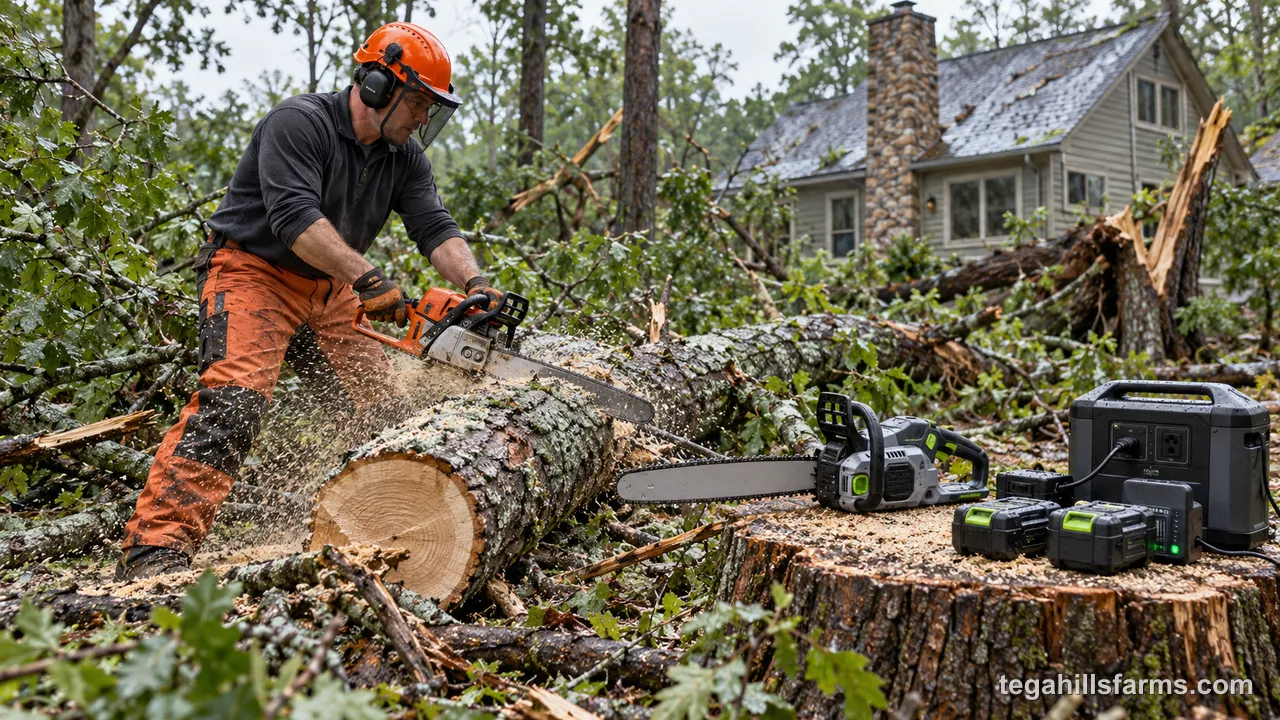
After a storm, the deciding factor is often the grid itself rather than cutting power. A widespread outage limits how many charged packs you have, while a gas saw needs only fuel. Convenience, noise and upkeep pull in the other direction. How long outages typically last where you live tells you which side should carry more weight.
Where Do Battery Chainsaws Fit in Storm Work?
Battery saws earn their place on limbs and mid-size trunks near the house. Push-button starting, no fuel to store and lower noise make quick cleanup easy. A saw that has sat for months starts the moment you squeeze the trigger, with no carburetor to clear.
Runtime is the catch after a storm. Each pack gives a limited cutting session, and if the outage covers your whole area, you can’t recharge until power returns or you have a backup source. That’s why a spare charged pack matters more for storm work than for weekend pruning. Brushless motors stretch each charge because they waste less energy as heat. For a wider look at cordless options, see the best battery chainsaws.
Where Do Gas Chainsaws Fit in Storm Work?
Gas saws take over when the job is large trunks or a long day of cutting. Refueling takes a few minutes, and the saw never waits on the grid. When outages stretch across a region, a can of mixed fuel keeps a gas saw running long after every battery in the house is drained.
That independence has costs. Gas saws are loud, produce exhaust, and ask more of you in maintenance. Two-cycle engines need fuel mixed with oil, fresh fuel kept on hand, and seasonal care for the spark plug, air filter and carburetor. Weight adds up too, especially with a long bar on the front. If you already maintain a gas mower and don’t mind the routine, the best gas chainsaws are worth comparing.
What Should You Look for in a Storm Cleanup Chainsaw?
The features that count are the ones that decide how safely and how long you can cut tangled, unstable wood. That means a saw sized to your largest debris and controllable enough to use through a full day of cleanup. Storm conditions expose weaknesses a tidy firewood pile never would, so judge each feature by how it behaves in a messy yard.
How Long Should the Bar Be for Storm Debris?
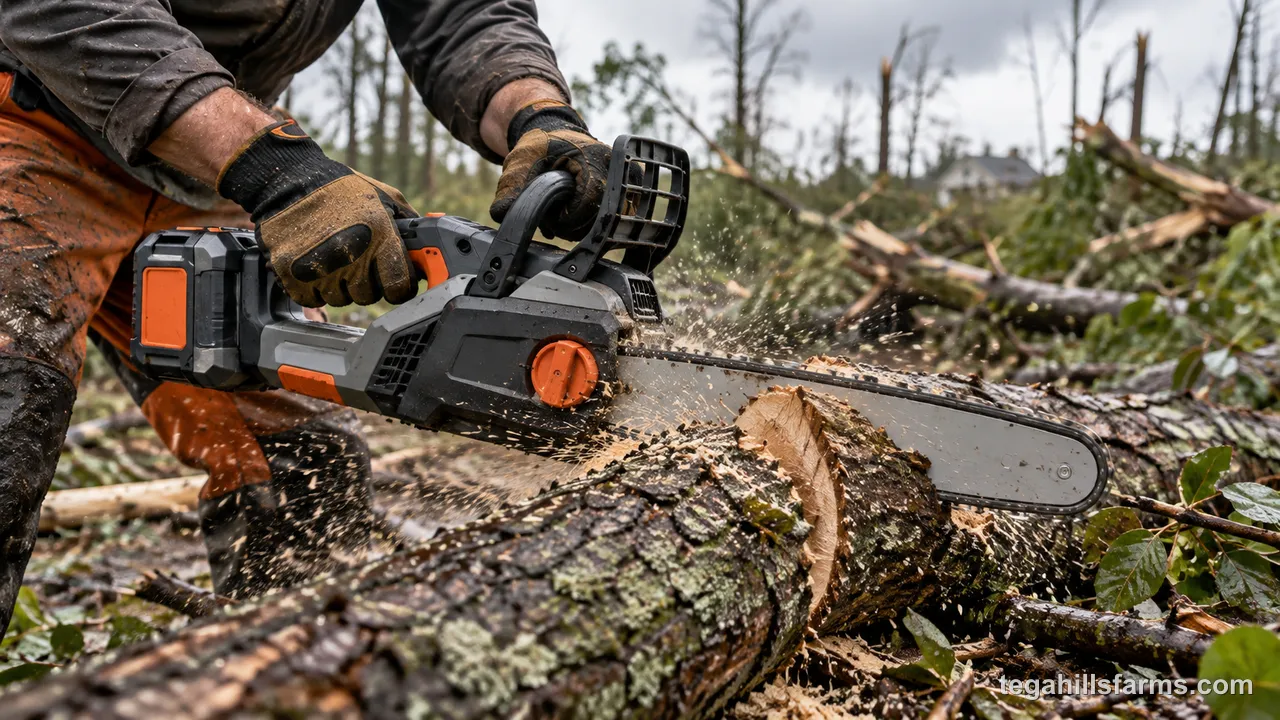
Bar length should match the thickest wood you plan to cut yourself. Short bars handle limbs and light pruning, mid-length bars cover most homeowner storm cleanup, and long bars reach large trunks at a cost in weight and control.
A bar long enough to cut straight through a trunk saves time and keeps cuts straight. Every extra inch, though, is more weight held out in front of you and a longer nose that can touch hidden branches in a tangled pile, which is the contact that triggers kickback. Mid-length bars balance those factors for yards with mature trees, and the best 16 inch chainsaws and the best 18 inch chainsaws sit in that range. A long bar earns its weight only when big trunks are a regular part of your storm damage.
How Much Saw Weight Can You Handle Through a Long Cleanup?
Saw weight decides how long you can keep cutting accurately, because storm cleanup is rarely done at bench height. Limbs hang at odd angles, trunks lie in tangled piles, and many cuts happen with your arms extended or the saw held off to one side.
A light, compact saw lets you hold position through repeated limb cuts and keep the bar where you aimed it late in the day. Heavier gas saws and long-bar cordless saws bring more cutting power but tire your arms and back sooner, and fatigue is when slips and sloppy cuts happen. If you’ll mostly clear branches, low weight pays off more than power. If trunks dominate, accept the weight and plan regular breaks.
Which Safety Features Matter Most on Storm Debris?
A chain brake, a low-kickback chain, a hand guard and a lock-off lever matter more on storm debris than on firewood. Wood under tension or tangled in a pile can shift without warning and throw the saw.
The chain brake stops the chain almost instantly when your front hand pushes the guard forward, which is exactly what happens during a kickback. A low-kickback chain uses guard links and shaped depth gauges to reduce how hard the cutters grab when the bar nose touches wood. The hand guard shields your front hand if it slips off the handle. A lock-off lever keeps the chain from engaging when you bump the trigger while climbing over branches or carrying the saw between cuts.
What Helps a Saw Perform in Wet, Low-Light Conditions?
Weather resistance, a built-in work light, auto oiling and easy tensioning keep cleanup going when conditions turn damp or daylight runs out. A rating such as IPX4 means the saw is protected against splashing water, so a light drizzle or wet brush won’t sideline it, though it isn’t built for heavy rain.
A work light on the front of the saw shows the cut line when the power is out and dusk arrives early. An automatic oiler keeps the bar and chain lubricated without stopping to pump oil in wet, slippery gloves. Tool-free tensioning lets you tighten a chain that loosens as it warms, with no need to hunt for a wrench in the debris.
How Do You Cut Storm-Damaged Trees Safely?
Storm-damaged trees are dangerous mostly because of stored energy in bent and trapped wood, which can pinch the bar or release suddenly. Technique matters more here than the saw itself. A fallen trunk looks like ordinary firewood bucking, but a cut that’s safe on a log lying flat can throw a limb at you when the wood is under load.
How Do You Read Tension and Pressure in Fallen Wood?
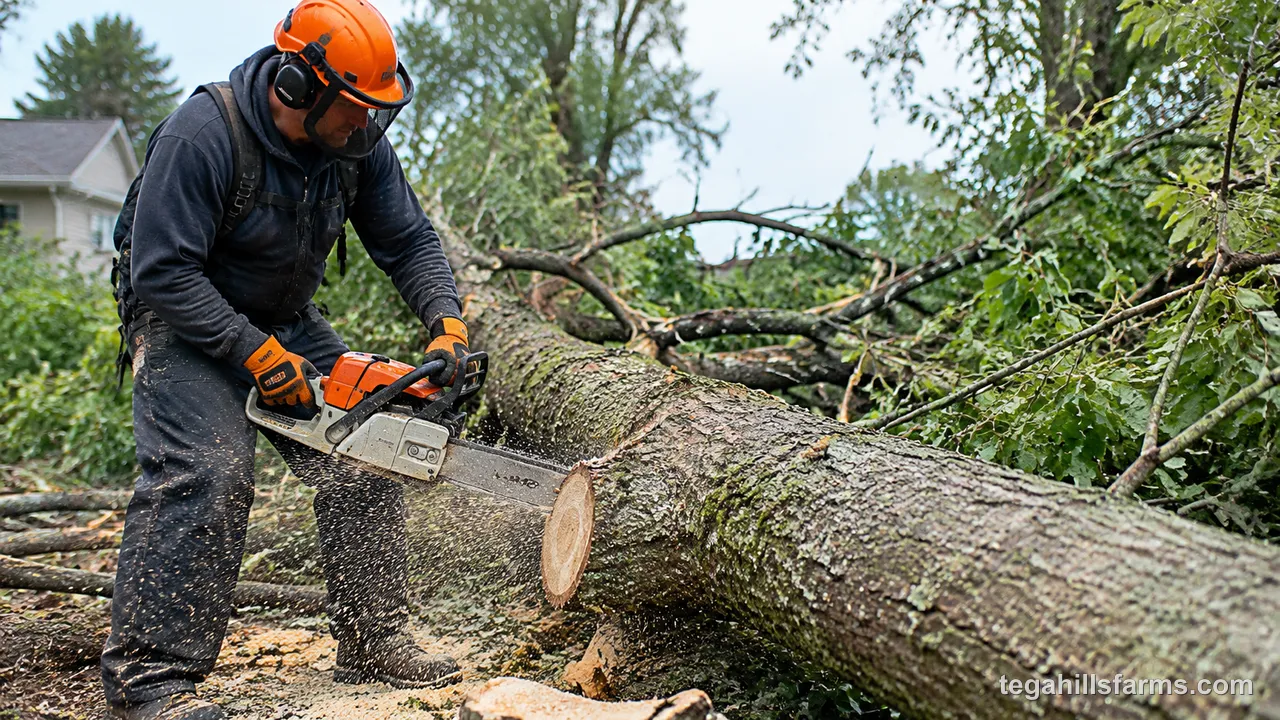
Wood bent under load has two sides. On the compression side, the fibers are squeezed together; on the tension side, they are stretched. Cutting the tension side first lets the wood snap or spring, while cutting only into the compression side closes the kerf and pinches the bar.
Start by looking at how the trunk or limb is supported. A log resting on both ends sags in the middle, so the top is in compression and the bottom is in tension. A log supported at one end with the other end hanging is the opposite: the top is in tension and the bottom is in compression. Branches pinned under a trunk or bent into an arc, called spring poles, carry the most energy.
The safe order is a relief cut on the compression side first, about a third of the way through, then the finishing cut from the tension side. Stand outside the path the wood will move. Release spring poles with shallow cuts on the inside of the bend so the energy lets go gradually.
What Protective Gear and Stance Does Storm Cutting Require?
Storm cutting calls for chainsaw chaps or cut-resistant pants, a helmet with a face screen, safety glasses, hearing protection, gloves, and boots with good grip. Uneven ground and shifting debris raise the odds of a slip near a running chain.
Clear brush and small branches from your work area before cutting so your feet have solid footing, and keep an escape path open behind you. Hold the saw with both hands and stand to the side of the cutting line rather than directly behind the bar. Keep the bar nose away from hidden branches, since nose contact is what starts kickback. Helpers and bystanders should stay well outside the reach of the saw and of any wood that could roll.
How Do Dirt and Embedded Debris Wear Down a Chain?
Soil, sand and grit carried into fallen wood dull a chain far faster than clean timber, because every grain acts as an abrasive on the cutters. A trunk that rolled through mud, or a root plate packed with dirt, can take the edge off a chain quickly.
The signs show up fast. The saw throws fine dust instead of chips, pulls to one side, or needs you to push it through the cut. Forcing a dull chain adds heat, wear and kickback risk. Carbide-tipped chains hold their edge much longer in dirty wood, so they’re worth considering when storm debris is your main work, and the best chainsaw chains cover those options. Keep a file or one of the chainsaw sharpeners on hand to touch up the cutters during breaks, and roll logs so the bar stays out of the soil.
Which Storm Cleanup Chainsaw Fits Your Situation?
Match the saw to the largest debris you’ll cut yourself and to how long your outages last.
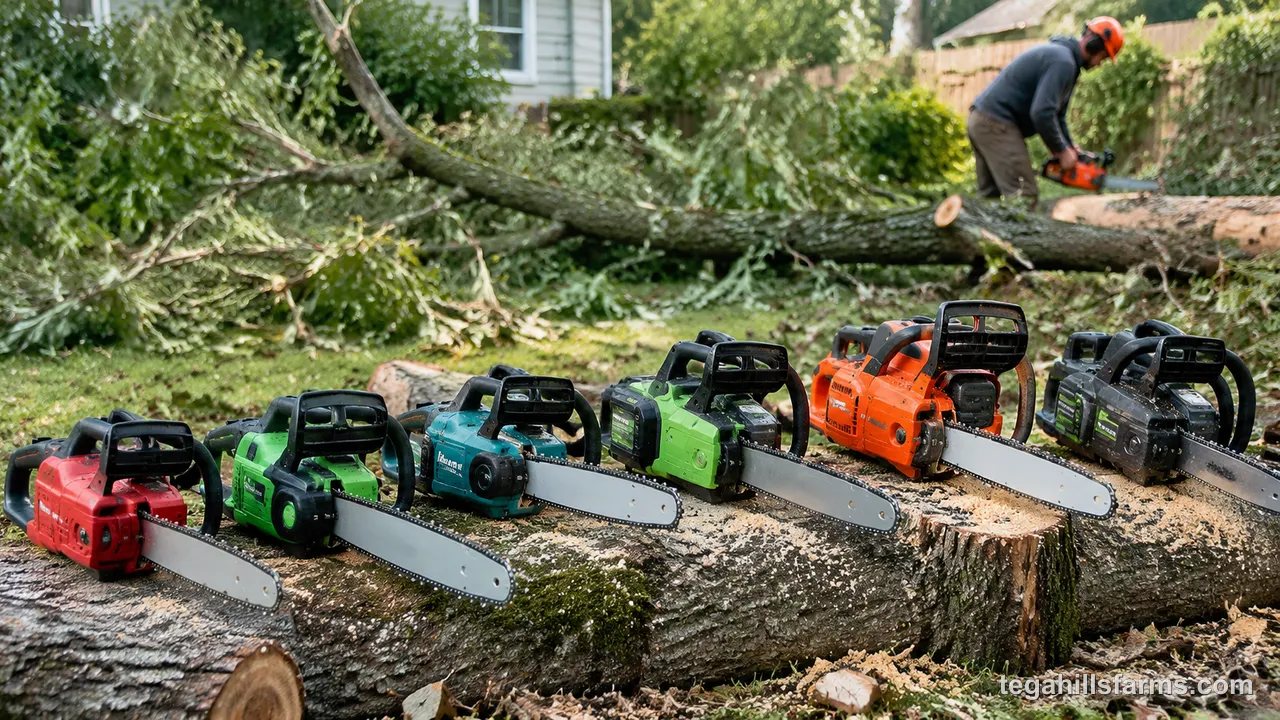
- Tight lot, mostly limbs: the CRAFTSMAN V20 CMCCS620M1 12in Chainsaw or the Greenworks 24V 10″ Chainsaw handles cleanup with little weight or upkeep.
- Existing battery platform, mid-size trunks: owners with Makita 18V LXT or Greenworks 80V batteries can step up to the Makita XCU04Z 18V X2 16″ or the Greenworks 80V 18 in Chainsaw without starting a new platform.
- Heavy downed trunks, power available: the EGO Power+ CS2005 20 in brings gas-class cutting.
- Outages that last for days: the Husqvarna 450X Rancher keeps cutting on fuel alone.
A gas saw that sat all summer with fuel in the tank often refuses to start when the next storm hits, because old fuel leaves varnish in the carburetor’s narrow passages, and batteries left drained in a hot garage lose capacity the same quiet way. The day a tree lands across the driveway is when you find out, and every repair shop in town is already backed up with storm calls.
How Should You Store a Chainsaw You Only Use After Storms?
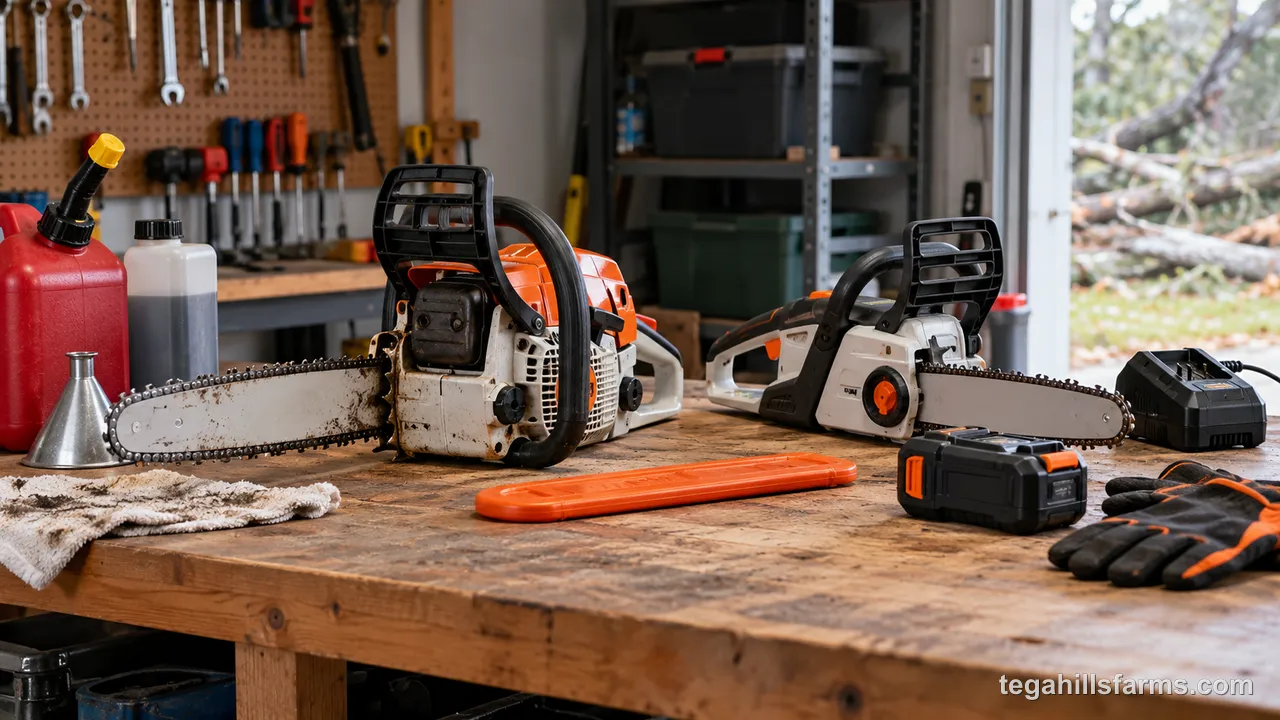
Idle time hurts the two power types in different ways. Gas saws fail from fuel that breaks down in the tank and carburetor. Battery saws lose readiness when packs sit fully drained or in extreme heat or cold. A short routine before storage, plus a quick check when storms are forecast, keeps either one ready.
How Do You Keep a Gas Saw Ready Between Storms?
Stale fuel is the main reason a gas saw won’t start after months on a shelf. Gasoline breaks down over time and leaves gummy deposits in the carburetor. Either add fuel stabilizer to fresh mix and run the saw briefly so treated fuel reaches the carburetor, or drain the tank and run the engine until it stops.
Before storage, check the spark plug for fouling and replace it if the electrode looks worn. Clean or replace the air filter, since sawdust packed into it starves the engine. Sharpen the chain and clean the bar groove so the saw is ready to cut the moment you pull it out. Keep a small can of fresh fuel mix and bar oil ready when storm season approaches.
How Do You Keep a Battery Saw Ready Between Storms?
Lithium-ion packs keep best partly charged, not full and not empty, so follow the manufacturer’s storage guidance rather than leaving them on the charger all off-season. Heat and deep cold both shorten battery life. A freezing shed or a hot attic is a poor home, while an indoor closet or a conditioned garage works well.
Check packs every few months and top them up if the charge has dropped low, because a fully drained pack can become hard to revive. Before storm season, or when a big storm is forecast, charge every pack you own. A spare charged battery is what keeps a cordless saw working through an outage.
Can You Share Batteries Across Cordless Chainsaws and Other Tools?
Batteries work only within a brand’s own platform, and sometimes only within one voltage line. The smartest saw purchase is often the one that fits batteries you already own, and a pack from one brand won’t power another brand’s saw.
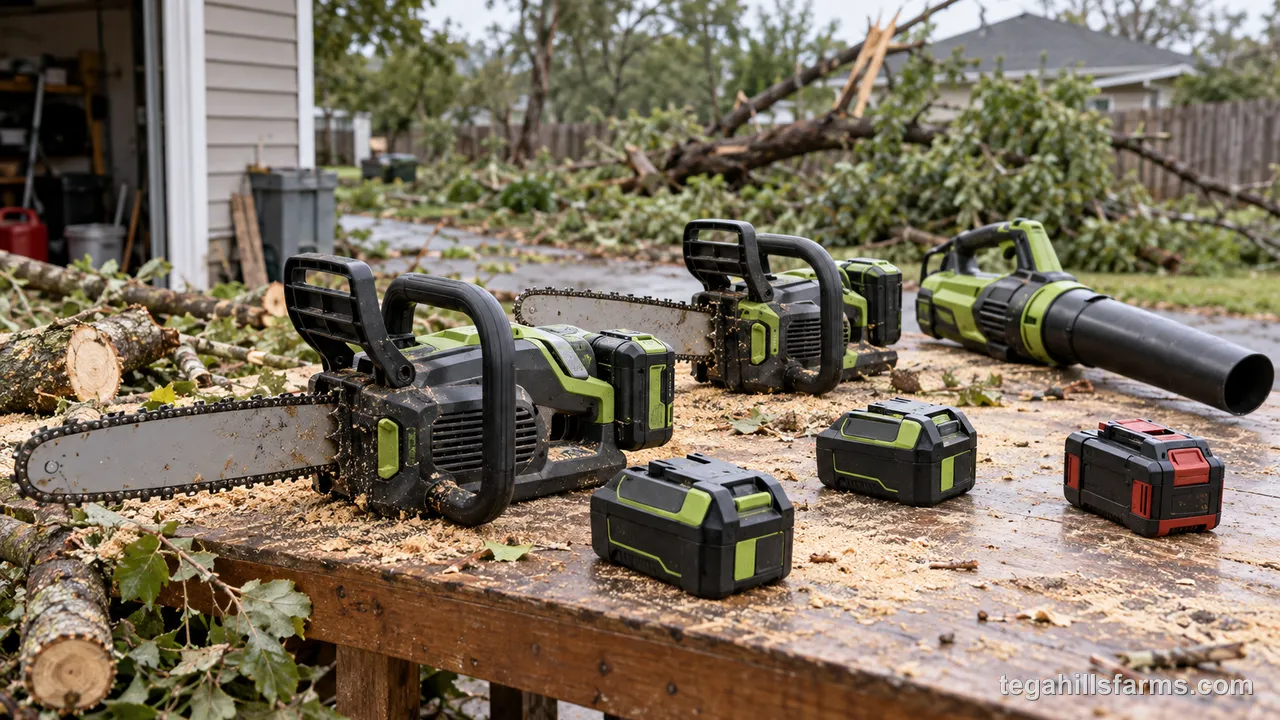
The EGO Power+ CS2005 20 in runs on EGO 56V ARC Lithium batteries, so owners of EGO mowers, blowers or trimmers can share packs. The CRAFTSMAN V20 CMCCS620M1 12in Chainsaw uses CRAFTSMAN V20 packs. Greenworks runs separate platforms: the Greenworks 24V 10″ Chainsaw fits the 24V line, the Greenworks 80V 18 in Chainsaw fits the 80V line, and the two don’t swap. The Makita XCU04Z 18V X2 16″ runs on two 18V LXT batteries and is sold without them. That makes it a sensible add-on for Makita owners and a costlier start for anyone else.
When Is a Fallen Tree Too Risky for DIY Chainsaw Work?
A fallen tree is a job for a professional tree service when it rests on a house, vehicle or power line, when limbs are hung up overhead, or when the trunk is under heavy tension or larger than your saw can handle safely.
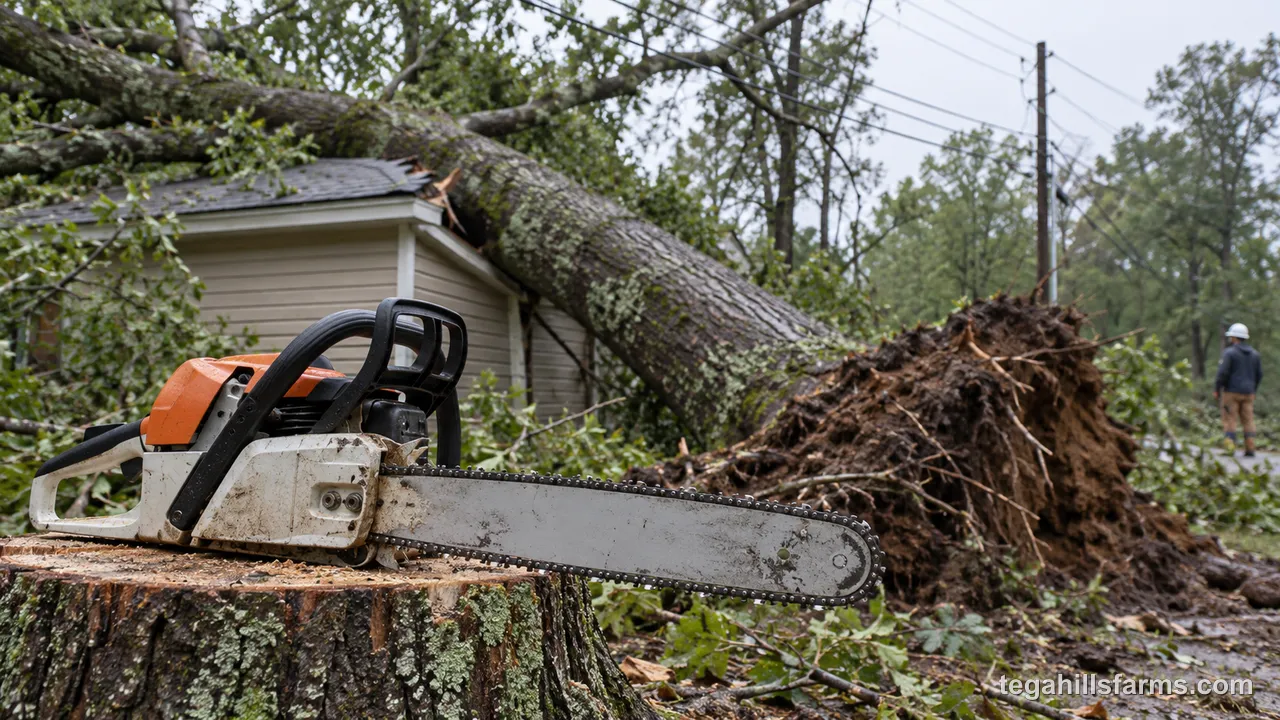
Treat any tree touching a power line as energized. Keep well away and call the utility, because wet wood and soil can conduct current. Hung-up limbs, often called widowmakers, can drop without warning when you cut nearby. An uprooted tree with its root plate still attached is another warning sign, since cutting the trunk free can let the root plate tip back into the hole with tremendous force. Large trunks bent under load store enough energy to break bones when released.
Overhead damage is often a reach problem rather than a power problem. A broken limb dangling from a high branch calls for a saw on a pole that keeps you on the ground, not a bigger chainsaw held above your head, and the best pole saws cover that work. If the limb is heavy or hangs near a structure, call a pro.
What Else Do Storm Cleanup Shoppers Ask About Chainsaws?
Can a compact chainsaw handle storm limbs?
Yes, for branches and small limbs a compact saw is often easier to use than a full-size one. You can hold it steady at awkward angles and work close to fences or shrubs. Its short bar is the limit, since thicker wood takes several cuts from different sides. The best mini chainsaws cover that size class in more depth.
How noisy are gas and battery chainsaws for neighbors?
Battery saws run much quieter than gas saws and make no engine noise between cuts, which matters when cleanup starts early or houses sit close together. Gas saws are loud enough that hearing protection is a must. Noise rules vary by town, so check local hours before cutting, and compare the best quiet chainsaws if noise is a priority.
Can you use a cordless chainsaw in damp weather?
Light dampness is usually fine for a saw with a weather-resistance rating such as IPX4, which covers splashing water. No cordless saw is meant for a downpour or for use in standing water, though. Dry the saw and battery before storing them, keep the battery contacts clean, and follow the manual’s guidance for wet conditions.
Can you recharge a battery chainsaw during a power outage?
Yes, if you have a portable generator or a portable power station that can run the charger. Run a generator outdoors and well away from doors and windows, because its exhaust carbon monoxide is deadly. Without a backup source, charge every pack before the storm arrives and rotate spares so the saw keeps cutting.
Is a storm cleanup saw also good for cutting firewood?
Usually, yes. The same bar length and power that clear downed trunks also buck firewood. The difference is volume, since firewood cutting means long sessions on clean wood, which favors gas saws or cordless saws with spare packs. Trunks from a storm can become next winter’s firewood once they’re cut, split and stacked to dry.



Write Your Review
No reviews yet. Be the first to share your experience!