

Our top picks for the best pole saws for storm cleanup in 2026 are Seesii 2-in-1 Cordless Pole Saw 8in (Best Overall), Seesii 2-in-1 Electric Pole Saws P6 Plus (Runner Up), Greenworks 40V 8in Pole Saw (Editor’s Choice), Suchtale 14ft Manual Pole Saw (Best Budget), Seesii 10in 2-in-1 Pole Saw & Mini Chainsaw (Also Great), AVADA 2-in-1 Pole Saw & Chainsaw 8in (Best Performance), Husqvarna 122LKP Gas Pole Saw (Also Great), Greenworks 40V 8in Pole Saw Hedge Trimmer (Also Great) and VINGLI 26ft Manual Pole Saw (Best Rust-Resistant). The battery kits handle the broken limbs a typical yard sees. The Husqvarna keeps cutting when the grid is down and your chargers are useless, and the manual poles clear thin growth with nothing to charge or fuel.
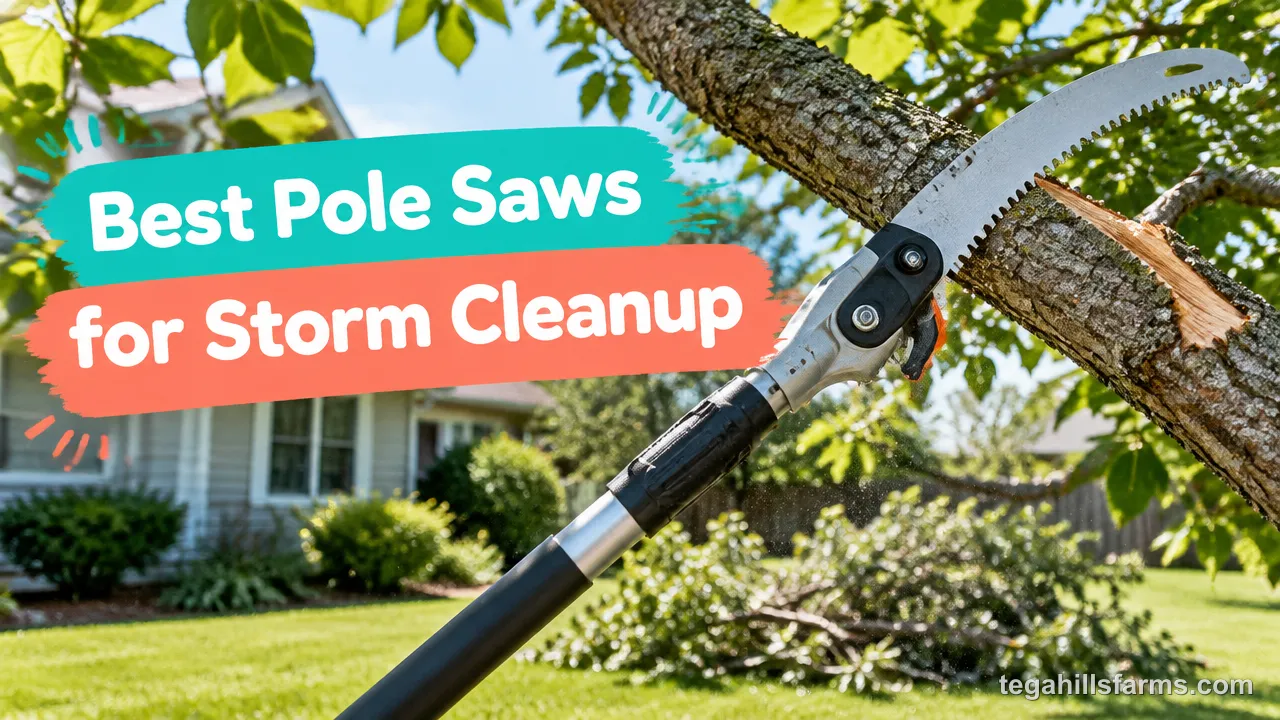
After a storm, these saws differ on power source, reach, bar length and how the weight feels when the cleanup runs long. If you already own Greenworks 40V or DeWALT 20V MAX batteries, that platform can settle the choice before anything else does.
The wood carries more risk than any saw. A torn limb caught in the crown can drop or spring the moment a cut releases it, and some damage belongs to an arborist or the utility company no matter what tool you own.




Charge every battery and check the chain before storm season, because a cordless saw with flat packs does nothing for you the morning after.
What Does a Pole Saw Need to Handle After a Storm?
The job means cutting broken, hung-up and partly torn limbs through wet, gritty wood, with the saw held overhead for long stretches and often no power at the house. That is a different task from routine pruning, where you choose the branch, the angle and the day. Hung-up limbs carry weight and tension that a pruning cut never meets, and dirty bark dulls a chain faster than clean live wood does.
Five things decide whether a saw fits this work: the power source, the reach, bar length against the thickness of your limbs, weight and balance at the head, and whether the saw runs on a battery platform you already own. For the usual mix of trees around a house, saws that rank among the best pole saws for homeowners can do this work, as long as the bar and battery match the debris. If your yard work goes beyond storm damage, our roundup of the best pole saws covers the everyday trimming a pole saw handles the rest of the year.
The 9 Best Pole Saws for Storm Cleanup of 2026
Our top picks for storm cleanup in 2026 are Seesii 2-in-1 Cordless Pole Saw 8in, Seesii 2-in-1 Electric Pole Saws P6 Plus, Greenworks 40V 8in Pole Saw, Suchtale 14ft Manual Pole Saw, Seesii 10in 2-in-1 Pole Saw & Mini Chainsaw, AVADA 2-in-1 Pole Saw & Chainsaw 8in, Husqvarna 122LKP Gas Pole Saw, Greenworks 40V 8in Pole Saw Hedge Trimmer and VINGLI 26ft Manual Pole Saw. The battery 2-in-1 kits suit light to moderate limbs in yards where you can recharge between sessions. The Greenworks and AVADA models fit best if Greenworks 40V or DeWALT 20V MAX packs already sit on your shelf. The Husqvarna runs on fuel, so it keeps cutting through a long outage, while the Suchtale and VINGLI need nothing to charge but only handle thin growth.
#1 Seesii 2-in-1 Cordless Pole Saw 8in — Best Overall
Homeowners facing a yard of small and medium broken limbs get real working time from this kit, because both 21V 4.0Ah batteries are rated for up to 50 minutes each. The saw also comes free of the pole for limbs already down.
Key Specs:
- Bar: 8-inch guide bar, manganese steel chain
- Motor: 800-watt brushless
- Reach: telescoping pole, 6 ft to 10 ft
- Batteries: 2 × 21V 4.0Ah, up to 50 minutes each
- Weight: 3.6 lb handheld, 7.2 lb as a pole saw
- Warranty: 3 years
Detailed Review:
The 8-inch bar is sized for the small to medium limbs that come down around a house, not for trunks. Its 800-watt brushless motor drives a manganese steel chain that gets through an 8-inch log in 12 seconds, so a broken limb goes from hanging to cut into sections quickly. Wood thicker than that is more than this bar can take in a clean pass.
Swapping between the two packs keeps the saw cutting while the spent one charges. During an outage, those two packs are all the cutting time you have, so charging both before the storm is part of owning this saw.
The telescoping pole runs from 6 ft to 10 ft, and the adjustable cutting angle lets you line the bar up with a limb hanging crooked in the crown. At 7.2 lb as a pole saw, it stays manageable overhead, and the included shoulder strap carries part of that load. The kit also includes a security lock, safety baffles, gloves and goggles, and a 3-year warranty covers a tool that will see rough use. I’d steer a typical suburban yard toward this kit first, because it covers overhead hangers and ground cleanup without a second tool.
Pros:
- Two 4.0Ah batteries keep long cleanups going.
- Switches between pole saw and handheld mini chainsaw.
- Telescoping pole adjusts from 6 ft to 10 ft.
- Shoulder strap, gloves and goggles come included.
- 3-year warranty on the tool.
Cons:
- 8-inch bar limits it to small and medium limbs.
- Recharging both packs depends on household power.
Who It’s For:
Suburban homeowners who clear small and medium broken limbs after a storm are a good match, since the same motor handles overhead hangers and wood already on the ground. If your trees drop thick limbs from high in mature crowns, the Seesii 10in 2-in-1 Pole Saw & Mini Chainsaw, with its longer bar, suits that work better.
Editor’s Verdict:
A well-rounded storm kit: enough bar for typical yard limbs, enough battery for a long session, and a handheld mode for cleanup on the ground.
#2 Seesii 2-in-1 Electric Pole Saws P6 Plus — Runner Up
Owners facing thinner limbs who want a light tool overhead will like this kit, because its 6-inch handheld saw weighs 3.2 lb. Automatic oiling removes a routine stop from long jobs.
Key Specs:
- Bar: 6-inch
- Cutting range: branches ¾ inch to 6 inches
- Reach: trims up to 10 ft high
- Batteries: 2 × 21V 2000mAh
- Weight: 3.2 lb handheld saw
- Chain oiling: automatic
Detailed Review:
The 6-inch bar and brush motor match branches from ¾ inch to 6 inches, which covers the snapped tips and smaller limbs that litter a yard after high wind. Compared with the Seesii 2-in-1 Cordless Pole Saw 8in, you give up bar length and battery capacity in exchange for a lighter handheld saw. That lower weight means less strain on your shoulders when the saw is up at full reach.
The adjustable cutting head angles the bar over fences, around corners and into undergrowth, so you can line up the cut without twisting your back. The two 21V 2000mAh batteries let you swap packs as one runs down, and automatic oiling keeps the chain lubricated without stopping to pump. The case holds a spare chain, charger, shoulder strap, goggles and gloves, but the oil bottle ships empty, so pick up bar oil with the kit.
Thick, wet hardwood near the top of its range is where it struggles, because a 6-inch bar at its limit cuts slowly and binds more easily. Those limbs are a better job for a longer bar and bigger batteries.
Pros:
- Handheld saw weighs 3.2 lb for easy overhead control.
- Automatic oiling means no manual pumping.
- Adjustable head reaches branches over fences and corners.
- Spare chain and safety gear come in the case.
Cons:
- 6-inch bar restricts it to thinner limbs.
- Smaller 2000mAh packs need more frequent swaps.
Who It’s For:
Gardeners and homeowners who mainly deal with small branches, fence-line growth and light wind damage will find the low weight easy to live with overhead. Anyone expecting thick hardwood limbs should look at the Seesii 2-in-1 Cordless Pole Saw 8in instead, since its longer bar and larger batteries handle heavier debris.
Editor’s Verdict:
Pick this kit for light, frequent cleanup where low weight matters more than cutting capacity.
#3 Greenworks 40V 8in Pole Saw — Editor’s Choice
Greenworks 40V owners can add this saw without buying another battery, and its 11 ft reach and 31.2 ft/s chain speed put overhead storm limbs within range from the ground. Big jobs call for a spare pack.
Key Specs:
- Bar: 8-inch, 31.2 ft/s chain speed
- Reach: up to 11 ft, 3-piece aluminum shaft
- Battery: 40V 2.0Ah, up to 15 minutes continuous runtime
- Charger: 2A, full charge in 60 minutes
- Weight: 7.8 lb
- Warranty: 3 years, tool and battery
Detailed Review:
The 31.2 ft/s chain speed on the 8-inch bar keeps chips clearing out of wet storm wood instead of letting the cut bog down. The 3-piece aluminum shaft comes apart for storage, which matters when the saw hangs on a garage wall or sits in a small shed between storms.
The included 2.0Ah pack is rated for up to 15 minutes of continuous cutting, and the 2A charger refills it in 60 minutes. On a large cleanup, that turns into cut, wait, cut unless you already own more Greenworks 40V packs, and owners who do are the buyers this saw fits.
Starting takes a 2-step trigger, and the built-in automatic chain oiler reduces chain wear with no gas to mix. The balanced body and big sponge grip ease fatigue over a long session, and the 7.8 lb weight keeps the head manageable at full extension. Low vibration also helps your hands stay steady through repeated cuts. The 3-year warranty covers both the tool and the battery.
Pros:
- Shares batteries with other Greenworks 40V tools.
- 3-piece aluminum shaft comes apart for storage.
- Automatic oiler and 2-step trigger start.
- Warranty covers tool and battery for 3 years.
Cons:
- Single 2.0Ah battery limits continuous cutting time.
- Recharging the pack takes 60 minutes between sessions.
Who It’s For:
Anyone already running Greenworks 40V mowers, trimmers or blowers gets a pole saw that uses the packs sitting on the charger. If you own no batteries from that platform and expect long cleanup sessions, a kit that ships with larger batteries, such as the Seesii 2-in-1 Cordless Pole Saw 8in, fits better.
Editor’s Verdict:
Choose it if your shelf already holds Greenworks 40V batteries; the saw itself is balanced, low in vibration and simple to start.
#4 Suchtale 14ft Manual Pole Saw — Best Budget
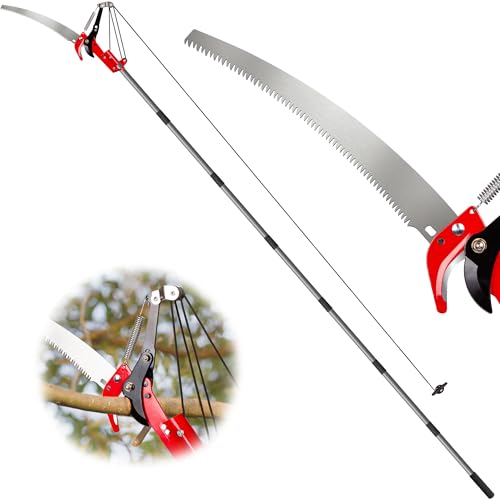
Thin branches and twigs during an outage are its job, since it needs no battery or fuel. Its pull-rope shears run through a 4-pulley system and close on branches up to about 1.2 inches, with an integrated saw blade as a backup for the occasional piece the shears can’t take.
Key Specs:
- Pruning capacity: branches up to about 1.2 inches
- Blade: 65Mn steel pruning blade plus integrated saw
- Pole: 14 ft sectional, threaded joints with wing nuts
- Pulley: 4-pulley rope system
- Weight: 6.2 lb
Detailed Review:
Nothing on this tool needs charging or fueling, so it works the morning after a storm whether or not the house has power. The 65Mn steel shears are worked by rope from the ground, and the 4-pulley system increases your leverage so the blade closes with less effort overhead.
Small side branches, twigs and snapped tips are what it handles. A broken limb as thick as your forearm is beyond the shears, and the integrated saw blade works as a backup for odd cuts rather than a stand-in for a powered chain. Hung-up storm limbs need a different tool entirely.
The pole is sectional, so you add or remove pieces to set the working height for each branch, and the threaded joints with wing nuts go together without tools. It comes apart for transport and compact storage, and at 6.2 lb it is easy to carry around the yard.
As a budget tool, it works well alongside a powered saw. It clears the light growth that would waste battery time and stays useful when every pack is flat.
Pros:
- Works with no battery, fuel or outlet.
- 4-pulley rope system eases overhead shear cuts.
- Sectional pole adjusts to each branch height.
- Wing nut joints assemble without tools.
Cons:
- Shears top out around 1.2-inch branches.
- Rope-pulled cuts are slower than a powered chain.
Who It’s For:
Budget-minded homeowners with fruit trees, shrubs and small yard trees can keep this on hand for twigs and light breakage, especially through outages when nothing else can charge. Thick or hung-up storm limbs are the wrong job for it; those call for a powered saw with a real bar and chain.
Editor’s Verdict:
Keep it as a no-power backup for light pruning; it does that narrow job well and asks nothing of your outlets.
#5 Seesii 10in 2-in-1 Pole Saw & Mini Chainsaw — Also Great
Yards with mature trees that drop thicker limbs are better served by this kit, because its 10-inch bar and 900W brushless motor take on heavier wood than the smaller Seesii kits. Runtime reaches up to 120 minutes.
Key Specs:
- Bar: 10-inch guide bar
- Motor: 900W brushless
- Reach: pole up to 10 ft, up to 16 ft total with user height
- Batteries: 2 × 21V 4000mAh, up to 120 minutes runtime
- Weight: 4.6 lb handheld, 8 lb as a pole saw
- Chain oiling: automatic
Detailed Review:
The 10-inch bar is rated for branches up to 10 inches in diameter, and the brushless motor’s torque finishes thick cuts in fewer passes. Compared with the Seesii 2-in-1 Cordless Pole Saw 8in, you gain bar length and motor output, and the extra capacity adds weight: 4.6 lb handheld and 8 lb on the pole, against 3.6 lb and 7.2 lb.
The two 21V 4000mAh batteries deliver about 200 cuts per charge, and the fast charger refills them in about 2 hours. That is enough for a long cleanup session before the packs need an outlet again.
Automatic chain oiling keeps lubrication steady through long sessions in dirty wood, so there is no oil bulb to press between cuts. A dual-button start with a safety lock guards against accidental starts, and the case adds goggles, gloves, an auxiliary handle and a shoulder strap. The pivoting head adjusts cutting angle and direction for limbs caught in awkward positions.
I’d only pick this over a smaller-bar kit when your trees actually produce thick limbs. For twiggy damage, the extra weight gains you nothing.
Pros:
- 10-inch bar handles thicker storm limbs.
- Up to 120 minutes of runtime per charge.
- Brushless motor with automatic chain oiling.
- Dual-button start with safety lock.
Cons:
- At 8 lb on the pole, arms tire sooner.
- Charging both packs takes about 2 hours.
Who It’s For:
After storms that bring down thick limbs from mature shade trees, homeowners get extra bar and motor without moving to gas. Anyone who mainly clears twigs and light breakage will find the Seesii 2-in-1 Electric Pole Saws P6 Plus easier to hold up, since it weighs less in hand.
Editor’s Verdict:
Worth the extra weight only if your trees drop limbs too thick for a smaller bar.
#6 AVADA 2-in-1 Pole Saw & Chainsaw 8in — Best Performance
DeWALT 20V MAX owners can run this saw on packs they already have. Its brushless motor drives the chain at up to 38 ft/s, and the cutting head pivots from 0° to 180° to meet hung-up limbs at awkward angles on a 5.7 lb tool.
Key Specs:
- Battery: DeWALT 20V MAX (battery and charger not included)
- Motor: 1200W brushless
- Bars: 8-inch and 6-inch included
- Chain speed: up to 38 ft/s with auto-lube
- Reach: pole 5.6 ft to 9.9 ft, up to 15.9 ft total
- Weight: 5.7 lb
Detailed Review:
This is a tool-only saw: it runs on DeWALT 20V MAX batteries, and neither the battery nor the charger comes in the box. If you already own those packs, it is ready to cut; if you don’t, add a battery and charger before the first storm.
The chain runs through the auto-lube system at up to 38 ft/s, faster than the 31.2 ft/s of the Greenworks 40V 8in Pole Saw, so it clears chips from wet wood more quickly. The Greenworks comes with a battery and charger in the box, which matters if you are starting without any packs.
The cutting head adjusts from 0° to 180°, which lets you set the bar square to a limb hung at an odd angle instead of cutting from a twisted stance. The pole telescopes from 5.6 ft to 9.9 ft, reaching up to 15.9 ft overhead for a 6-foot user at shoulder height, and the kit includes both an 8-inch and a 6-inch bar.
Tool-free chain installation and an automatic tensioner keep a chain that stretches in wet wood tight without a trip to the workbench. At 5.7 lb it stays light overhead, and the kit adds a shoulder strap, gloves and goggles.
Pros:
- Runs on DeWALT 20V MAX batteries you may own.
- Chain speed up to 38 ft/s with auto-lube.
- Cutting head adjusts from 0° to 180°.
- Tool-free chain install and automatic tensioner.
- Comes with both 8-inch and 6-inch bars.
Cons:
- Battery and charger are sold separately.
- Telescoping pole tops out at 9.9 ft.
Who It’s For:
If your garage already holds DeWALT 20V MAX batteries, this saw turns them into storm cleanup power with a quick chain and a flexible head. Buyers with no packs on the shelf will have an easier time with a kit that includes a battery and charger, like the Greenworks 40V 8in Pole Saw.
Editor’s Verdict:
For DeWALT 20V MAX owners, it adds a quick, light pole saw without another battery system to manage.
#7 Husqvarna 122LKP Gas Pole Saw — Also Great
When a storm knocks out power for days, this gas saw keeps cutting on fuel alone, with a 12-foot reach and a rating for limbs up to 8 inches thick. Fuel and engine upkeep come with it.
Key Specs:
- Engine: 21.7cc gas
- Reach: up to 12 ft
- Cutting capacity: limbs up to 8 inches thick
- Chain: Husqvarna X-CUT with automatic oiling
- Weight: 13.1 lb
- Shaft: detachable, accepts click-on attachments
Detailed Review:
A gas engine doesn’t depend on the grid or on charged batteries, so this saw keeps working through an outage of any length. Smart Start pairs a specially designed engine and starter for fast starts with minimal effort, which helps on a cold, wet morning.
The X-CUT chain is built to hold its sharpness, and automatic oiling extends the life of the bar and chain through long days of cutting. Both matter more when the cleanup means working through a pile of gritty wood.
At 13.1 lb, it is heavier than the Greenworks 40V 8in Pole Saw at 7.8 lb, so your shoulders feel it sooner on long overhead stretches. The engine also brings fuel to store and keep fresh, plus spark plug and air filter care, chores a battery saw never asks for.
The detachable shaft takes click-on attachments, including an edger and a hedge trimmer sold separately. That lets the engine do yard work between storms instead of sitting in the shed.
Pros:
- Runs on fuel, independent of outlets and chargers.
- 12-foot reach for high hung-up limbs.
- Rated for limbs up to 8 inches thick.
- Shaft accepts click-on attachments like an edger.
Cons:
- 13.1 lb grows heavy when held overhead.
- Engine needs fuel storage and regular upkeep.
Who It’s For:
Rural homeowners, and anyone who loses power for long stretches after storms, will value a saw that keeps going on a can of fuel. People who want a light tool overhead, or who dislike engine upkeep, are better served by the Greenworks 40V 8in Pole Saw, which carries less weight.
Editor’s Verdict:
Buy the gas model when outages run long and limbs run thick; skip it if a battery saw already covers your yard.
#8 Greenworks 40V 8in Pole Saw Hedge Trimmer — Also Great
Storms that shred hedges as well as trees call for this pair. It combines an 8-inch pole saw with a 20-inch dual-action hedge blade on a 7-position pivoting head, both running on a Greenworks 40V battery.
Key Specs:
- Pole saw: 8-inch bar and chain, easy-adjust tensioning
- Pole hedge trimmer: 20-inch dual-action blade
- Hedge head: 7-position pivoting
- Battery: 40V 2.0Ah with charger
- Chain oiling: automatic oiler
- Weight: 11 lb
Detailed Review:
The pole saw handles broken limbs, and the pole hedge trimmer squares up tall hedges that wind has torn or bent out of shape. The 7-position pivoting head sets the hedge blade at an angle, so you can cut a hedge top or side from the ground without a step stool. The 20-inch dual-action blade covers a long stretch of hedge with each pass.
On the saw side, easy-adjust tensioning tightens a chain that loosens in wet wood, and the automatic oiler keeps the bar and chain lubricated. Both tools run on Greenworks 40V power, so they start instantly, run quietly and need no gas or engine oil.
The kit weighs 11 lb in total, against 7.8 lb for the Greenworks 40V 8in Pole Saw alone, so the hedge trimmer is extra weight to store and carry if your hedges never take storm damage. Both tools draw from the included 2.0Ah battery, so a day that mixes saw and hedge work empties it quickly.
Pros:
- Adds a pole hedge trimmer with a pivoting head.
- Easy-adjust tensioning for quick chain tightening.
- Automatic oiler protects the bar and chain.
- Quiet, instant start with no gas or emissions.
Cons:
- Both tools share the included 2.0Ah battery.
- 11 lb kit weight exceeds the standalone saw.
Who It’s For:
Homeowners with tall hedges along the property line get one setup for broken limbs and wind-torn hedge tops, all on Greenworks 40V power. If storm damage at your place stays in the trees, the Greenworks 40V 8in Pole Saw handles that work and weighs less.
Editor’s Verdict:
A practical combo when storms hit hedges as hard as trees; otherwise the hedge trimmer is weight you do not need.
#9 VINGLI 26ft Manual Pole Saw — Best Rust-Resistant
For high limbs on palms and tall trees, this pole extends to 26 feet on 8 fiberglass sections and cuts with no battery or engine, whatever the power situation. Its rust-treated steel head holds up to wet weather.
Key Specs:
- Reach: extends up to 26 ft
- Pole: 8 fiberglass sections, threaded metal connections
- Saw blade: curved, 3-sided gear-ground, plus replacement blade
- Pruner: spring-action pruning jaw
- Rust protection: rust-treated steel blade and pruner head
- Storage: carrying bag
Detailed Review:
Seamless steel pipe joints and threaded metal connections hold the fiberglass sections together, so the pole stays tight instead of wobbling or slipping apart at length. The curved, 3-sided gear-ground saw blade takes on thick branches, and the spring-action pruning jaw snips twigs and leaves, so one head covers both jobs.
The steel blade and pruner head are rust-treated and the fiberglass resists corrosion, so a pole put away damp after a rainy cleanup keeps its edge and its finish. A replacement blade in the kit extends that working life further.
At full extension, every saw stroke moves a long pole, and the tip wanders more the farther it sits from your hands, so controlled cuts on thick limbs take real effort. The non-slip rubber grip and lightweight fiberglass help your hold. Even so, the pole is better suited to thinner limbs and the occasional thick branch you can reach from a steady stance than to a yard full of heavy storm wood.
The poles detach without tools and break down into compact sections for the included carrying bag. That makes it easy to store in a closet or truck between jobs.
Pros:
- Extends up to 26 feet without a ladder.
- Rust-treated steel blade and pruner head.
- Saw blade and pruning jaw share one head.
- Threaded metal joints keep sections secure.
- Carrying bag and replacement blade included.
Cons:
- Manual sawing at full length takes real effort.
- Long pole tip is harder to control precisely.
Who It’s For:
Owners of tall palms, oaks and other high trees who want reach without a motor, especially where tools stay damp, will get steady use from this pole. If your storm debris includes heavy limbs you want cut quickly, a powered saw like the Husqvarna 122LKP Gas Pole Saw fits that job.
Editor’s Verdict:
Long, rust-resistant and fully manual, it suits high trimming in damp yards better than heavy storm cutting.
What Should You Look for in a Storm Cleanup Pole Saw?
Storm work rewards a saw you can keep running and keep holding up through a long, awkward session more than a saw with impressive cutting specs. A limb hung in a crown rarely comes down in a single clean pass. You reposition, wait for a gust to pass and cut again, so whatever drains your battery or your shoulders first sets the pace of the whole cleanup. How the saw handles in your hands decides whether you finish the job or quit halfway, and how high and how thick it can cut is a separate limit.
Battery, Gas or Corded: Which Power Source Works Best After a Storm?
For a typical home, a battery saw with every pack charged before the storm is the practical choice, and gas only makes sense where outages run long or limbs run thick. A corded saw is the poorest fit, because it stops the moment the power goes out, which is exactly when storm cleanup starts.
Here is how the four power options compare once the grid is down:
| Power source | Works in an outage | Prep before the storm | Ongoing upkeep | Limbs it suits |
|---|---|---|---|---|
| Battery | Yes, while packs last | Charge every pack | Chain care, battery storage | Light to moderate |
| Gas | Yes, while fuel lasts | Fresh fuel on hand | Fuel, spark plug, air filter | Moderate to thick |
| Corded electric | No | None | Low | Light to moderate |
| Manual | Yes | None | Blade care | Thin growth only |
Even with the grid up, a corded saw ties you to an outdoor GFCI outlet and an extension cord dragged through wet grass and debris. The best corded pole saws still make sense for planned trimming close to the house, just not as your only storm tool.
A battery saw works through an outage only on the charge it had when the lights went out, so charge every pack when a storm is forecast and keep spares if your platform has them. Runtime usually ends a cordless session before cutting power does, and the best battery pole saws for this job pair a capable bar with enough pack capacity to finish.
Gas keeps running as long as there is fuel in the can, which matters in an outage that lasts days. The cost is fuel to store and refresh, an engine to maintain, and more weight and noise on the pole.
Manual poles need no power at all, but they only cut thin growth, so they back up a powered saw rather than replace it. I’d pick battery for most suburban yards and add gas only if long outages are normal where you live.
How Much Do Weight and Balance Matter for Overhead Cutting?
Weight and balance decide how long you can keep the saw raised before your arms and shoulders force a break, and how accurately the chain lands on the cut. A pole saw puts its motor or engine and chain at the far end of a long lever, so weight at the head feels heavier at your hands, and the effect grows as you extend the pole.
That leverage is why a heavy gas head or a fully extended pole is harder to steer: the tip wanders, your grip tightens and the cut drifts out of line. Fatigue also affects safety, because tired arms let the saw dip just as a limb releases.
A shoulder strap moves part of the load onto your torso, which frees your hands to guide the bar instead of just holding it up. Use the shortest extension that reaches the cut, since a lighter pole with its weight closer to your hands keeps cuts accurate late in a long cleanup.
Does Your Existing Battery Platform Matter?
Yes. A pole saw that shares batteries with tools you already own saves you from buying new packs, and the batteries on your shelf become spare runtime for a long storm cleanup.
A platform is a battery design and voltage shared across one maker’s tool line, so a 40V pack from a mower or blower fits the pole saw from the same line. Some saws are built to take another brand’s batteries and are sold as bare tools, with the battery and charger sold separately. If you own none of those packs, the real cost of that bare tool includes a battery and charger you still have to buy.
With no batteries yet, or with packs from a brand that makes no pole saw, a self-contained kit with batteries and charger included is simpler. Everything arrives matched, charges together and is ready before the storm.
How Much Reach and Bar Length Do You Need for Storm Limbs?
You need enough height to get the saw to the damage from the ground and enough cutting capacity for the thickest limb at that spot, and those are two separate limits. A saw that gets to a hanger but can’t cut through it is as useless as one that cuts well but stops short of the limb. Look up at the damage before choosing, note how high the worst breaks sit and how thick they are where you would cut, and match both.
How Far Should a Pole Saw Reach?
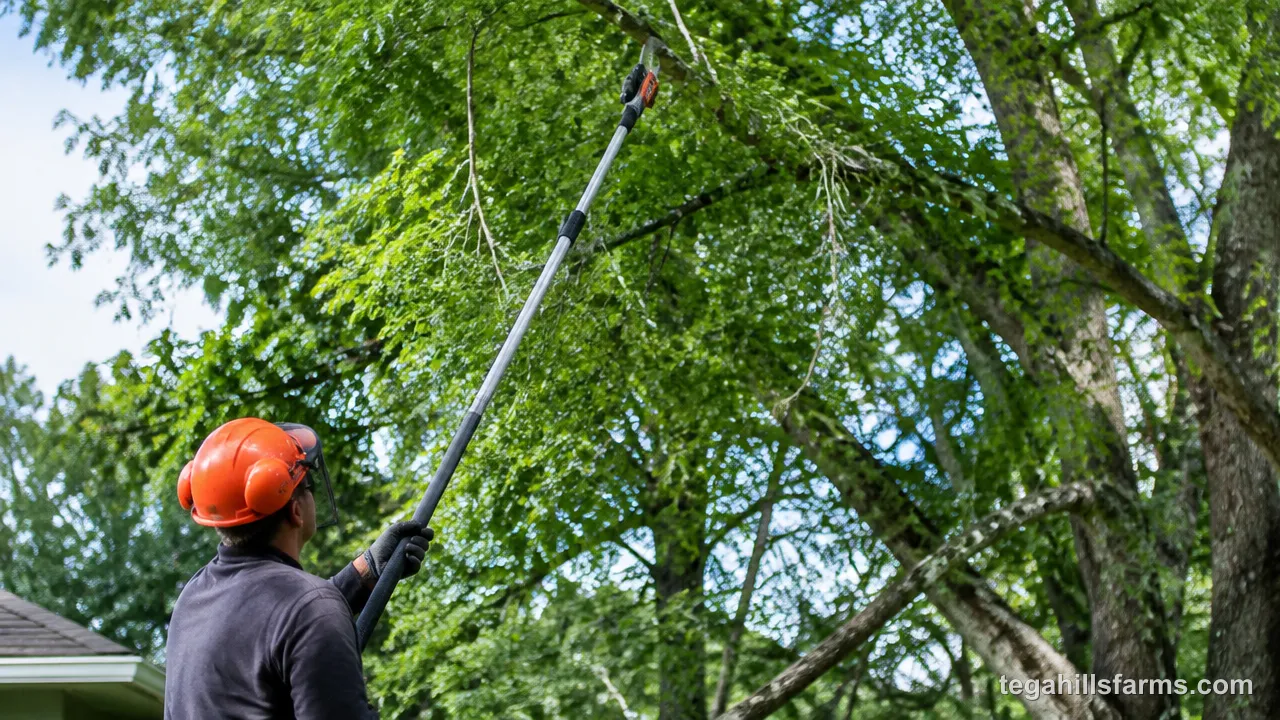
Far enough to put the bar on the cut while you stand on firm ground in a safe spot, and no farther. Listed reach usually adds your standing height and arm extension to the pole length, so the figure on the box runs higher than the pole itself.
Each added foot of pole brings more weight and wobble at the tip, which makes it harder to keep the chain in the cut. A telescoping or sectional pole lets you shorten it for lower limbs and get that control back, which is why the best telescoping pole saws suit cleanup with breaks at mixed heights.
If you are working at full extension, angled steeply and unsure where a limb will fall, stop and call a pro. If tall trees on your property shed limbs regularly, the best pole saws for tall branches are worth a look, but treat maximum reach as the edge of the job rather than its normal range.
Which Bar Length Matches Storm Branch Diameter?
Pick a size longer than the thickness of the limbs that usually come down on your property, because that length sets the thickest wood the saw can handle in a single cut. A limb thicker than the bar forces cuts from more than one side, which is slow and awkward with the saw overhead.
A small bar working at its limit stalls or binds in thick, wet wood, because the chain buries itself and has little room to clear chips. Wet storm wood also tends to close on the bar as a hanging limb sags, which pinches the chain harder than a dry pruning cut does.
Big limbs come down in sections: take short pieces from the far end first so the weight drops gradually, then work back toward the trunk. A longer bar handles thicker wood but adds weight at the head and makes overhead control harder, so size it to the limbs you actually get.
Pole Saw, Pole Pruner or Chainsaw: Which Fits Each Storm Job?
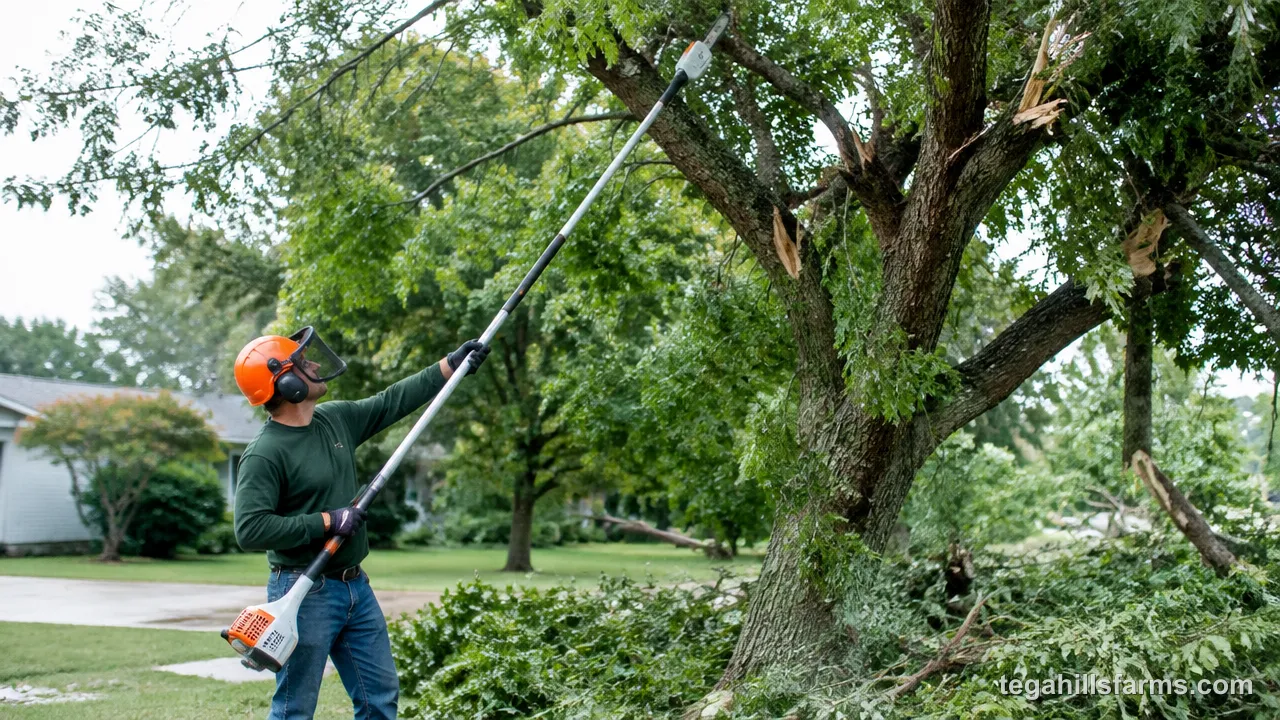
Hung-up limbs overhead call for a powered saw on a long shaft, thin twigs and small branches for rope-pulled shears, and wood already on the ground for a full-size handheld saw.
Each tool fits a different part of the cleanup:
| Storm job | Powered pole saw | Manual pole pruner | Chainsaw |
|---|---|---|---|
| Limbs hanging overhead | Good fit | Thin pieces only | Unsafe to hold overhead |
| Twigs and small branches | Works, uses battery or fuel | Good fit | Awkward and unnecessary |
| Limbs already on the ground | Slow for big wood | Not suited | Good fit |
| Thick trunk sections | Not suited | Not suited | Good fit |
A pole pruner’s shears close only on small wood, and every cut depends on how hard you can pull the rope, so it handles twigs and snapped tips and stops there. If your trees mainly need shaping rather than cleanup, the best pole saws for pruning lean toward light weight and clean cuts.
A regular chainsaw is the faster tool once wood is on the ground, with a bigger bar and engine or motor behind it. Holding one above shoulder height puts the bar near your face and the kickback zone where you can’t control it, so it stays on the ground.
A powered pole saw covers the overhead work from a safe distance, and 2-in-1 kits whose saw comes free of the pole also cover light ground cleanup. Thick sections on the ground still belong to a full-size chainsaw.
How Do You Cut Storm Damage Safely With a Pole Saw?
Working from the ground protects you only as far as your read of the damage and your willingness to leave a limb alone when it carries more risk than a homeowner tool can manage. Storm wood fails in ways pruning wood does not: it hangs, twists and releases suddenly, and it can drop from above while your eyes are on the bar. What you check, what you wear and where you draw the line matter more here than which saw you bought.
What Should You Check Before the First Cut?
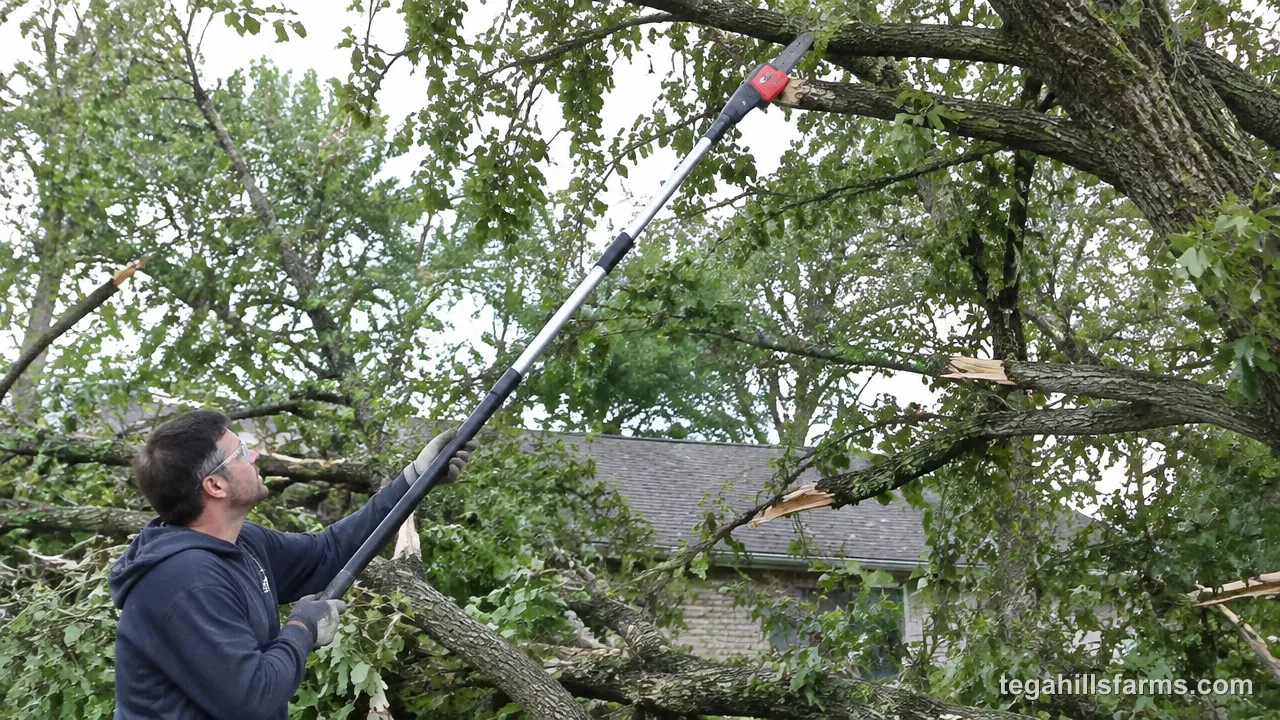
Check what is holding each broken limb up, where it will go when it comes free, and where you will stand, all before the chain touches wood. A limb caught in other branches can drop or swing the moment you cut its last connection, and a hanger you cut from directly below falls straight at you.
Look for wood under tension: a limb bent under load, a split running along the grain, or a branch pinned by another. Wood under tension can spring sideways or split ahead of the cut, which pinches the bar or kicks the pole toward you.
Pick the drop zone and clear it of people, pets, vehicles and loose debris you could trip on. Stand to the side of the limb, never under it, with the pole angled so the piece falls away from you.
Cut in an order that keeps the weight away from the saw. Remove small pieces from the outer end first, so the remaining limb gets lighter and is less likely to tear or pinch the bar on the final cut.
What Protective Gear Do You Need for Overhead Cutting?
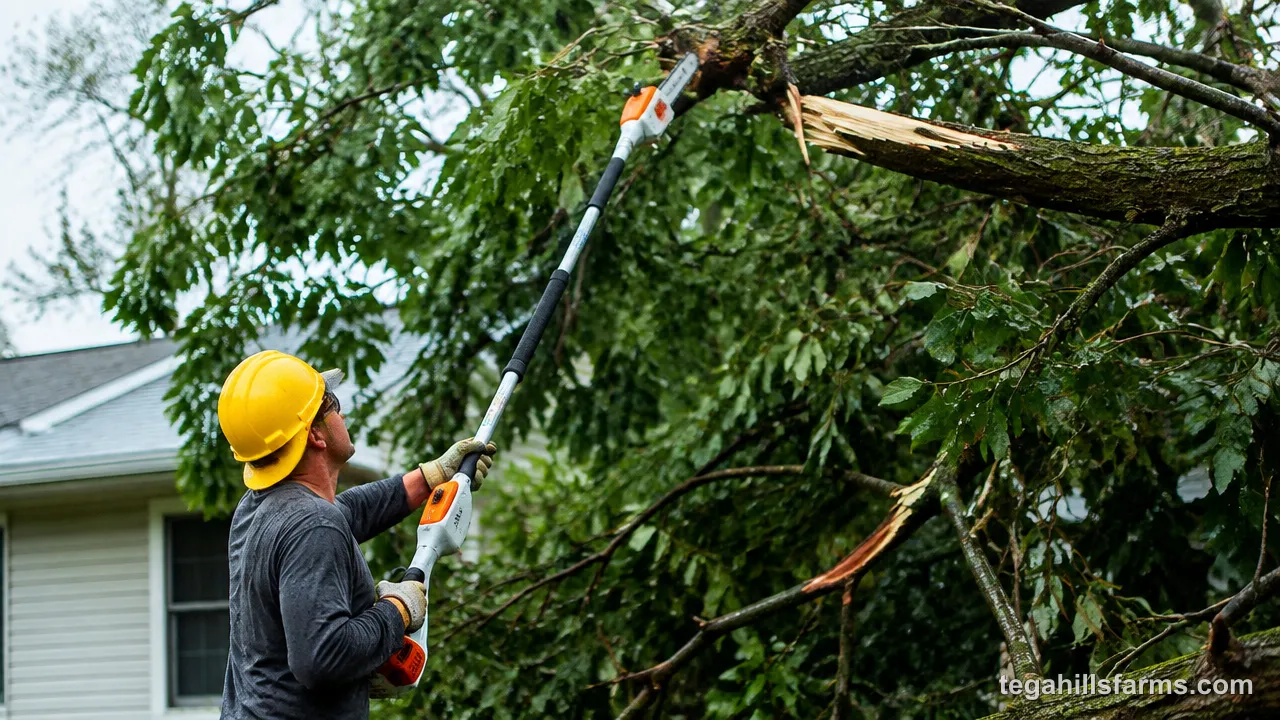
You need a hard hat, eye protection or a face shield, sturdy gloves and non-slip footwear, because overhead cutting sends sawdust, bark and branch pieces down toward your face and head.
A hard hat protects you from the piece you didn’t see, like a dead twig knocked loose from higher in the crown. Eye protection matters more overhead than at ground level, since chips fall into your line of sight with every cut. Gloves protect against rough bark and the chain during adjustments, and non-slip boots keep your footing on wet grass and scattered branches.
The shoulder strap and your stance are part of control, not extras. A strap carries the weight so your hands can steer, and feet set apart on firm ground let you react when a limb releases.
When Is a Branch Too Risky for a Pole Saw?
A branch is too risky whenever it touches or sits near a power line, hangs high on a mature tree, is torn and still under tension, or belongs to a tree that is leaning or split at the trunk. Those jobs go to a certified arborist or the utility company, because the danger comes from the tree and the lines, not from the saw.
Never cut a limb touching or near an overhead line, including the service drop to your house. Electricity can travel through wet wood and a pole, and a fiberglass pole is no substitute for distance. Keep yourself and the full length of the tool at least 10 feet from any line, and call the utility.
Large limbs high on mature trees can weigh more than you can control from below, and torn limbs under tension can swing or spring unpredictably. A tree leaning after a storm or split at the trunk can fail completely when the loss of one limb changes its balance. A longer pole or a bigger bar does nothing about these risks, because they come from where the wood is and how it is loaded.
Limbs that spent a night in mud, rain and blown grit carry that dirt into every cut, and it wears a chain far faster than live wood does. Keep working with a chain that has gone dull in that wood and the saw starts to bind and smoke over your head, burning through battery or fuel on cuts that should take moments.
How Do You Keep a Pole Saw Chain Cutting Cleanly in Wet, Dirty Storm Wood?
Keep the chain sharp, tensioned and oiled, and clean the bar and head after every dirty session, because grit and wet wood wear a chain much faster than routine pruning.
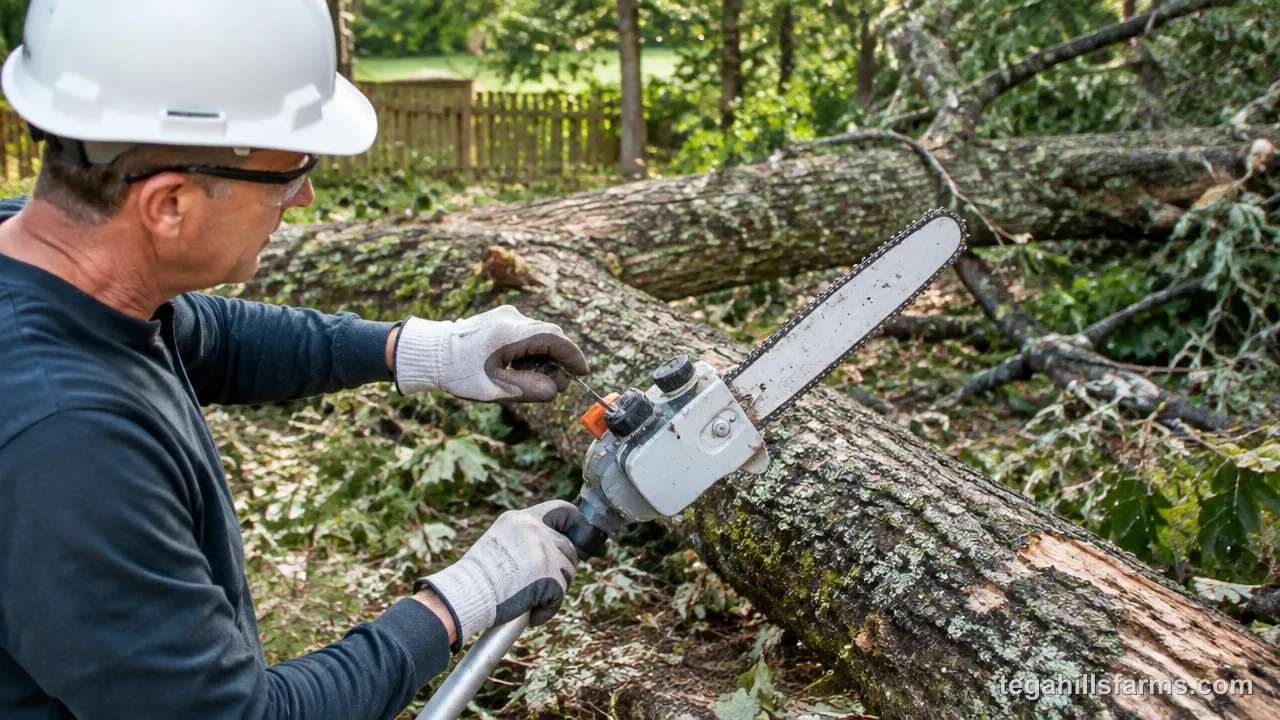
A sharp chain throws chips; a dull one makes fine dust, smokes, pulls to one side or needs you to force the saw through the cut. Any of those signs means you should stop and sharpen before you force another limb.
Check tension with the saw cool: the chain should sit snug against the bar but still pull around by hand with gloves on. Wet wood and heat stretch a chain during use, so recheck it through long sessions.
Bar and chain oil matters on battery and gas saws alike. Keep the reservoir filled and confirm oil is reaching the bar, since a dry chain in dirty wood wears the bar rails and the drive sprocket.
Sharpen when cuts slow down. Replace the chain when the cutters are worn back or damaged from hitting dirt or stone. After cutting, brush grit from the bar groove and saw head, and dry the chain before storage.
Can You Buy a Gas Pole Saw in Every State?
Not always. Some states restrict sales of two-stroke gas equipment that does not meet California Air Resources Board (CARB) emissions rules, so a listing for a gas pole saw may not ship to every address.
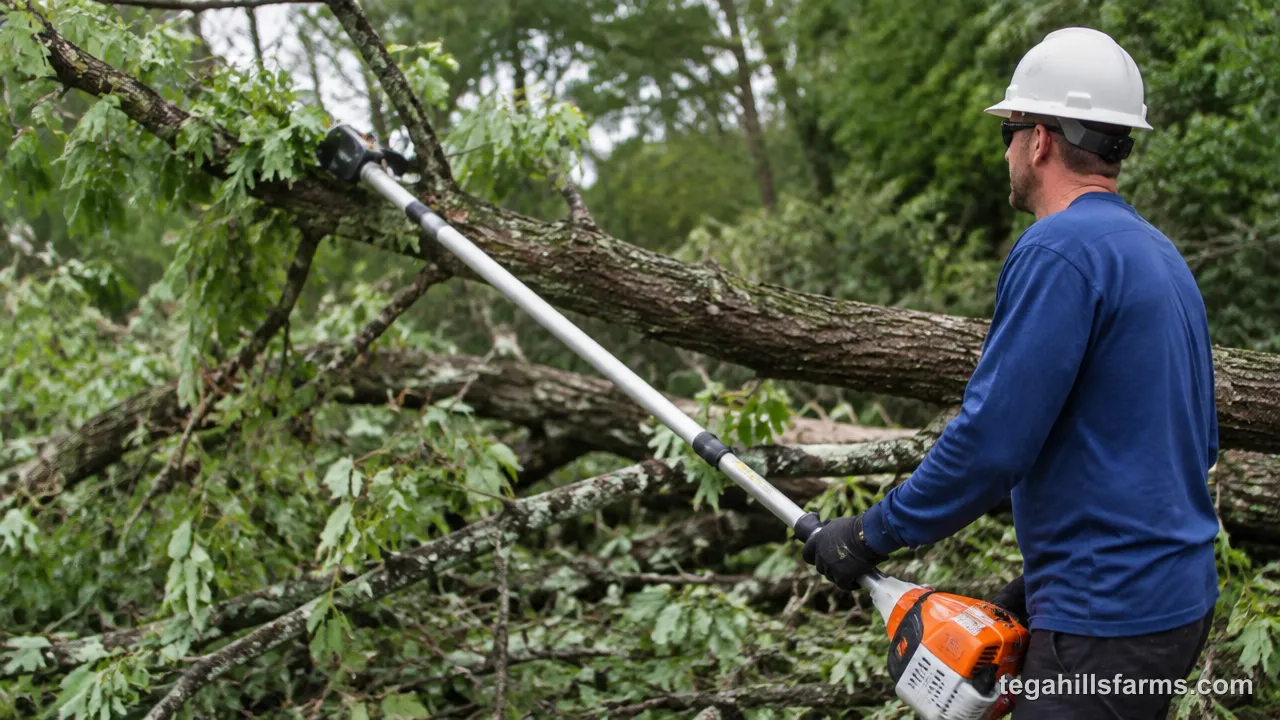
California sets its own small-engine emissions standards and has moved new small gas equipment toward zero-emission models, so a new gas pole saw can be hard or impossible to buy there. Other states may follow CARB rules for some equipment, which is why a model sold in one state can show shipping limits in another.
Check the listing’s shipping restrictions and your state’s rules before settling on gas. If the gas model you want won’t ship to you, a battery pole saw with spare packs is the practical alternative for storm work.







Write Your Review
No reviews yet. Be the first to share your experience!