

Our top picks for the best pole saws for pruning in 2026 are Supstable Cordless Pole Saw 16ft (Best Overall), Seesii 2-in-1 Cordless Pole Saw 8in (Runner Up), Seesii 2-in-1 Electric Pole Saws P6 Plus (Editor’s Choice), BlumeTrec Manual Pole Saw 11ft (Also Great), VEVOR Manual Pole Saw 27ft (Also Great), VEVOR Manual Pole Saw 7.3-27ft (Also Great), Greenworks 40V 8in Pole Saw (Best Easy-Start), Walensee Manual Pole Saw 7.7ft (Best Budget), Likeem Manual Pole Pruner 27ft (Also Great) and BlumeTrec Manual Pole Saw 14.5ft (Also Great). The battery models do the cutting for you. The manual poles give you long reach and almost no upkeep, but your arms do the work.
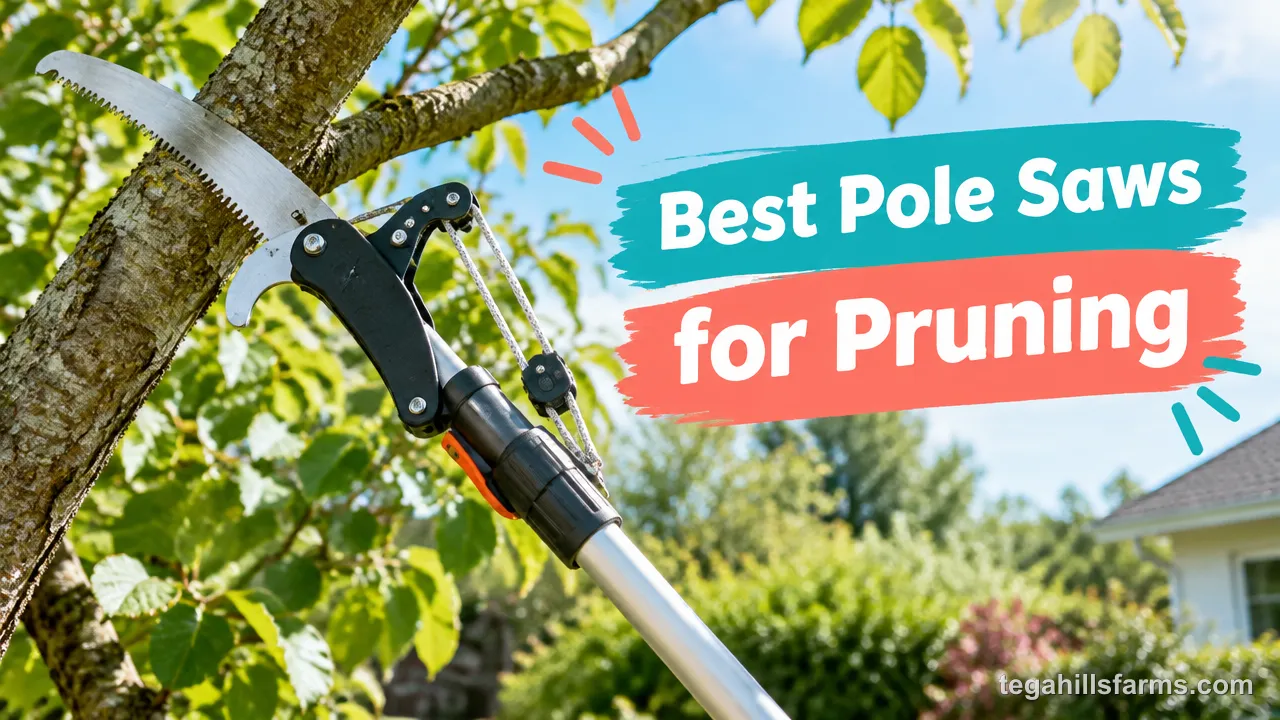
To choose between them, look at how high your problem limbs are, how thick they are and how long you can hold weight at arm’s length. A pole that reaches a branch but can’t cut through it cleanly leaves torn bark. A powerful saw on a short pole still sends you back up a ladder.
A ragged cut that tears bark below the branch collar heals slowly and can let rot in, so the tool has to cut cleanly at whatever angle you can reach. Working overhead also brings its own hazards: sawdust falling toward your eyes, limbs dropping where you stand and power lines running through the crown.


If you prune a few small trees once or twice a season, a light manual pole will cover the job. If you have thick limbs or a long list of trees, a powered kit is worth the battery care.
What Is the Difference Between a Pole Saw and a Pole Pruner?
One cuts with saw teeth or a bar and chain that can get through thick limbs, while the other closes shears or hook blades on twigs and small branches with one pull of a rope.
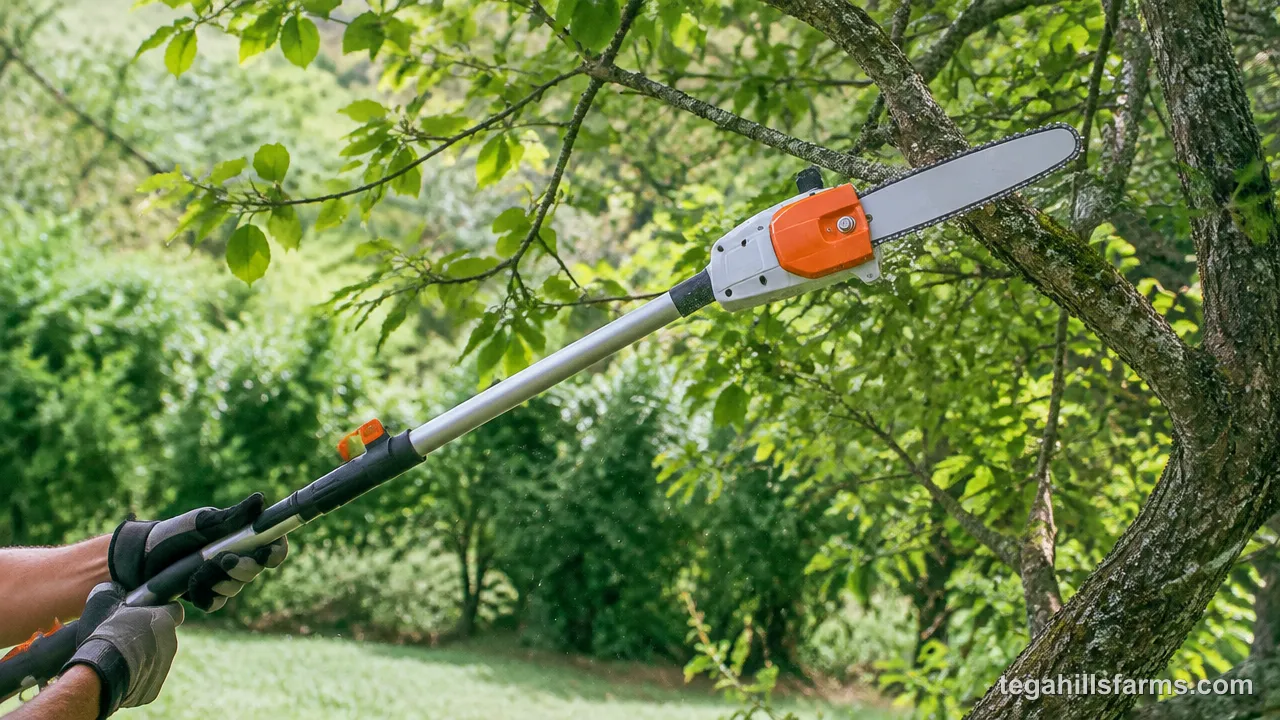
The way each tool cuts decides how thick a branch it can take and how clean the wound will be. A saw removes a thin strip of wood and leaves a flat face you can place right at the branch collar, and the tree seals that over quickly. Shears slice cleanly through thin stems. On wood too thick for the jaws, though, they crush and split it, and a crushed stub heals slowly.
The VEVOR Manual Pole Saw 7.3-27ft, the Likeem Manual Pole Pruner 27ft and the BlumeTrec Manual Pole Saw 14.5ft blur that line by pairing a saw blade with rope-pulled shears. Before you buy, check which cutting head a model carries. For a wider look at every pole saw type, including gas models built for felling-size limbs, see our guide to the best pole saws.
The 10 Best Pole Saws for Pruning of 2026
My picks for pruning in 2026 are Supstable Cordless Pole Saw 16ft, Seesii 2-in-1 Cordless Pole Saw 8in, Seesii 2-in-1 Electric Pole Saws P6 Plus, BlumeTrec Manual Pole Saw 11ft, VEVOR Manual Pole Saw 27ft, VEVOR Manual Pole Saw 7.3-27ft, Greenworks 40V 8in Pole Saw, Walensee Manual Pole Saw 7.7ft, Likeem Manual Pole Pruner 27ft and BlumeTrec Manual Pole Saw 14.5ft. Powered 2-in-1 battery kits cut with little effort, but they bring battery charging, winter storage and extra weight at the tip of the pole. Manual extendable poles reach far for little money, but they need arm work and a steady stroke. Between them, they cover small ornamental trees, fruit trees and taller shade trees, whether you want a tool with no fuel and no cord or one with no battery at all.
#1 Supstable Cordless Pole Saw 16ft — Best Overall
If you want to prune high limbs and then cut up the fallen wood at ground level, this kit does both with one brushless powerhead, a 16-foot working reach and both 6-inch and 8-inch bars. Two 4.0Ah batteries keep it running.
Key Specs:
- Reach: up to 16 ft
- Guide bars: 6 in (pre-installed) and 8 in
- Batteries: 2 × 4.0Ah, up to 100 minutes of runtime
- Cutting head: adjustable from 0° to 180°
- Weight: 10 lb
- Warranty: 2 years
Detailed Review:
With a 16-foot working reach, the bar gets to limbs that would otherwise mean setting up a ladder. The cutting head pivots anywhere from 0° to 180°, so you can line the chain up square with a branch growing out sideways instead of twisting your wrists to match it. That keeps the cut clean at the collar.
The brushless motor is rated for branches up to 8 inches. A brushless motor has no brushes to wear, so it runs quieter and lasts longer than a brushed one. The kit includes both a 6-inch and an 8-inch bar. The shorter bar slips into a crowded crown more easily, and the longer one takes thicker limbs and cuts them into firewood once they’re down.
The automatic oiler feeds the chain from a 1 fl oz tank with a clear window, so you can see the level drop before the chain runs dry. Chain tension adjusts by hand without a wrench, which helps when a new chain stretches over its first few cuts.
The two batteries give up to 100 minutes of runtime between them, enough to work through several trees in one session. At 10 pounds it gets heavy at full extension, so I’d plan on resting the pole between cuts on a long day.
Pros:
- Long reach handles high limbs from the ground.
- Two bar lengths cover both pruning and cutting up wood.
- Clear oil window shows when the tank needs filling.
- Chain tension adjusts without a wrench.
- Kit includes two batteries, gloves and goggles.
Cons:
- Its weight tires your arms at full extension.
- Two-tool design means more parts to store and swap.
Who It’s For:
This kit makes the most sense for homeowners with a mix of tall shade trees and fruit trees who also want a small chainsaw for limbs on the ground. If you only trim a few low ornamentals each year, a light manual pole will do the same work with much less weight overhead.
Editor’s Verdict:
A capable pruning kit that switches between high limbs and ground-level cutting without a second tool, with enough battery for a long session.
#2 Seesii 2-in-1 Cordless Pole Saw 8in — Runner Up
Yards full of mid-height fruit and ornamental trees suit this kit, since its 6-to-10-foot telescoping pole puts an 8-inch bar on limbs you would otherwise climb to reach. It weighs 7.2 pounds as a pole saw.
Key Specs:
- Pole length: 6 to 10 ft, telescoping
- Guide bar: 8 in with manganese steel chain
- Motor: 800 W
- Batteries: 2 × 21V 4.0Ah, up to 50 minutes each
- Weight: 7.2 lb as a pole saw, 3.6 lb handheld
- Warranty: 3 years
Detailed Review:
An 800-watt motor drives the manganese steel chain on the 8-inch bar. It’s built for the small and medium limbs a residential yard produces, and it gets through an 8-inch log in 12 seconds. Speed matters overhead: the longer the chain stays in the wood, the longer you’re holding the pole steady at arm’s length.
The telescoping pole adjusts from 6 to 10 feet, while the Supstable reaches considerably higher, so the top limbs of a tall shade tree are a job for a longer tool. In return, the shorter pole keeps the head closer to your hands. The adjustable cutting angle lets you work over a fence or into the crown without leaning.
The saw comes with a shoulder strap, which takes some of the overhead load off your arms. With two batteries rated up to 50 minutes each, one pack can charge while the other cuts.
Built-in safety features include a security lock, safety baffles, a reinforced pole and an anti-slip handle, and gloves and goggles come in the box. The chain is designed for routine pruning, not large tree trunks.
Pros:
- Strong motor clears small and medium limbs quickly.
- Telescoping pole slides to length without extra sections.
- Shoulder strap eases arm load in pole mode.
- Light handheld saw handles ground cleanup.
- Long warranty covers the kit.
Cons:
- Shorter pole leaves the tallest limbs out of reach.
- Not designed for large trunks or heavy cutting.
Who It’s For:
Owners of fruit trees, ornamentals and mid-height shade trees who want powered cuts without a pull cord will find the pole length and shoulder strap a comfortable fit. If you need to reach limbs high in a mature oak or maple, you’ll need more reach than this telescoping pole gives.
Editor’s Verdict:
Strong cutting speed and a thorough set of safety features make this a dependable pruning saw for trees of moderate height.
#3 Seesii 2-in-1 Electric Pole Saws P6 Plus — Editor’s Choice
At 3.2 pounds for the saw itself, this compact kit suits gardeners shaping fruit trees and shrubs who care more about control than about cutting through big limbs. Its reach goes up to 10 feet.
Key Specs:
- Reach: up to 10 ft
- Guide bar: 6 in, with two chains included
- Cutting range: branches ¾ to 6 in across
- Batteries: 2 × 21V 2.0Ah
- Weight: 6.5 lb overall; saw alone 3.2 lb
- Oiling: automatic
Detailed Review:
The light saw body keeps weight off the end of the pole, which is where extra weight is most tiring to hold. A light head is easier to place just outside a branch collar, so careful shaping cuts on fruit trees and ornamentals come out cleaner.
The 6-inch bar is rated for branches from ¾ inch up to 6 inches across. The Supstable takes thicker limbs but weighs considerably more, so this kit gives up cutting very thick limbs in exchange for much less weight overhead. Thick storm limbs are where it runs out of capacity.
The multi-angle cutting head adjusts for branches over fences, around corners and in undergrowth, so you change the head angle instead of your stance. Two swappable batteries let one charge while the other runs, though smaller packs mean shorter stretches between swaps.
Automatic oiling keeps the chain lubricated as it runs. The kit also includes a spare chain, a chain sleeve, a shoulder strap, gloves and goggles. The oil bottle ships empty, so pick up bar oil before your first job.
Pros:
- Light saw body is easy to aim overhead.
- Multi-angle head works over fences and around corners.
- Two batteries let you keep working while one charges.
- Spare chain comes in the kit.
- Automatic oiling keeps the chain lubricated.
Cons:
- Short bar limits it to thinner limbs.
- Smaller batteries need swapping more often.
- Oil bottle arrives empty, so buy bar oil first.
Who It’s For:
If most of your pruning is on fruit trees, hedges and shrub borders, you’ll appreciate how little this saw weighs at the end of the pole, and the quiet electric motor suits early-morning work near neighbors. If thick storm limbs are on your list, a tool with a longer bar is a better fit.
Editor’s Verdict:
Light, quiet and easy to aim, this kit makes precise routine pruning cuts but shouldn’t be pushed past the thin and medium limbs it was built for.
#4 BlumeTrec Manual Pole Saw 11ft — Also Great
Homeowners who prune a handful of trees a few times a year get 11 feet of manual reach from this saw at about 4.1 pounds, with no battery or fuel to look after. Its barbed blade grips the branch.
Key Specs:
- Length: 11 ft, 8 detachable sections
- Blade: Mn steel, three-sided edge with double-sided barbs
- Pole: powder-coated stainless steel
- Weight: about 4.1 lb
- Head mount: extra securing screw
Detailed Review:
The Mn steel blade has a three-sided cutting edge with barbs on both sides. The barbs bite into the bark, so the blade holds its line instead of skating across the branch on the first strokes. Because it cuts from several angles, you can work a branch from below or from the side without repositioning the pole for every pull.
The pole doesn’t telescope. You set the length by adding or removing stainless steel sections, which is slower to change mid-job, but there’s no locking collar to slip. This 11 ft version uses eight sections, and 8.5 ft and 14.5 ft lengths are also available. With fewer sections, the same saw handles close pruning on shrubs and hedges.
The light weight keeps it easy to hold overhead. An extra screw fixes the saw head to the pole so it can’t loosen and wobble during strokes. The powder-coated finish resists rust, and the anti-slip grip keeps your hands in place when sap makes the pole slick.
Every cut comes from your arms, so a thick limb high overhead takes many long strokes. That effort is the price of a tool with no battery, fuel or chain oil to deal with.
Pros:
- Light weight keeps overhead sawing manageable.
- Barbed blade grips bark instead of sliding.
- Extra screw keeps the saw head tight.
- No battery, fuel or chain oil to manage.
Cons:
- Changing length section by section is slower than telescoping.
- Thick limbs take many tiring strokes.
Who It’s For:
If your pruning list is a few ornamental and fruit trees and you’d rather skip batteries entirely, this light sectioned pole is an easy tool to keep in the garage. If you face thick, high limbs every season, manual sawing will be slow going.
Editor’s Verdict:
Simple, light and secure at the head, this manual saw covers routine pruning at modest heights with no upkeep beyond keeping the blade clean.
#5 VEVOR Manual Pole Saw 27ft — Also Great
For tall trees where speed matters less than reaching the limb at all, this fiberglass pole extends to 27 feet in eight sections. The full pole weighs 15.65 pounds.
Key Specs:
- Length: up to 27 ft, 8 sections
- Recommended working length: about 20 ft (6 sections)
- Pole: 1.26 in diameter fiberglass
- Blades: two dual-hook 65Mn steel blades, plus a small saw and pruning scissors
- Weight: 15.65 lb
- Storage: carrying bag
Detailed Review:
The recommended working length is about 20 feet, roughly six sections, because each added section increases the leverage working against your hands. Metal-threaded joints hold the sections together. You build the pole one piece at a time: lean the first section against the trunk, then thread on the next.
The two dual-hook blades are 65Mn steel with an electroplated rust-proof coating. The hook pulls a branch back toward you, and holes in the blade clear wood chips so the teeth keep biting in green wood. A small saw and pruning scissors are included for closer, detailed cuts.
Wearing back support is recommended for long sessions with this much pole. The BlumeTrec 11ft is much lighter but stops at 11 feet, so this VEVOR gives up easy handling in exchange for far more reach. That suits slow, careful work on high limbs.
The fiberglass pole goes together and comes apart without tools. A sturdy carrying bag holds everything for storage or a trip to another property.
Pros:
- Eight sections reach limbs far above a ladder.
- Hooked blades pull branches back during the stroke.
- Holes in the blade clear chips in green wood.
- Pruning scissors and a small saw handle detailed cuts.
- Carrying bag keeps the sections together.
Cons:
- Full extension wears out your arms fast.
- Threaded sections take time to assemble and adjust.
Who It’s For:
This pole is made for tall shade trees and palms with limbs far above a ladder’s reach, especially if you can take your time between cuts. If you have a sore back or tired shoulders, a lighter sectioned pole will treat you better.
Editor’s Verdict:
Worth buying when height is the whole problem and you can pace yourself, since the hooked blades and long fiberglass pole get to limbs that shorter manual poles can’t.
#6 VEVOR Manual Pole Saw 7.3-27ft — Also Great
Because it comes with both a carbon steel saw blade and rope-pulled shears, this pole handles thick limbs and thin twigs on the same tall tree. Double-lock joints hold its sections firm.
Key Specs:
- Length: 7.3 to 27 ft, 8 sections
- Blade: 0.05 in carbon steel with Teflon coating, top and bottom hook knives
- Shears: Mn steel, with 11.5 ft nylon rope and pulley
- Joints: double-lock
- Weight: 14.8 lb (pole 13 lb)
Detailed Review:
The 0.05-inch carbon steel blade has a Teflon coating that resists rust. A hook knife on top strips twigs as you pull the pole back. A second hook on the bottom frees a branch that pinches the blade mid-cut, so you spend less time wrestling a stuck saw.
Along with the blade, you get Mn steel scissors for twigs and leaves, worked by an 11.5-foot nylon rope through a pulley that cuts down the pulling effort. On a tall tree, you can shape with the shears and take limbs with the blade.
Eight poles set the length anywhere from 7.3 to 27 feet. Double-lock joints make each connection firm, so the pole doesn’t bend or come apart at full length. With the pole shortened, it also works as a hand-held saw for low branches, brush and logs.
The whole setup weighs 14.8 pounds, 13 of them in the pole, and that adds up fast when the saw is fully extended over your head. A saw sleeve covers the blade between jobs, and a storage bag keeps the scissors, rope and sections together.
Pros:
- Saw blade and pulley shears handle both thick and thin cuts.
- Double-lock joints hold the sections firmly.
- Bottom hook frees branches that pinch the blade.
- Saw sleeve and storage bag keep the parts together.
Cons:
- Heavy pole gets tiring at full extension.
- Rope and shears add setup steps before each job.
Who It’s For:
This saw-and-shear combination suits yards with tall trees that need both limb removal and lighter shaping, like thinning twigs and leafy growth. If you only cut small branches near head height, the long pole and its weight are more tool than the job needs.
Editor’s Verdict:
Choose this one when a tall tree needs both sawing and snipping and you’re willing to give up some arm comfort for reach.
#7 Greenworks 40V 8in Pole Saw — Best Easy-Start
If you’ve never run a chain tool before, this saw starts with a two-step trigger, with no pull cord, choke or fuel mixing. It weighs 7.8 pounds.
Key Specs:
- Guide bar: 8 in, 31.2 ft/s chain speed
- Reach: up to 11 ft, 3-piece aluminum shaft
- Battery: 40V 2.0Ah, up to 15 minutes of continuous runtime
- Charging: 2A charger, full charge in 60 minutes
- Weight: 7.8 lb
- Warranty: 3 years on tool and battery
Detailed Review:
The two-step trigger start removes the usual hurdles for someone who has never run a chain tool. A built-in auto chain oiler feeds the chain as it runs, so upkeep comes down to topping up bar oil and keeping the chain sharp.
Runtime is up to 15 minutes of continuous cutting on the 2.0Ah battery, and the charger refills it in 60 minutes. Continuous runtime only counts the time the chain is moving, so the pauses between pruning cuts stretch one charge across a longer session. The Seesii 8-inch kit comes with two larger battery packs, so it keeps going through a long day while this saw waits on its charger.
The 8-inch bar runs at 31.2 ft/s chain speed. The 3-piece aluminum shaft reaches 11 feet and then breaks down to fit in a tight garage or shed. A balanced body and a big sponge grip ease fatigue, which matters when you’re holding the saw overhead.
Pros:
- Trigger start needs no pull cord or fuel mixing.
- Auto chain oiler reduces chain wear.
- Aluminum shaft breaks down for storage.
- Warranty covers both the battery and the tool.
- Fast chain speed keeps cuts quick.
Cons:
- Single small battery limits long sessions.
- Recharge time stalls work without a spare pack.
Who It’s For:
This is an easy way into powered pruning for first-time owners and for anyone who has given up on a gas saw that won’t start, especially if you already run Greenworks 40V tools. For a full day of cutting storm limbs, a kit with two battery packs fits better.
Editor’s Verdict:
Easy to start, easy to store and well covered by its warranty, this saw makes sense for short pruning sessions rather than all-day cutting.
#8 Walensee Manual Pole Saw 7.7ft — Best Budget
For a small yard with ornamental and fruit trees that need a trim each season, this affordable manual saw weighs about 3 pounds and reaches 7.7 feet with nothing to charge or fuel. It also works as a hand saw.
Key Specs:
- Length: 7.7 ft, 5 stainless steel sections
- Blade: manganese steel, triple-ground teeth, dual hooks
- Weight: about 3 lb
- Head mount: reinforced locking screw
- Use modes: pole saw or detached hand saw
Detailed Review:
This saw stays easy to hold overhead through a long run of small cuts, which suits anyone who finds heavier poles tiring. The manganese steel blade has triple-ground teeth for fast, clean cuts. Its two hooks do different jobs: the front hook pulls down and removes high branches, and the rear hook steadies the cut.
This 7.7 ft version uses five stainless steel sections, and 10 ft and 14 ft versions are also available. Your own height and arm reach add to the pole, so it covers the lower limbs of small trees and fruit trees without a ladder. Taller trees need one of the longer versions or a different tool.
If you detach the blade, it becomes a hand saw for low pruning, shrubs and limbs on the ground. A reinforced locking screw keeps the saw head firm on the pole, and the powder-coated poles resist rust and corrosion.
With no motor, battery or chain oil, it’s one of the more affordable ways to start pole pruning, and there’s nothing to maintain beyond the blade. The soft non-slip handle gives a secure grip when your hands get sticky with sap.
Pros:
- Very light weight keeps overhead cuts easy on your shoulders.
- Triple-ground teeth cut small limbs cleanly.
- Blade detaches for use as a hand saw.
- Locking screw holds the saw head firm.
Cons:
- Short pole leaves higher limbs out of reach.
- Manual strokes slow down on thick branches.
Who It’s For:
If your trees are young or kept small and you want an affordable tool that hangs on a garage hook, this short manual saw does the job without batteries or oil. Tall shade trees need a longer pole.
Editor’s Verdict:
Inexpensive, very light and quick to set up, this saw handles low pruning well and needs nothing between seasons except a dry place to hang.
#9 Likeem Manual Pole Pruner 27ft — Also Great
Fruit growers who mostly thin small branches high in the canopy get pulley-operated, spring-action jaws here, plus a saw blade for the occasional thicker limb. The pole extends to 27 feet.
Key Specs:
- Reach: up to 27 ft
- Pole: epoxy resin
- Pruner: pulley-operated, spring-action hardened carbon steel jaws
- Saw blade: thickened alloy steel
- Head fit: any 1 in (25 mm) diameter telescopic rod
- Weight: about 16.3 lb
Detailed Review:
The pruner head uses pulley-operated, spring-action jaws of hardened carbon steel, built for shearing smaller branches. Pulling the rope closes the jaws and the spring opens them for the next cut, so a thin shoot comes off in one stroke instead of bending away from a saw blade.
For limbs too thick for the jaws, the thickened alloy steel saw blade has a high hardness that resists bending under a long stroke. Between the blade and the shears, one tool handles both sawing and shearing.
The epoxy resin pole resists corrosion. The head fits any 1-inch telescopic rod, so you can also mount it on an aluminum telescopic rod. The full setup weighs about 16.3 pounds. The BlumeTrec 14.5ft also pairs shears with a saw and is much lighter, so the Likeem’s extra reach comes with far more weight to hold overhead.
The same tool also trims low growth without bending or kneeling. That range is useful for fruit trees where some cuts are overhead and others are at waist height.
Pros:
- Pulley jaws snip thin branches in one pull.
- Saw blade handles limbs too thick for the jaws.
- Head also fits standard telescopic rods.
- Epoxy resin pole resists corrosion.
Cons:
- Heavy at full extension, so long sessions tire you.
- Shear jaws are meant for smaller branches only.
Who It’s For:
Orchard owners and anyone who shapes fruit trees by thinning lots of small shoots will put the rope-driven jaws to steady use. If your pruning is mostly thick limbs, a powered saw will save your arms. If you can’t comfortably hold a heavy pole overhead, a lighter sectioned pole is a better fit.
Editor’s Verdict:
A reach-first pruner for thin growth high in the canopy, and a good buy for patient work if you’re prepared for its weight at full length.
#10 BlumeTrec Manual Pole Saw 14.5ft — Also Great
Pruners who keep switching between snipping twigs and sawing thicker limbs will like having shears and a saw together, with a 4-pulley rope system doing much of the pulling. It weighs about 6.2 pounds.
Key Specs:
- Length: 14.5 ft, 11 stainless steel sections
- Shears: up to 1.37 in cutting capacity
- Saw blade: 0.05 in triple-edged Mn steel
- Rope system: 16.5 ft rope with 4 pulleys
- Weight: about 6.2 lb
Detailed Review:
The 16.5-foot rope runs through a 4-pulley system that cuts pulling effort by up to half. A high-tension spring snaps the shears open again for the next cut. Over a long session of small cuts, the lighter pull keeps your arms from wearing out.
The pruning shears cut branches up to 1.37 inches thick. Past that, the 0.05-inch triple-edged Mn steel saw blade takes over and cuts cleanly through both green and dry wood. Having both on one tool means fewer tool changes in the middle of a job.
This 14.5 ft version uses 11 modular stainless steel sections with tool-free screws and threaded connections. A 10.5 ft version with eight sections is also available. Compared with the BlumeTrec 11ft, which is lighter and carries only a saw blade, this model adds shears and extra reach.
The sections come apart for compact storage between jobs. The stainless steel resists rust, which matters for a tool that lives in a damp shed.
Pros:
- Pulley system lowers the pull needed for each cut.
- Shears and saw cover both twigs and limbs.
- Tool-free sections go together and come apart quickly.
- Stainless steel poles resist rust.
Cons:
- Shears stop at small branches, so thicker wood needs sawing.
- Assembling the full length takes many section joins.
Who It’s For:
Gardeners who look after several fruit or shade trees and want to snip and saw without hauling two tools will find this combination practical. If all your cuts are on thick limbs, the shears are parts you won’t use.
Editor’s Verdict:
Pick this pole when your pruning mixes twigs and limbs, since the pulley-assisted shears and sharp saw handle both without much weight.
Which Power Type Is Best for Pole Saw Pruning: Battery, Corded, Gas or Manual?
Cordless lithium-ion models suit most homeowners because there’s no fuel mixing and no extension cord, while hand-powered poles fit light, occasional work and gas engines only earn their weight on thick limbs.
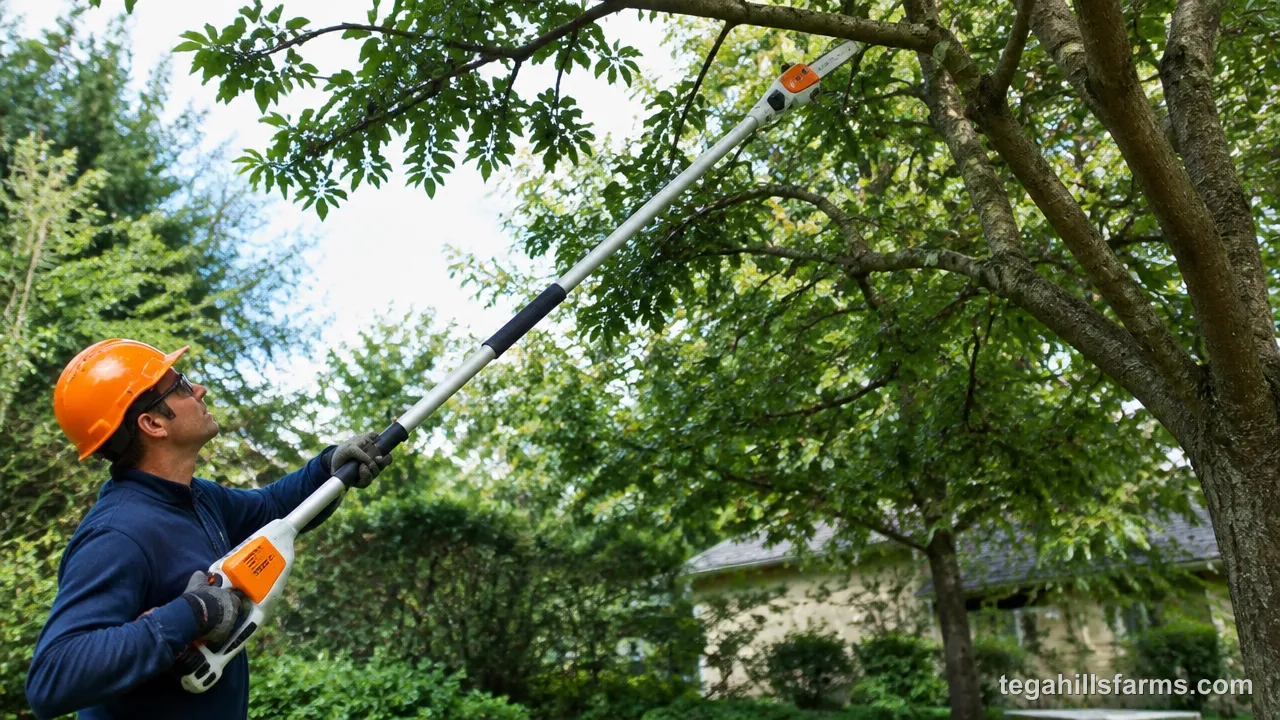
The four power sources differ in noise, weight, runtime, upkeep and starting:
| Factor | Battery | Corded electric | Gas | Manual |
|---|---|---|---|---|
| Noise | Quiet | Quiet | Loud | Silent |
| Weight overhead | Moderate | Light | Heavy | Light to heavy, depending on pole length |
| Runtime | Until the pack runs down | Unlimited while plugged in | Unlimited with fuel | Limited by your arms |
| Upkeep | Chain oil, battery storage | Chain oil, cord care | Fuel mix, spark plug, air filter, chain oil | Blade cleaning |
| Starting | Trigger | Trigger | Pull cord | None |
| Freedom of movement | Free | Limited by cord | Free | Free |
Battery models fit most yards because there’s nothing to mix or pull. You snap in a pack, and the chain stops when you let go of the trigger, so the saw is silent between cuts. Runtime ends when the pack does, and the pack’s weight rides on the pole you’re holding up, so spare batteries and a light head make a real difference. If you’ve settled on cordless, compare the best battery pole saws by bar length and battery size.
Corded electric models never run out mid-job and carry no battery weight. The tradeoff is the extension cord, which limits how far you can get from an outdoor GFCI outlet and has to be kept out of the cutting path. That’s why the best corded pole saws make sense on small lots with an outlet close to the trees.
Gas models are heavier and need fuel mixing, spark plug and air filter care, and attention on cold starts, but they cut thick limbs for as long as there’s fuel in the tank. Manual poles cost the least and need nothing beyond a clean, dry blade, but every cut comes from your arms, which limits how many thick limbs you can finish in one session.
Reach and Cutting Capacity: What to Match to Your Trees
A pole saw only works on a branch when it can put the cutting head on the limb and cut through its full diameter without forcing, so check height and thickness together. A long pole with a light blade can reach a high limb it can’t cut through. A strong motor on a short pole leaves you climbing a ladder anyway, which takes away the reason to own a pole saw.
How Much Reach Do You Need?
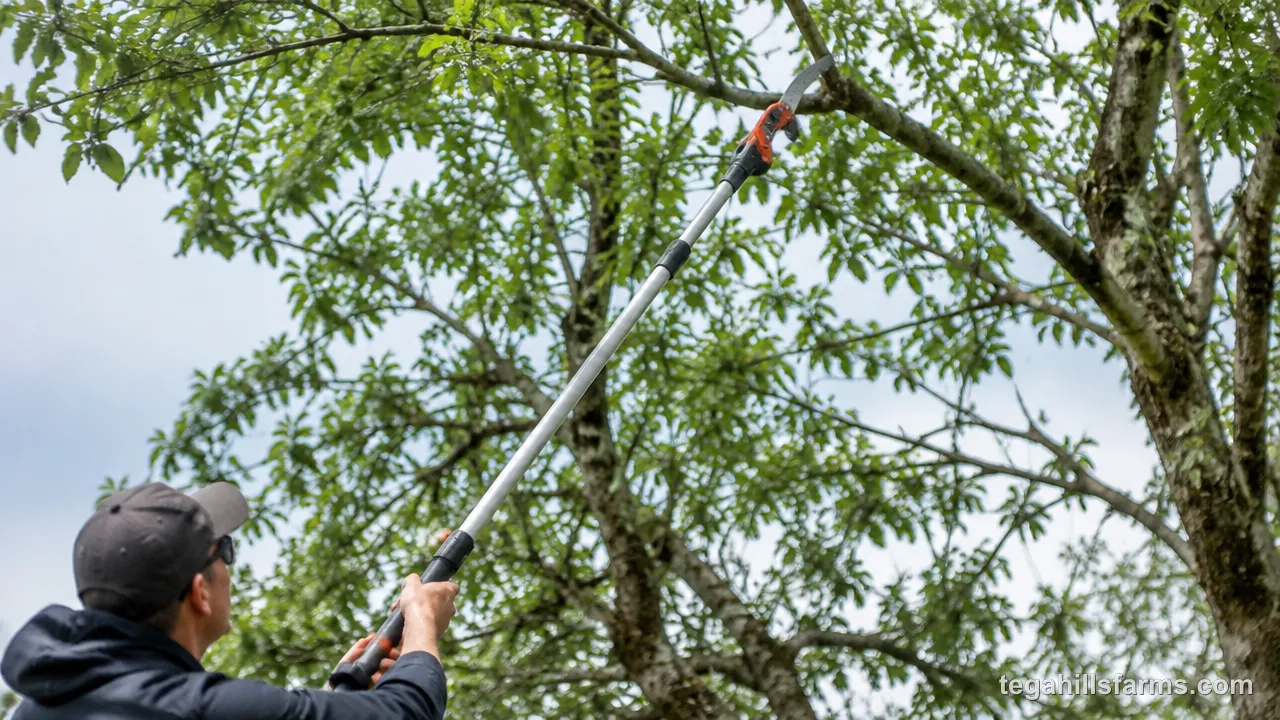
Working reach is your standing height plus how far your arms reach overhead plus the length of the extended pole. That means the pole length on the box is always shorter than the height you can actually cut. Measure from the ground to the highest branch you need to remove, then subtract your own overhead reach to see how much pole you need.
Each extra section adds leverage against your hands, so a fully extended pole wobbles more and places the blade less precisely at the branch collar. Telescoping poles slide to length and lock with a collar, which makes it quick to shorten the pole for a lower limb in the middle of a job. If you change length often, the best telescoping pole saws are worth a look.
Sectioned poles thread together piece by piece. They’re slower to change, but they can be built much longer and have no collar to slip, so limbs high in a mature tree push the choice toward sectioned poles. When you shop the best pole saws for tall branches, steadiness at full length matters as much as the length itself. For limbs higher than any pole lets you control, a professional with a lift is the safer call.
What Branch Thickness Can a Pole Saw Handle?
The branch thickness a saw can actually handle depends on bar length and motor power together. A bar cuts most cleanly on branches well under its own length, because the bar tip has to clear the far side of the branch and the motor has to keep the chain moving with the whole bar buried in wood. A branch close to the rated maximum is the upper limit, not something to cut every day.
Manual blades and shear heads are built for thinner growth. Shears handle stems their jaws can close around, and a hand-powered blade slows to a grind on thick wood as your arms tire.
Forcing an oversized cut on a light-duty tool lets the cut close on the bar and pinch it, which is called bar binding. Then the limb’s weight tears a strip of bark down the trunk as it drops. Torn bark heals slowly and leaves the trunk open to decay. That’s why matching the tool to the thickness of the branches you actually cut matters more than the biggest number on the spec sheet.
Weight, Battery Platform and Upkeep Considerations
Whether a pole saw stays in use after its first season depends on how it feels overhead, what powers it and how much care it needs. A tool that wears you out or sits with a dead pack ends up left in the shed. These details rarely show up in a quick spec comparison, but they decide whether pruning is a short Saturday job or a chore you keep putting off.
How Much Weight Can You Comfortably Hold Overhead?
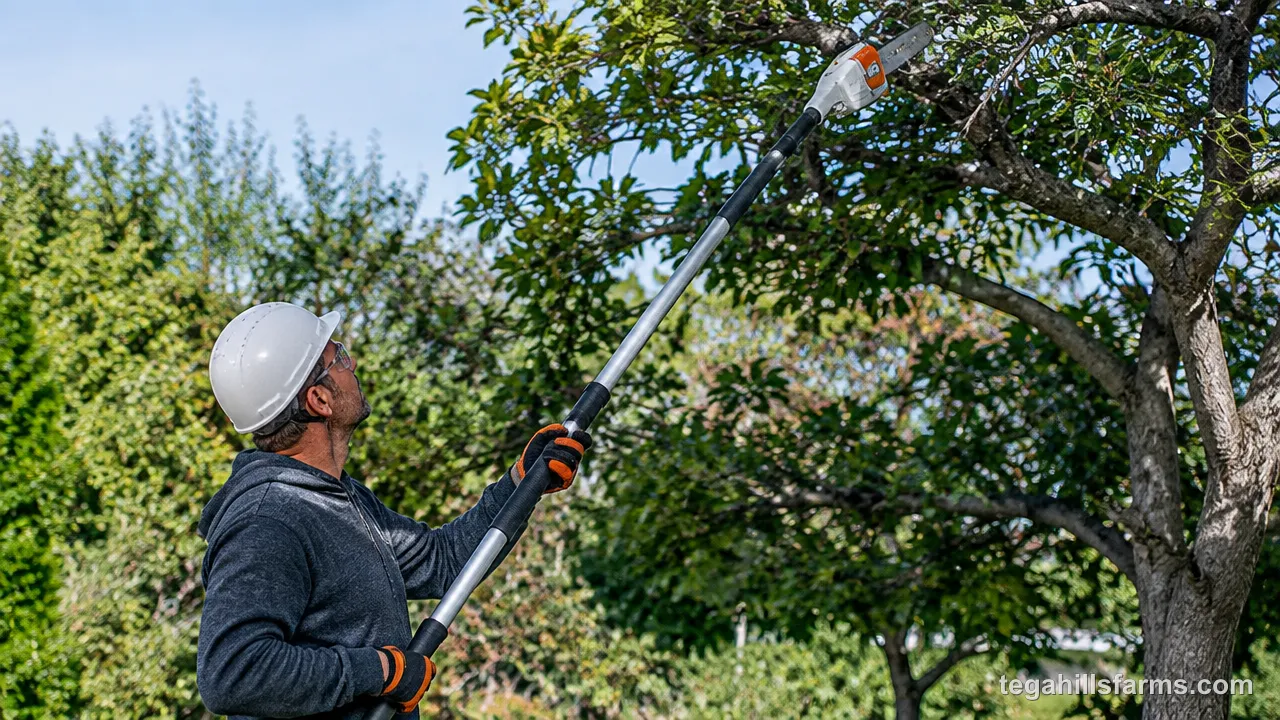
You feel a pole saw’s weight at arm’s length, so balance matters more than the number on the scale. A heavy powerhead at the tip of a long pole feels far heavier than the same weight near your hands. A motor at the cutting end puts its full weight on the far end of the pole, while weight closer to the handle sits back toward you.
Lighter battery kits and short manual poles suit people with less upper-body strength and long sessions of small cuts. A pole that’s heavy at full extension tires your shoulders well before the work is done.
A shoulder strap shifts part of the load from your arms to your torso. A lighter head lets you place each cut with your wrists instead of your whole body. If comfort comes first for you, start with the best lightweight pole saws.
Should You Match a Pole Saw to a Battery Platform You Already Own?
Yes, if the brand and voltage match tools you already run. Sharing packs means no new charger, no extra batteries to store over winter and a spare pack ready when the first one runs flat.
A kit with its own batteries and charger makes more sense if you own no cordless yard tools or if your current packs are a different brand, since the kit arrives ready to work. The downside of kit batteries is that they’re often proprietary. If a pack fails after a few seasons, a replacement can be hard to find, and the saw is useless without it.
Spare packs extend your working time because one charges while the other cuts. That makes a second battery worth having for any job longer than a single charge.
What Upkeep Does a Pole Saw Need?
Powered pole saws need bar oil, correct chain tension and a sharp chain. Manual blades just need to be kept clean and dry.
An auto oiler feeds oil from a reservoir while the chain runs, so your job is to check the level before each session and top it up with bar oil. Chain tension drifts as the chain warms up and stretches. A chain that sags off the bottom of the bar can jump off, and one set too tight wears the bar and drains the battery faster.
Sharpen or replace the chain when it throws fine dust instead of chips. Over winter, store batteries indoors, partly charged and away from freezing temperatures. Wipe sap off manual blades and oil them lightly to stop rust. Skipped upkeep shows up as slow cuts, torn bark at the collar and a stretched chain that keeps loosening.
Which Pole Saw Should You Choose for Your Yard?
Match the tool to your highest problem limb and its thickness: powered 2-in-1 kits for thicker limbs and less effort, light manual poles for small trees and long manual poles for height when speed doesn’t matter.
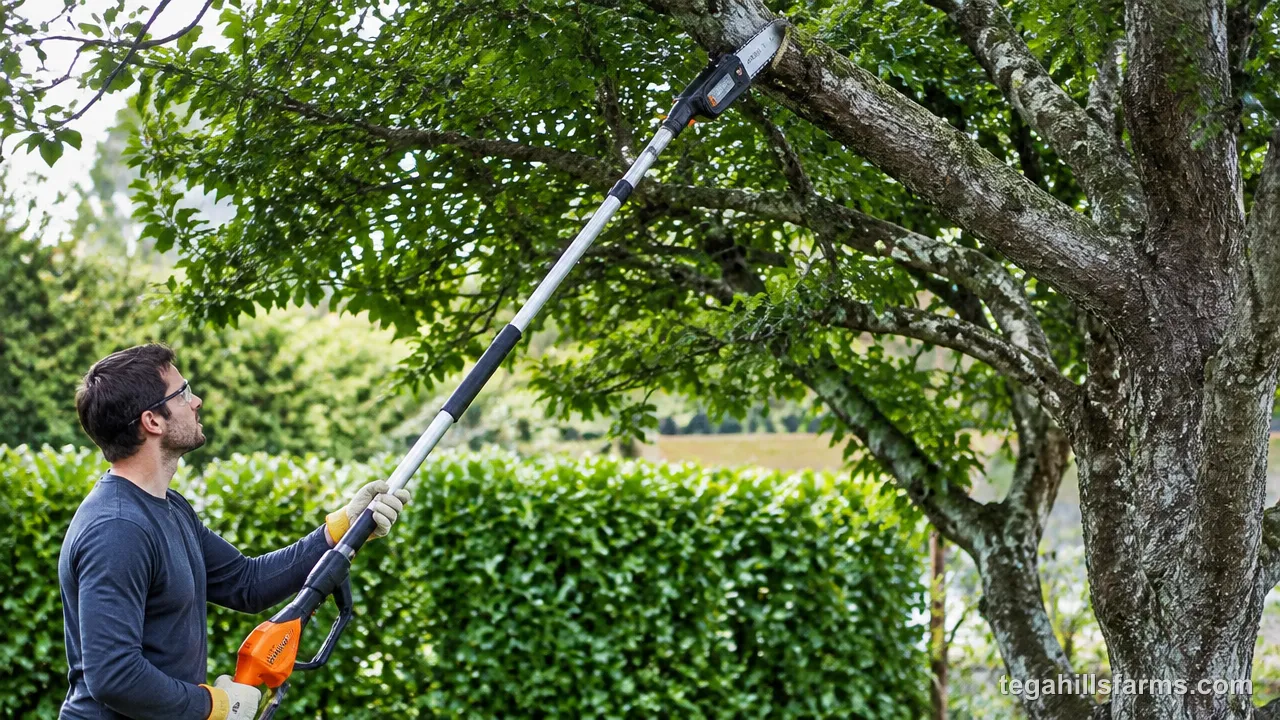
- Choose the Supstable Cordless Pole Saw 16ft or the Seesii 2-in-1 Cordless Pole Saw 8in if you have thick limbs and want to spare your arms. The Seesii 2-in-1 Electric Pole Saws P6 Plus and the Greenworks 40V 8in Pole Saw suit lighter pruning, where low weight and an easy start count more than cutting capacity.
- Pick the Walensee Manual Pole Saw 7.7ft or the BlumeTrec Manual Pole Saw 11ft if your trees are small and you only prune now and then.
- Go with the VEVOR Manual Pole Saw 27ft or the VEVOR Manual Pole Saw 7.3-27ft if your limbs sit high in tall trees and you can take your time.
- Reach for the Likeem Manual Pole Pruner 27ft or the BlumeTrec Manual Pole Saw 14.5ft if most of your work is thinning twigs and shaping fruit trees.
A shorter, lighter tool beats a longer one on the low limbs of a small fruit or ornamental tree. A long pole hits the ground or the fence before the blade is in place, and its weight at the tip makes precise collar cuts harder. I’d keep a short manual saw for that work even with a long pole hanging next to it. For a typical suburban lot, also compare the best pole saws for homeowners.
A fiberglass or resin pole feels like protection near a power line, but wet bark, morning dew or a film of dirt on the pole is enough to carry current to your hands. Overhead lines often run right through the crowns of street-side and backyard trees, and if the saw head brushes one, you don’t get a second chance.
How Do You Stay Safe Pruning Near Overhead Lines?
Keep the saw, the pole and yourself at least 10 feet from any overhead line. Leave any branch that touches or hangs near a line to your utility company or a line-clearance arborist.
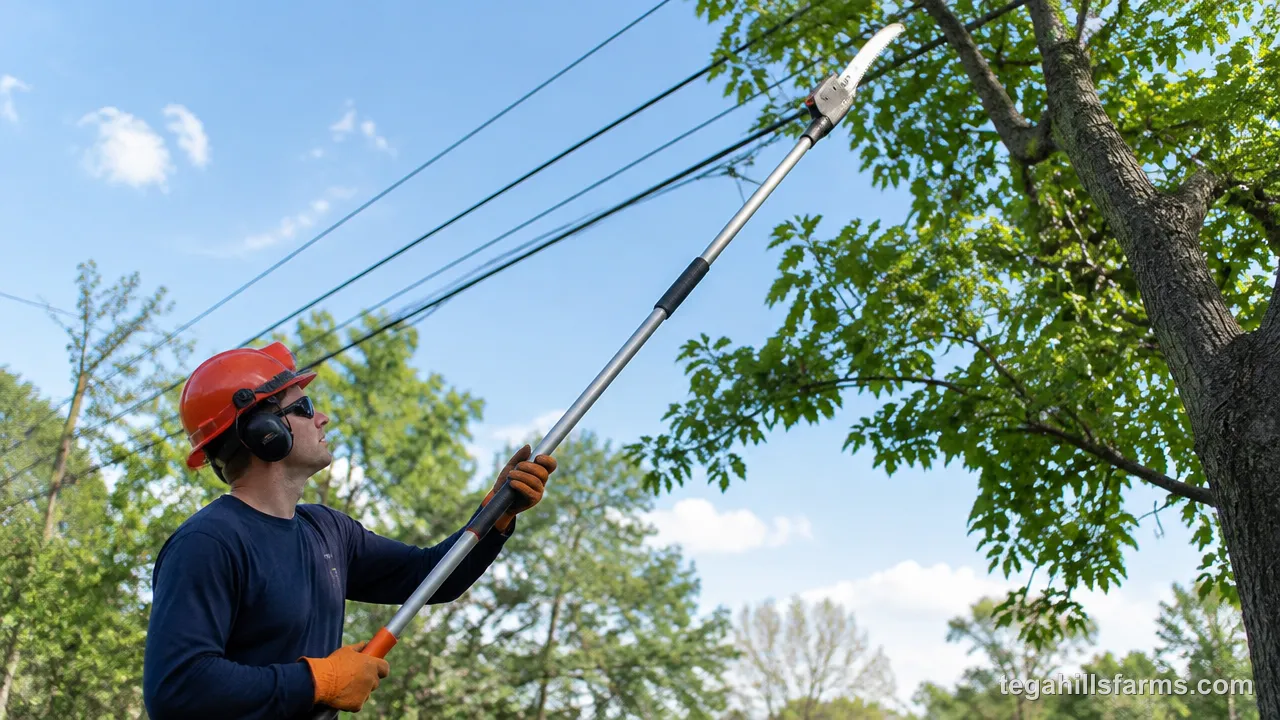
Pole material doesn’t change that. Fiberglass and resin only resist current when they’re clean and dry, and sap, rain, dew and dirt on the surface give electricity a path. Aluminum and steel poles conduct outright. A branch resting on a line can be energized too, so cutting it brings current to the saw even if the pole never touches the wire.
The protective gear that matters is for your eyes, head and hands. Safety glasses keep sawdust and bits of twig out of your eyes when you look up into the cut. A hard hat protects you from small limbs that drop sooner than you expect. Gloves improve your grip on a pole that gets slick with sap.
Using a pole saw from a ladder defeats the point of owning one. It puts you closer to the line and the falling limb, and an overhead cut with a long pole throws your balance off where you have nothing solid to catch yourself.
How Should You Cut a Branch With a Pole Saw?
Cut a heavy branch in stages. Make a relief cut on the underside first, then a top cut a little farther out to drop the limb, then a final cut just outside the branch collar to remove the stub. The underside cut stops the bark from peeling down the trunk when the limb’s weight tears it free, which is a common way a pruning cut turns ragged.
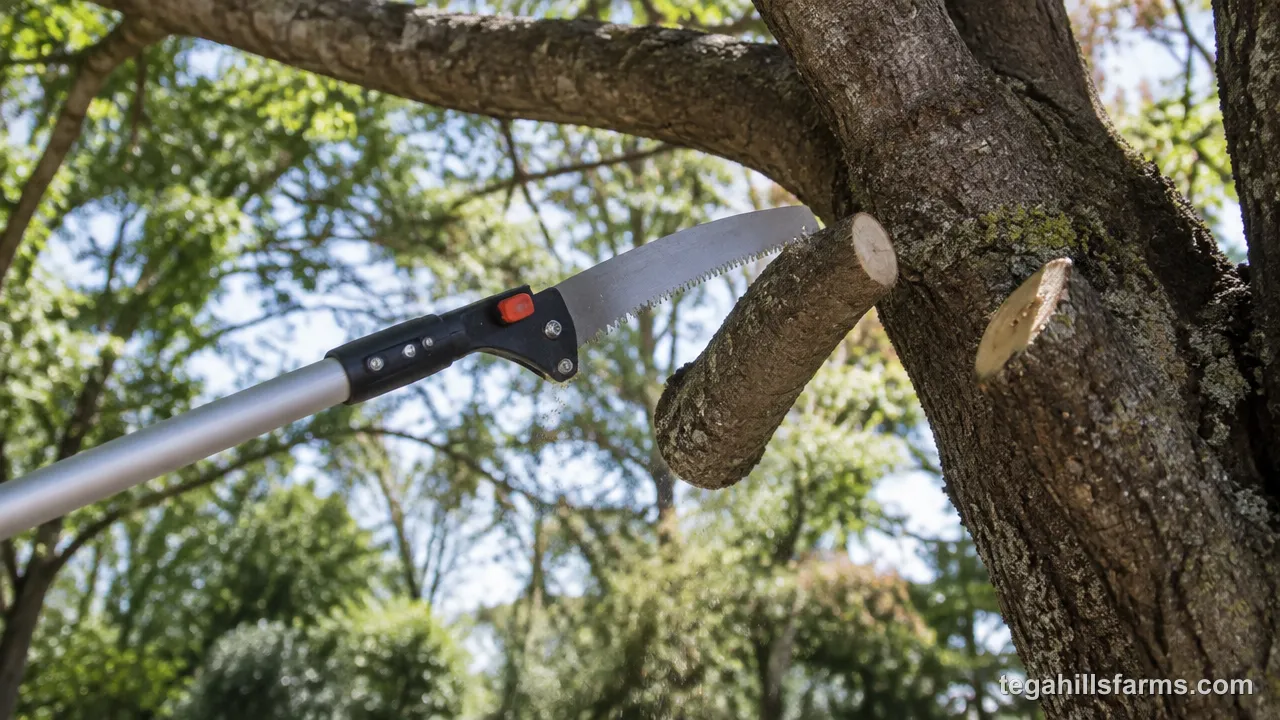
The final cut goes just outside the collar, the swollen ring where the branch meets the trunk, because that tissue grows over the wound. Cutting flush removes the collar, and a long stub gives decay a place to start.
Stand outside the drop zone, off to the side of where the limb will fall rather than under it, and angle the pole so the branch falls away from you. Let the saw do the work. Pushing a chain harder bends the bar and pinches it in the cut. With a manual blade, long smooth strokes cut faster than short forced ones and keep the blade on its line.
A clean cut seals over faster. That matters most on fruit trees, where a slow-healing wound can let disease into the wood that carries next year’s crop. If you’re equipping for that work, look at the best pole saws for orchard care.
When Should You Call an Arborist Instead of Cutting It Yourself?
Call an arborist when a limb is too thick or too high to cut under control, when it’s near a power line, when it’s storm-damaged and under tension, or when it could hit the house, a fence or a car on the way down.
A pole saw is the right tool for limbs you can see clearly, cut cleanly and drop onto open ground. Storm damage changes that. A broken limb that’s bent or pinned against another branch is under tension, and cutting it can make it spring back or swing toward you unpredictably. For hanging limbs you can reach safely after a storm, the best pole saws for storm cleanup are worth comparing.
Large trees add weight and height to every falling piece. A homeowner with a pole saw can’t control where a heavy limb lands the way a crew with ropes and rigging can.
Trimming small limbs on a fruit tree is a job you can finish cleanly in an afternoon. Dropping a large limb over a roof can end with roof damage, an injury or a tree left with wounds that decay. Once you count a possible repair bill or a lost tree, hiring a professional can make more financial sense.
Is a 2-in-1 Pole Saw Worth Buying Over a Dedicated Pole Saw?
A 2-in-1 is worth it if you cut both overhead and on the ground. One powerhead works as a pole saw for high limbs and as a handheld mini chainsaw for cutting fallen branches into firewood or pieces for the brush pile, and it takes up one spot on the shelf instead of two.
To stay light enough for both jobs, combo tools usually use a lighter-duty motor and a shorter bar than a dedicated pole saw. They slow down sooner on thick limbs and need more passes to finish a big cut.
You’ll get real value from the handheld mode if you prune and then cut up what falls, or if you don’t own a chainsaw at all. If you already have a chainsaw or only need to reach high limbs, you’re paying for a handheld mode you’ll never use, and a dedicated pole saw or a manual pole is the simpler buy.



Write Your Review
No reviews yet. Be the first to share your experience!