

Our top picks for the best pole saws for orchard care in 2026 are Supstable Cordless Pole Saw 16ft (Best Overall), Seesii 2-in-1 Electric Pole Saws P6 Plus (Runner Up), CRAFTSMAN V20 CMCCSP20B Pole Saw (Editor’s Choice), Fiskars 8-12ft Tree Pruner & Pole Saw (Also Great), LAANPOLE Telescoping Pole Saw 26ft (Best Budget), Seesii 10in 2-in-1 Pole Saw & Mini Chainsaw (Best for Heavy Pruning), LETYANGER Extendable Pole Saw 27ft (Also Great) and Husqvarna 122LKP Gas Pole Saw (Best Gas-Powered). The cordless kits and the gas saw handle structural limbs. The manual poles cover thin shoots and tall crowns with no motor to maintain.
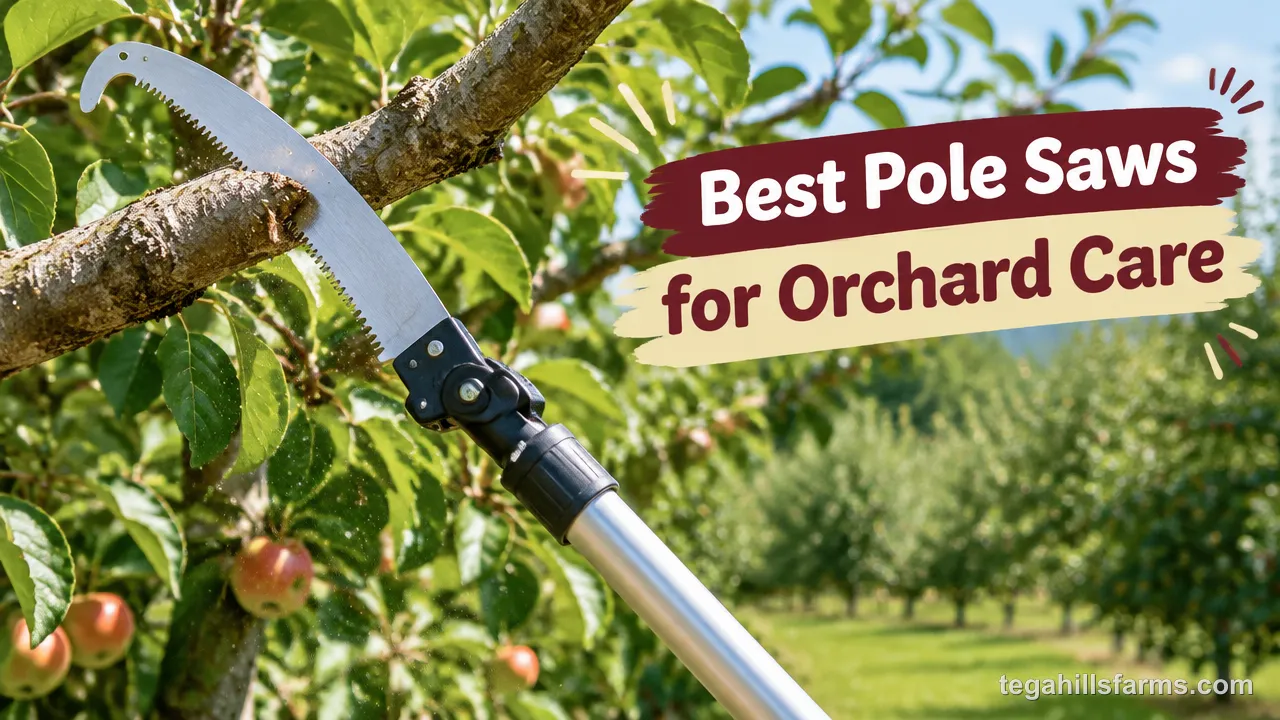
The right saw depends on four things: how tall your trees grow, how thick the limbs you remove each year are, how far the trees sit from an outlet, and how long you can hold a tool overhead. Orchard pruning tests all of that harder than ordinary yard trimming. You come back to the same trees every season and make many cuts in a single session.



A saw that stalls halfway through a limb, or a pole that wobbles at full length, pushes you into ragged cuts, and ragged cuts heal slowly on fruit trees. Upkeep is the other thing you sign up for. Gas brings fuel and tune-ups, batteries need charging and winter storage, and even a manual blade needs cleaning between trees when disease is around.
What Should You Look for in a Pole Saw for Orchard Care?
Four specs decide whether a saw suits fruit trees: reach, power type, branch capacity and weight. Orchard trees come back for pruning every year, most of the cuts happen at height, and the ground between rows is rarely flat. A saw that looks adequate on paper starts to wear on you partway down the first row. If fruit trees are only part of what you cut, compare these picks against the best pole saws.
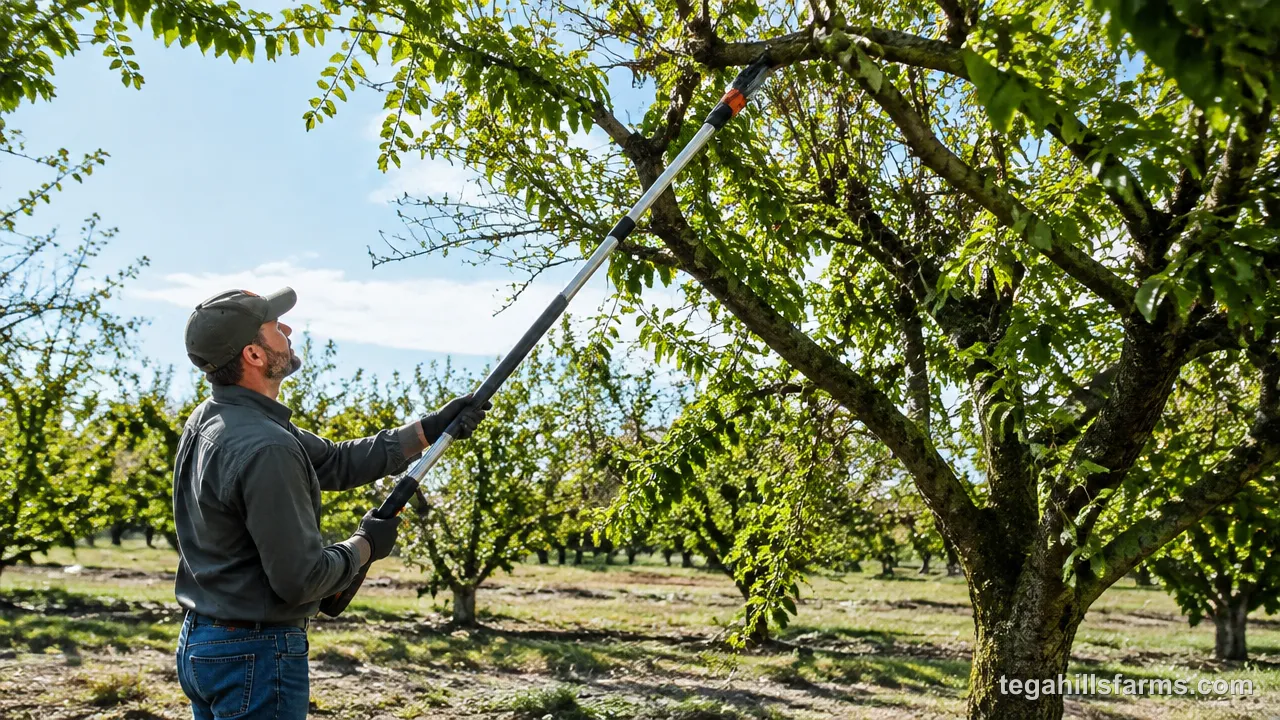
How Much Reach Does an Orchard Tree Need?
Working height decides whether you can reach the top of a tree from the ground, and working height is not the same as pole length. A stated maximum reach usually counts your own height and raised arms on top of the pole. That makes the pole itself several feet shorter than the headline number, which matters when you size a saw to your tallest tree.
Dwarf trees stay low enough that a short pole, or even a handheld saw, covers most of the crown. Semi-dwarf trees carry their upper scaffold limbs above head height, and that is where a telescoping pole replaces the ladder. Full-size standard trees are where long poles earn their place. Near full extension, though, a pole flexes and the head drifts, so each cut takes more effort to place and control.
Tree heights vary across most orchards. The best telescoping pole saws let you collapse the pole for low limbs and extend it only for the top, which keeps the weight closer to your hands for most of the session.
Which Power Type Fits an Orchard: Battery, Gas, Corded or Manual?
Battery power suits most home orchards and gas suits large plantings far from an outlet. Corded suits a few trees within reach of the house, and manual suits thin growth when you want no upkeep beyond a sharp blade.
A battery saw starts at the push of a trigger, runs quietly and needs no fuel. Each charge covers only a limited stretch of cutting, though, so a second pack decides whether you finish a row in one go. If you already own tools on one battery platform, a saw that shares those packs and that charger gives you spare batteries from day one. That is why the best battery pole saws usually make the most sense for owners already invested in a brand.
Gas runs as long as you carry fuel and has no cord to manage. In exchange you deal with fuel storage, engine noise, and spark plug and air filter upkeep. Corded saws never run down, but the extension cord snags on trunks and limits how far down the row you can work. Manual saws have no motor, which keeps them light and maintenance-free. Cutting thick wood by hand is slow, though, and it tires your arms quickly when you are working overhead.
How Thick a Branch Can a Pole Saw Cut?
A powered pole saw can cut a branch about as thick as its bar is long. It only cuts cleanly and quickly well below that rating, and a manual saw is suited to thinner wood still.
Bar length sets the ceiling because the chain has to pass all the way through the limb. Motor power and a sharp chain decide whether the saw keeps its speed in dense wood or bogs down as it nears that ceiling. Near the limit, the chain slows, the limb sags and pinches the bar, and the saw stalls or binds. A slow cut also gives the limb time to tear a strip of bark as it drops, and on a fruit tree that torn bark lets rot in.
Thin shoots, water sprouts and twiggy growth are work for a pruner or hand saw. Structural limbs are the scaffold branches that carry the fruit. They need a powered bar sized with room to spare, so the saw is never working at its limit.
How Much Does Weight and Balance Matter During a Long Pruning Session?
Weight counts for more on a pole saw than on most yard tools. A pound carried at the tip of a long pole loads your shoulders far more than the same pound held against your body. A saw that feels light on the bench can wear you out long before the row is done.
Where the heavy parts sit changes that. Convertible cordless kits carry the whole mini chainsaw and its battery at the top of the pole. Gas pole saws keep the engine down near your hands, which balances the shaft even though the total weight is higher. A stiff pole holds the head steady, while a flexing one bounces and makes you grip harder. A shoulder strap moves part of the load onto your body.
Fatigue shows up in the cuts. As your arms tire, the saw drifts away from the branch collar and leaves stubs, and across a row of trees those stubs add up.
The 8 Best Pole Saws for Orchard Care of 2026
Our top picks for orchard work are Supstable Cordless Pole Saw 16ft, Seesii 2-in-1 Electric Pole Saws P6 Plus, CRAFTSMAN V20 CMCCSP20B Pole Saw, Fiskars 8-12ft Tree Pruner & Pole Saw, LAANPOLE Telescoping Pole Saw 26ft, Seesii 10in 2-in-1 Pole Saw & Mini Chainsaw, LETYANGER Extendable Pole Saw 27ft and Husqvarna 122LKP Gas Pole Saw. The cordless saws and the gas saw take on structural limbs. The manual telescoping pruners are lighter and need nothing beyond a sharp blade, so your choice comes down to how thick your cuts are against how much upkeep you will accept. Together they cover small backyard orchards and multi-row plantings, from light shaping to heavier limb removal. If your pruning stays light and occasional, the best pole saws under $100 cover the manual end of that range.
#1 Supstable Cordless Pole Saw 16ft — Best Overall
If you want one tool for low limbs at chest height and fruit wood near the top of the tree, this kit switches between a handheld mini chainsaw and a pole saw with 16 ft of reach. Two 4.0Ah batteries come with it.
Key Specs:
- Reach: up to 16 ft with the telescopic pole
- Guide bars: 6 in (pre-installed) and 8 in
- Branch capacity: up to 8 in
- Batteries: 2 × 4.0Ah, up to 100 minutes of runtime
- Oiling: automatic, 1 fl oz tank with a transparent window
- Weight: 10 lb
Detailed Review:
The kit ships with both bar lengths, so the head can stay compact for thinning cuts between fruiting spurs. The longer bar goes on when a scaffold limb approaches the saw’s rated capacity, and the brushless motor keeps cutting power steady with lower noise. Compared with the Seesii 2-in-1 Electric Pole Saws P6 Plus, this saw reaches higher and cuts thicker limbs. That difference shows once your trees grow past dwarf size.
The cutting head adjusts through 180°, so you can angle the chain to meet a branch at its collar instead of sawing straight across from underneath. With the telescopic pole extended, the upper limbs of a semi-dwarf tree come within reach from the ground, so the ladder can stay in the shed.
The second battery lets one pack charge while the other runs, which matters when you are working down a row instead of trimming a single tree. Tool-free chain tensioning and a transparent oil window make the checks between trees quick: a glance at the window and a hand adjustment. Gloves, goggles, an oil bottle and a 2-year warranty complete the kit.
Pros:
- Two bar lengths cover thinning cuts and thicker limbs.
- Head pivots through 180° to meet branches at the collar.
- Second battery keeps you cutting while one charges.
- Tool-free tensioning keeps chain adjustments quick between trees.
Cons:
- Switching between handheld and pole modes adds setup time.
- Motor and battery sit at the pole tip, tiring arms faster.
Who It’s For:
Owners of a mixed home orchard who want one saw for ground-level cleanup and overhead pruning will make full use of this kit. It changes roles without a second tool to store. If you only shape thin shoots on low trees, a manual pruner is lighter to carry.
Editor’s Verdict:
A versatile cordless kit for both ground-level limb work and overhead pruning, with enough bar for the scaffold branches on most home fruit trees.
#2 Seesii 2-in-1 Electric Pole Saws P6 Plus — Runner Up
For fruit trees whose branches stay thin, this saw keeps arm strain low: the handheld unit weighs just 3.2 lb, and the cutting head adjusts to awkward angles. It converts to a pole in seconds.
Key Specs:
- Reach: up to 10 ft with the extension pole
- Guide bar: 6 in
- Branch range: 3/4 in to 6 in
- Batteries: 2 × 21V 2000mAh
- Motor: brushed
- Handheld weight: 3.2 lb
Detailed Review:
A light handheld unit on the end of the pole puts far less load on your shoulders over a row of trees. The adjustable shoulder strap in the kit carries part of what remains. For a session of thinning rather than limb removal, that low tip weight is what lets you finish the row with steady hands.
The short bar and brushed motor are matched to the thinner end of orchard work: water sprouts, crossing branches and secondary limbs rather than main scaffolds. Pushing it into wood near its rated maximum slows the cut, so it suits maintenance pruning better than renovating a neglected tree. Compared with the Seesii 10in 2-in-1 Pole Saw & Mini Chainsaw, it gives up bar length and battery capacity for a lighter handheld unit.
The multi-angle cutting head lets you reach over a fence line or come at a crossing branch from the side without twisting your back. Two batteries let you swap and keep going, and a second chain in the kit replaces a dull one. Automatic oiling keeps the chain lubricated. The pole stops well below the top of a full-size tree, so this saw fits dwarf and semi-dwarf work.
Pros:
- Light handheld unit reduces arm fatigue overhead.
- Multi-angle head reaches branches over fences and around corners.
- Spare chain and shoulder strap come in the kit.
Cons:
- Short bar limits it to thinner orchard wood.
- Lower-capacity batteries mean more swaps during long sessions.
- Pole reach stops short of tall standard trees.
Who It’s For:
Gardeners pruning dwarf and semi-dwarf fruit trees will appreciate how little this saw asks of their arms, especially if they tire quickly holding a tool overhead. If your trees carry thick, old scaffold limbs, the Seesii 10in 2-in-1 Pole Saw & Mini Chainsaw is better matched to that wood.
Editor’s Verdict:
Light, easy to aim and well equipped, it handles routine thinning on smaller fruit trees without wearing you out.
#3 CRAFTSMAN V20 CMCCSP20B Pole Saw — Editor’s Choice
Owners already running CRAFTSMAN V20 tools get a pole saw that reaches up to 14 ft from the ground and runs on the batteries and charger sitting in their garage. Expect up to 325 cuts per charge.
Key Specs:
- Reach: up to 14 ft with the extension pole
- Runtime: up to 325 cuts per charge
- Battery platform: CRAFTSMAN V20 (tool-only)
- Head: angled head and blade
- Grip: soft grip on the pole extension
- Weight: 10 lb
Detailed Review:
This saw is sold as a bare tool, so it makes the most sense when V20 packs already sit on your shelf. The battery and charger you own become its power source, and spare packs from your other CRAFTSMAN tools let you keep pruning longer. Without them, you are buying into a platform rather than a single saw. If you already own V20 tools, I’d look here before buying into a second battery system.
Measuring runtime in cuts suits orchard work, because pruning is a series of separate cuts with walking in between rather than one continuous run. A cuts-per-charge rating tells you whether one pack will carry you through a single tree or most of a row, depending on how heavily you prune.
The angled head and blade meet the limb at an angle, which helps you place the final cut tight to the branch collar instead of leaving a stub. A soft grip on the pole extension gives your lower hand a secure hold as you steer the head through a crowded canopy. When pruning season ends, the integrated hook hangs the saw on a VERSATRACK wall system (sold separately), so a long pole stays up and out of the way.
Pros:
- Shares batteries and charger with other CRAFTSMAN V20 tools.
- Angled head helps place cuts near the branch collar.
- Soft grip on the extension improves control overhead.
- Integrated hook hangs it on VERSATRACK wall storage.
Cons:
- Tool-only package needs a separate V20 battery and charger.
- Ties you to the CRAFTSMAN V20 battery system.
Who It’s For:
Anyone with a shelf of CRAFTSMAN V20 tools and a home orchard to keep in shape should start here, because the saw runs on the packs and charger they already have. A homeowner with no V20 batteries has to add a battery and charger before the first cut.
Editor’s Verdict:
For V20 owners, this is the simplest way to add a powered pole saw without starting a second battery system.
#4 Fiskars 8-12ft Tree Pruner & Pole Saw — Also Great
If you prune thin growth and never want to charge a battery or handle fuel, this manual pruner and saw extends from 7.9 to 12 ft on an aluminum pole weighing 4.8 lb. Its coated blade resists gumming with sap.
Key Specs:
- Pole length: 7.9 to 12 ft, telescoping aluminum
- Saw blade: 15 in double-grind steel
- Pruner: chain-drive gearing
- Locking: double locking system
- Weight: 4.8 lb
- Warranty: lifetime
Detailed Review:
One head carries both pruner jaws and a saw blade, so you can snip thin shoots and saw heavier wood without switching tools. Chain-drive gearing gives the pruner jaws more cutting force. The head rotates, so you can line the jaws up with a branch without moving your feet.
The double-grind saw blade takes over for limbs too thick for the jaws. A low-friction coating keeps sap and debris from gumming it, which matters on sappy fruit wood where a sticky blade drags on every stroke. The steel blades stay sharp through heavy use.
The light aluminum pole lets you hold the head up through a full row of dwarf trees without your arms giving out. The double locking system keeps the extended pole from sliding shut mid-cut. Next to the LAANPOLE Telescoping Pole Saw 26ft, the pole is much shorter, so this tool belongs among low and mid-height trees rather than tall standards. For a backyard of dwarf trees, I’d take it over a powered saw, and a lifetime warranty backs it.
Pros:
- Pruner jaws and saw blade share one head.
- Coated blade resists gumming from sap.
- Double locking keeps the pole from collapsing mid-cut.
- No battery, fuel or engine upkeep.
Cons:
- Hand sawing is slow on thick limbs.
- Shorter pole limits work in tall standard trees.
Who It’s For:
Backyard growers with dwarf fruit trees are the natural fit, especially if they prune a little each season and want a tool that hangs in the shed with no battery to charge. Anyone renovating overgrown trees with heavy limbs will want a powered bar instead.
Editor’s Verdict:
Simple, light and backed by a lifetime warranty, it handles routine thinning cuts with nothing to maintain beyond a clean blade.
#5 LAANPOLE Telescoping Pole Saw 26ft — Best Budget
Occasional pruning of tall limbs is where this manual saw fits, since its aluminum pole telescopes from 5 to 20 ft and holds steady with a safety locking joint. It keeps high cuts affordable.
Key Specs:
- Pole: 5 to 20 ft telescoping aluminum
- Blade: carbon steel, precision ground and coated
- Blade design: hook knife for tangled branches
- Grip: insulating, anti-slip material
- Weight: 4.8 lb
Detailed Review:
Collapsed, the aluminum pole is short enough for trunk suckers and low branches. Extended, it reaches into tall standard trees without a ladder, so one tool covers the full height range of a mixed planting.
A safety locking joint keeps the pole steady under load, and a reinforcing screw fixes the saw head so it cannot work loose as you pull. Those details matter more on a manual pole than on a powered one, because every stroke pushes and pulls against the joints.
The carbon steel blade is precision ground and coated to resist corrosion and wear, and its hook knife pulls down tangled or hung-up branches after the cut. An anti-slip grip holds in wet conditions. The universal fitting accepts other saw heads, so the pole can outlast the blade it came with.
Hand sawing is the main limitation. At full extension each stroke takes more effort and the tip moves more, so thick limbs high in the crown go slowly. For occasional cuts on a modest budget, that is a fair exchange.
Pros:
- Wide telescoping range covers low suckers and tall limbs.
- Locking joint keeps the extended pole steady.
- Hook knife pulls down tangled branches.
- Universal fitting accepts other saw heads.
Cons:
- Hand sawing at full extension is slow and tiring.
- Manual blade struggles with thick, high limbs.
Who It’s For:
Homeowners who prune tall trees only now and then, and want reach without a motor, battery or fuel to look after, will find this saw does the job. If your pruning includes thick limbs on every tree, a powered saw will save your arms and your afternoon.
Editor’s Verdict:
An affordable way to reach high limbs from the ground, suited to occasional cuts rather than heavy pruning.
#6 Seesii 10in 2-in-1 Pole Saw & Mini Chainsaw — Best for Heavy Pruning
When old or neglected fruit trees carry thick scaffold limbs, this kit’s 10 in bar and 900W brushless motor take on branches up to 10 in across, either on the pole or as a handheld saw. Two 4.0Ah batteries keep it running.
Key Specs:
- Guide bar: 10 in
- Branch capacity: up to 10 in diameter
- Motor: 900W brushless
- Batteries: 2 × 21V 4000mAh, up to 120 minutes or about 200 cuts per charge
- Reach: pole up to 10 ft, working reach up to 16 ft including user height
- Weight: 8 lb as a pole saw, 4.6 lb handheld
Detailed Review:
A longer bar with a brushless motor behind it keeps chain speed up in dense, older wood, so renovation cuts on a neglected apple or pear tree take fewer passes. The brushless design also runs with less noise and vibration, which you notice over a long session holding the saw overhead.
Set beside the Seesii 2-in-1 Electric Pole Saws P6 Plus, this kit has higher-capacity batteries and a brushless motor instead of a brushed one. What you give up is a heavier handheld unit at the tip of the pole. The shoulder strap and auxiliary handle spread that weight, and a dual-button safety lock guards against accidental starts.
Runtime is rated in both minutes and cuts, which helps you plan a day around how many trees need work. The included charger refills a pack in about 2 hours, and automatic oiling keeps the chain lubricated through long cuts in thick limbs.
The pole is on the short side, and the working reach figure counts your own height, so the crowns of tall standard trees stay out of range. I’d reach for this saw on overgrown trees with heavy scaffold limbs, not for topping tall ones.
Pros:
- Longer bar handles thick scaffold limbs on old trees.
- Brushless motor keeps chain speed up in dense wood.
- Higher-capacity batteries extend each pruning session.
- Shoulder strap and auxiliary handle spread the load.
Cons:
- Heavier handheld unit at the tip tires arms faster.
- Short pole leaves tall crowns out of reach.
Who It’s For:
Orchard owners taking back overgrown trees, or clearing storm-damaged limbs, need a saw that keeps working in thick wood, and this kit is built for that. Gardeners who mostly thin small shoots will find the Seesii 2-in-1 Electric Pole Saws P6 Plus lighter to hold overhead.
Editor’s Verdict:
Built for renovation work, it pairs a long bar with a brushless motor and enough battery for extended sessions on thick limbs.
#7 LETYANGER Extendable Pole Saw 27ft — Also Great
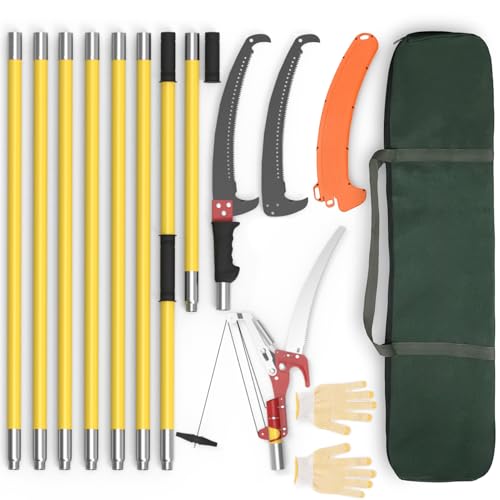
This set reaches the crown of a tall standard tree without power, building from 7.3 to 27 ft with seven epoxy resin poles joined by aluminum alloy fittings. It also comes with a pruner head.
Key Specs:
- Reach range: about 7.3 to 27 ft (7 poles)
- Poles: thickened epoxy resin with aluminum alloy joints
- Blades: 65Mn alloy steel
- Heads: saw head, pruner head with pulley, spare saw with sheath
- Weight: 9.5 lb at full length (7 poles and head)
Detailed Review:
The modular design lets you add only the poles a tree needs. Fewer sections keep the head steady and the weight down for mid-height limbs, while the full set reaches high crowns from the ground.
Control drops as you add sections. At full length it feels heavy at the tip and is hard to steer unless you are strong. It handles best at about 20 ft with six poles, and a back support helps on long sessions. Against the LAANPOLE Telescoping Pole Saw 26ft, this set reaches higher but weighs considerably more, and joining sections takes longer than sliding out a telescoping pole.
The pruner head runs on a pulley that changes the pulling direction, which makes snipping crossing branches from far below easier. Hook knives at the saw’s tip and heel clear twigs, and the spare saw keeps you working if a blade gets pinched in a branch.
Bright yellow poles stand out against the trees, so anyone walking nearby notices you are working overhead. Every part packs into the carry bag between seasons.
Pros:
- Modular poles let you match length to each tree.
- Pulley-assisted pruner head makes high snips easier.
- Spare saw keeps you working if a blade sticks.
- Carry bag holds every part for storage.
Cons:
- Hard to control near full length without real strength.
- Adding and removing sections slows moves between trees.
Who It’s For:
Growers with tall standard apple, pear or nut trees who want reach without an engine or battery should look here, as long as they are comfortable steadying a long pole. Anyone with limited upper-body strength will do better with a shorter telescoping manual pole.
Editor’s Verdict:
It lets you prune tall trees from the ground, as long as you can steady the weight at full length.
#8 Husqvarna 122LKP Gas Pole Saw — Best Gas-Powered
This 21.7cc gas saw suits large plantings far from an outlet, cutting limbs up to 8 in thick with no battery to run down halfway along a row. Smart Start makes it easy to fire up.
Key Specs:
- Engine: 21.7cc gas
- Reach: up to 12 ft
- Branch capacity: limbs up to 8 in thick
- Chain: Husqvarna X-CUT with automatic oiling
- Shaft: detachable, accepts click-on attachments (sold separately)
- Weight: 13.1 lb
Detailed Review:
Fuel, not a charger, decides how long this saw runs, so it suits rows of trees far from the house. Smart Start pairs a purpose-built engine and starter for easy, fast starts with minimum effort, which helps every time you restart after a refuel.
The X-CUT chain is built to hold its sharpness, and automatic oiling extends the life of the bar and chain. The cutting edge holds up through a day of thick limb work, which makes it a good match for renovation pruning, where most cuts go through heavy wood.
The shaft detaches, and the powerhead accepts click-on attachments such as an edger and a hedge trimmer, sold separately. One engine can then handle several yard jobs instead of sitting idle between pruning seasons.
Gas power brings fuel handling, noise and tune-up upkeep. Next to the Supstable Cordless Pole Saw 16ft, it is heavier and has less reach, but it never waits on a charger. I’d only steer you here if your trees sit well away from an outlet and you already keep up with small-engine maintenance.
Pros:
- Gas engine runs as long as you carry fuel.
- X-CUT chain holds its edge through heavy limb work.
- Smart Start makes starting easier with less pulling effort.
- Detachable shaft accepts edger and hedge trimmer attachments.
Cons:
- Gas engine brings fuel handling, noise and tune-up upkeep.
- Heavier build tires arms faster during long sessions.
Who It’s For:
Large, multi-row plantings far from power call for a saw that never waits on a charger. Owners who already keep up with small-engine maintenance will settle into this one quickly. For a small backyard orchard near the house, a cordless saw spares you the fuel routine.
Editor’s Verdict:
Strong, long-running and expandable, it is the right pick when distance from an outlet matters more than weight or noise.
Which Pole Saw Fits Your Orchard Size and Tree Type?
Match the saw to your tallest tree and your thickest routine cut: a manual pole for lightly pruned dwarf trees, a light cordless kit for mixed backyard plantings, and a long-running battery or gas saw for many rows. Reach, branch capacity, power source and weight each matter more or less as your trees and your workload change.
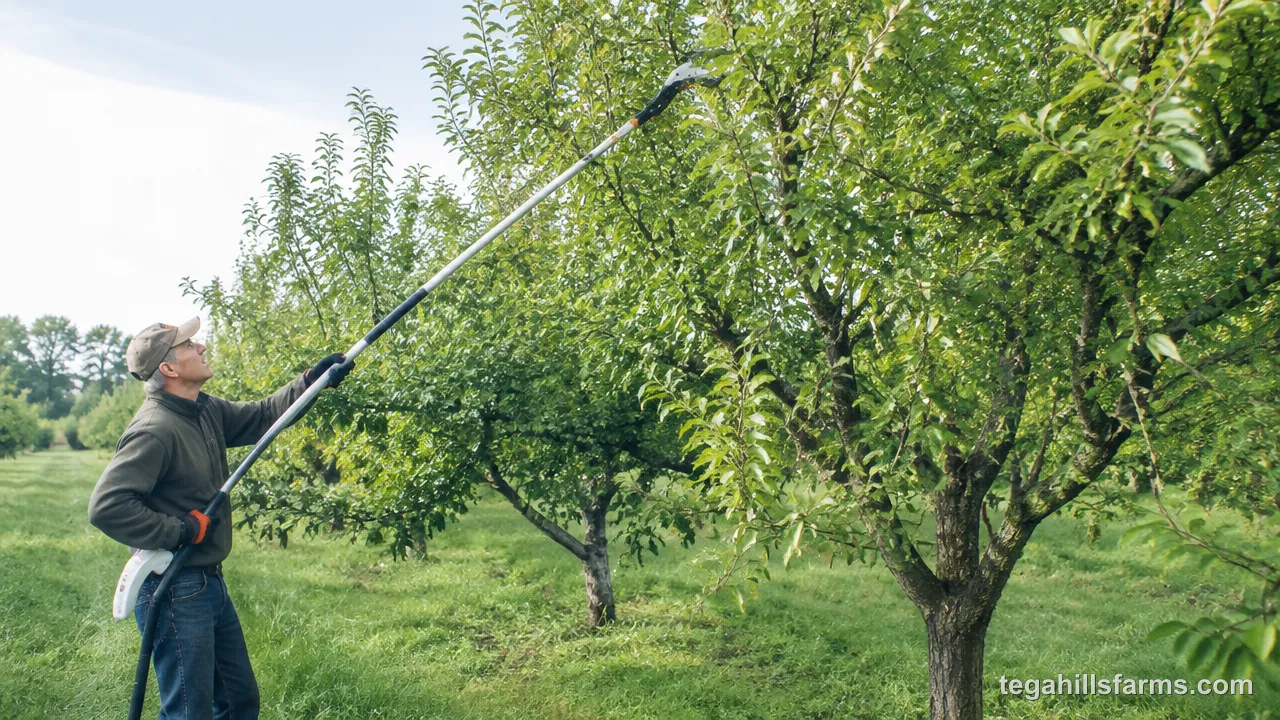
Choose the Fiskars 8-12ft Tree Pruner & Pole Saw if you keep dwarf trees and mostly remove water sprouts and thin crossing shoots each year. Reach and branch capacity barely matter there, while low weight and zero upkeep matter a lot. If you want power for the same trees, the Seesii 2-in-1 Electric Pole Saws P6 Plus belongs among the best lightweight pole saws for overhead thinning.
Choose a long pole if your trees are full-size standards. The LAANPOLE Telescoping Pole Saw 26ft covers occasional high cuts, and the LETYANGER Extendable Pole Saw 27ft reaches higher if you can steady a long pole. The Supstable Cordless Pole Saw 16ft brings powered cutting to upper limbs. If height is your main problem, also compare the best pole saws for tall branches.
Choose the Seesii 10in 2-in-1 Pole Saw & Mini Chainsaw or the Husqvarna 122LKP Gas Pole Saw if you are renovating neglected trees. Thick scaffold limbs need bar length and steady power more than extra reach.
If you work many rows in a session, choose by run time. Spare batteries keep a cordless saw going, which favors the CRAFTSMAN V20 CMCCSP20B Pole Saw if your shelf already holds V20 packs. A fuel tank you refill in the field keeps the Husqvarna running far from any outlet.
A manual saw is enough when most of your cuts are thin shoots and secondary branches and you prune a little each season. Step up to a powered saw once scaffold limbs need cutting on every tree, or once hand sawing tires your arms before the row is done.
A limb cut flush against the trunk, or left as a long stub, heals slowly, and an open wound on an apple or peach tree is an easy way in for rot and canker. Get the cut position wrong across a whole season of pruning and you lose fruiting wood on the very limbs you meant to keep productive.
How Do You Make a Clean Pole Saw Cut on a Fruit Tree?
Make three cuts on any limb heavy enough to tear as it falls, and place the last one just outside the branch collar. The collar is the slightly swollen ring where a branch joins the trunk or a larger limb. It holds the tissue that grows over the wound, so a cut there seals into a neat ring.
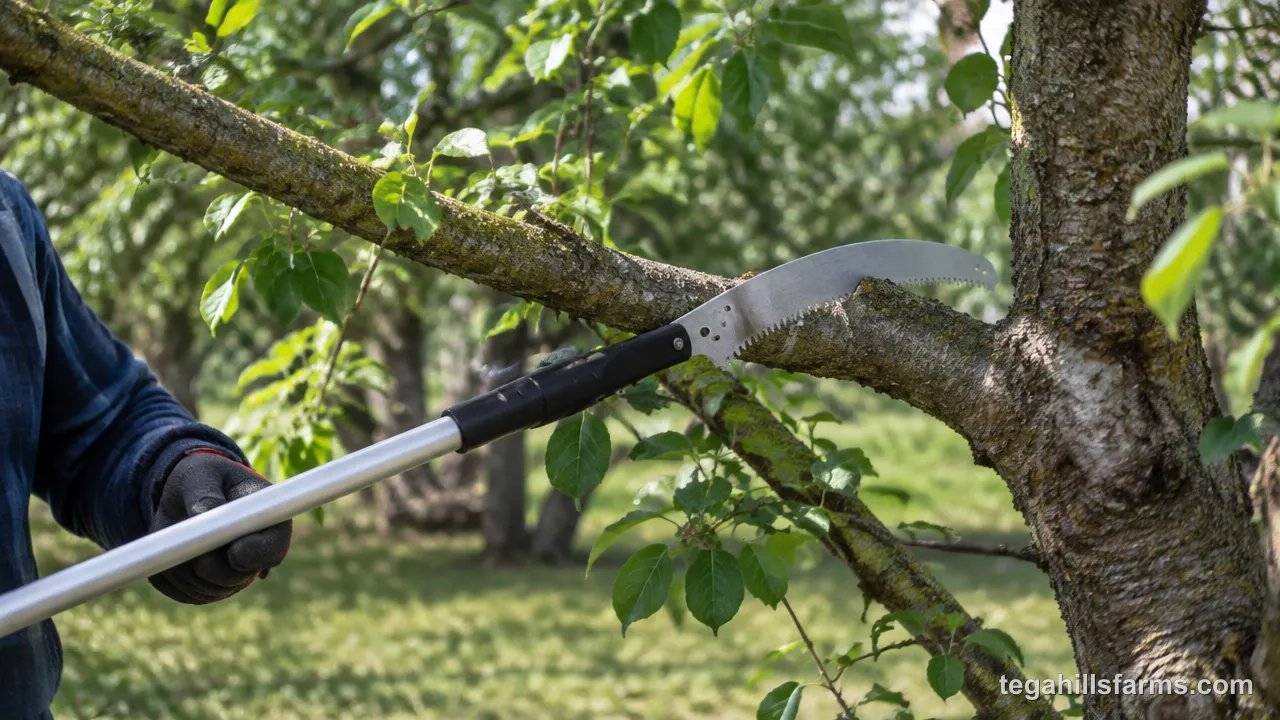
The first cut goes into the underside of the limb a short way out from where you plan to finish, only partway through. That way, the falling weight cannot strip bark back toward the trunk. The second cut comes from the top, a little farther out, and drops the limb. The third removes the short stub at the collar. An angled head, a common feature on the best pole saws for pruning, makes that final angle easier to hit without changing where you stand.
Remove dead wood first, then branches that cross or rub, then shoots growing into the center of the tree, and only then thin for shape. A flush cut removes the collar and leaves a wound the tree struggles to close. A long stub dies back and lets rot work into the limb behind it.
When Is the Best Time to Prune Orchard Trees With a Pole Saw?
Do the structural pruning in the dormant season, in late winter before buds break, and save summer pruning for light thinning and for slowing vigorous growth. With the leaves down you can see every crossing limb. Dormant cuts also push strong regrowth once the season starts, which is what you want on a tree you are shaping.
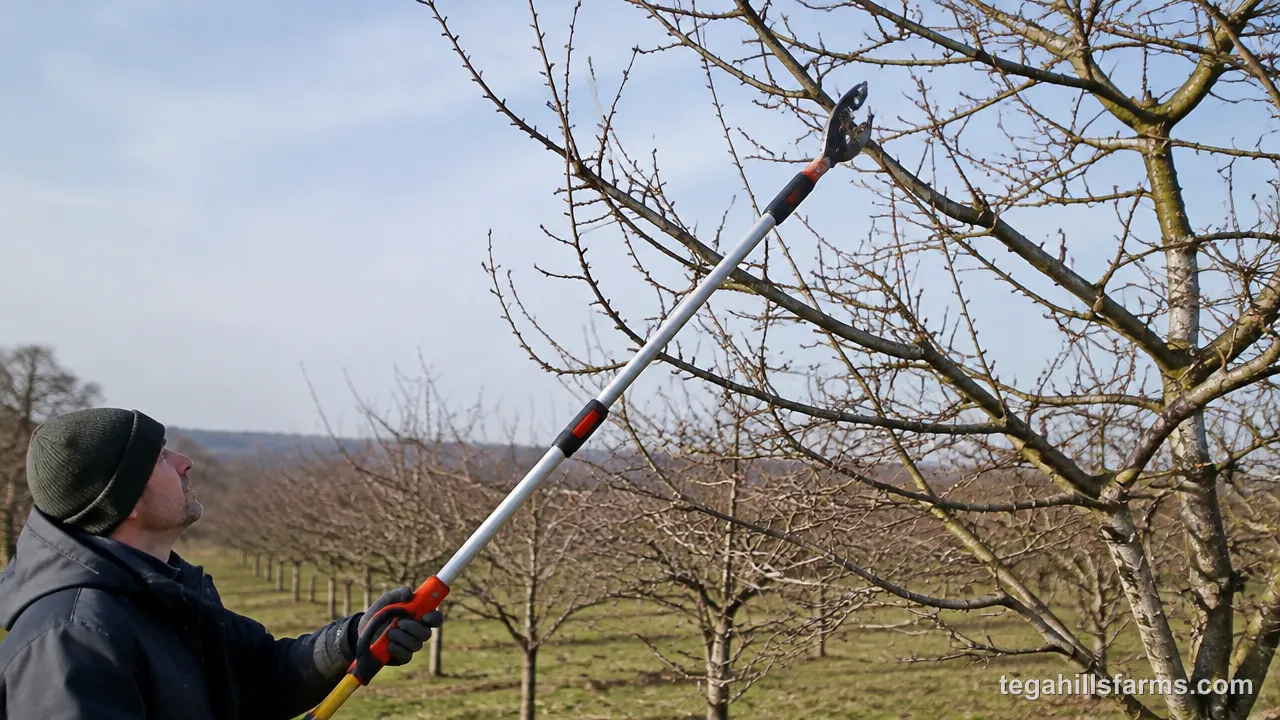
Summer cuts work the other way. Removing leafy growth slows regrowth, lets light into the canopy and helps the fruit color. Apple and pear trees get most of their pruning while dormant. Peach and other stone fruit are usually pruned late in the dormant period or around bloom, because wounds made in cold, wet early winter stay open to canker longer. Citrus in warm regions needs only light pruning after harvest and before new growth. Timing shifts with your climate, so check with your local extension office for your area.
Most orchard pruning happens in a short window each year. That means the saw spends far more time in storage than in use, and storage is where most of its upkeep happens.
How Do You Keep a Pole Saw From Spreading Disease Between Trees?
Clean the chain, bar or blade between trees, and work from healthy trees toward suspect ones. Sap and wood chips on the cutting parts carry pathogens such as fire blight bacteria straight into the next fresh wound.
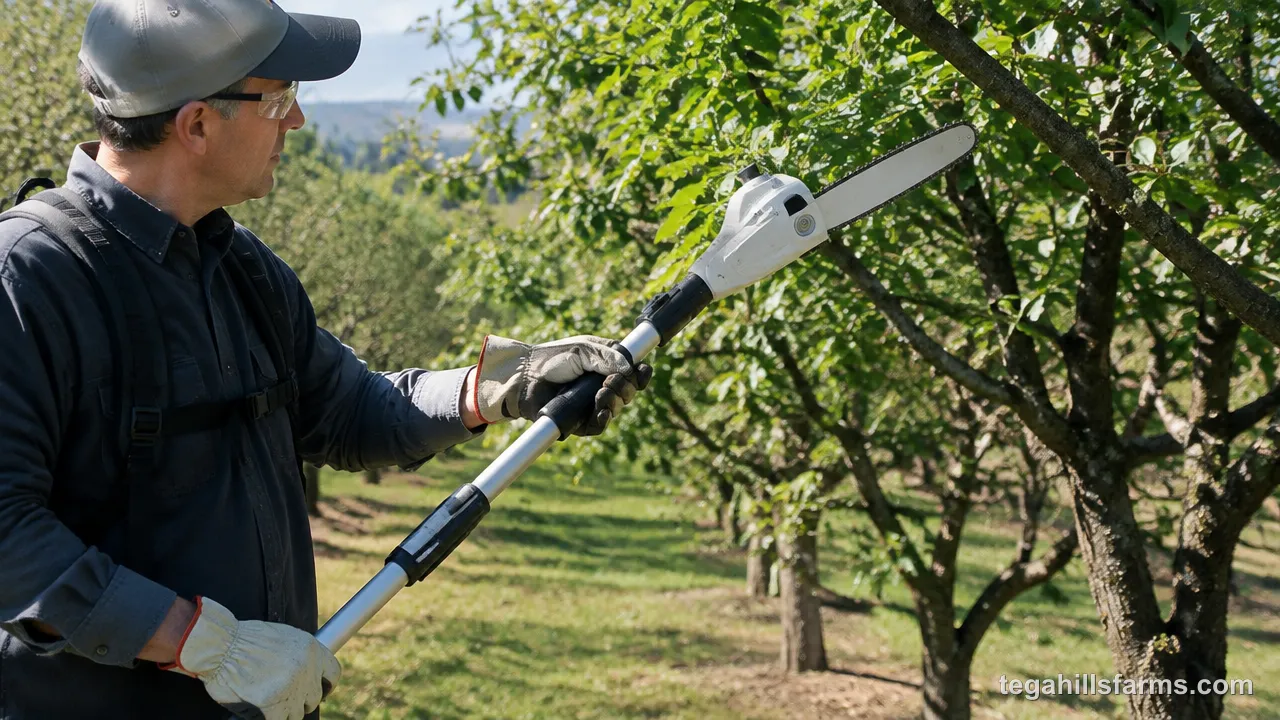
Between trees, brush away chips and sap. Then wipe or spray the cutting parts with rubbing alcohol or a household disinfectant and let them dry before the next cut. Diluted bleach also works, but it corrodes chains and blades, so rinse and oil them afterward. When you remove infected wood, cut well below the visible damage and clean the saw right after that cut.
A contaminated saw turns every cut down a row into a new infection site, so one sick tree can become several by the end of the session. A clean saw keeps the problem on the tree where it started.
How Do You Use a Pole Saw Safely Around an Orchard?
Work from firm, level ground outside the spot where the limb will land, keep the whole pole well clear of overhead lines, and leave the ladder in the shed.
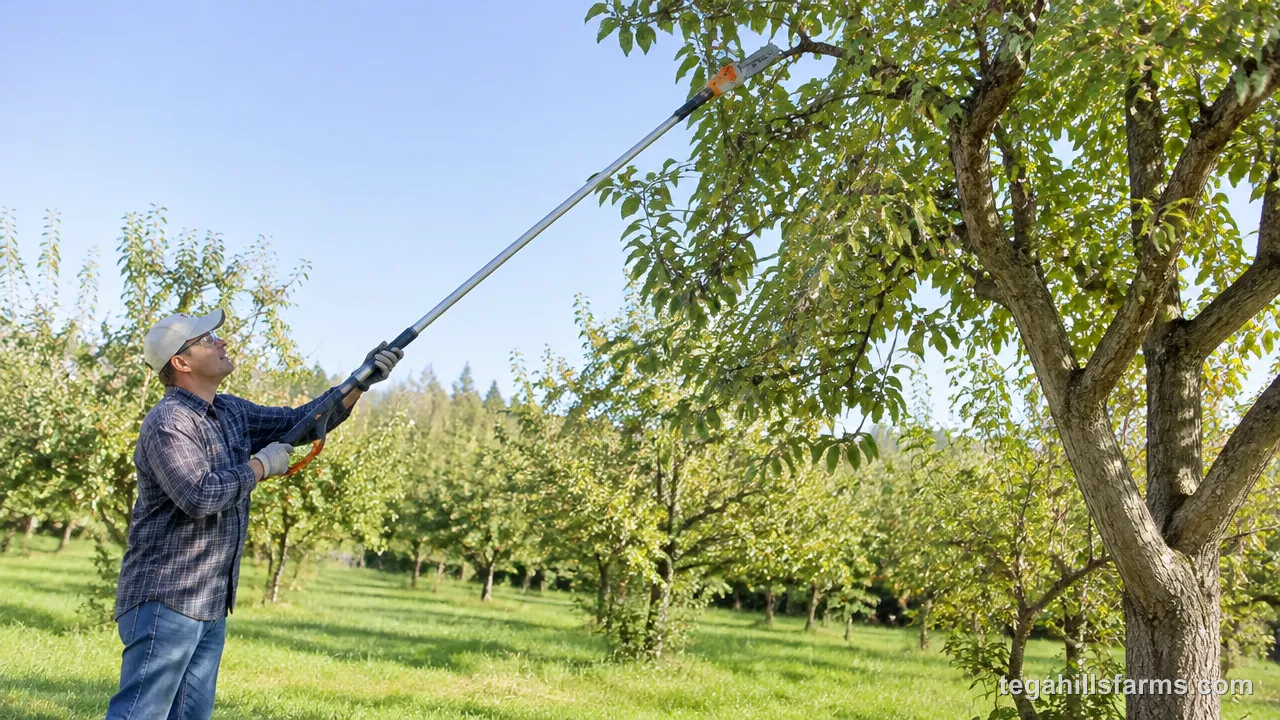
A long pole magnifies every shift in your footing, so soft soil, wet grass or a slope between rows can pull you sideways mid-cut. Set your feet wide and square to the branch before you start. Never stand under the limb you are cutting. Position yourself to the side so it falls away from you, and remember that cut limbs bounce and roll once they hit the ground. Keep helpers, kids and pets well outside that drop zone.
Overhead service lines often run along property edges, close to orchard rows. Treat any pole as conductive whatever its grip or material, and call your utility about limbs near a line. Standing on a ladder with a pole saw combines a long reach with a falling limb, and that is how ladders tip.
A hard hat with a face shield guards against falling debris, and gloves protect your hands around a chain. Wear hearing protection with a gas engine.
How Do You Maintain a Pole Saw Between Pruning Seasons?
Before the saw goes into storage, set the chain tension, top up the bar oil, sharpen or replace a dull chain, and store batteries or fuel properly so it starts cleanly next season.
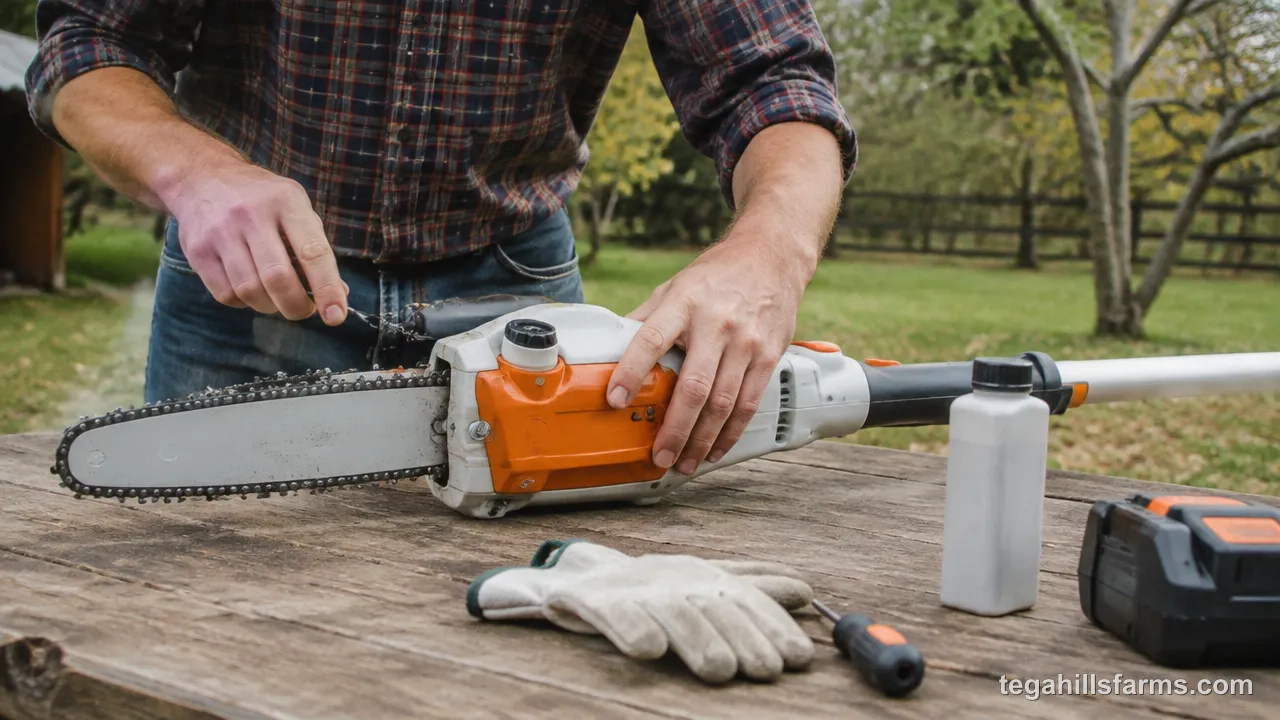
A correctly tensioned chain sits snug against the bar but still pulls around by hand. A sagging chain can jump the bar. Automatic oilers only work with oil in the tank, so check the level before each session. A dull chain gives itself away with fine dust instead of chips, smoke, scorched wood, rough cut faces, or a saw you have to force through the limb. File or replace it before the next season instead of in the middle of a pruning day.
Store batteries indoors, partly charged, in a cool, dry place rather than in an unheated shed or a hot garage. On a gas saw, drain the tank or add fuel stabilizer, then run the engine until it stops so old fuel cannot gum up the carburetor. Manual blades need cleaning and a light coat of oil to stay free of rust.
Pole Saw for Orchard Care FAQs
Can a pole saw be used to trim hedges and shrubs?
Yes, for cutting woody stems in an overgrown shrub or topping a tall hedge. A chain cuts one stem at a time, though, so it makes rough work of shaping a flat hedge face, and a hedge trimmer is faster for that. The Husqvarna 122LKP Gas Pole Saw accepts a hedge trimmer attachment, sold separately, on the same powerhead.
Can a convertible pole saw be used as a handheld chainsaw?
Yes. The Supstable Cordless Pole Saw 16ft and both Seesii kits detach from the pole and work as compact handheld chainsaws. In that mode they handle low limbs and trunk suckers, and they can cut fallen branches into manageable lengths. Where an auxiliary handle is included, it gives you a two-handed grip for ground-level cuts.



Write Your Review
No reviews yet. Be the first to share your experience!