

A rubber hose is the better pick for durability, long runs, and steady handling, while an expandable hose wins on low weight and compact storage. Your yard size and how often you drag the hose decide which trade-off matters more.
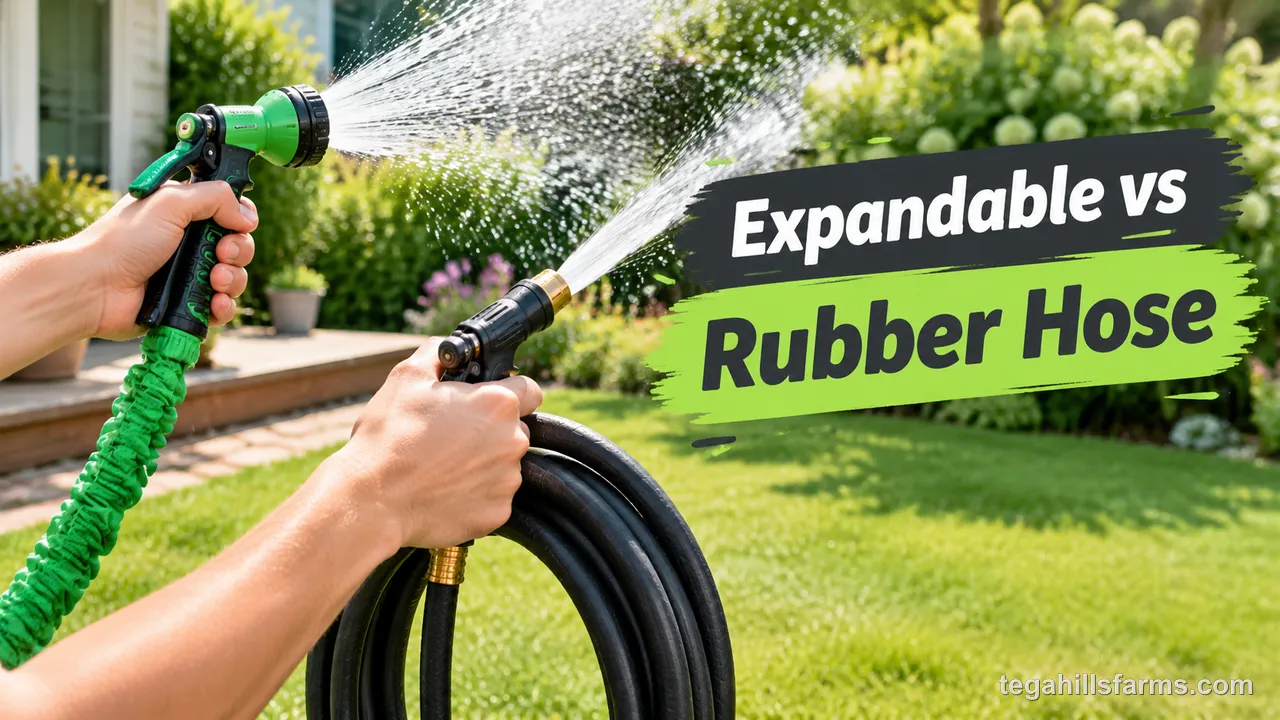
Both types can water a garden well. The differences show up in wear points, kink behavior, flow, storage, and how each material handles sun and frost.
The real worry is buying a hose that leaks by midsummer or leaves your wrists aching. Fabric shells and latex cores tend to fail sooner than thick rubber walls, and a heavy hose tires your hands fast.
Before you buy either one, measure the distance from the spigot to your farthest bed. That single number rules out a lot of hoses.
What Is the Difference Between an Expandable Hose and a Rubber Hose?
An expandable hose is a latex core inside a fabric shell that stretches when water flows, while a rubber hose is a thick reinforced wall that keeps its size and shape.
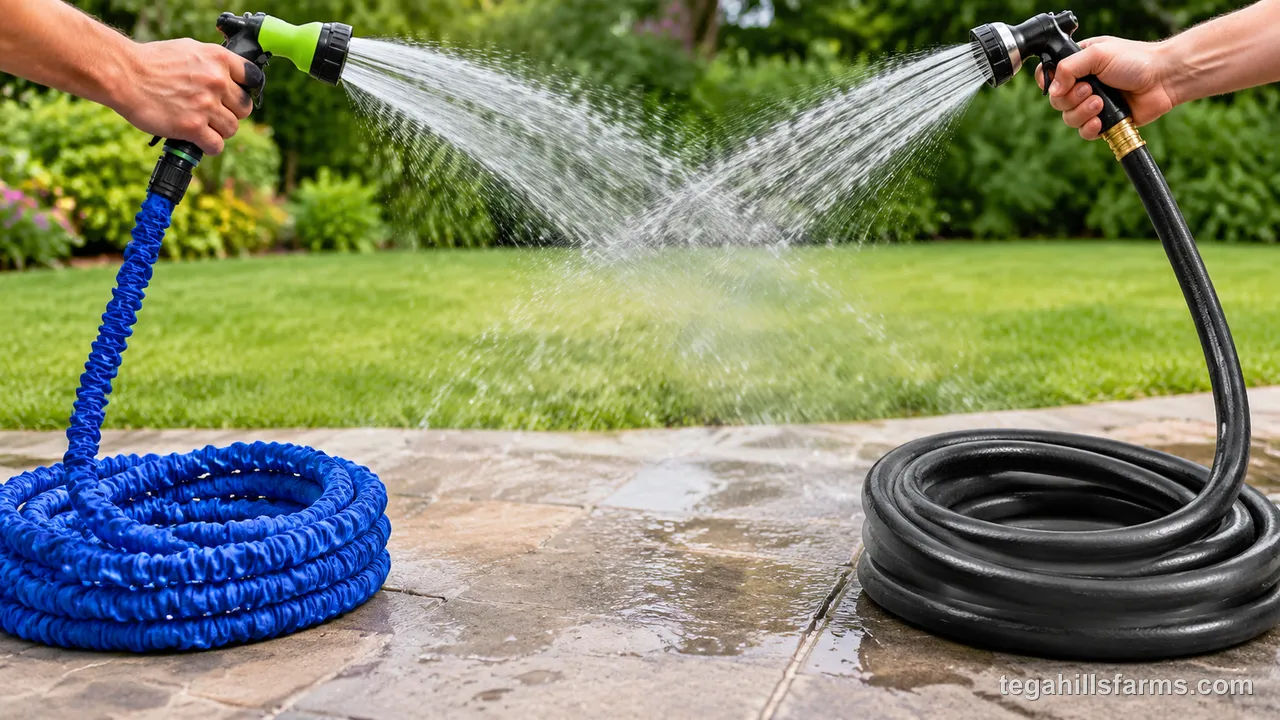
The expandable design is what makes it light. Water pressure pushes the inner latex tube outward, and the fabric shell limits how far it can grow, up to about three times its resting length. A Black+Decker 25-foot expanding hose, for example, measures 25 feet when full and 12.5 feet when empty. Most expandable models finish with ABS plastic connectors, and some use brass.
A rubber hose has no stretch. Its wall is thick and reinforced, and it usually ends in solid brass couplings. That gives it weight, but it also gives it a shape that stays put in your hand.
If you are still weighing hose types beyond these two, our guide on how to choose a garden hose covers material, diameter, and fittings in one place.
Which Lasts Longer, an Expandable Hose or a Rubber Hose?
A rubber hose generally outlasts an expandable one, because the latex core and connectors on an expandable hose fail first, a rubber hose’s thick wall takes abuse well, and weather treats the two materials very differently.
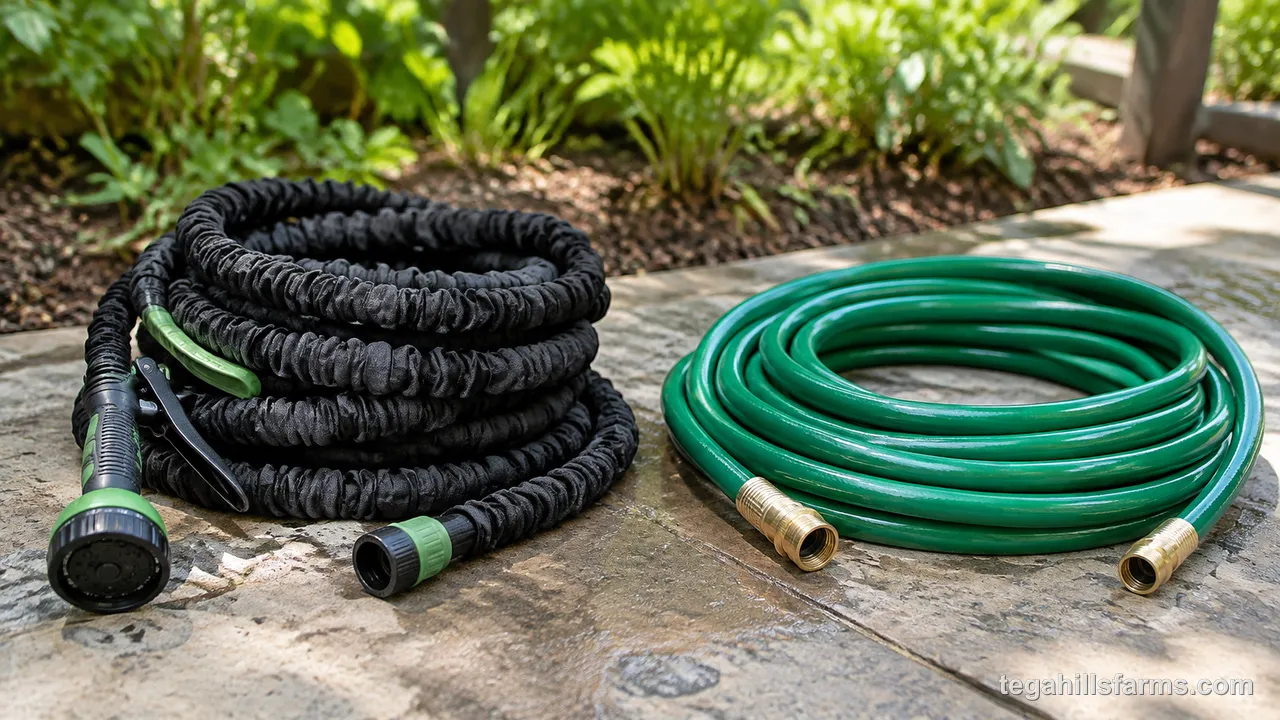
Each hose breaks down in a predictable way. Knowing where helps you spot trouble early.
Where Expandable Hoses Wear Out First
Expandable hoses fail first at the latex core, where pinhole leaks form, then at the fabric shell and the connectors.
The latex tube stretches and relaxes every time you turn the water on and off. Over a season, that cycling thins the material, and tiny leaks start to spray or weep through the shell. You notice it as damp spots on the lawn and a hose that sprays sideways.
Dragging is the second problem. The fabric shell scuffs on concrete, gravel, and mulch edges, and a worn shell no longer holds the core in check. Models such as the Pocket Hose and J&B XpandaHose share this construction, so the same weak points apply.
Connectors are the third. ABS plastic ends can loosen or crack where the hose meets the fitting. You see it as a drip at the spigot that tightening does not stop.
How Rubber Hoses Hold Up Season After Season
A rubber hose holds up through repeated use because its thick wall and solid couplings tolerate dragging, rough ground, and being stepped on.
The wall does not rely on stretching, so there is no thin inner tube to wear through. A kinked rubber hose may fold, but it rarely splits. Brass couplings resist the cross-threading and crushing that can damage plastic ends, and thick-walled models like Flexzilla are built around that idea.
Service life still depends on how you treat the hose. Leaving it in the sun, letting it freeze full of water, or hauling it over sharp edges shortens any hose. For realistic expectations, see our guide on how long do garden hoses last. No exact figure applies to every hose, so treat any number as a general range.
How Sun, Heat, and Cold Affect Each Hose
A rubber wall tolerates sun, hot pavement, and cold better than a fabric shell, though neither should live outdoors year-round.
UV light breaks down the fabric on an expandable hose over time. The shell fades, weakens, and eventually lets the core bulge. Rubber hoses also age under strong sun, but the thick wall gives them more material to lose before they fail.
Heat on pavement softens both. A rubber hose left in direct sun can heat the water inside it, so run it for a moment before you use it.
Freezing is the bigger risk. Water trapped in the latex core can freeze and split it. A rubber hose can crack in a hard freeze too, but the thicker wall takes more punishment. In either case, drain the hose before the first frost and keep it out of direct sun between uses.
Which Hose Kinks Less and Feels Easier to Handle?
An expandable hose is easier on the hands, while a rubber hose is steadier on the ground, and the split comes down to kink and tangle behavior and carrying weight.
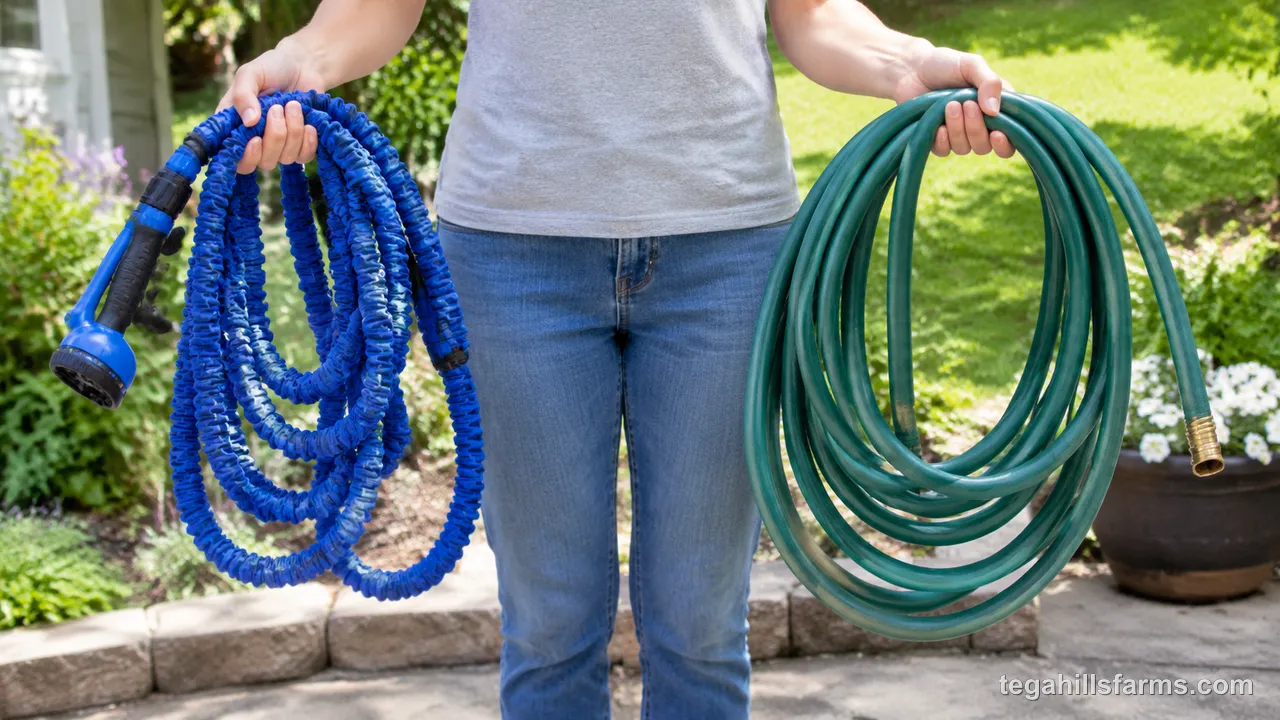
Both matter if you garden every week. A hose that fights you adds up over an hour of work.
Kinking and Tangling in Everyday Use
An expandable hose resists permanent kinks when empty, but it can twist and tangle as it fills, while a rubber hose keeps its shape yet can fold sharply and cut off flow.
When an expandable hose is empty, it is a loose, floppy tube that has no memory of a bend. Once water enters, it grows and can knot around plant stakes or itself. Expandable models such as the Flexi Hose tangle most when you pull them across a bed with the water already running.
A rubber hose behaves the opposite way. It rarely tangles in loops, but a sharp fold stops the water completely. You notice it when the spray dies mid-sweep, and you walk back along the hose to find the bend.
Straighten the hose before you turn on the water, and either type behaves better.
Weight and Hand Fatigue
An expandable hose is lighter to drag and lift, which eases hand and wrist strain, especially for older gardeners or anyone with limited grip strength.
The sourced weights show how little these hoses carry. The 100-foot Pocket Hose Copper Head weighs 5.9 pounds with its nozzle. The 150-foot J&B XpandaHose weighs 6.79 pounds with its nozzle. Those are easy loads to lift onto a hook.
Rubber hose weights depend on length, diameter, and whether water is inside, so no single figure fits them all. What holds in general is that a rubber hose of similar length is clearly heavier and heavier still when full. Dragging it across a big yard works your grip and forearm, and lifting it back onto a reel works your back.
If hand fatigue is your main concern, weight should weigh heavily in your decision.
Do Expandable Hoses Deliver the Same Water Flow as Rubber Hoses?
Not always. An expandable hose usually gives enough flow for light watering, but a rubber hose holds steadier pressure thanks to a fixed inner diameter and a rigid wall.
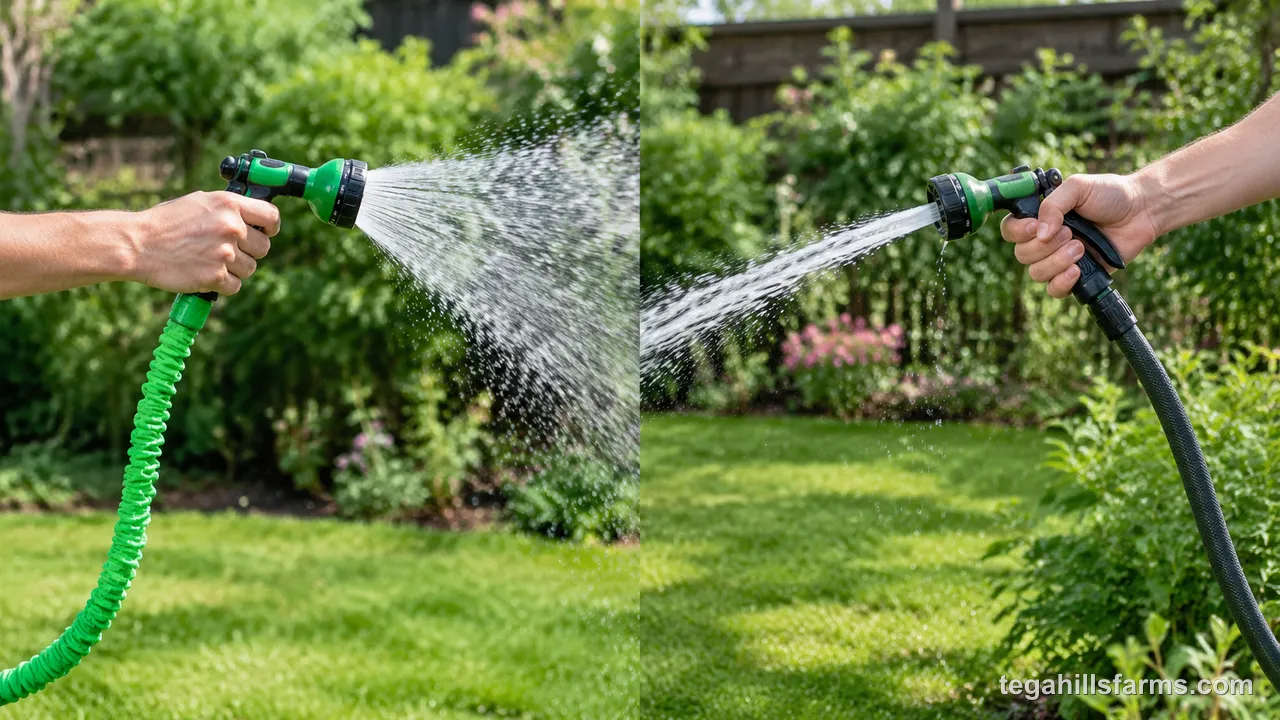
Three things shape what reaches your nozzle. First, the inner diameter. A rubber hose has a set bore, while an expandable hose’s inner tube only reaches full size once pressurized. Second, the expanding core itself. Until it fills, the tube restricts flow, so pressure at the nozzle can feel uneven at the start and drop with a partly open spigot. Third, the connectors. Small or narrow ends on an expandable hose can pinch the flow right where the water enters.
For a hand-held nozzle on a patio or flower bed, that difference is easy to live with. For a sprinkler, a long run, or a pressure-hungry attachment, a rubber hose is more consistent. For a deeper look at bore sizes, see the garden hose diameter breakdown.
Which Hose Is Easier to Store and Set Up?
An expandable hose wins on storage space, and a rubber hose wins on reach that matches the label.
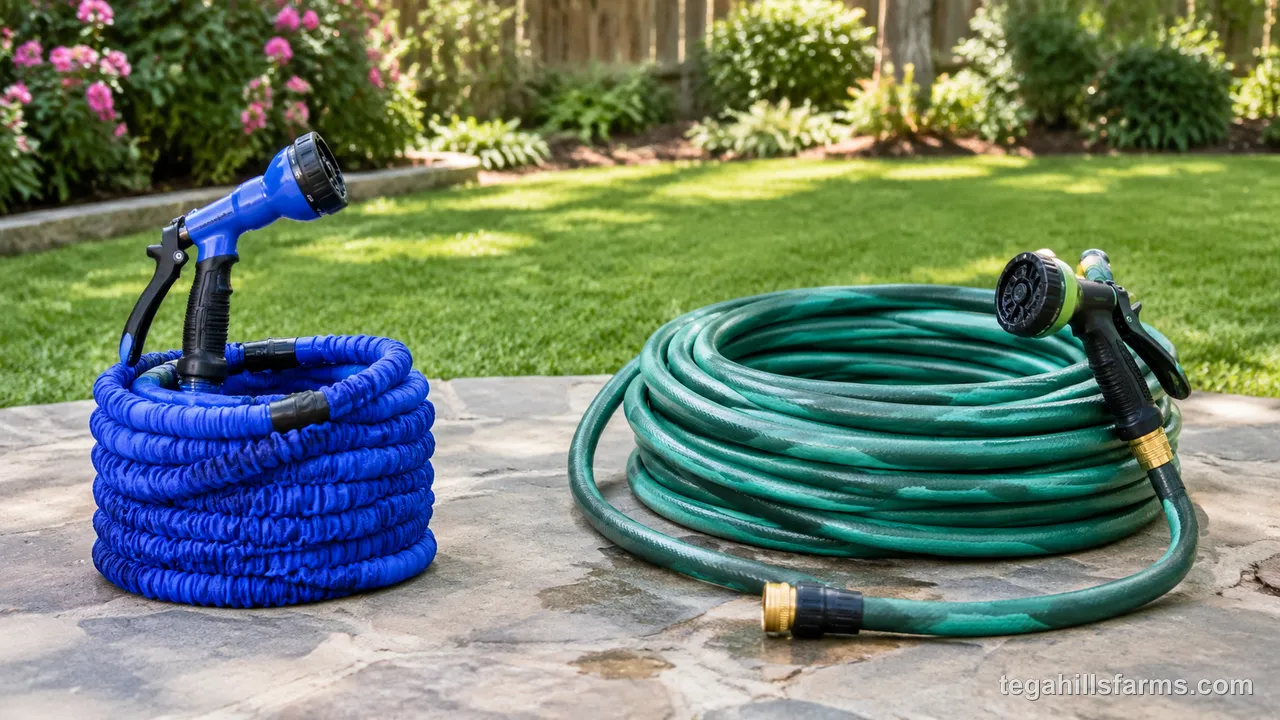
The compact form helps in a small shed or on a balcony. The gap between advertised and real length matters when you pick a size.
Storage Space and Reel Needs
An expandable hose takes less than half the space of a hose reel setup and needs no reel, while a rubber hose usually needs a reel or hanger.
Once drained, an expandable hose shrinks to a short, soft bundle. A 50-foot Pocket Hose Silver Bullet contracts to about 17.1 feet, and you can tuck it on a shelf or hook it on a wall. The Orbit coil hose goes further, resting at just 2.4 feet when it is not stretched.
A rubber hose does not shrink. It takes a reel, a hanger, or a large loose coil, and those need floor or wall room.
Both types need the same care at put-away. Drain the water, then coil loosely to avoid sharp bends. When you reconnect, hand-tighten the coupling against a seated washer. Our walkthrough on how to set up a garden hose covers the connecting steps in detail.
Real Reach Compared With the Advertised Length
An expandable hose often reaches a few feet shorter than its label when stretched under pressure, while a rubber hose stays close to its stated length.
The label usually reflects the maximum stretch, and a hose filled with water tends to come in short of that. The expansion is also limited to roughly three times the resting length. Contracted lengths show the starting point. A 50-foot Flexi Hose contracts to about 17.7 feet, and the 50-foot Pocket Hose Silver Bullet contracts to about 17.1 feet.
The practical fix is simple. Measure from the spigot to the farthest spot you water, then allow a few extra feet when you choose an expandable hose. With rubber, the label is a fair guide.
Which Hose Fits Your Yard Size and Watering Jobs?
Hose choice splits into three groups: small yards, patios, and containers favor an expandable hose, large lawns and long runs favor a rubber hose, and car washing, pets, and climate extremes depend on the job.
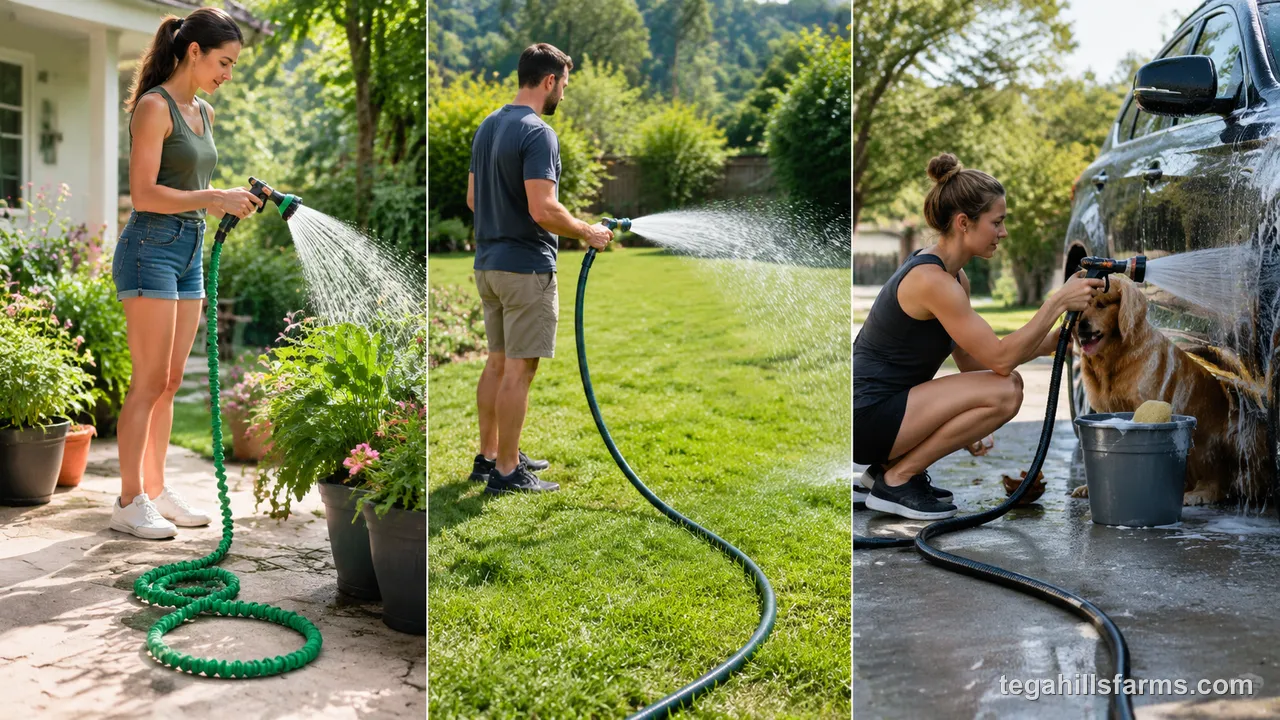
Match the hose to where you water most, not to the occasional exception.
Small Yards, Patios, and Container Gardens
A lightweight, short expandable hose suits patios, balconies, and container beds, where you water briefly and put the hose away often.
A shorter model like the Black+Decker expanding hose is easy to carry from the spigot to a row of pots. It stores in a small space and does not demand a reel. It is also gentle on your wrists, which matters if you water by hand most mornings.
The limits show up in long sessions. If you stand and water for a long stretch, the light hose can twist and bounce, and the connector takes constant tugging. For small spaces and quick jobs, though, it fits well.
Large Lawns and Long Garden Runs
A rubber hose suits large lawns and long runs because it handles constant dragging and sustained pressure without stretching or tangling.
Long distances put the most stress on a hose. Pulling it across turf, around corners, and past beds scuffs a fabric shell, while a rubber wall takes it. Steady pressure also matters if you attach a sprinkler.
A long expandable hose still makes sense when you move it rarely or need to carry it easily. Match the length to the walk from spigot to the far bed, with a margin. For sizing detail, our guide to what size garden hose do i need helps you pick the right length and bore.
Car Washing, Pets, and Hot or Cold Climates
For car washing and pet rinsing, either hose works with a good nozzle, and climate tips the balance, with rubber more reliable in heat and freezing weather.
A light expandable hose is easy to swing around a car or a dog, and its soft shell will not scratch paint. Pair it with an adjustable nozzle, and rinsing is quick.
Climate matters more. In hot summers, sun weakens fabric over time, so a rubber hose holds up better if it stays out. In freezing winters, trapped water can split a latex core, so drain either type and bring it inside.
Is an Expandable Hose Worth Buying Over a Rubber Hose?
Yes, for light, occasional use. An expandable hose is worth it when low weight and compact storage matter more than long service life, while a rubber hose is the better buy for frequent, heavy use.
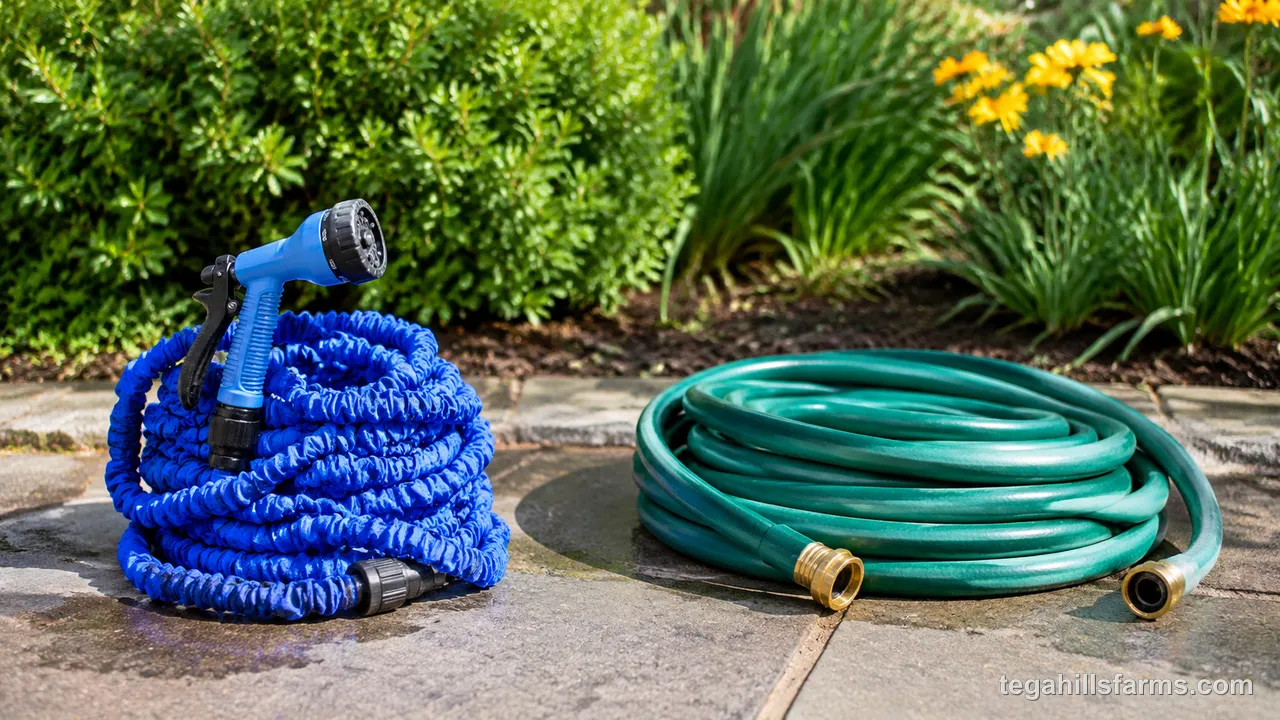
The question comes down to replacement frequency and reliability. A rubber hose tends to last through more seasons, so you replace it less often. An expandable hose may need replacing sooner, especially if you drag it or leave it in the sun. If your yard is small and your hands tire easily, the lighter hose can still be the smarter fit.
For pricing detail, see our guide on how much does a garden hose cost. Base the decision on how you water, not on the label alone.
A soft bulge in the fabric near the spigot looks harmless on a Saturday morning. By the next weekend, that spot can split mid-watering and soak your shoes. Knowing which warning signs are cosmetic and which mean the hose is done saves you from finding out the hard way.
How Do You Know When an Expandable or Rubber Hose Needs Replacing?
Replace a hose when you see bulges or weeping fabric on an expandable one, cracks or stiff walls on a rubber one, or loose or corroded fittings on either.
On an expandable hose, a bulge in the shell means the latex core is weakening underneath. Fabric that feels damp along its length points to pinhole leaks. Neither is fixable, so replace the hose before it bursts.
On a rubber hose, look for surface cracks, a wall that has gone stiff, and flat spots that no longer spring back. Those signs mean the rubber has aged, and it will split under pressure.
Fittings are different. A worn washer or a loose coupling can often be fixed. Corroded brass or a cracked ABS end that keeps dripping after tightening usually means the connector, or the hose, is finished.
Is Water From an Expandable or Rubber Hose Safe to Drink?
Water from either hose is not automatically safe to drink, so look for a drinking-water-safe label, lead-free fittings, and BPA- and phthalate-free materials, and flush the hose before use.
Many garden hoses are not made for drinking. The material, the fittings, and warm water sitting inside can all affect what comes out. Check the packaging for a clear drinking-water-safe statement. Labels vary, so read the wording rather than assuming.
Water left in a hose on a hot day warms up and picks up whatever the hose leaches. Run the water until it feels cool before you drink it, fill a pet bowl, or water an edible garden. That flush takes a few moments and clears the stagnant water.
If you grow vegetables or herbs, a hose labeled for drinking water gives you more confidence. Without that label, treat the hose as a watering tool only.
How Do You Store and Repair Each Hose Through Winter?
The two jobs are separate: draining and dry storage protect the hose from frost, while connector and leak repair decide whether a damaged hose is worth saving.
Do the storage step first, since trapped water causes much of the damage.
Winter Storage and Draining
Drain each hose completely before freezing weather, because trapped water splits the latex core of an expandable hose and can crack a rubber one.
For an expandable hose, remove it from the spigot, open the nozzle end, and let the water run out as it contracts. Hang it loosely or lay it in a bin, away from sunlight.
For a rubber hose, lift one end and walk the hose to push the water out, then coil it in wide loops. Hang it on a reel or hanger so no sharp bends set in.
Store both indoors, in a garage or basement, if you can. A shed works if it stays dry and shaded.
Replacing Connectors and Repairing Leaks
A rubber hose can be repaired with new connectors and washers, while repair options on an expandable hose are limited.
On a rubber hose, a dripping end is usually a worn washer. Replace it first. If the coupling is damaged, a repair kit with a new brass fitting lets you cut the hose and attach a fresh end.
On an expandable hose, you can sometimes swap a loose ABS connector. A pinhole leak in the latex core is not worth fixing, because other weak spots follow. Repair makes sense when the problem sits at a fitting. Replace the hose when the leak is in the body.
What Is a Coil Hose, and When Does It Beat Both Options?
A coil hose is a spiral-wound hose that springs back to a short resting length, which makes it a good fit for small patios and quick rinsing.
Because it pulls itself back, a coil hose stores without a reel and does not tangle in loops. The Orbit coil hose rests at about 2.4 feet when it is not stretched, so it takes almost no room.
The same spring is its weakness. The reach is short, and the hose constantly tugs back toward the spigot, which gets tiring on any distance. It also tends to drag a nozzle or pot along as it recoils.
For a balcony, a wash station, or rinsing boots at the door, it can beat both options. For anything bigger, an expandable or rubber hose will serve you better.
Expandable vs Rubber Hose FAQs
How should I read user reviews of Pocket Hose and other named brands?
Look for complaints that repeat, such as pinhole leaks, loose connectors, and how long the hose lasted. A hose praised after one month tells you little. Weigh reviews that mention a full season or two, and check what the reviewer used it for, since patio watering is far gentler than daily lawn use.
How should I approach the most popular hose lengths?
Measure from the spigot to the farthest spot you water, then pick the nearest length above that number. For an expandable hose, allow a few extra feet, because it reaches a bit short of the label when full. Going much longer adds weight and tangles without helping you.
Can I leave an expandable hose outside?
Only briefly. Sun degrades the fabric shell, and water trapped inside can freeze and split the latex core. Drain it and keep it in shade or a shed between uses, and bring it indoors for winter. A rubber hose tolerates outdoor storage better but still benefits from shade.
Can I swap a nozzle or fittings between hose types?
Most nozzles and spray heads thread onto either type, since both use standard garden hose threads. The catch is weight. A heavy metal nozzle can strain an expandable hose’s connector and tug the shell, so choose a lighter nozzle for it and check that the washer seats firmly.
Write Your Review
No reviews yet. Be the first to share your experience!