

My picks for the best machetes for large yards in 2026 are Mossy Oak 16in Machete (Best Overall), Gerber Gator Machete 25in (Best Rust-Resistant), Freelander Japanese Machete with Wood Sheath (Best Ergonomic Design), REAT Machete with Saw 17in (Best Budget), Fiskars 24in Machete Saw (Best for Heavy Pruning), Mossy Oak Kukri Machete 11.5in (Best Compact) and Corona MA 60062 ErgoHandle Machete 22in (Also Great). Each one handles a different mix of grass, vines, brush and limbs, and each carries its weight differently in the hand.
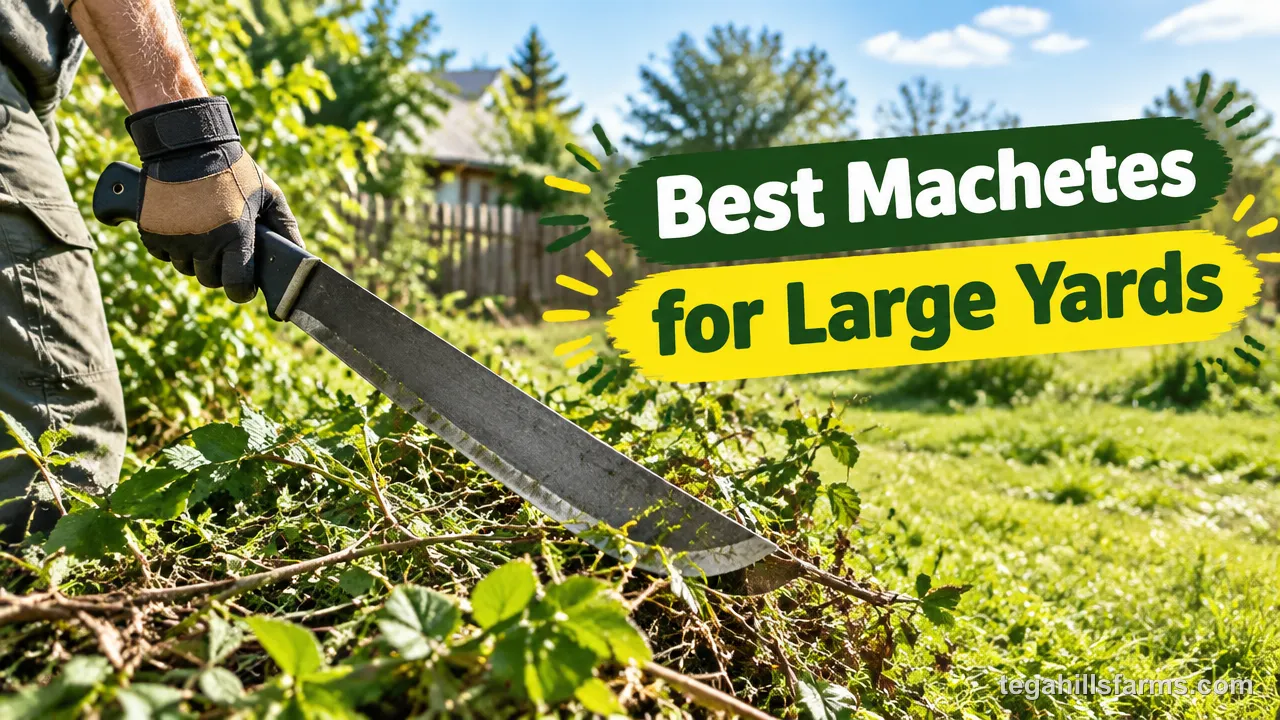
Blade shape and length decide how well a machete matches the growth on your property and how far you have to bend to reach it. Steel type decides how the edge holds up and whether the blade rusts in a damp shed. The handle and overall weight decide whether your hand and wrist still feel right late in the afternoon.
On a large yard, the real worry is wear on you and wear on the tool. A machete that is too heavy, too tip-heavy or slick in a wet hand turns a long session into sore forearms and blisters. A blade with thin stock or a loosely fitted handle starts to flex and rattle after a few hard sessions.



Start with the typical woody growth you cut every season and where the tool will hang between jobs. Those two facts narrow the choice faster than blade length or brand.
What Should You Look for in a Machete for a Large Yard?
What matters most is how the tool is built, because on a big property you swing it for long stretches and its construction shows up in your hands, wrists and back before it shows up in the cut. When the build suits the growth you face and how long you work, each swing stays controlled late in the day. A poorly matched tool starts pulling at your wrist and wandering toward plants you want to keep. For a wider look at the whole category beyond large-yard work, our guide to the best garden machetes covers it.
Which Blade Style Clears Your Yard’s Vegetation Best?
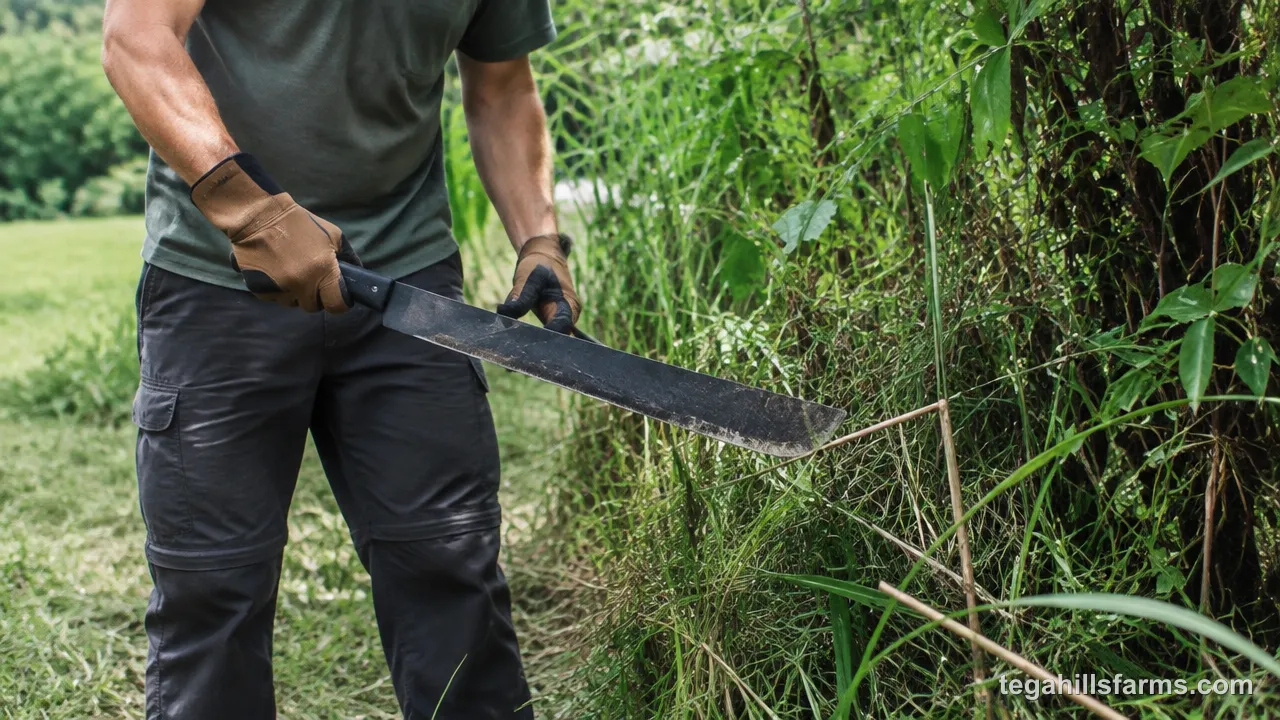
Shape decides where the weight sits along the blade, and that weight decides what the edge cuts well. A Latin blade is straight and fairly even in width, so it stays light and quick through tall grass and soft stems. A bolo widens toward the tip, which moves mass forward and helps it chop thicker stems and young saplings. A panga has a broad, weighted tip that pushes through dense grass and tangled brush. Kukri and parang blades carry thick spines and heavy bellies, so they bite into woody growth without bouncing. Japanese-style blades are broad and thick and built to chop more than slash.
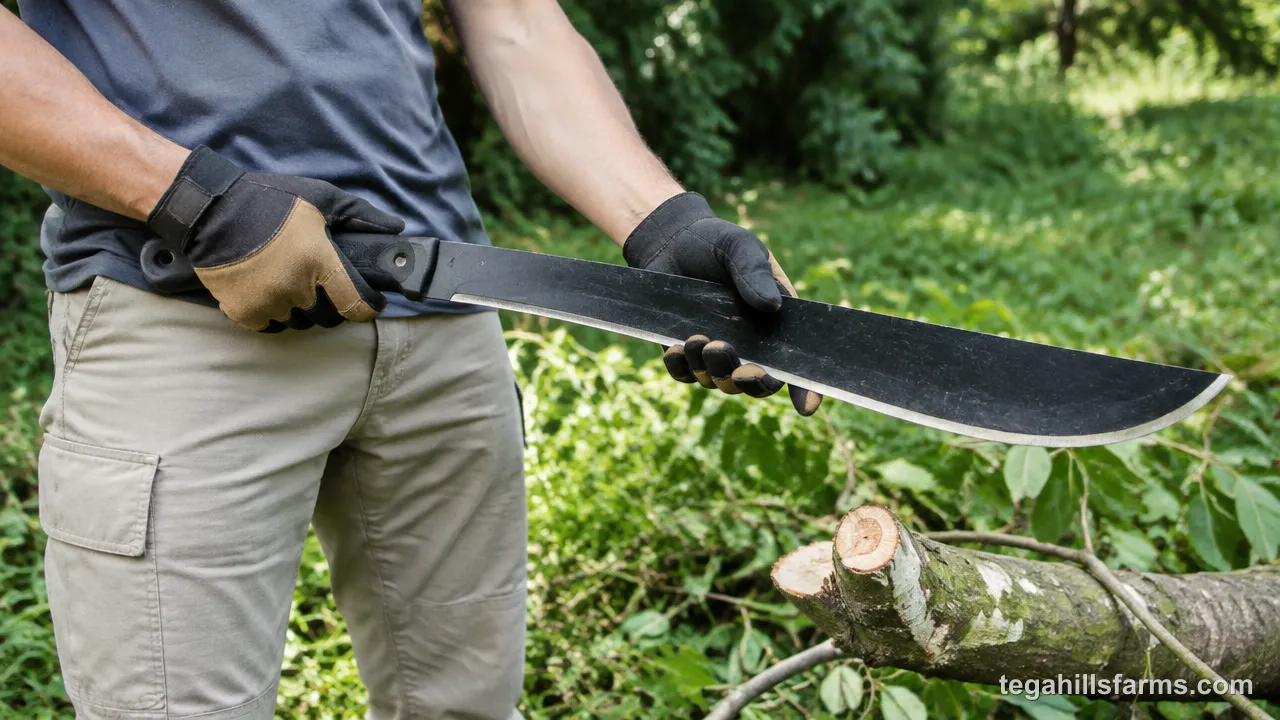
Pick the shape first, because length and brand only refine a tool that either suits your growth or fights it. If vines and brambles are your main problem, a lighter Latin or panga profile keeps pace with you. If saplings and woody stems are common, a kukri or parang has the strength for them. That forward weight keeps moving after the cut, so a missed stroke with a kukri or parang swings further and loads the wrist harder than a light Latin blade would. For tangled undergrowth in particular, compare the best machetes for brush removal.
How Long Should the Blade Be to Cut Down on Bending?
Extra reach lets you cut low growth from a more upright stance, while a shorter edge gives you control around shrubs, fences and beds. On open ground, that reach is what spares your lower back, because you no longer fold at the waist to get at grass near the soil.
Every extra inch adds leverage and moves the balance toward the tip. The blade then keeps pulling forward after each swing, and your forearm works harder to stop and steer it. Over a long session, that tip-heaviness shows up as a tired wrist and looser, less accurate cuts. Reach can also come from a longer handle, which lets you stand taller without adding weight out at the tip.
A yard with wide, open stretches favors a longer blade. One with dense beds, borders and fence lines favors a shorter blade you can steer between plants.
Does Steel Type Matter for Rust and Edge Life?
Yes. A carbon blade takes a keener edge and shrugs off hard blows, but it rusts if you put it away damp. Stainless resists corrosion, yet it dulls sooner and takes more work to bring back to sharp. High carbon stainless sits between the two: it gives up a little edge-holding for much better rust resistance.
Hardness, usually given on the Rockwell C scale (HRC), decides how a blade fails. A harder blade holds its edge longer but can chip when it meets a knot or a hidden rock. A softer one rolls and dulls instead, and a file fixes that in a few passes. Blade thickness works separately: thicker stock resists flexing when you chop into woody stems, while thin stock whips and bends under the same blow.
A tool that hangs in an unheated shed or gets wiped on wet grass all season is better off in stainless or high carbon stainless. Carbon steel suits a gardener who dries and oils the blade after every use.
What Handle and Weight Reduce Hand and Back Fatigue?
What keeps your hands and back fresh over a long session is a grip that stays put in a wet or gloved hand, plus a balance that lets the blade’s momentum carry the swing. Rubberized and TPR handles have a slight give and a textured surface, so your hand doesn’t shift on each impact. That shifting is what raises blisters. Wood feels warm and smooth and can be shaped closely to the hand, though it needs to stay dry and get an occasional coat of oil. A lanyard hole lets you tether the tool to your wrist, which matters when sweat or rain loosens your grip.
When the weight sits forward, the blade’s own momentum drives the cut and your wrist mostly guides it. When the weight sits near the handle, your wrist has to whip the blade to get speed. A heavier blade chops thicker stems in fewer strokes, but that extra mass has to be lifted and stopped on every swing, so it wears you out sooner. If chopping is your main job, the best machetes for chopping lean toward that extra weight.
The 7 Best Machetes for Large Yards of 2026
Mossy Oak 16in Machete, Gerber Gator Machete 25in, Freelander Japanese Machete with Wood Sheath, REAT Machete with Saw 17in, Fiskars 24in Machete Saw, Mossy Oak Kukri Machete 11.5in and Corona MA 60062 ErgoHandle Machete 22in each fit a different kind of work on big ground. Longer blades and saw-back designs pay off on open stretches and heavy limbs. The short kukri and the comfort-focused handles on the Freelander and the Corona put control and lower fatigue first over a long day. Between them, they cover homeowners clearing grass, vines, brush and small limbs on large properties, from buyers keeping spending low to those who put a comfortable grip first.
#1 Mossy Oak 16in Machete — Best Overall
If your yard mixes brush, vines and the occasional fallen limb, this machete covers all three with a stainless blade that carries saw teeth along its spine. The full tang keeps it solid.
Key Specs:
- Length: 16 in
- Weight: 0.8 lb
- Blade: stainless steel with sawback teeth
- Construction: full tang
- Handle: black TPR with hammerhead end and lanyard hole
- Sheath: Oxford cloth, plastic-reinforced, nickel-plated rivets, hook-and-loop closure
Detailed Review:
The stainless blade handles soft growth on its edge, and the saw teeth along the spine work through branches that would stop a plain edge. On a big property, that pairing saves a walk back to the shed for a pruning saw every time a limb blocks the path. The full tang runs through the whole handle, so the blade stays firmly seated after a season of hard chopping.
Next to the heavier, longer Corona MA 60062 ErgoHandle Machete 22in, this one gives up reach and chopping momentum. In return, it asks much less of your wrist and forearm over a long session. I value that more when the work includes overhead branches and careful cuts near shrubs.
The black TPR handle stays secure even in wet conditions, and the lanyard hole lets you tether it to your wrist. The hammerhead at the butt gives you a striking surface for tapping in a garden stake. The Oxford cloth sheath is reinforced with plastic and nickel-plated rivets, and its hook-and-loop closure keeps the blade in place while you walk between beds.
Pros:
- Saw teeth on the spine handle branches without a second tool.
- Full tang keeps the handle solid under hard swings.
- TPR grip stays secure in wet conditions.
- Hammerhead end adds a striking surface.
- Riveted, plastic-reinforced sheath closes securely with hook-and-loop.
Cons:
- Stainless edge needs more frequent touch-ups than carbon steel.
- Mid-length blade gives up reach on open ground.
- Saw teeth trap sap and take longer to clean.
Who It’s For:
Homeowners whose clearing changes from week to week, vines one weekend and a fallen limb the next, will get good use from a tool that slices, saws and strikes without a swap. If your work is mostly long runs of tall grass, a longer blade will spare your back more.
Editor’s Verdict:
A well-rounded machete that slices, saws and strikes, with a full tang and a riveted sheath that point to seasons of steady use.
#2 Gerber Gator Machete 25in — Best Rust-Resistant
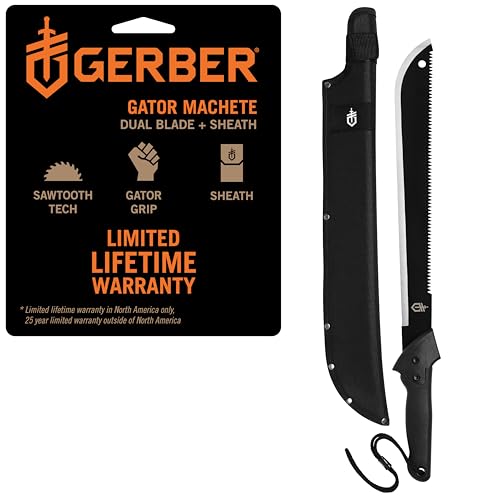
When your machete hangs in a damp shed or gets wiped on wet grass all season, its corrosion-resistant high carbon stainless blade is the reason to buy this one. Its long edge adds welcome reach.
Key Specs:
- Overall length: 25 in
- Blade: 18 in plain edge with a saw on the reverse
- Steel: corrosion-resistant high carbon stainless
- Weight: 1.125 lb
- Handle: textured Gator Grip, rubberized
- Extras: nylon sheath; limited lifetime warranty
Detailed Review:
The high carbon stainless blade resists corrosion, so a tool that goes back into an unheated shed after a dewy morning is far less likely to pit than plain carbon steel. That matters on a large yard, where the machete often rides in a cart or hangs by the door between jobs.
The long plain edge lets you take tall grass and vines near the ground while standing upright, and the saw on the reverse takes over when a limb is too thick to chop. Next to the Mossy Oak 16in Machete, the Gator trades some lightness for considerably more reach. Each swing covers more ground, but your forearm feels the extra weight late in the day.
The textured Gator Grip is rubberized and holds securely in wet or dry hands, which keeps your grip steady as dew or sweat builds up. A nylon sheath covers the blade for carrying and storage, and Gerber backs the tool with a limited lifetime warranty. I’d lean toward this one when storage conditions, more than the vegetation itself, are what wear tools out on your property.
Pros:
- Corrosion-resistant blade handles damp storage well.
- Long plain edge reaches low growth from an upright stance.
- Reverse saw takes over on limbs too thick to chop.
- Textured Gator Grip holds in wet or dry hands.
- Limited lifetime warranty backs the tool.
Cons:
- Long blade is harder to steer around beds and fences.
- Saw on the reverse rules out a smooth striking spine.
- Extra length and weight load the wrist late in a session.
Who It’s For:
If your property has long runs of tall grass and vines, and the tool often goes away wet, this machete suits both conditions. Gardeners who work mostly in tight beds and along fence lines will find a shorter blade easier to steer.
Editor’s Verdict:
Reach and a corrosion-resistant blade make this a sound choice for open, damp ground, provided you have room to swing a longer blade.
#3 Freelander Japanese Machete with Wood Sheath — Best Ergonomic Design
Gardeners whose hands tire before the work is done will appreciate the full tang red sandalwood handle, polished and shaped for a secure hold, paired with a thick high carbon blade that chops woody stems without flexing. It rewards a little care.
Key Specs:
- Blade: 10.5 in high carbon steel
- Blade width: 3 in
- Blade thickness: 0.2 in
- Construction: full tang
- Handle: polished red sandalwood with lanyard hole
- Sheath: handcrafted wood and leather
Detailed Review:
The blade is short, wide and thick, a profile that packs mass behind each chop so it bites into saplings and woody stems instead of flexing. Its sharp, non-serrated edge keeps sharpening simple, since there are no teeth to work around.
Because the blade is high carbon steel, it rewards drying and a light coat of oil after damp work and punishes neglect with rust. That care fits easily into the end of a session, and it keeps the edge keen for the woody cuts this blade is built for.
The red sandalwood handle is polished and shaped to fill the hand, and the full tang runs through it, so it feels solid on impact. The lanyard hole lets you secure the tool to your wrist during long sessions. For a gardener whose hands tire first, I’d put this handle ahead of blade reach.
The short blade does limit reach, so open stretches of low grass mean more bending. The handcrafted wood and leather sheath protects the edge between jobs.
Pros:
- Thick, wide blade puts real mass behind each chop.
- Full tang sandalwood handle feels solid on impact.
- Non-serrated edge is simple to sharpen.
- Lanyard hole lets you tether the tool to your wrist.
- Wood and leather sheath protects the edge.
Cons:
- High carbon blade rusts if not dried and oiled.
- Short blade limits reach across open grass.
- Polished wood handle needs more care than rubber.
Who It’s For:
Anyone whose grip gives out before the job does, or who chops more saplings and woody stems than grass, will appreciate this one. It suits a gardener happy to dry and oil a blade after each session, and it is a poor match if you want to store a tool damp and forget it.
Editor’s Verdict:
Handle comfort and a thick blade built for chopping are the draw here, in exchange for a little routine care after damp work.
#4 REAT Machete with Saw 17in — Best Budget
If you want one affordable tool that both chops and saws, this full tang machete pairs a 420 steel blade with saw teeth and a handle that stays firm in wet hands. It handles brush and limbs alike.
Key Specs:
- Length: 17 in
- Weight: 1.24 lb
- Steel: 420
- Construction: full tang
- Design: chopping edge with saw back
- Handle and sheath: ergonomic non-slip handle; protective sheath included
Detailed Review:
The 420 steel blade combines hardness with corrosion resistance, so it tolerates being set down in wet grass or stored in a humid garage. Pairing a chopping edge with saw teeth lets one tool clear brush and cut through limbs, so you don’t have to carry a second tool around a large property.
Next to the Mossy Oak 16in Machete, which shares the saw-back layout, the REAT carries noticeably more weight for only slightly more length. That extra mass puts more authority behind each chop into woody stems, but it also tires the forearm a little sooner.
The non-slip handle holds firm even with wet hands, and its shape is meant for long stretches of work. The full tang adds stability when you chop hard, and the protective sheath keeps the edge covered in a cart or truck bed.
I see this as a sensible first machete for a big yard when you want chopping and sawing without spending much. For more choices at a similar budget level, compare the best machetes under $50.
Pros:
- 420 steel resists corrosion in wet grass.
- Chopping edge and saw back cover two jobs.
- Full tang adds stability for hard chopping.
- Non-slip handle stays firm with wet hands.
- Protective sheath included for storage and transport.
Cons:
- Added weight tires the forearm sooner on long sessions.
- Saw teeth on the spine take longer to clean.
Who It’s For:
Gardeners who want one affordable tool for brush, vines and small limbs, and who often work with wet hands, will find it a practical fit. If you plan long afternoons of grass clearing and want an easy swing above all, a lighter blade will treat your wrist better.
Editor’s Verdict:
Solid steel, a saw back and a full tang make this an affordable all-rounder, as long as you accept a bit more weight per swing.
#5 Fiskars 24in Machete Saw — Best for Heavy Pruning
When thick branches and small trees are the main job, the aggressive saw that cuts on both the push and pull stroke takes down limbs that a plain edge would only bounce off. It works one-handed.
Key Specs:
- Overall length: 24 in
- Blade length: 18 in
- Weight: 0.9 lb
- Blade: tempered steel, precision-ground
- Saw: aggressive teeth that cut on push and pull
- Extras: wrist lanyard; lifetime warranty
Detailed Review:
The aggressive saw on the reverse cuts on both the push and pull stroke, so every stroke removes wood and thick branches come down in fewer passes. That makes this the tool I’d reach for when storm-damaged limbs or overgrown hedgerows are the main job.
On the other side, the tempered steel blade is precision-ground to cut with less effort, which helps through brush and along trail edges. One-handed use leaves your free hand to grab and pile cuttings as you go. On a large yard, that saves a second trip to gather debris.
The Gerber Gator Machete 25in also pairs a long blade with a saw on the reverse, but the Fiskars is lighter in hand. That lightness is easier on the wrist over a long session, though it gives up some of the chopping momentum a heavier blade brings to woody stems. A lanyard secures the machete to your wrist for added control and safety, and Fiskars covers it with a lifetime warranty.
Pros:
- Saw cuts on push and pull through thick branches.
- One-handed use frees your other hand for cuttings.
- Precision-ground tempered blade cuts with less effort.
- Wrist lanyard adds control and safety.
- Lifetime warranty covers the tool.
Cons:
- Aggressive saw teeth can snag vines on the backswing.
- Lighter blade carries less chopping momentum into woody stems.
Who It’s For:
Yards with overgrown hedgerows, storm-fallen limbs and trails to reopen call for this kind of tool, especially if you like to gather cuttings as you go. When your work is mostly soft grass and vines, the saw teeth add cleaning time without adding much use.
Editor’s Verdict:
Strong saw work and one-handed handling make this the machete to grab when limbs, not grass, stand between you and a clear yard.
#6 Mossy Oak Kukri Machete 11.5in — Best Compact
For trimming along beds, fences and shrub borders where a long blade has no room, the short kukri-shaped 3Cr13 stainless blade chops with forward weight in a tool small enough to wear on your belt. Its padded sheath carries it safely.
Key Specs:
- Length: 11.5 in overall, 6.73 in blade
- Steel: 3Cr13 stainless, 50–55 HRC, blackened finish
- Blade thickness: 0.1 in (2.75 mm)
- Weight: about 0.73 lb
- Handle: black TPR with textured thumb and palm areas, lanyard hole
- Sheath: plastic-lined Oxford cloth, double-stitched, PE padding, safety buckle, belt loop
Detailed Review:
The kukri shape angles forward and carries its weight toward the belly, so even a short blade chops through thin woody stems and roots with force. The short length is what makes it useful in tight cover, because you can work between shrubs and along fence posts without the tip catching on plants you want to keep.
The 3Cr13 stainless blade has a blackened finish that adds wear durability and rust resistance. Its moderate hardness means the edge tends to dull rather than chip, and a few passes with a file bring it back. Next to the Freelander Japanese Machete with Wood Sheath, whose blade is noticeably thicker, this kukri is easier to carry but gives up strength against heavy woody growth.
The TPR handle stays non-slip even in wet conditions, and textured thumb and palm areas give you finer control on short, precise cuts. The Oxford cloth sheath is lined with plastic, double-stitched and padded with PE at both ends. A safety buckle and belt loop let it ride on your hip between jobs.
Pros:
- Short kukri blade steers easily between shrubs and posts.
- Blackened stainless finish resists rust.
- Textured thumb and palm areas improve control.
- Padded sheath with safety buckle rides on a belt.
Cons:
- Small size leaves low grass out of comfortable reach.
- Thin blade stock limits heavy chopping.
Who It’s For:
Tight beds, shrub borders and fence lines are where this one belongs, especially for a gardener who wants a blade on the belt while weeding and trimming. On wide stretches of tall grass, a longer blade keeps you upright and covers ground faster.
Editor’s Verdict:
Small, rust-resistant and easy to carry, this kukri is a belt tool for close work rather than open-ground clearing.
#7 Corona MA 60062 ErgoHandle Machete 22in — Also Great
Long clearing sessions along property lines, through tall grass and vines, are where the ErgoHandle grip, shaped to reduce hand fatigue, pays off on a heavy-duty blade with real reach. Your back stays straighter.
Key Specs:
- Blade: 22 in, heavy-duty
- Weight: 1.5 lb
- Handle: ErgoHandle grip
- Design: balanced for controlled swings
- Model: MA 60062
Detailed Review:
The long heavy-duty blade gives you reach into tall grass, vines and dense vegetation, so you can cut low growth without stooping. Along property lines and trail edges, that reach adds up over an afternoon, because your back stays straighter with every swing.
The balanced design keeps swings controlled and delivers consistent cutting power, which helps when thick weeds and undergrowth would otherwise stall a blade mid-cut. With the balance set this way, the blade’s momentum carries more of the cut and your wrist mostly steers.
The ErgoHandle grip is shaped to give a secure, comfortable hold and reduce hand fatigue during extended clearing. Next to the Gerber Gator Machete 25in, the Corona carries a longer blade and more weight. It brings more force to dense undergrowth but is more tiring to carry from one end of the yard to the other.
I’d choose it for clearing days when grass and vines outnumber branches. In tight beds, the same length that helps in the open becomes harder to manage.
Pros:
- Long blade covers tall grass and vines without stooping.
- ErgoHandle grip helps reduce hand fatigue.
- Balanced design keeps swings controlled.
- Heavy-duty blade pushes through thick weeds and undergrowth.
Cons:
- Heavier build is tiring to carry across a big yard.
- Length makes close work around shrubs awkward.
Who It’s For:
Property owners who spend whole afternoons on fence lines, trail edges and overgrown corners will feel the benefit of this reach and handle comfort. For careful work around delicate plantings, a shorter blade keeps the tip away from plants you want to keep.
Editor’s Verdict:
Built for long clearing sessions, this machete pairs reach with a grip that keeps your hands fresher on open ground and in dense undergrowth.
Which Machete Should You Choose for Your Yard?
The right pick follows the growth you cut most and where the tool lives between jobs, since reach, saw teeth, steel and grip each solve a different problem on a big property.
- Open ground with tall grass and vines: choose the Gerber Gator Machete 25in or the Corona MA 60062 ErgoHandle Machete 22in if you want long reach that keeps you upright.
- Tight beds, shrubs and fence lines: choose the Mossy Oak Kukri Machete 11.5in if you need a short blade you can steer between plants and carry on your belt.
- Thick branches and small trees: choose the Fiskars 24in Machete Saw if limbs are your main job, because its saw cuts on both strokes.
- Mixed work with one tool: choose the Mossy Oak 16in Machete if your week moves between vines, brush and the odd limb.
- Damp storage: choose the Gerber Gator Machete 25in if the tool often goes back wet, because its corrosion-resistant blade tolerates it.
- Long sessions where comfort comes first: choose the Freelander Japanese Machete with Wood Sheath if hand fatigue ends your day before the work does.
- Tight spending: choose the REAT Machete with Saw 17in if you want an affordable tool that chops and saws.
If you’re working with a tighter limit, compare the best machetes under $30. If you’re willing to spend more on a tool meant to last many seasons, look through machetes under $100.
Thick woody stems are where a machete starts to bounce, bind and jar your wrist instead of cutting through, and on a big property you meet them along every overgrown fence line. Pushing past that point chips the edge, loosens the handle over time and leaves you with sore forearms and a stem still standing.
When Is a Machete the Wrong Tool for a Large Yard?
Stems woody enough to stop the blade, wide stretches of grass and repeated mowing-type work are where a brush axe, billhook, sickle, grass slasher, string trimmer or brush cutter takes over. Each of those tools puts its force where a machete can’t.
A brush axe sets a heavy hooked blade on a long handle, so it cuts woody stems and saplings that would bind a thinner blade. A billhook’s curved tip hooks brush and pulls it toward you as it cuts, which suits hedges and tangled growth. Sickles and grass slashers cut grass close to the ground in sweeping strokes. A string trimmer or brush cutter handles wide areas you would otherwise clear one swing at a time.
Forcing a machete past that point chips or rolls the edge on hard wood. It also lodges the blade so you have to wrench it free, and it sends each jarring blow into your wrist and elbow. Over a season of that, even a well-fitted handle can start to loosen.
Is a Saw Back Worth Having on a Yard Machete?
For anyone who regularly meets branches and limbs too thick to chop cleanly, yes. The teeth on the spine cut through wood that a plain edge bounces off or splinters, so you can flip the blade, saw through the limb and keep clearing without fetching a second tool.
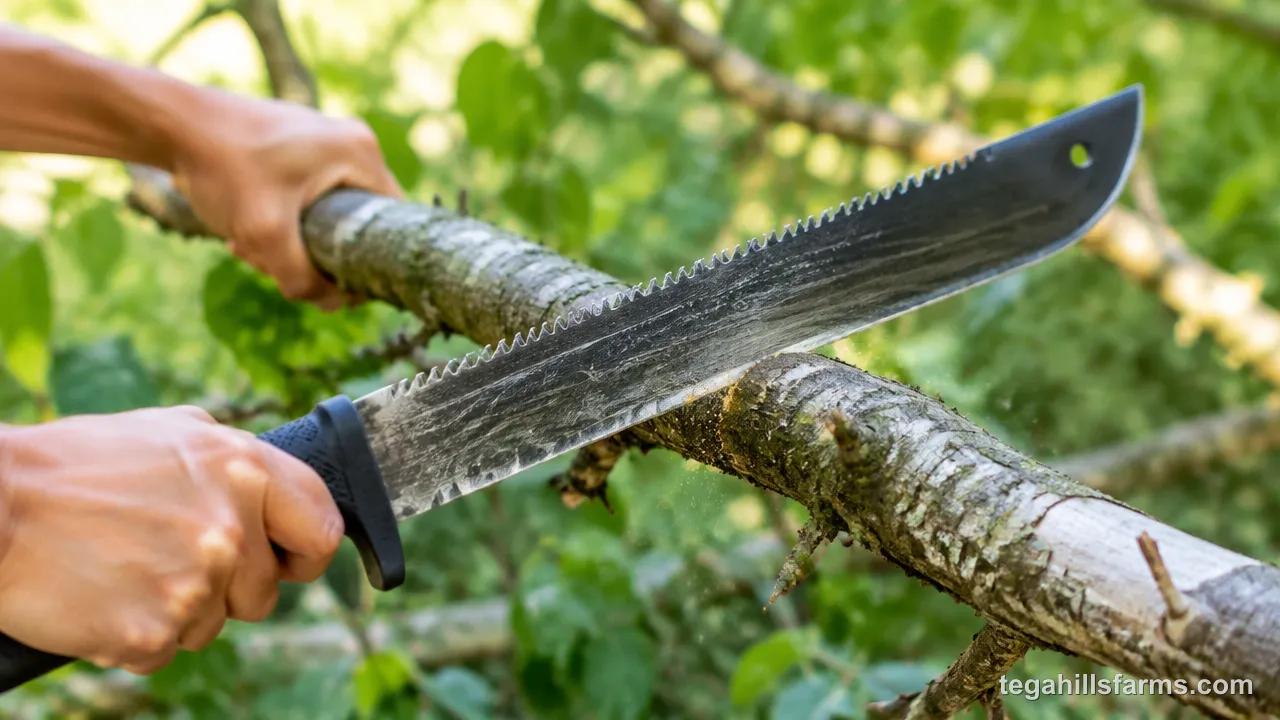
Those teeth catch sap, bark and fine debris, so they take longer to clean than a smooth spine. They can also snag vines and clothing on the backswing, which matters in dense brambles. A toothed spine can’t be struck with a mallet or baton to split wood or drive the blade through a stubborn stem. It also gives you no smooth surface to press on with your free hand.
A saw back pays off in yards with fruit trees, hedgerows and storm-fallen limbs. If your clearing is mostly grass, vines and soft brush, a plain edge is simpler to clean and safer to handle in thick growth.
How Do You Swing a Machete Safely and Avoid Tiring Out?
Let the blade’s weight carry the cut while your wrist and forearm guide it. Heaving from the shoulder tires you quickly and sends the blade wide. Cut on a downward angle across the stem so the blade exits away from your body.
Bend at the knees rather than the waist, and pick a blade or handle long enough that low growth doesn’t force you to stoop. Keep your free hand and both legs out of the swing’s path. Plant your feet so that a blade glancing off a stem follows through into open air, not toward your shin. Keep people and pets well beyond the reach of your arm plus the blade, because a blade that slips from a wet hand travels farther than you expect.
Wear snug gloves, eye protection against flying chips and thorns, long pants and sturdy closed footwear. A lanyard keeps the machete attached if your grip slips. Sheathing it between cuts keeps the edge away from you while you gather debris or move to the next patch. Take short breaks before your forearm feels heavy, since tired swings are the inaccurate ones.
How Do You Sharpen and Store a Machete So It Doesn’t Rust?
Touch up the edge whenever it starts tearing stems instead of slicing them, which after hard brush work can mean every session, and dry the blade completely before it goes away. A mill file or sharpening puck worked along the bevel at the existing angle brings back a working edge quickly. A machete doesn’t need a razor finish, and a slightly toothy edge bites grass well.
Sap and dirt hold moisture against the steel, so scrub them off with warm soapy water and a stiff brush after each use, then dry the blade fully. A light coat of oil matters most on carbon steel, which rusts quickly when left damp, though stainless benefits too. A cloth, nylon or leather sheath can trap moisture, so sheath the blade only once it is fully dry. Keep it through winter somewhere that doesn’t stay humid.
A machete cared for this way keeps its edge and finish for years. One put away wet and dirty pits along the edge, dulls faster and needs heavy grinding to recover.
How Can You Spot a Machete That Won’t Last?
The warning signs are thin blade stock that flexes, a handle that isn’t full tang or sits loosely, rough grinds, weak sheath stitching and a blade length chosen for looks. Each one shows up within a few sessions of hard use.
A full tang means the steel runs the length of the handle, so the force of each impact goes into a solid core. A partial tang held by glue or a pin can work loose, and you feel it first as a click or rattle on each blow. Thin stock bends or whips when you chop woody stems, which spoils accuracy and can leave a permanent bend.
Rough, uneven grinds tear stems rather than slicing them, and they are hard to sharpen evenly. Loose or thin stitching on a sheath lets the edge work through the seam, which puts the blade against your leg. A blade far longer than your yard needs adds tip weight you carry on every swing, with nothing gained in the cut.
Are There Legal Limits on Owning and Carrying a Machete?
Keeping one for yard work is ordinary almost everywhere. Rules on carrying it in public, transporting it in a vehicle and blade length can vary by state, by city and by location, such as parks or schools.
Carrying a machete openly away from your property, or keeping it within reach in a car, can be treated very differently from using it in your own yard. Keep it sheathed and stowed, in the trunk or a closed toolbox, whenever you move it between properties or to a job site. Before you travel with one, especially across state lines, check the local rules where you’re going.
Write Your Review
No reviews yet. Be the first to share your experience!