

An oscillating sprinkler fits flat, rectangular lawns that need wide, even coverage. An impact sprinkler suits large, irregular or round areas where you want an adjustable arc and a stream that holds up in wind.
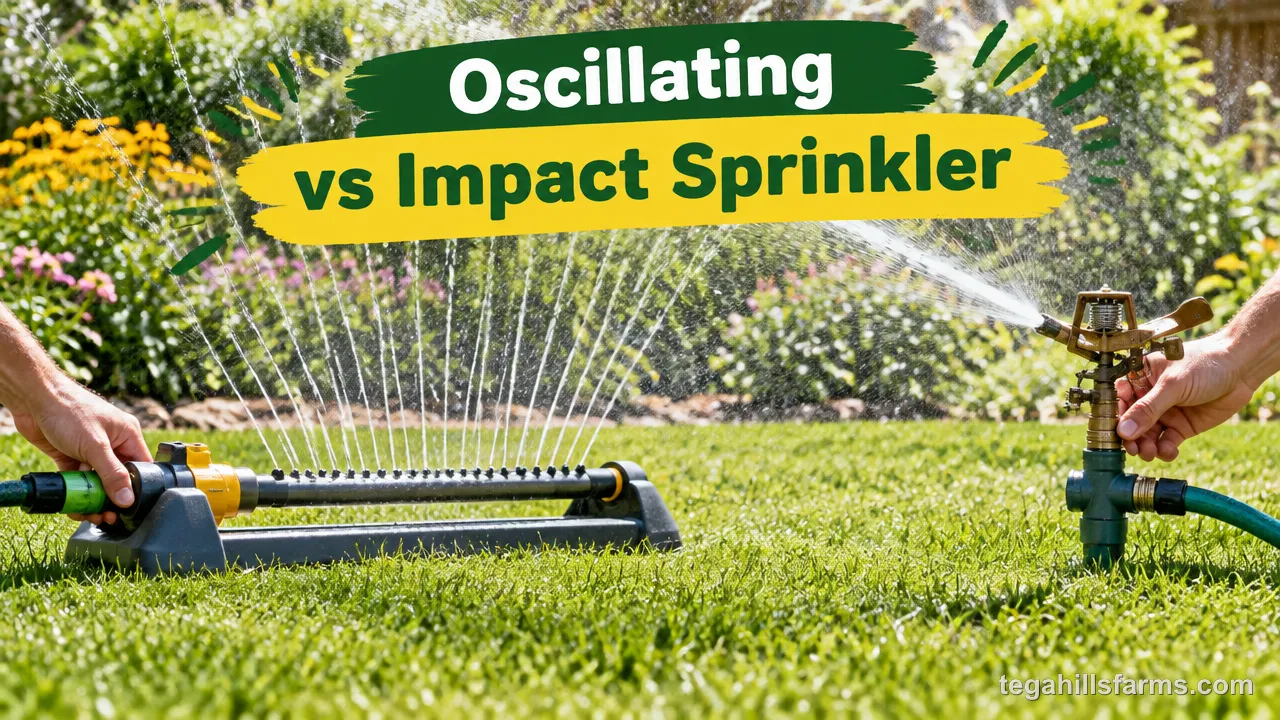
The choice comes down to a few practical differences: how far each type throws water, how much it puts out per minute, how the spray behaves in wind and on your soil, and how much hand work it takes to set up and keep running.
Most homeowners worry about the same failures with either type. Water lands on the driveway instead of the grass, corners stay brown, clay soil sheds runoff into the street, or a sprinkler that worked in June clogs or stops turning by August.
Pace off your lawn before you compare anything else. Note where beds, walks and the house cut into the grass, because the shape of the watered area rules out one of these two types faster than any spec does.
Oscillating vs Impact Sprinkler: Which One Fits Your Lawn?
Flat, rectangular lawns get the most even coverage from an oscillating sprinkler’s sweeping tube, while large, curved or irregular yards are better served by an impact sprinkler’s adjustable circular arc.
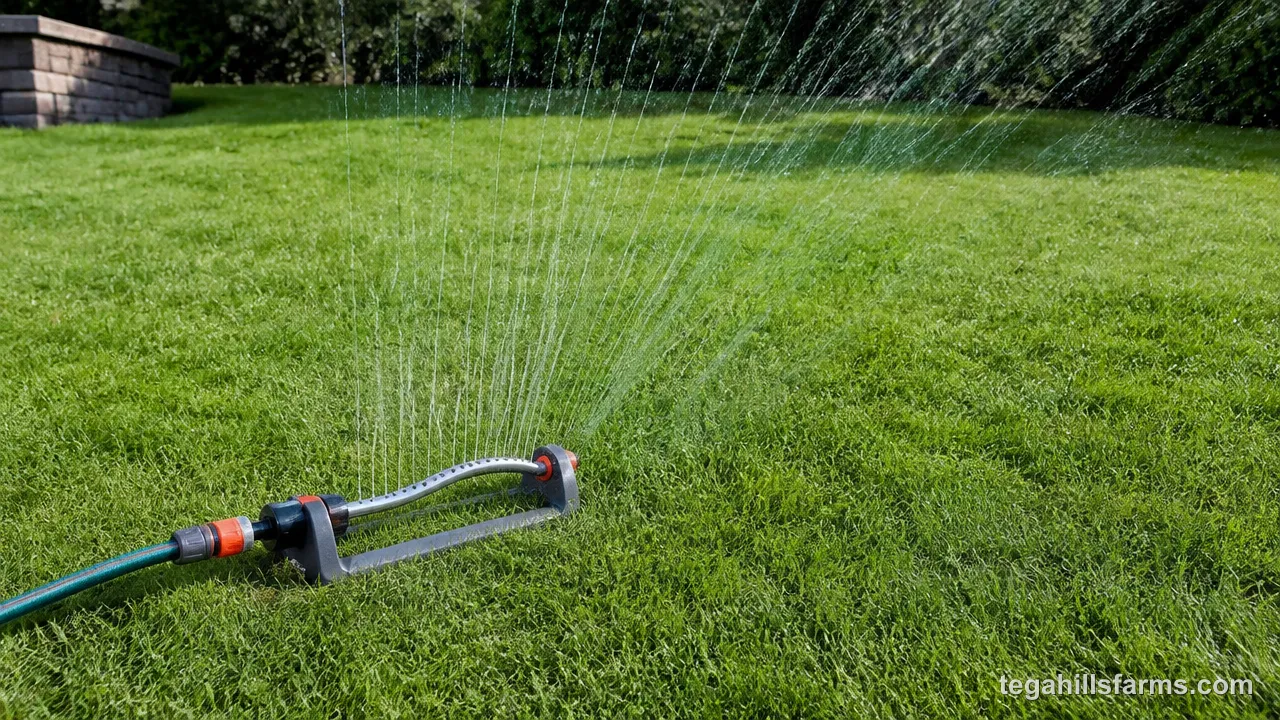
The two designs move water in different ways, and that explains the split. An oscillating sprinkler rocks a perforated tube from side to side, so it lays down a rectangle of fine spray. An impact sprinkler fires one jet against a spring-loaded arm. Each hit kicks the head around a few degrees, which builds a full circle or a wedge you choose. A rectangle matches a rectangular lawn. A circle or wedge can be fitted into corners and curves that a rectangle would overshoot.
The two types compare as follows on the criteria that decide fit. Figures are typical for each type, and criteria without a standard figure are compared in words.
| Criterion | Oscillating | Impact |
|---|---|---|
| Coverage area | Up to 5,000 square feet | Full or partial circle, sized by reach and arc |
| Spray distance | Up to 70 feet in one direction | Up to 30 feet with adequate pressure |
| Flow rate | About 5 to 8 gallons per minute | Up to 5 gallons per minute |
| Adjustability | Sweep width and range | Arc between 15 and 360 degrees |
| Spray pattern | Rectangle of fine droplets | Circle or wedge of heavier droplets |
| Lawn shape fit | Flat, rectangular lawns | Irregular, curved or round areas |
| Wind behavior | Fine spray drifts easily | Low, heavier stream holds its line |
On paper the oscillating type reaches farther and covers more ground from one spot. The impact type gives that up in exchange for control, because it can water a quarter-circle in a corner without soaking the patio next to it.
If you’re still weighing sprinkler types beyond these two, our guide on how to choose a sprinkler covers the full range of options.
Which Sprinkler Covers Your Lawn Shape and Size Better?
Rectangular lawns get more coverage per setting from an oscillating sprinkler. An impact sprinkler reaches less far but fits curved edges, corners and odd shapes because you can narrow its arc.
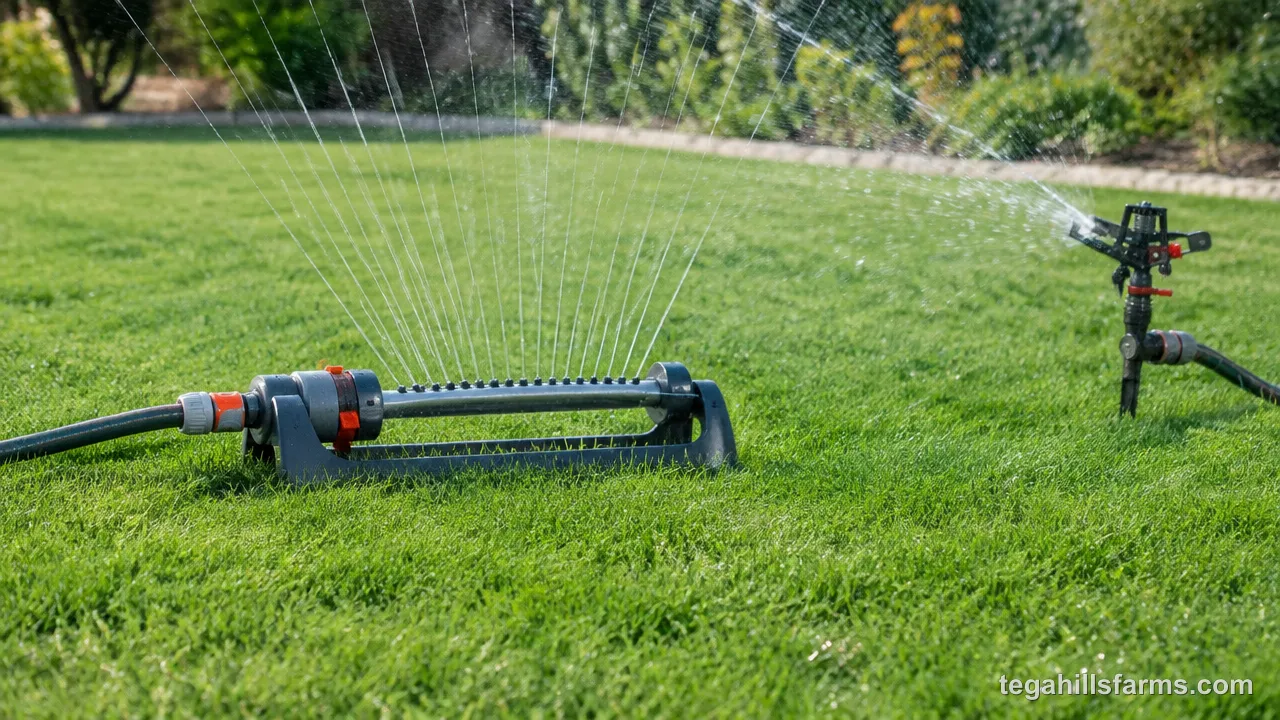
On a small lawn, an oscillating sprinkler’s long throw is often more than the space needs. You have to dial back the range, or the spray hits the fence and the sidewalk. An impact head placed at the edge of a small patch and set to a half or quarter arc keeps its shorter reach inside the grass.
Medium rectangular lawns are where the oscillating type works best. One setting covers the whole area, and the rectangle lines up with straight edges, so little water lands outside the lawn. An impact head on the same lawn throws a circle into a rectangle, which leaves dry corners unless you move it or overlap it with a second head.
Large yards depend more on shape than on size. A wide, open rectangle is covered from one spot by the oscillating type’s long one-direction reach. A large yard broken up by island beds, curved borders and a driveway is easier to cover with impact heads, each set to its own arc, than with a rectangle that keeps overspraying beds and pavement.
Narrow side strips favor the oscillating type, because sliding its width tabs inward turns the rectangle into a long, thin band. An impact head on a strip still throws its full radius in every direction its arc allows, so part of the water goes over the house or onto the neighbor’s side.
Measuring your lawn before you buy tells you what size sprinkler you need and whether one head will be enough.
For rectangular lawns and narrow strips, the oscillating sprinkler covers more from a single position. The impact sprinkler is the better choice on irregular, curved or corner-heavy yards, where an adjustable arc keeps water on the grass.
How Do Flow Rate and Water Efficiency Compare?
The oscillating sprinkler puts out more water per minute as a fine spray. The impact sprinkler delivers less water in heavier droplets that resist wind drift and evaporation.
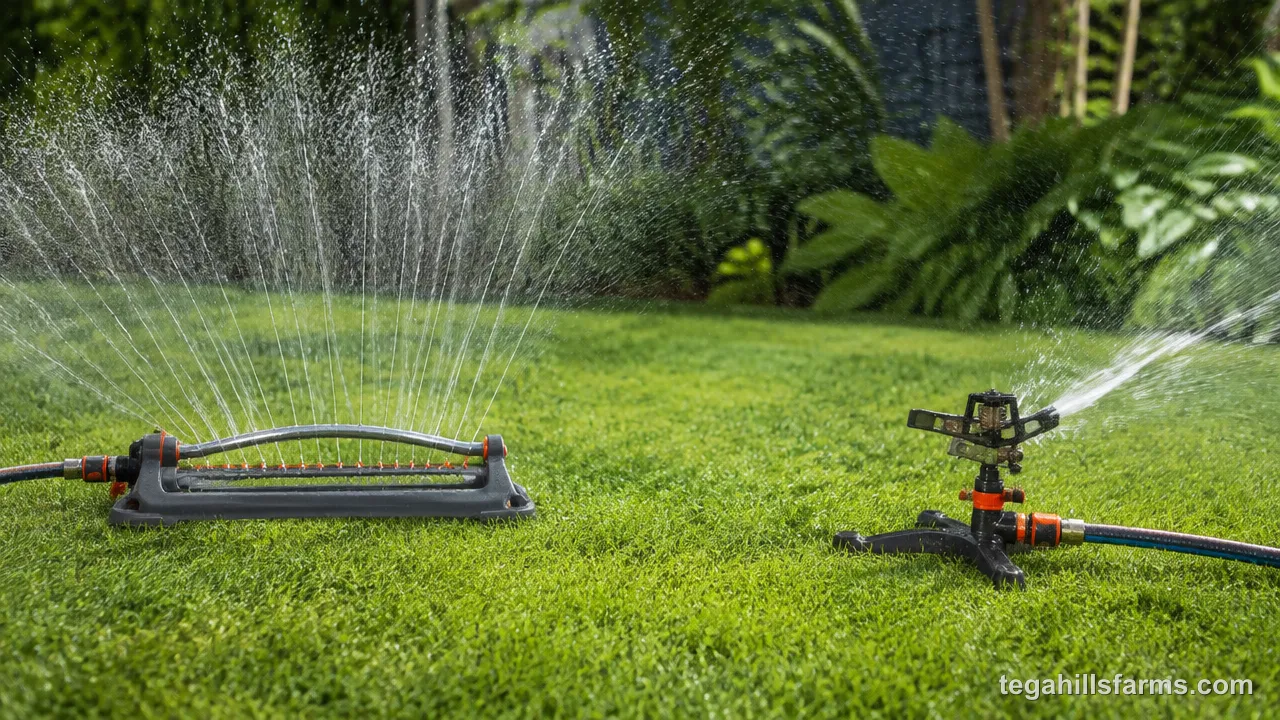
Droplet size matters more than flow rate once the wind picks up. An oscillating tube throws a high arc of small droplets. On a hot, breezy afternoon those droplets drift sideways and evaporate before they reach the grass. An impact sprinkler shoots a low, flat jet, and the heavier drops break up near the ground, so more of what leaves the head ends up in the soil.
The oscillating design also pauses briefly at each end of its sweep as the tube reverses. Those edges get more water than the middle, and you can see it as soggy strips along the sides while the center is just damp.
Soil decides whether higher output turns into a problem. Clay absorbs water slowly, so an oscillating sprinkler’s heavy output can pool and run off before it soaks in. Splitting the watering into two shorter sessions with a break in between gives clay time to absorb. An impact sprinkler spreads lower flow over its circle, so it applies water more gently and clay can keep up. Sandy soil takes in water fast and handles the oscillating type’s output well, though it drains past the roots quickly, so shorter, more frequent sessions make better use of it.
Since output and soil both change the timing, how long to run sprinklers depends on which type you use and what’s under your grass.
The impact sprinkler wastes less water on windy sites and slow-draining clay. The oscillating sprinkler is only as efficient in calm morning conditions on soil that absorbs water readily.
Which Type Holds Up Better and Is Easier to Maintain?
Impact sprinklers, especially metal-bodied models, usually hold up better. Oscillating sprinklers need more routine care because their small nozzle holes clog and their gear motors wear.
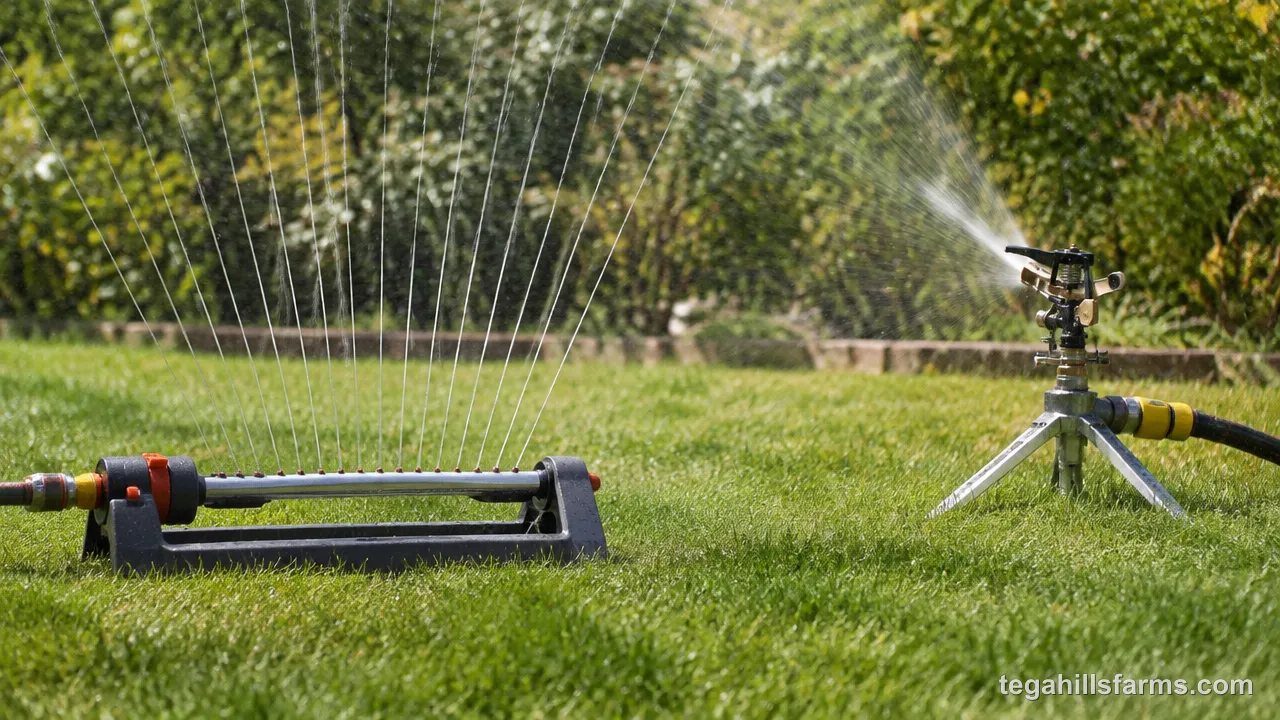
An oscillating sprinkler packs more moving parts into a plastic body. A water-driven gear motor rocks the tube, and every spray hole is small enough for grit or hard-water minerals to plug. A clogged hole shows up as a dry stripe across the lawn. Clearing each hole with a pin, or soaking the tube in vinegar to dissolve mineral crust, takes care of it, and on hard water it becomes a regular job. When the gear motor wears out, the tube stops rocking or sticks partway through its sweep, and that part usually can’t be replaced on its own.
An impact sprinkler has fewer parts: the arm, its spring and the bearing the head turns on. A brass or zinc head shrugs off sun and knocks that would crack plastic. The weak points are a spring that loses tension, so the head stops stepping around, and a bearing that grits up and sticks. A bent arm from a mower or a misstep also throws off the rhythm. Plastic impact heads look the same but give up much of that toughness.
Both types need the same care before frost. Drain them, then store them indoors, because water left inside freezes and splits plastic housings and tubes. Habits like these matter more than brand when it comes to how long sprinklers last.
The impact sprinkler is the lower-maintenance choice for gardeners with hard water or little patience for nozzle cleaning, as long as its spring and bearing get a quick check each season.
Which Is Easier to Set Up and Use Day to Day?
An oscillating sprinkler is simpler to use because it sits flat on a sled base and adjusts with one large dial. An impact sprinkler’s arc and spray have to be set by hand at small collars and a screw.
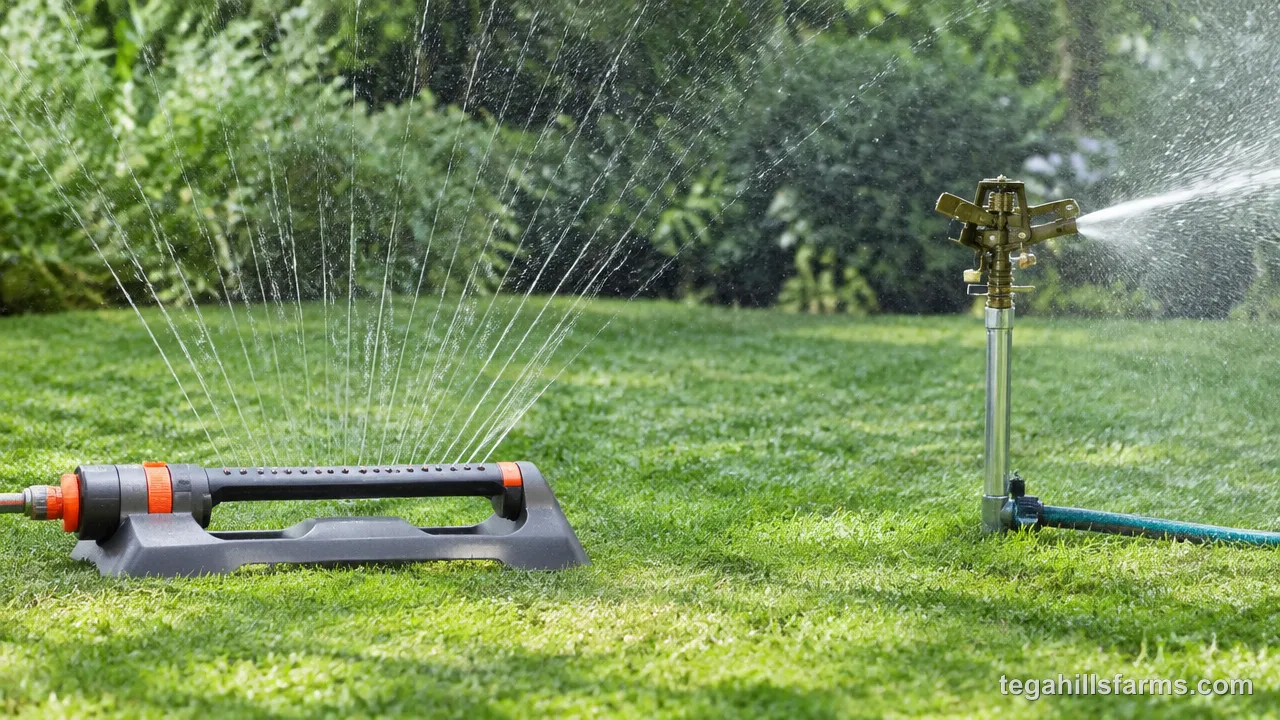
Both connect to a standard garden hose, so the difference starts with placement. An oscillating sprinkler rests on a sled base that needs reasonably level ground, or the sweep runs unevenly. Most impact sprinklers come on a spike pushed into the lawn. Sled versions sit on patios and hard soil, and tripod stands lift the head above tall perennials so the stream clears the foliage.
Adjustment is where the two feel most different in your hands. On an oscillating sprinkler you turn a dial on the motor housing to set the sweep range, and slide tabs or clips along the tube to narrow the width. An impact sprinkler sets its arc with two friction collars or trip pins at the base, and adjusts the stream with a small diffuser screw that breaks the jet into finer spray. Those collars are often stiff, and on a wet metal head they are hard to turn for gardeners with arthritis or a weak grip.
Running behavior differs as well. The oscillating type sweeps quietly. The impact type ticks steadily as the arm strikes, and that sound carries to neighbors on early summer mornings. Pulling a spike out of soaked ground to move an impact head also takes more effort than sliding a sled across the grass.
Placement still decides how evenly either type waters, and how to set up a sprinkler explains spacing, overlap and leveling step by step.
The oscillating sprinkler is the easier one to use day to day, because its large dial and flat base ask less of your hands than the impact’s stiff collars and spike.
Should You Choose an Oscillating or an Impact Sprinkler?
Decide by lawn shape first, then by wind exposure and soil. Rectangles in calm, open yards favor the oscillating type. Irregular, windy or clay-heavy yards favor the impact type.
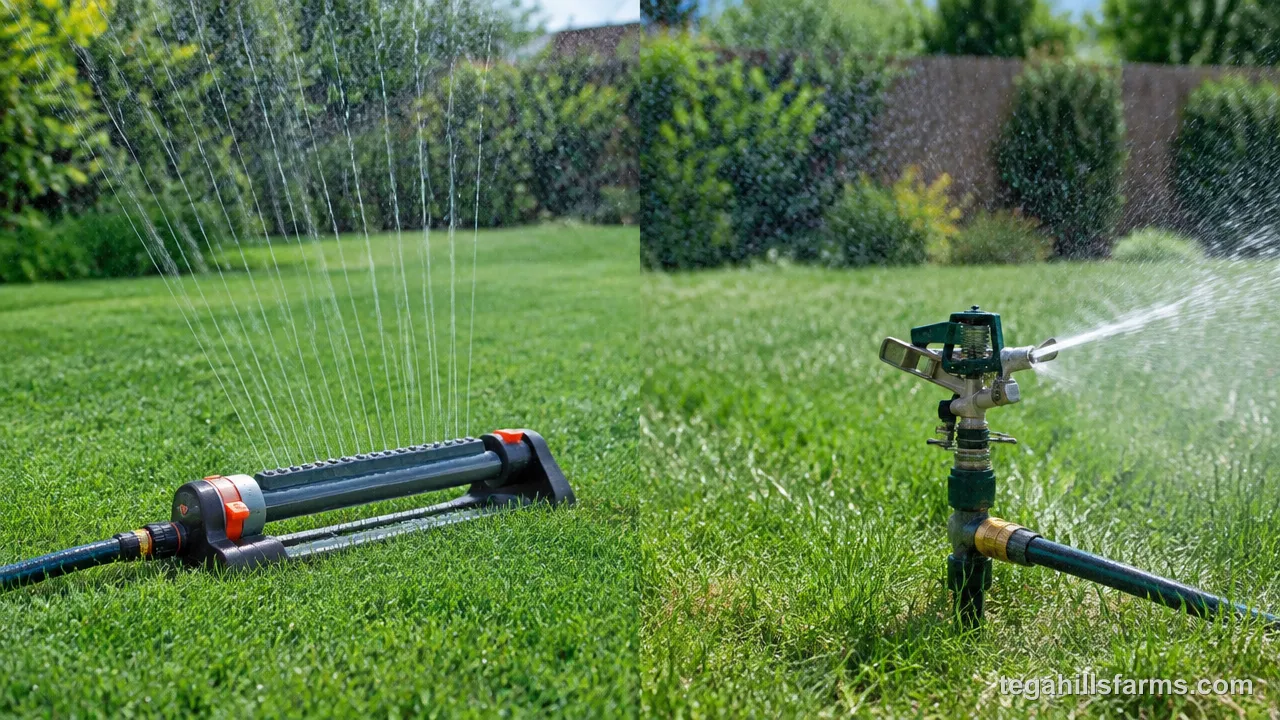
Choose an oscillating sprinkler if:
- Your lawn is a flat rectangle or a long, narrow strip with straight edges.
- You’re watering new grass seed and need a soft spray that won’t wash seed away.
- Your yard is sheltered from wind and you water in the early morning.
- Your soil drains well enough to absorb higher output without pooling.
- You want adjustments you can make with a large dial rather than small, stiff collars.
Choose an impact sprinkler if:
- Your lawn curves around beds, has tight corners or wraps around the house.
- Your yard is open to steady breezes that would blow fine spray off course.
- Your soil is clay and needs water applied slowly to avoid runoff.
- You have hard water and would rather not clean clogged spray holes.
- You need an arc you can set exactly, such as a half-circle along a fence.
I’d point gardeners with stiff or tired hands toward an oscillating model, because the impact’s friction collars are the one part of either type that fights back. For a yard that combines a rectangular front lawn with curved back borders, I’d keep one of each and stop forcing a single design to handle both shapes.
A shrub border watered from overhead ends up with wet leaves while the roots under the mulch stay dry, and a tight bed beside the front walk catches more spray on the pavement than in the soil. Spots like these are where either broad-throw sprinkler loses water, and leaving them on the same head as the lawn means dry roots in one place and a soaked sidewalk in another.
When Is an Impulse, Rotary or Bubbler Sprinkler the Better Pick?
A bubbler is the better choice for shrubs, young trees and tight beds that need water at the roots. A rotary spinner fits small round patches. An impulse head makes sense when you want impact-style arc control in a lighter package.
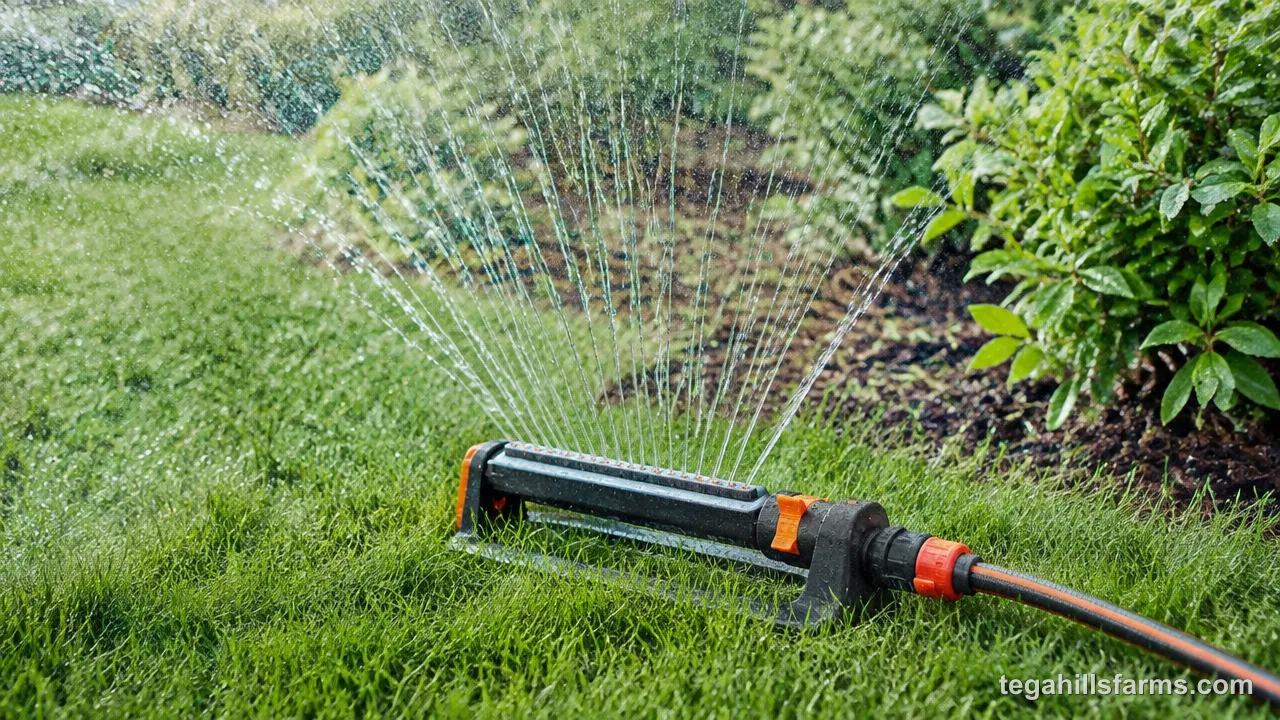
Impulse sprinklers use the same rocking-arm action as impact sprinklers, and the name usually refers to lightweight plastic versions on spikes. They’re easy to move around a small yard but give up some of the durability of a metal impact head.
Rotary sprinklers spin two or more arms using water pressure and spread a gentle circle of droplets. They suit compact lawns and play areas and keep turning on modest household pressure.
A bubbler covers a 5-foot diameter at up to 2 gallons per minute, and the flow is adjustable. It floods the root zone slowly with no overhead spray, so nothing is lost to wind and the leaves stay dry.
Permanent heads buried in the lawn are a separate decision, weighed when you compare above ground vs in ground sprinklers.
Oscillating vs Impact Sprinkler FAQ
Which sprinkler is better for new grass seed?
An oscillating sprinkler is better for new grass seed because its fine, soft spray keeps the surface moist without moving seed. An impact sprinkler’s heavier stream can wash seed into low spots or expose bare soil unless you open the diffuser screw to break the jet into a gentler spray.
Which sprinkler handles wind better?
An impact sprinkler handles wind better. Its low, flat jet carries heavier droplets that hold their path in a breeze. An oscillating sprinkler throws fine droplets in a high arc, and wind pushes them off target or evaporates them. On a windy site, more of the impact’s water reaches the lawn.
Which works better on clay versus sandy soil?
Clay soil does better with an impact sprinkler, because its lower output soaks in instead of running off. Sandy soil absorbs an oscillating sprinkler’s higher output easily. Sand also drains fast, so short, frequent sessions with either type keep water in the root zone longer than one long soak.
Which is gentler on plants and flower beds?
An oscillating sprinkler is gentler on delicate plants, since its fine spray won’t flatten blooms or splash soil onto leaves. An impact sprinkler’s stream can knock over tender stems at close range. Raising an impact head on a tripod and opening its diffuser softens the spray over beds.
Can either sprinkler reach a long, narrow lawn?
An oscillating sprinkler handles a long, narrow lawn best. Its tube throws far in one direction, and sliding the width tabs inward shrinks the pattern to a thin band. An impact sprinkler throws a circle or wedge, so on a strip much of its water lands outside the grass.
Write Your Review
No reviews yet. Be the first to share your experience!