How to Choose a Sprinkler to Save Water and Cut Waste
A sprinkler saves water when three things are true. Its pattern fits the shape of the lawn, it puts water down no faster than the soil can absorb it, and its droplets are heavy enough to land where they’re aimed instead of drifting. In practice, that points to rotary or impact sprinklers for large lawns, adjustable oscillating or stationary sprinklers for small rectangular yards, and bubblers for trees, shrubs and flower beds.
Four details separate an efficient choice from a wasteful one:
- how much area the sprinkler covers
- how precisely you can trim its spray to the lawn’s edges
- whether it runs well at the pressure your outdoor spigot supplies
- how it shuts off once the grass has had enough
The waste looks much the same from yard to yard: a wet driveway, a stripe of runoff in the gutter, mist blowing over the fence, or a soggy patch next to a dry one. Each of these comes from a mismatch between the sprinkler and the yard, and you can avoid each one when you choose what to buy.
A tape measure and a screw-on pressure gauge answer most of these questions before you shop. If your hands tire easily, also check the adjustment controls. You’re more likely to re-aim a drifting spray if the dials and tabs turn without pliers.
What causes a sprinkler to waste water and spray where it shouldn’t?
Most of it comes down to three mismatches: a spray pattern larger or shaped differently than the planted area, water applied faster than the soil absorbs it, and droplets so fine that wind or sun takes them before they reach the roots.
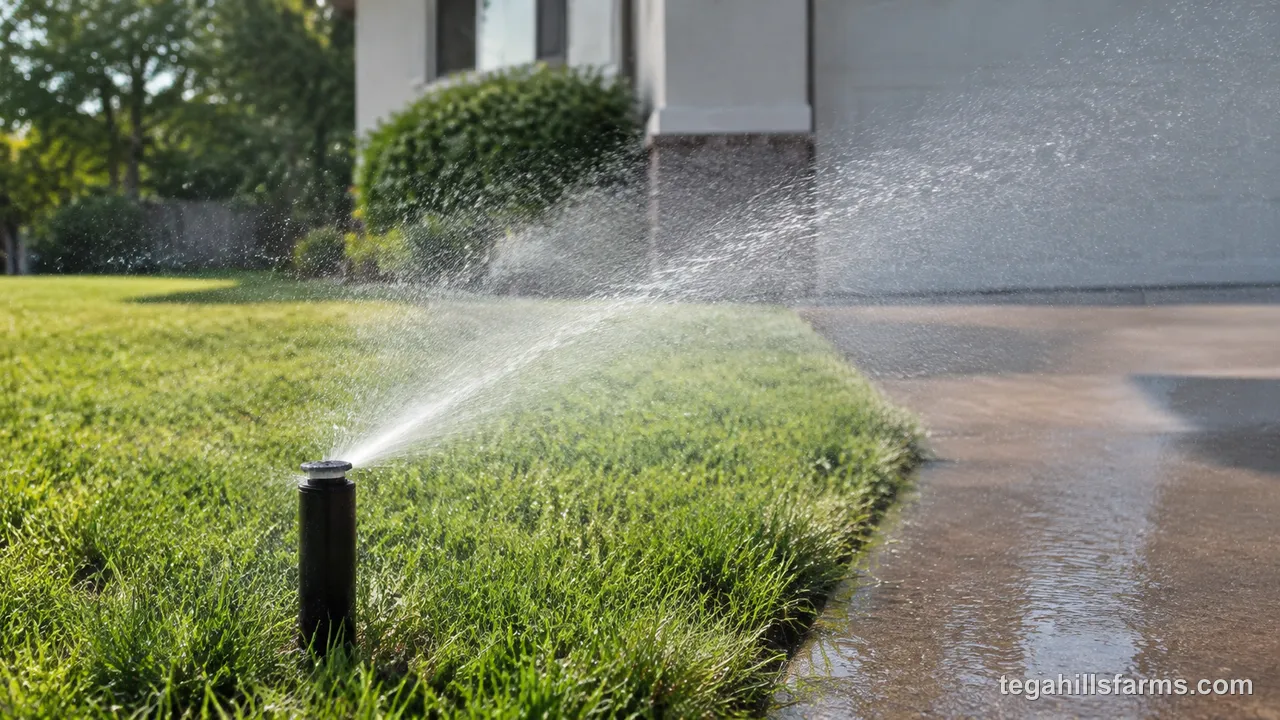
Pattern mismatch is the easiest to see. A circular pattern on a rectangular lawn either misses the corners or, when pushed out to reach them, soaks the sidewalk. Water that lands on concrete runs straight to the storm drain.
Application rate causes waste you notice later. When water arrives faster than the ground takes it in, the surplus sheets off the surface instead of soaking down to the roots. Heavy clay and sloped lawns show this first.
Droplet size depends on pressure and nozzle design. A fine-mist nozzle, or pressure above what the sprinkler is built for, breaks the stream into droplets light enough to drift on a breeze and evaporate in midday heat. Part of what leaves the nozzle never touches the ground.
Once you know which of these problems your yard has, a side-by-side look at the best sprinklers lets you sort water-saving models by yard type and budget.
Which sprinkler type saves the most water and controls overspray best?
For lawns, rotary sprinklers usually keep the most water on target. For beds and trees, bubblers waste almost none. Fine-spray oscillating models lose the most to wind and evaporation.
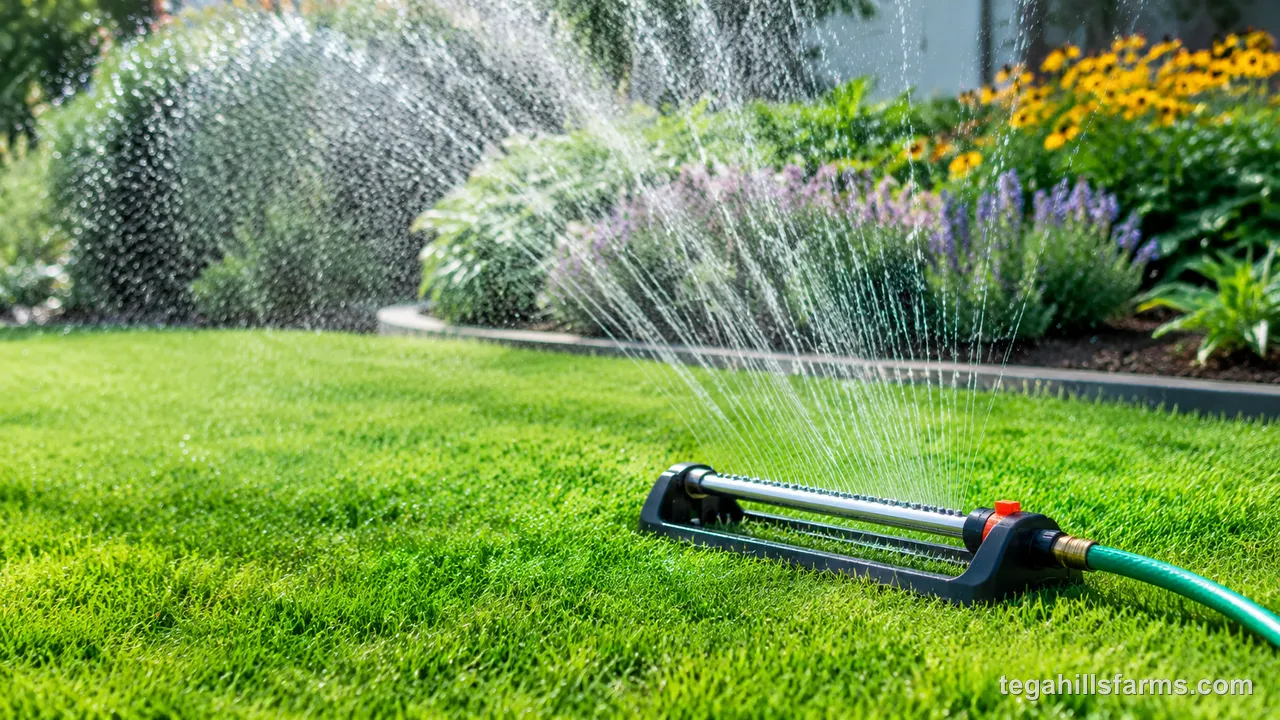
Two physical traits matter more than brand or price: droplet size and how fast water reaches the ground. Large droplets on a low trajectory resist drift, and slow delivery gives the soil time to absorb each pass. Shape matters too. A sprinkler you can trim to the lawn’s outline wastes nothing on pavement, while a fixed circle on a narrow strip always overshoots somewhere.
Are oscillating and stationary sprinklers good for saving water on small rectangular lawns?
Yes, on a small rectangular lawn they’re a sensible fit, as long as you trim the spray to the lawn’s edges and run it in calm, cool hours. An oscillating sprinkler sweeps a row of jets back and forth to paint a rectangle, so its natural shape already matches the yard. Models cover up to 4,000 square feet. Tabs on the spray bar narrow the width and shorten the throw, which keeps the outer jets off a walkway.
The weakness is the high, fine arc. Water lifted that high and broken into small droplets drifts in a breeze and evaporates on hot afternoons. An oscillator set out at midday in summer wastes more than its pattern suggests.
Stationary sprinklers have no moving parts and spray a fixed circle, square or strip. The most powerful models reach up to 1,800 square feet. On a small lawn, a fixed shape works as long as it matches the space. When comparing the best oscillating sprinklers, look for width controls you can set without tools. An adjustment that’s hard to make tends not to get made.
When do rotary and impact sprinklers reduce runoff on large areas?
They cut runoff wherever the soil can’t keep up with fast watering. That includes heavy clay, slopes, and big lawns where a sprinkler has to stay in one spot for a long time. Both types send a few solid streams around in a slow circle. Any one patch of grass gets a short pass of water, then a pause while the stream travels around, then another pass. That rhythm gives the soil time to absorb each layer before the next one arrives.
A rotary sprinkler covers up to 3,000 square feet and throws water up to 30 feet with adequate pressure. Its arc adjusts from 20 to 360 degrees, so it can water a quarter-circle corner without wetting the street. Impact sprinklers, the ones with the ticking spring arm, reach up to 6,000 square feet. Their heavy, low streams also hold up better in wind than mist from a spray bar.
I’d start with a rotary head for most large lawns. Among the best rotary sprinklers, favor ones with an arc collar you can set by hand.
How do bubbler and traveling sprinklers avoid overspray?
Both keep water off pavement by controlling where it lands rather than how far it flies. A bubbler doesn’t spray at all. It floods a circle about 5 feet in diameter at up to 2 gallons per minute, so nothing rises into the wind or reaches a nearby sidewalk. That makes it the efficient choice for trees, shrubs and sections of a flower bed, where a spraying head would wet leaves, mulch and paths along with the roots.
A traveling sprinkler drives itself along a garden hose laid out on the lawn, watering as it goes. The hose is the steering track, so you can route it around beds, tight curves and odd corners that no fixed pattern fits. Water pressure powers the drive, and these models run on 30 to 100 PSI. Lay the hose path slightly inside the lawn’s edge, because the spray still reaches out to the sides of the machine.
How do you match a sprinkler to your yard size, shape, and soil?
The right match is the smallest pattern that still reaches every edge, delivered no faster than the soil can absorb it.
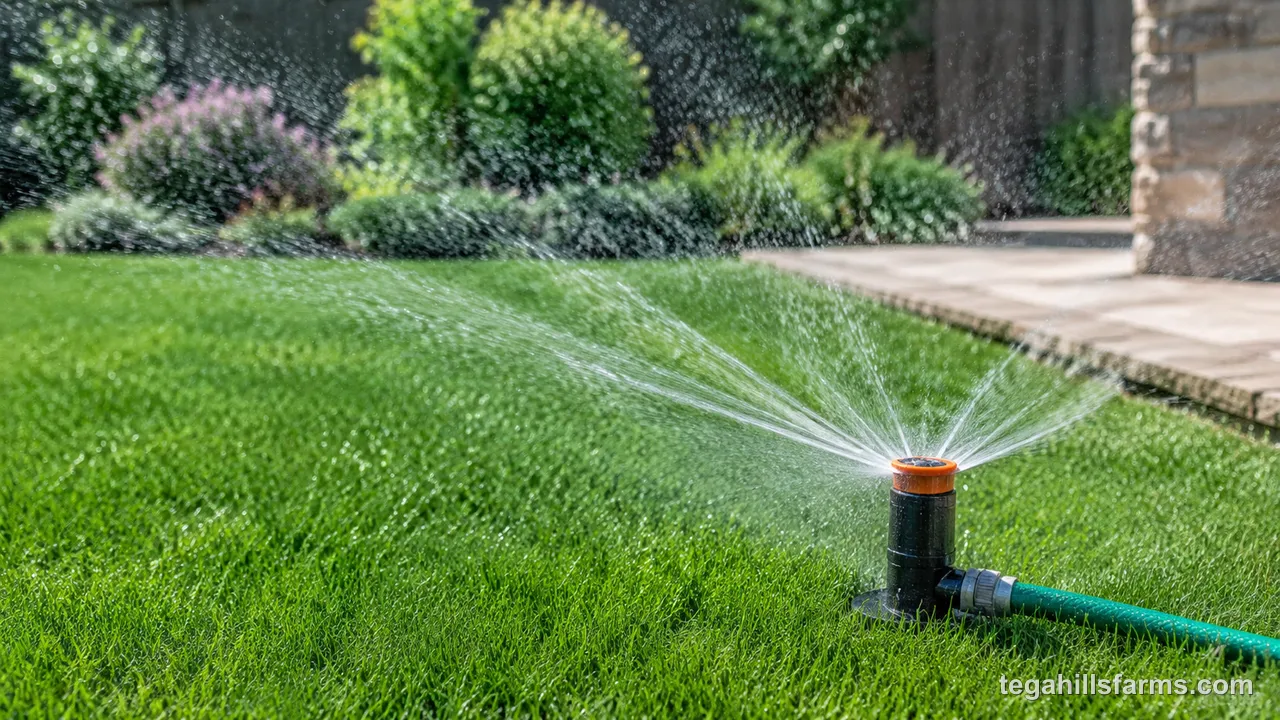
Most waste happens at the margins. A sprinkler sized for a bigger yard sprays past the property line or onto concrete. One sized too small has to be moved more often, which leaves overlapping wet strips with dry gaps between them. The soil sets a second limit: even a perfectly shaped pattern wastes water if it arrives faster than the ground can take it in.
How big an area do you actually need to water?
Measure each lawn section separately and multiply its length by its width to get square feet. An L-shaped or curved yard is easier to handle as two or three rectangles than as one awkward shape. Leave beds, patios and walkways out of the total, since those areas need different watering or none at all.
Then compare that figure with the sprinkler’s rated coverage. The rating is a maximum, reached only at ideal pressure. A model rated far above your lawn works only if its pattern adjusts down. One rated at or below your area will need moving partway through.
Working out what size sprinkler you need starts from these section measurements, not from the lot size on your deed.
How do you keep the spray off driveways and sidewalks?
You can, and it takes two things: a sprinkler whose pattern you can trim, and placement that aims the spray inward. Oscillating sprinklers have width tabs that close off the outer jets on one or both sides. Rotary and impact sprinklers have an arc collar or trip pins that stop the rotation and send it back. That lets a head beside the driveway water a half-circle facing the lawn instead of a full circle that hits concrete.
Set up on a dry day and do a short test run. Wet stripes on the pavement show exactly where the pattern needs pulling back, which is easier to read than guessing from the lawn side.
Recheck after mowing or moving the hose. A bump to the base can swing the pattern back toward the curb.
Does soil, slope, or climate change your choice?
Yes, all three change how fast you can put water down without losing it.
- Clay soil absorbs slowly. A sprinkler that sprays heavily in one spot starts pooling and running off long before the root zone is wet, so a slow rotary or impact head suits it better.
- Sandy soil takes water in fast and drains it quickly. It tolerates higher-output sprinklers but needs shorter, more frequent runs.
- Slopes add gravity to the problem. Water that isn’t absorbed at the top runs to the bottom, so a slope does best with a low-output sprinkler run in short cycles with soak time in between.
- Hot, dry and windy climates favor large droplets on a low trajectory over fine mist.
Many areas also limit watering days or hours during dry seasons, so check your local rules before settling on a schedule.
How do water pressure and flow rate affect water savings?
They decide whether water lands where roots can use it. Excess pressure atomizes the stream into drifting mist, while low pressure shortens the throw and leaves dry rings at the edge of the pattern.
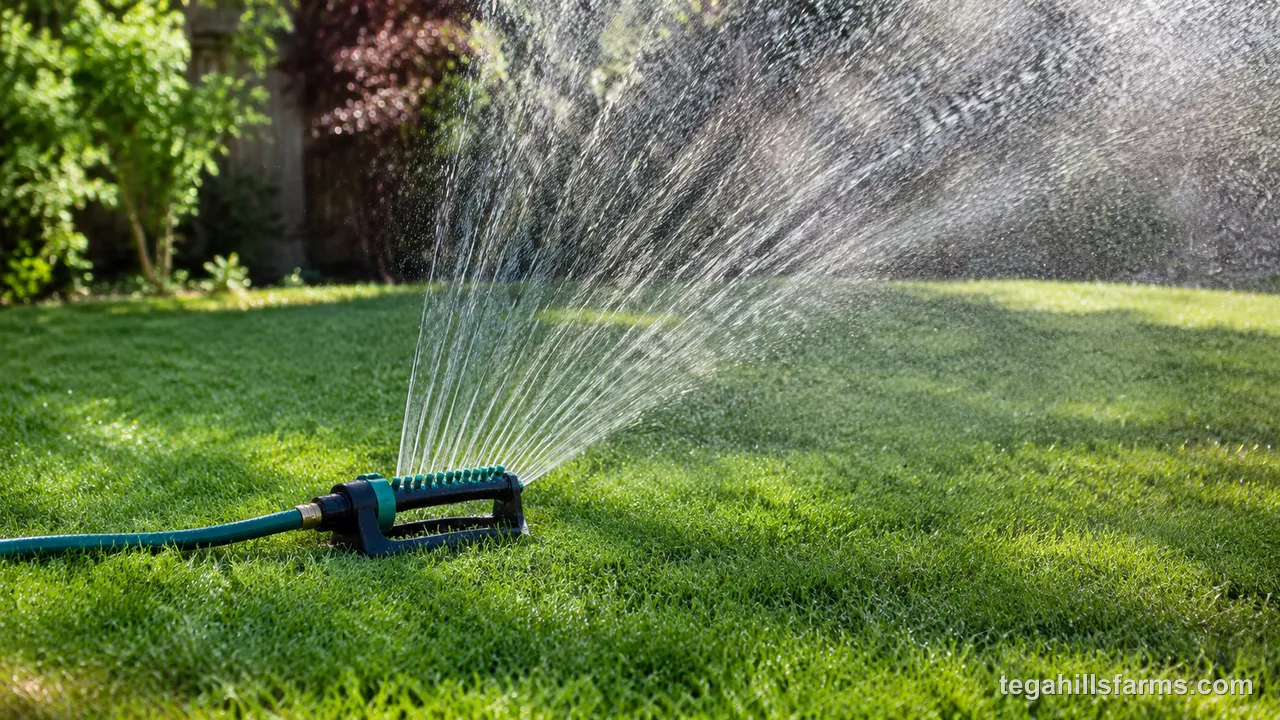
Every sprinkler is built for a pressure range, and outside that range the pattern stops matching the one on the package. Mist evaporates and blows into the neighbor’s yard. A short throw tempts you to run the sprinkler longer to green up the dry band, which overwaters the middle.
Flow matters alongside pressure. A sprinkler that needs more gallons per minute than your line delivers loses throw as soon as another faucet in the house opens.
What pressure and flow do you have at the spigot?
A screw-on pressure gauge from a hardware store gives the answer quickly. Thread it onto the outdoor spigot, turn off every other faucet in the house, open the valve fully, and read the dial. That’s static pressure, the highest figure your sprinkler will see. Take a second reading with a shower or washing machine running to see how far it drops during normal household use.
Flow takes a bucket and a timer:
- Fill a 5-gallon bucket through the hose you’ll actually use.
- Time how long it takes to fill.
- Divide the gallons by the minutes to get gallons per minute.
Compare both numbers with the pressure range and flow printed on the sprinkler’s package. A model rated above what your line delivers will underperform no matter how you adjust it.
What if your pressure is too low for even coverage?
You still have good options, because several sprinkler types are designed for modest pressure:
- Stationary sprinklers are built to work at about 30 PSI, the lower end of residential water pressure.
- Bubblers run anywhere from 20 to 90 PSI.
- Rotary sprinklers typically need 30 to 40 PSI, though they tolerate up to 80.
- Oscillating sprinklers want 40 to 80 PSI, so on a weak line the spray bar may stall partway through its sweep and leave dry strips.
You can also make better use of the pressure you already have. Run one sprinkler at a time, use the shortest hose that reaches, and replace kinked or crushed sections. Models matched to weak lines are what you’ll find among the best sprinklers for low water pressure.
Which features and setup habits save the most water?
The largest savings come from shutting water off automatically once the root zone is soaked. Water applied after that point runs off or drains below the roots.
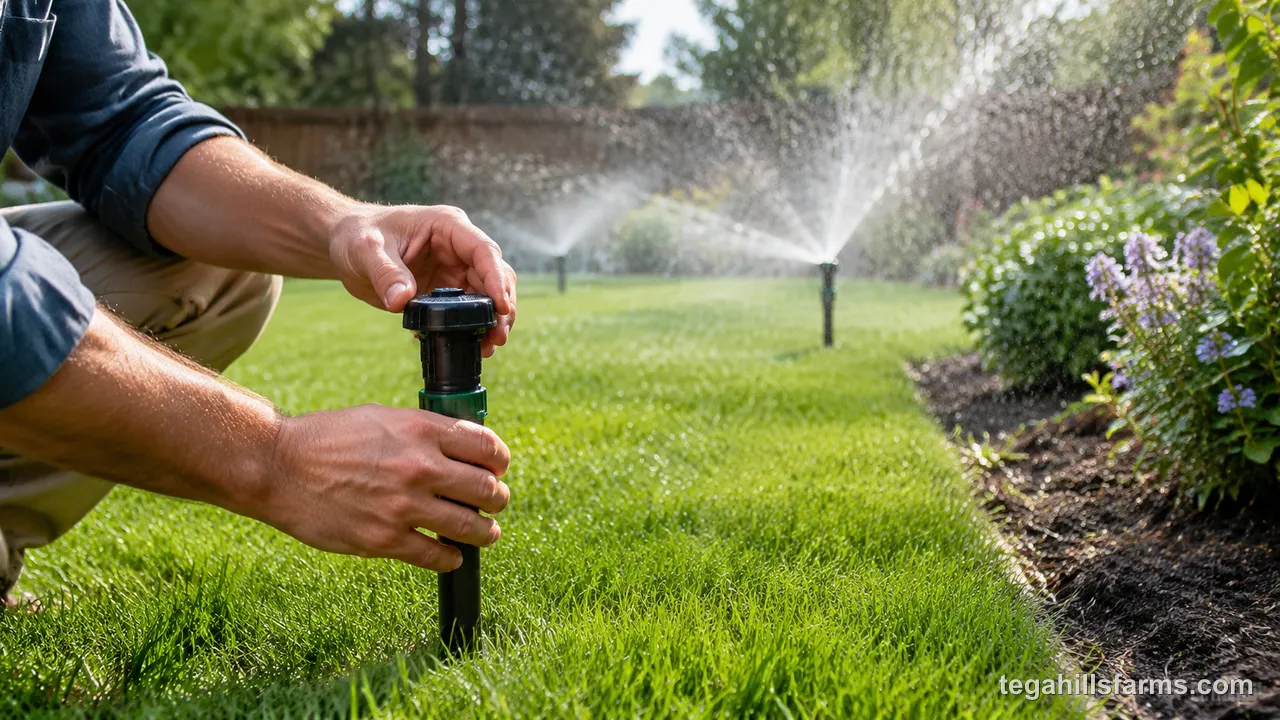
For a hose-end setup, habits matter as much as the sprinkler type. The same model can water efficiently or wastefully depending on how long it runs and where it sits. Comfortable controls count as a feature too: a dial you can turn with a wet hand gets adjusted, while a stiff one stays wherever it was left.
Do adjustable nozzles and matched precipitation nozzles really cut overspray?
Yes, both keep water on target, in different ways. Adjustable nozzles let you set the arc and throw so the spray stops at the lawn’s edge instead of the sidewalk, which stops overspray at its source.
Matched precipitation rate (MPR) nozzles solve a subtler problem in in-ground systems. Without them, a quarter-circle head and a full-circle head on the same zone release similar amounts of water. The corner covered by the quarter-circle head gets far more water per square foot. The usual response is to run the zone longer until the full-circle areas look green, which floods the corners.
MPR nozzles scale flow to the arc, so every head in a zone puts down water at the same rate and one run time fits the whole zone. On hose-end sprinklers, the equivalent is trimming the arc or width to fit the space.
How does timing and smart control prevent overwatering?
Running the sprinkler in the early morning and letting a timer end the cycle prevents most overwatering. Morning water meets cooler air and calmer wind, so less evaporates or drifts, and the grass dries during the day instead of staying wet overnight.
A common guideline is about 1 inch of water a week, rainfall included. To find your sprinkler’s run time, set a few empty tuna cans across the lawn and time how long it takes to collect that much. That measurement is the starting point for deciding how long to run sprinklers in your yard.
A mechanical or digital hose-end timer then shuts the water off even if you forget. Smart controllers go further. They skip cycles after rain and adjust run times using local weather data or a soil moisture sensor.
Where should you place the sprinkler to avoid waste?
Place the sprinkler so the outer edge of its throw lands just inside the lawn border, aimed inward from edges and corners rather than outward from the middle. If the reach falls a little short, a strip of grass gets slightly less water, instead of the spray landing on pavement or in a flower bed that doesn’t need it.
A few more placement rules help:
- Overlap the patterns from each position so the wet zones meet. Even coverage is what keeps run times short.
- Set the base on firm, level ground. A tilted oscillator throws farther on one side.
- In a windy spot, place the sprinkler upwind of the area being watered, so drift carries water across the lawn rather than off it.
- If you move the sprinkler often, choose a lighter base or one with a carry handle. It’s easier on your wrists and back.
Hard-water scale building up inside a nozzle can turn a neat rectangle of spray into a lopsided fan that soaks one corner while another slowly browns. The natural response is to run the sprinkler longer, which spreads the waste across the whole lawn without touching the cause. A worn washer or a stalled rotor works the same way, quietly turning an efficient sprinkler into the thirstiest thing in the yard while the water bill climbs.
How do you know a water-saving sprinkler is no longer saving water?
A sprinkler has stopped saving water when its pattern, its seals or its movement change, and each change leaves a visible clue on the lawn or the pavement.
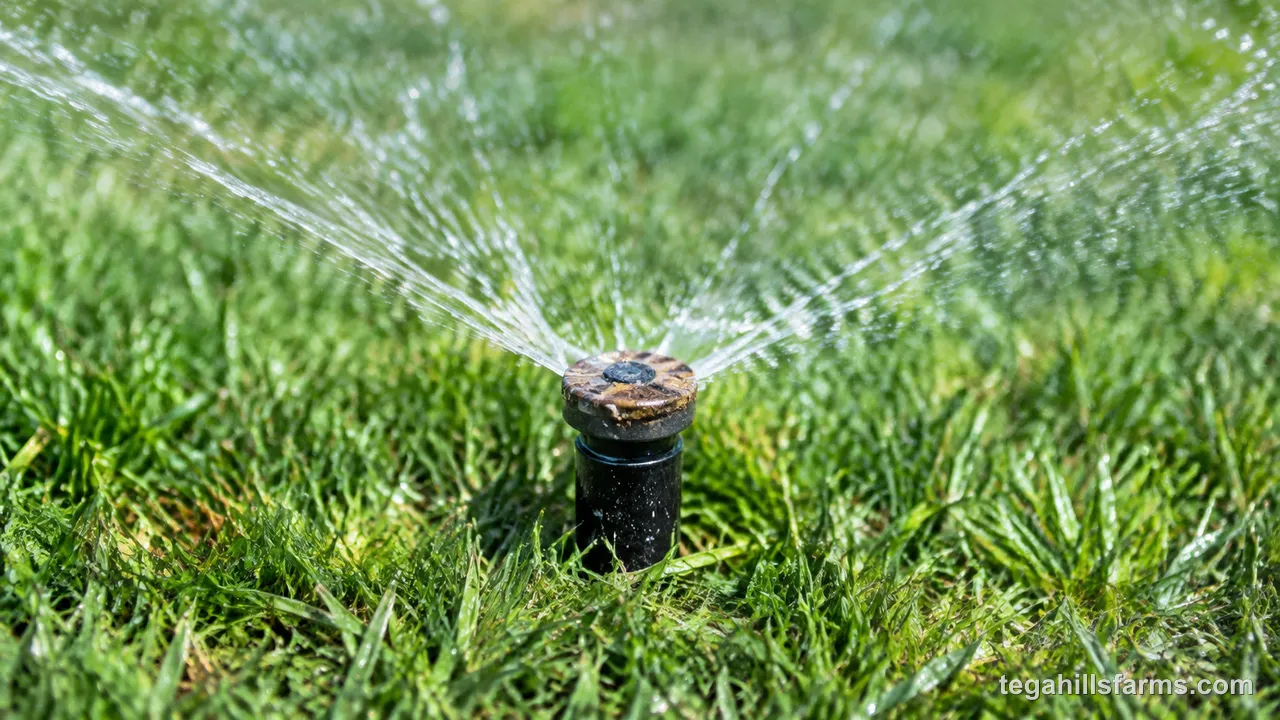
- Pattern changes: dry spots appear where the lawn used to stay even, streams veer to one side, or mist replaces solid streams. Clogged nozzles and debris in the inlet filter screen cause most of these.
- Leaks: drips at the hose coupling, a soggy patch around the sprinkler base, or water weeping from the garden hose. A flattened washer wastes water the whole time the spigot is open. On sprinkler hoses, a split that sprays higher than the rest of the holes means the hose has torn.
- Movement problems: an oscillator sticks at one end, a rotary head stalls, or an impact arm stops ticking. A stuck sprinkler pours a full run onto one strip.
- Schedule drift: water still runs after rain, or runoff reaches the gutter before the cycle ends.
Most fixes are quick. Clear nozzles with a pin or soft brush, rinse the filter screen, and replace washers. Before the first freeze, drain hose-end sprinklers and store them indoors so ice can’t crack their housings.
When does paying more for a sprinkler actually save water?
Paying more saves water when the extra money buys parts that keep the pattern accurate for years. That means metal or reinforced bodies, replaceable washers and nozzles, and arc settings that stay where you put them. A disposable plastic sprinkler can work well at first. Once a coupling cracks, gears wear or a width tab slips, it starts leaking or drifting onto pavement, and that waste repeats every time it runs.
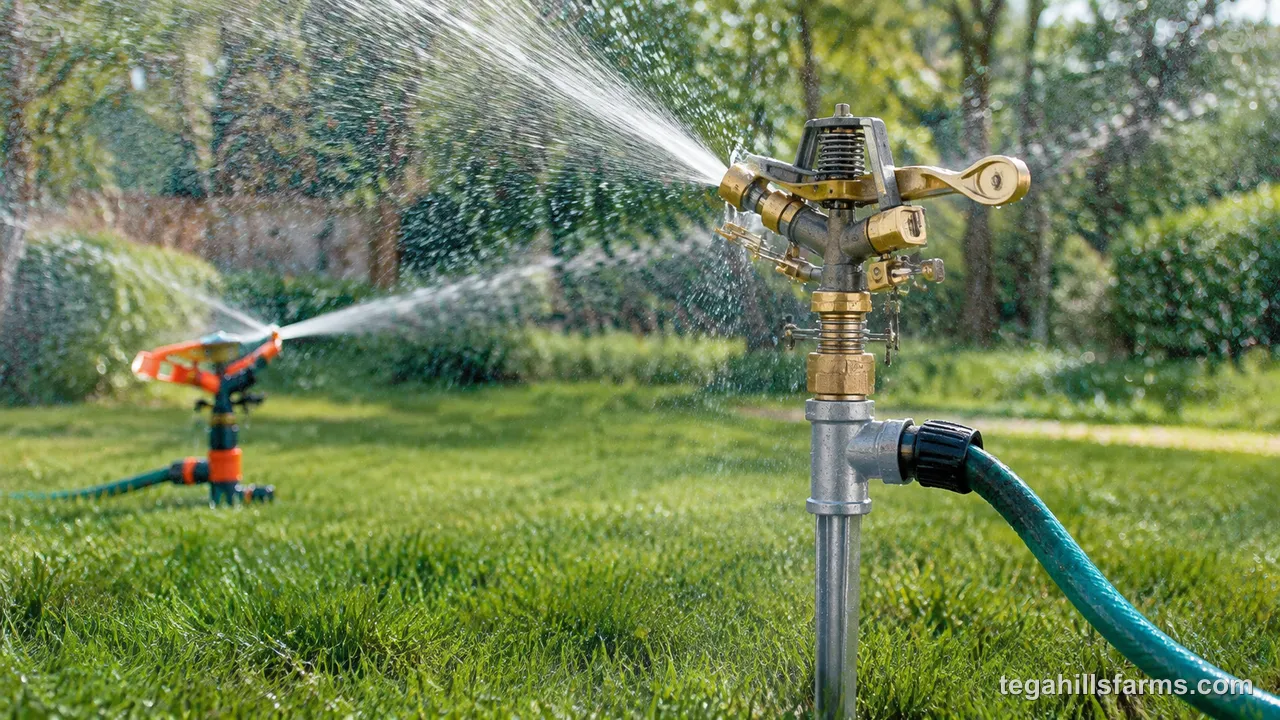
Typical price ranges show that most types are affordable:
| Sprinkler type | Typical price range |
|---|---|
| Bubbler | about $3 to $9 |
| Impact | about $5 to $33 |
| Oscillating | about $6 to $25 |
| Traveling | about $67 to over $100 |
Within any type, the higher end usually reflects heavier materials and finer adjustment rather than more coverage. Comparing how much a sprinkler costs with how long sprinklers last shows value better than price alone. A sprinkler that holds its pattern for many seasons keeps saving water long after a cheap one has started to leak.
Quick answers on choosing a sprinkler that saves water
Is a soaker hose or drip line better than a sprinkler for saving water?
For flower beds, vegetable rows and shrubs, yes. Soaker hoses and drip lines release water at soil level, so nothing drifts, evaporates in the air or wets the leaves. Lawns are different: grass covers the ground solidly and needs even overhead coverage, which a rotary or impact sprinkler delivers more practically.
What time of day should a sprinkler run?
Early morning works best. The air is cooler and wind is usually calmer, so less water evaporates or drifts, and the grass dries during the day. Evening watering also limits evaporation, but it leaves foliage wet overnight, which can encourage fungal disease in turf and garden plants.
Do I need a pressure regulator for my sprinkler?
Only if your spigot pressure is higher than the sprinkler’s rated range. Excess pressure breaks the spray into fine mist that drifts and evaporates, and it strains hose couplings. A hose-end pressure regulator lowers the pressure to a level the sprinkler handles, restoring a solid, even pattern.
Is an in-ground system more water-efficient than a hose-end sprinkler?
It can be, when the zones are well designed, the heads use matched precipitation rate nozzles, and a smart controller handles timing. A poorly zoned system wastes as much as any hose-end sprinkler, though. Choosing between above ground vs in ground sprinklers comes down to yard size, budget, and how much hands-on moving you want to do.