

For the best dewalt hedge trimmers in 2026, the choices are DEWALT DCHT820P1R Hedge Trimmer 20V (Best Overall), DEWALT DCHT821P1 22in Hedge Trimmer (Runner Up), DEWALT DCPH820B Hedge Trimmer 20V (Editor’s Choice), DEWALT DCPH820M1 Hedge Trimmer 20V Kit (Best for Hilly Terrain), DEWALT DCMHT520N Hedge Trimmer 18V 7.9in (Best Lightweight), and DEWALT DCMHT567N Hedge Trimmer 18V Brushless (Best Premium).

They differ in physical ways. You can choose a handheld body or a pole with an articulating head, a short shaping blade or a long one, a narrow tooth gap or a wide one, and more or less weight held out in front of you. Those details decide whether a trimmer finishes your hedges from the ground in one session or sends you back to the garage for a ladder or loppers.
Several of these ship as bare tools with no pack or charger. That makes them an easy add if you already run DeWalt 20V MAX or XR batteries, and a poor fit if you’re starting from nothing. The kits fix that, though they put a battery in the box that an existing owner doesn’t need.


Check your tallest hedge against your own reach before anything else. If you can cut its top from flat ground with a handheld trimmer, a pole model’s extra weight buys you nothing.
What Should You Look for in a DeWalt Hedge Trimmer?
The right pick comes down to the batteries already on your shelf and the height and thickness of the hedges you cut. Get those two wrong and you end up holding a heavy pole over a waist-high boxwood, or buying into a second battery system for one tool. If you haven’t settled on DeWalt yet, it helps to see how it stacks up against the best hedge trimmer brands before you commit to a battery platform.
Which DeWalt Battery Platform and Kit Option Fits Your Setup?
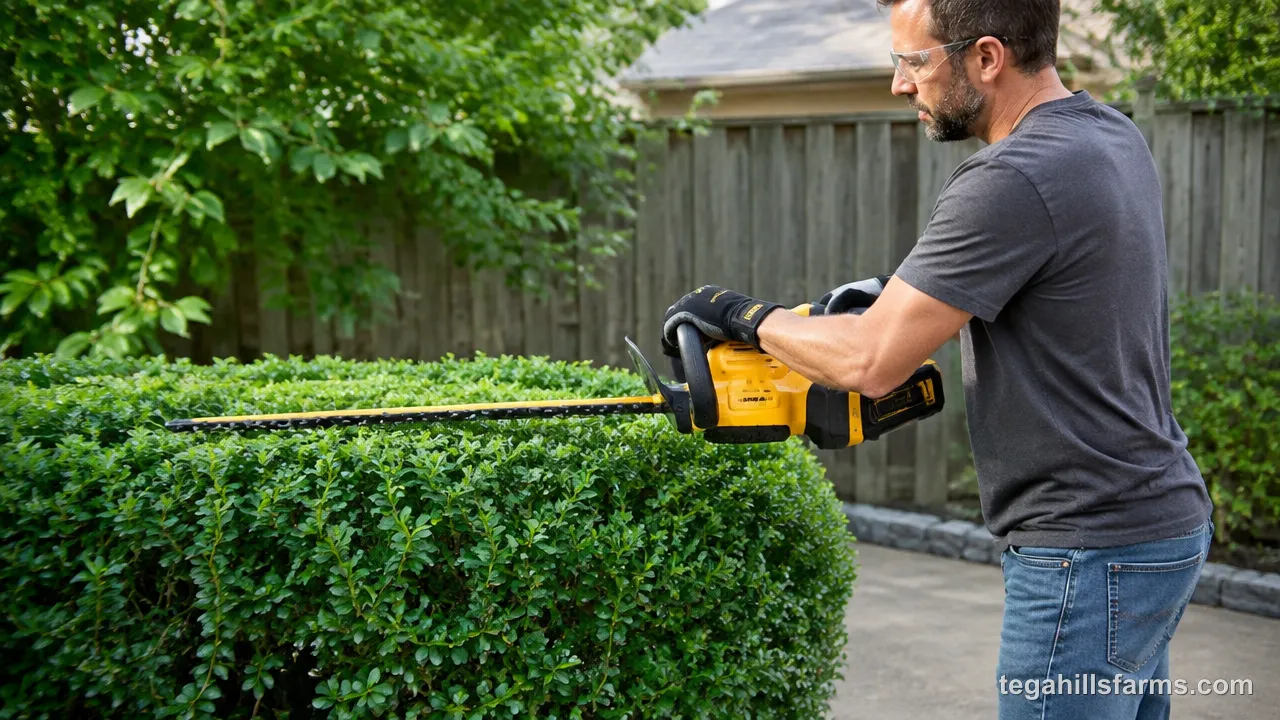
If you already run DeWalt 20V MAX drills, blowers or string trimmers, buy a tool-only trimmer. If this is your first DeWalt tool, buy a kit with a battery and charger in the box. A tool-only unit ships bare, so it works only with a pack you already own, and you don’t pay for a charger you’d never use.
The 20V MAX models here share batteries with the rest of DeWalt’s 20V MAX tools. The 18V models belong to DeWalt’s XR range, which swaps packs across its own tools. Before buying a bare tool, check that the range named on the trimmer matches the label on your batteries.
Buying into the wrong platform leaves you with one battery that fits nothing else in the garage. Your runtime is then limited to that single pack. When the trimmer runs flat halfway down a hedge, you can’t grab a charged pack off the drill. A higher amp-hour pack runs longer between charges, but it also adds weight to the tool in your hands.
How Much Do Blade Length and Cutting Capacity Matter?
A longer blade clears more of the hedge face with each sweep. The gap between its teeth sets the thickest stem the trimmer can cut cleanly, which is called cutting capacity. Together they decide how fast you finish and whether the trimmer can handle the woody growth on your hedge.
On woody stems, the tooth design decides whether the cut is clean. Laser-cut teeth have sharp, precise edges that slice rather than crush. Hooked teeth catch a stem and hold it in the gap while the blades close. A dual-action blade moves both cutting edges against each other, so it cuts faster and with less vibration than a single moving blade.
When a branch is thicker than the gap, the blade bounces off it or chews it. That leaves split, ragged ends that brown out on the hedge, and you finish the job with loppers. A longer blade has its own cost: more length out in front of your hands is harder to steer around curves, topiary and the tight space between a shrub and the house wall.
Handheld, Pole or Articulating Head: Which Style Suits Your Hedges?
For hedges you can cut standing flat-footed, roughly waist to chest high, a handheld trimmer is faster and more accurate. Your hands sit close to the blade, so every small correction lands where you aim it. A pole trimmer with a multi-position head is for tops you can’t reach from the ground, hedges too wide to lean across, and the far side of a hedge you can’t walk around.
The articulating head locks the blade at an angle to the pole. You can lay it flat over a tall top or tilt it down the far face without climbing. That reach makes the tool bulky. A pole carries its weight well out in front of you, which loads your shoulders, and it takes more storage room than a compact handheld unit.
On uneven or sloped ground the extra weight is worth carrying. A ladder on a bank or a soft bed rarely sits level, and cutting from below keeps both feet planted. If you’re weighing a pole-style unit on another platform, compare these against the best Husqvarna hedge trimmers.
How Much Does Weight Change a Long Trimming Session?
A trimmer held at arm’s length or overhead feels much heavier than its listed weight. Every pound at the blade end pulls on your shoulder through leverage. As you tire, the bar drifts and leaves a wavy line along the top of the hedge.
Check whether a listed weight is tool only or includes a battery. A tool-only figure leaves out the pack, so add the weight of the battery you’ll actually run. A larger pack adds more.
Balance can matter as much as the number. A heavier trimmer with its weight close to the rear handle can feel steadier than a lighter one that tips nose-down. A D-handle lets you rotate your grip, which spreads the load over a long session. Short hedges you trim in a few minutes forgive almost any weight. Tall hedges cut at shoulder height for a long stretch reward the lightest tool that still reaches.
The 6 Best DeWalt Hedge Trimmers of 2026
In rank order, they are the DEWALT DCHT820P1R Hedge Trimmer 20V, DEWALT DCHT821P1 22in Hedge Trimmer, DEWALT DCPH820B Hedge Trimmer 20V, DEWALT DCPH820M1 Hedge Trimmer 20V Kit, DEWALT DCMHT520N Hedge Trimmer 18V 7.9in and DEWALT DCMHT567N Hedge Trimmer 18V Brushless. The handheld models stay light enough to hold at arm’s length through a long session. The pole-style models add reach and an articulating head, but you carry their weight farther from your hands. If your hedges are small to mid-size, look at the handheld units. If they’re tall or wide, look at the pole models. Owners with DeWalt packs can skip the battery by going tool only, and the compact 18V shaping trimmer is light enough to handle easily through a long session.
#1 DEWALT DCHT820P1R Hedge Trimmer 20V — Best Overall
If you trim ordinary yard hedges and want one trimmer that handles most jobs without wearing you out, this one pairs a 22 in laser-cut blade with a 7.5 lb build. It’s a certified refurbished unit with a 5Ah pack.
Key Specs:
- Power: 20V MAX system, 5Ah pack
- Blade: 22 in, laser-cut
- Cutting capacity: branches up to 3/4 in thick
- Weight: 7.5 lb
- Condition: Certified Refurbished, minimum 90-day warranty
Detailed Review:
The full-length laser-cut blade covers a long stretch of hedge face with each pass, and the light body stays manageable when you hold it level along a hedge top. A full blade on a light body is why I’d send most homeowners to this one first.
A high-output motor drives the blades through branches up to 3/4 in thick. That covers the new growth and woody tips on a hedge you keep in shape. The pole-style DCPH820B opens to a wider cutting gap and handles a neglected hedge better, but it carries noticeably more weight and gives up handheld control.
It belongs to the 20V MAX system, so the pack in the box runs your other 20V MAX tools, and packs you already own fit this trimmer. If you’re new to DeWalt, that battery gives you a start on the rest of the system.
As a certified refurbished unit, it has been through functionality testing, cleaning and inspection. It ships with its accessories and a minimum 90-day warranty, possibly in a generic box. Check the seller’s return terms before ordering. Run the battery down once soon after it arrives, so a weak pack shows up while you can still return it.
Pros:
- 22 in laser-cut blade covers long hedge runs per pass.
- 7.5 lb build stays manageable when held out level.
- Takes any 20V MAX pack you already own.
- Ships with a 5Ah pack.
Cons:
- Refurbished unit may arrive in a generic box.
- Thick woody stems past 3/4 in need loppers.
- Handheld design can’t reach tall hedge tops from the ground.
Who It’s For:
Suburban homeowners with foundation shrubs and privet rows who want a light, full-length trimmer will get the most from it, especially if 20V MAX packs already sit in the garage. If you want a new-in-box tool, or your hedges have grown thick woody stems, a pole model with a wider gap is the better fit.
Editor’s Verdict:
Pick this trimmer if you want a full-length blade at a weight you can hold level, and you’re comfortable buying refurbished from a seller with clear return terms.
#2 DEWALT DCHT821P1 22in Hedge Trimmer — Runner Up
Long privet or laurel rows that take a while to finish suit this kit, because its battery is rated for up to 78 minutes of runtime. The hooked teeth hold each stem for a clean cut.
Key Specs:
- Power: 20V MAX kit with battery and charger
- Runtime: up to 78 minutes
- Blade: 22 in, laser-cut, hooked teeth
- Cutting capacity: branches up to 3/4 in thick
- Transmission protection: friction clutch
- Weight: 11.85 lb
Detailed Review:
The runtime covers a long run of hedges in one go, so you’re not stopping halfway down a property line to recharge. The charger comes in the kit too, which makes this a complete starting point if you don’t own DeWalt packs yet.
The laser-cut blades have hooked teeth that catch a stem and hold it in the gap while the blades close. That way, branches up to the rated thickness get sliced instead of pushed aside. A high-output motor keeps the blade speed up when you hit a clump of woody growth.
A friction clutch sits between the motor and the blades. When the teeth hit fence wire, a hidden stake or a stem they can’t cut, the clutch slips instead of passing the shock into the gears. That protects the transmission from the kind of jam that wears out a trimmer early.
At 11.85 lb, it is noticeably heavier than the DCHT820P1R, which has the same blade length and branch capacity. You’ll feel that most when you hold the blade level across a hedge top for a whole charge.
Pros:
- Battery runs up to 78 minutes per charge.
- Hooked teeth hold stems in place for clean cuts.
- Friction clutch protects the transmission when the blade hits obstacles.
- Kit includes battery and charger for first-time DeWalt buyers.
Cons:
- 11.85 lb weight tires arms on overhead cuts.
- Branch capacity stops at 3/4 in.
Who It’s For:
If you’re starting fresh on DeWalt with long hedge rows to keep tidy, this kit has everything you need to start trimming in the box. If arm fatigue on long overhead cuts worries you more than runtime, the lighter DCHT820P1R suits you better.
Editor’s Verdict:
Choose this kit when long runtime and a protected transmission matter more to you than a lighter tool in your hands.
#3 DEWALT DCPH820B Hedge Trimmer 20V — Editor’s Choice
If you already run 20V MAX packs and have tall or wide hedges, this tool-only trimmer gets you pole reach without buying another battery. Its 7-position head angles the blade to the hedge.
Key Specs:
- Power: 20V MAX, tool only
- Head: 7-position, 180-degree articulating
- Reach: up to 12 ft
- Blade: 22 in hardened steel, laser-cut, dual-action, 2,800 spm
- Cutting capacity: 1 in
- Weight: 10.7 lb
Detailed Review:
The articulating head swings through 180 degrees across 7 positions. You can lay the blade flat over a hedge top or tilt it to square off the far side without moving a ladder. Up to 12 ft of reach brings tall tops within range while you stand on the ground.
The blade is hardened steel, laser-cut and dual-action, running at 2,800 strokes per minute. Its 1 in cutting gap takes thicker woody stems than the handheld DCHT820P1R, so a hedge that skipped a season gets cut back instead of chewed.
Tool only means there’s no battery or charger in the box, which is the reason to choose this version when your shelf already holds 20V MAX packs. The bare tool weighs 10.7 lb. On a pole, that weight sits well out in front of you, so long sessions load your shoulders.
I’d take this one over the DCPH820M1 kit if you already own the batteries, since the head, reach and blade are identical. Skip it for hedges you can reach from the ground, where the pole only adds bulk.
Pros:
- 180-degree head locks into 7 cutting angles.
- Reaches up to 12 ft from the ground.
- 1 in cutting gap handles thick woody stems.
- Tool-only format uses 20V MAX packs you already own.
Cons:
- No battery or charger in the box.
- Pole length makes it bulky to store.
- 10.7 lb load tires shoulders on long sessions.
Who It’s For:
If tall privet, wide hedges or awkward angles are your problem and 20V MAX packs are already charging in your garage, this is the trimmer to add. If you only have waist-high shrubs, the pole gains you nothing, and a handheld model will be quicker to use.
Editor’s Verdict:
Buy this one when your batteries are already on the shelf and your hedges have outgrown what you can reach with a handheld trimmer.
#4 DEWALT DCPH820M1 Hedge Trimmer 20V Kit — Best for Hilly Terrain
On sloped yards and uneven ground, this kit lets you cut tall hedges with both feet planted instead of balancing on a ladder, because its pole reaches up to 12 ft. The battery and charger come included.
Key Specs:
- Power: 20V MAX kit with battery, charger and accessories
- Head: 7-position, 180-degree articulating
- Reach: up to 12 ft (based on a 6.0 ft person holding the pole at shoulder level)
- Blade: 22 in hardened steel, laser-cut, dual-action, 2,800 spm
- Cutting capacity: 1 in
- Weight: 13 lb
Detailed Review:
On a slope, a ladder rarely sits level, and this trimmer’s reach means you can leave it in the garage. The reach figure assumes a 6.0 ft person holding the pole straight at shoulder level, so shorter users or a lower arm position will get less.
The 7-position articulating head lets you tip the blade to match the hedge face whether you’re standing uphill or downhill of it. With a fixed blade, the same cut would force your wrists into an awkward angle, which costs accuracy and tires your forearms.
Its hardened steel dual-action blade runs at 2,800 strokes per minute, and the 1 in cutting gap takes thick woody stems. That gap lets you cut back a hedge that has gone woody without switching to loppers.
The kit adds a battery, charger and accessories to the same head, reach and blade as the tool-only DCPH820B, which makes it the version for anyone new to 20V MAX. At 13 lb, it is heavier than the DCPH820B, and you’ll feel that most at full extension.
Pros:
- Reaches up to 12 ft without a ladder.
- Articulating head adjusts the blade angle on uneven ground.
- 1 in cutting gap takes thick stems.
- Kit includes battery, charger and accessories.
Cons:
- 13 lb weight builds fatigue at full extension.
- Pole design is overkill for low shrubs.
Who It’s For:
If you have a hilly lot, banks or terraced beds and don’t own DeWalt batteries yet, this complete kit is the one to get. If you already own DeWalt batteries in this platform, the tool-only DCPH820B gives you the same head and reach, so the kit’s battery adds little.
Editor’s Verdict:
Get this kit if your hedges grow on a slope and you’d rather carry extra weight than lean a ladder on uneven ground.
#5 DEWALT DCMHT520N Hedge Trimmer 18V 7.9in — Best Lightweight
Detail shaping and small topiary call for a trimmer you can steer with one hand, and at under 3.1 lb tool only, this one is the easiest to hold up for a long stretch. Its short blade gets into tight spots.
Key Specs:
- Power: 18V XR range, tool only
- Blade: 7.9 in (20 cm), laser-cut
- Weight: under 3.1 lb (1.4 kg), tool only
- Controls: integrated safety switch for one-handed use
- Included: full-cover blade sheath, hanging hook
Detailed Review:
The laser-cut blade is short enough to follow the curve of a rounded boxwood or trim around a garden ornament without the tip catching the next plant over. On a long privet row the same length works against you, because a full-length blade covers far more hedge per pass.
Without a battery it stays easy to hold at arm’s length through a long shaping session. The textured overmolded handle keeps your grip secure as your hand tires. The DCMHT567N, the other 18V XR handheld here, is noticeably heavier.
An integrated safety switch blocks accidental starts and allows controlled one-handed use, which frees your other hand to hold back a branch. The included guard covers the blade and protects nearby surfaces, and the hanging hook keeps the trimmer off the bench between jobs.
It runs on DeWalt’s XR range, which shares batteries across more than 250 tools, and it ships without a pack or charger. I’d treat it as a shaping tool alongside a full-size trimmer, or as the only trimmer in a yard of small ornamental shrubs.
Pros:
- Under 3.1 lb, it’s easy to hold out for long sessions.
- Short 7.9 in blade follows tight curves and topiary.
- Safety switch allows controlled one-handed trimming.
- Blade sheath and hanging hook come included.
Cons:
- Short blade means many passes on long hedges.
- Ships without battery or charger.
Who It’s For:
If you shape boxwood, small ornamental shrubs or topiary and value control over speed, this is your trimmer, especially if you already run 18V XR packs. If you mostly cut long privet rows or overgrown hedges, a full-length trimmer like the DCMHT567N covers far more hedge per pass.
Editor’s Verdict:
This trimmer is light enough to handle easily and the one I’d reach for on shaping work, but it’s a detail tool, not a hedge-row cutter.
#6 DEWALT DCMHT567N Hedge Trimmer 18V Brushless — Best Premium
Thick, overgrown hedges that bog down shorter blades suit this brushless model, whose 24 in double-acting blade with a 1 in gap clears wide faces fast. It’s a long-bar handheld for owners already on DeWalt’s XR packs.
Key Specs:
- Power: 18V XR range, brushless motor, tool only
- Blade: 24 in (60 cm), laser-cut, double-acting with sawteeth
- Blade gap: 1 in (25 mm)
- Weight: 7.7 lb
- Handle: D-handle with lower secondary switch
- Included: blade sheath, hanging hook, hedge sweep
Detailed Review:
The laser-cut blade is long, so each sweep clears a wide band of hedge face. The double-acting blades carry sawteeth and a wide gap, which bite into thick, stubborn stems instead of skating off them.
The brushless motor holds its performance under load and lasts longer in service. That counts on a dense hedge you cut back every season. It runs on the XR range and ships without a pack, so it makes the most sense if you already have XR batteries.
The D-handle with a lower secondary switch lets you shift your grip as you move from the side of the hedge to the top, which eases hand pressure over a long session. The hedge sweep pushes clippings off the hedge as you cut. The metal tip guard protects the blade end when you work near a wall or the ground.
At 7.7 lb tool only, it is heavier than the compact DCMHT520N, and a long blade takes more effort to steer in tight spots. This is a premium buy, and what you get for it is speed on big hedges rather than finesse on small ones.
Pros:
- 24 in blade clears wide hedge faces quickly.
- 1 in blade gap cuts thick, stubborn stems.
- Brushless motor offers longer service life.
- Hedge sweep clears clippings off the hedge as you cut.
- D-handle and secondary switch ease grip changes.
Cons:
- Long blade is harder to steer in tight spaces.
- Tool only, so you need an XR pack.
Who It’s For:
If you face long, dense hedges that have gone woody and already run DeWalt 18V XR packs, this trimmer will get through them quickly. If you mostly shape topiary or small shrubs, you don’t need the long bar, and a short-blade trimmer will do finer work.
Editor’s Verdict:
Expect quick work on big, overgrown hedges from this trimmer, as long as you already own XR packs and can handle a long bar.
Which DeWalt Hedge Trimmer Fits Your Yard and Workload?
Hedge height and branch thickness narrow the choice fastest, and the batteries on your shelf settle whether a tool-only unit or a kit makes sense.
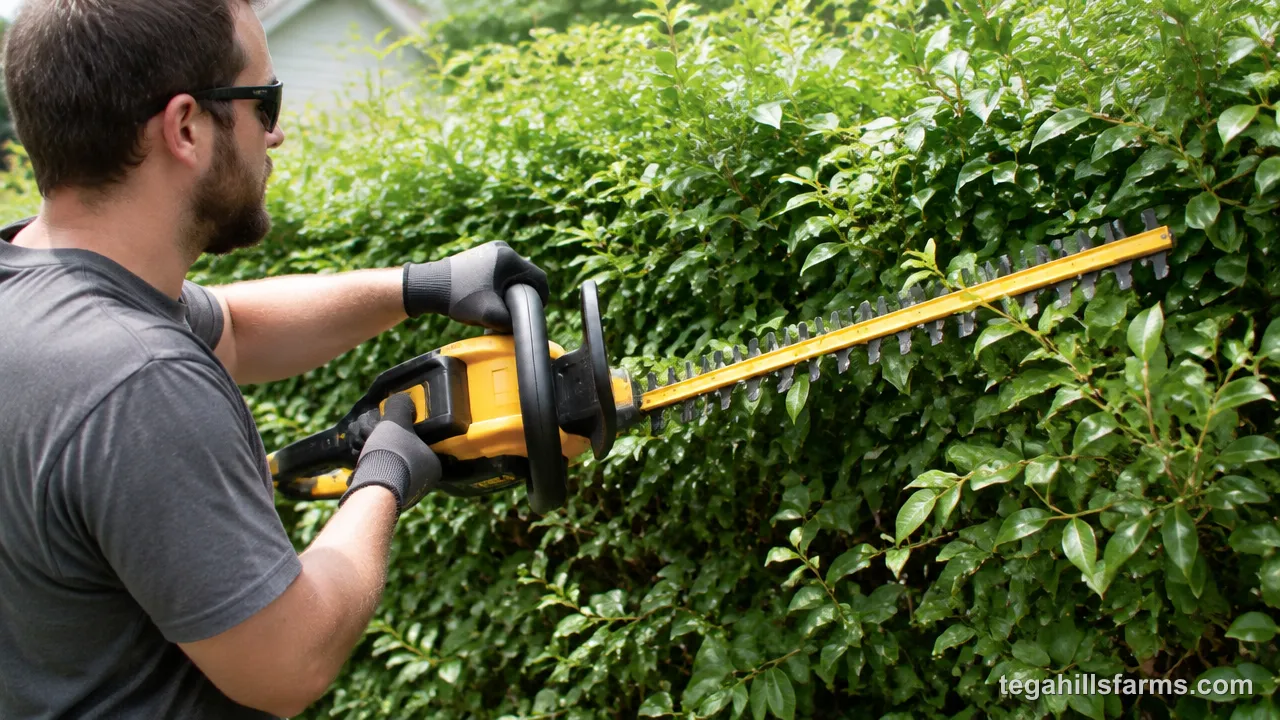
Common yard situations match up with these trimmers as follows, along with what each choice costs you in weight, reach or capacity:
| Your situation | Trimmer | What you give up |
|---|---|---|
| Small hedges, occasional trimming | DEWALT DCHT820P1R Hedge Trimmer 20V | Refurbished condition, less capacity for woody stems |
| Long hedge rows, no DeWalt batteries yet | DEWALT DCHT821P1 22in Hedge Trimmer | Heavier handheld body |
| Tall or wide hedges, 20V MAX packs on hand | DEWALT DCPH820B Hedge Trimmer 20V | No battery included, bulky pole |
| Sloped ground, first DeWalt purchase | DEWALT DCPH820M1 Hedge Trimmer 20V Kit | Heaviest trimmer of the group |
| Fine shaping and topiary | DEWALT DCMHT520N Hedge Trimmer 18V 7.9in | Slow on long hedges |
| Heavy, overgrown growth with XR packs | DEWALT DCMHT567N Hedge Trimmer 18V Brushless | Harder to steer in tight spots |
The two 20V MAX handheld models differ on runtime and weight. The DCHT821P1 adds a long-runtime battery and a friction clutch, while the DCHT820P1R stays lighter with the same blade length and branch capacity. The pole models have the same head, reach and blade, so the only question between them is whether you need a battery in the box. Choose a pole when you’d otherwise be climbing to reach the top of a hedge. You’ll carry the weight on a long reach, and it pays off only on hedges you can’t cut from the ground.
The two 18V XR models are at opposite ends. The DCMHT520N has a short blade and very little weight for detail shaping, and the DCMHT567N has a long blade with a wide gap for thick growth. For a yard of mixed foundation shrubs, I’d start with the DCHT820P1R and add a pole model only once a hedge grows past your reach.
Hooked and dual-action teeth pick up sap and resin with every cut, and on evergreens that film hardens into a sticky coat that drags on the blades. A dull or gummed blade tears stems instead of slicing them, which leaves ragged, browning tips across the hedge and makes the motor work harder on every pass.
How Do You Keep a DeWalt Hedge Trimmer Blade Sharp and Clean?
Pull the battery, clean the sap off the teeth after each session, and wipe on a light coat of oil. That routine keeps a blade cutting cleanly much longer than sharpening alone. A blade needs attention when cut ends turn ragged and brown, when it stalls on stems it used to slice, or when you see sticky buildup along the teeth.
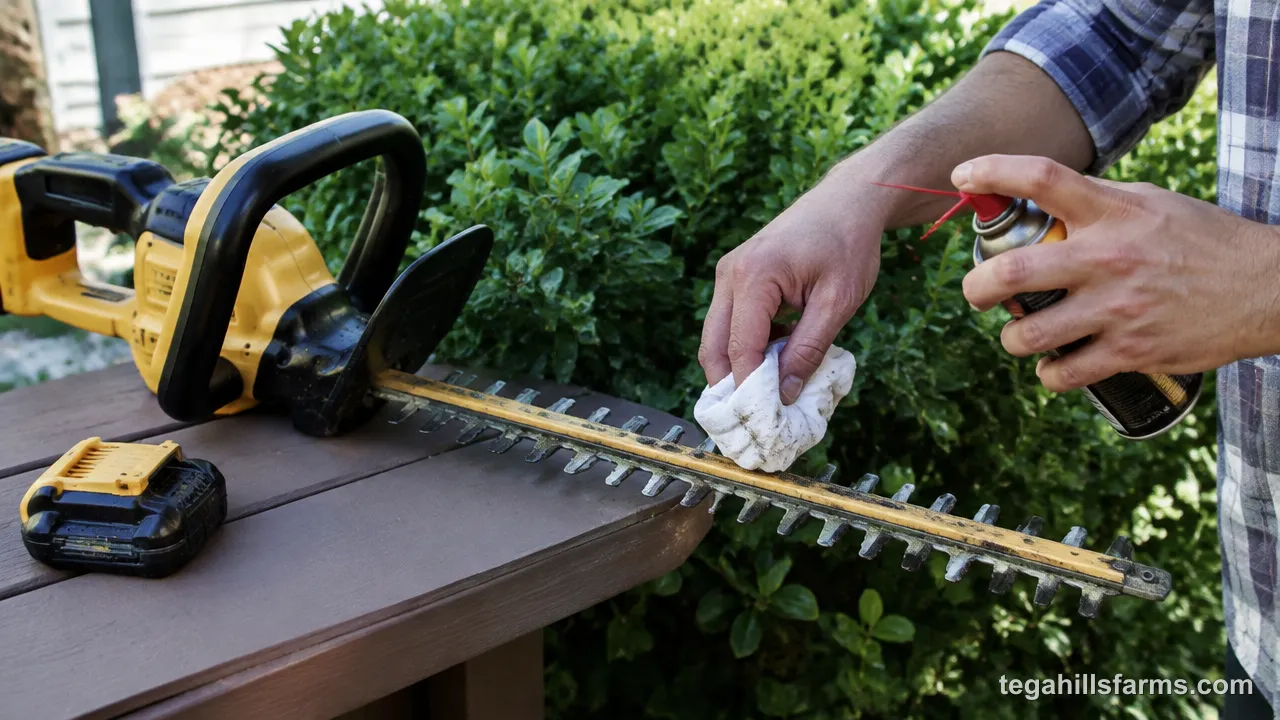
For resin, spray on a resin solvent or blade cleaner, scrub with a stiff brush and wipe the teeth dry. Keep liquids away from the motor housing. Then run a light machine oil or spray lubricant along both blades so they slide freely and resist rust over winter storage.
Sharpen when the tooth edges look rounded or nicked. Use a flat file along each tooth’s original bevel. Replace the blade when teeth are bent or cracked, or when the blades no longer sit flat against each other.
A battery trimmer starts the instant the trigger is touched, with no engine warm-up to warn you. Always take the battery out before your hands go near the teeth, and put the sheath back on before storage.
Is a Certified Refurbished DeWalt Hedge Trimmer Worth Buying?
Yes, when you already know the platform, trim occasionally and buy from a seller who backs the unit with clear return terms. A certified refurbished label generally means the unit has been through functionality testing, inspection and cleaning, then repackaged with its accessories, sometimes in a generic box.
Before you order, confirm who did the refurbishing, how long the warranty runs and how long you have to return it. Get those answers in writing on the listing, not from a chat message.
On a kit, battery condition matters most. Lithium packs lose capacity with charge cycles and age, so ask whether the included pack is new or used. Run it down once soon after it arrives. If runtime fades quickly, send it back before the return window closes.
Refurbished makes sense for a second trimmer, a light trimming schedule, or someone adding to batteries they already own. If you’ll trim heavily every season or want certainty about the battery’s full life, buy new.
What Gear and Technique Make Hedge Trimming Safer?
Wear safety glasses, hearing protection, snug gloves and sturdy non-slip boots. For technique, keep your footing firm, keep both hands on the trimmer and cut with a steady sweeping motion. Twig ends and debris fly toward your face, a fast blade is loud over a long session, and loose gloves or sleeves can snag in the teeth. Long pants protect your legs if the blade dips.
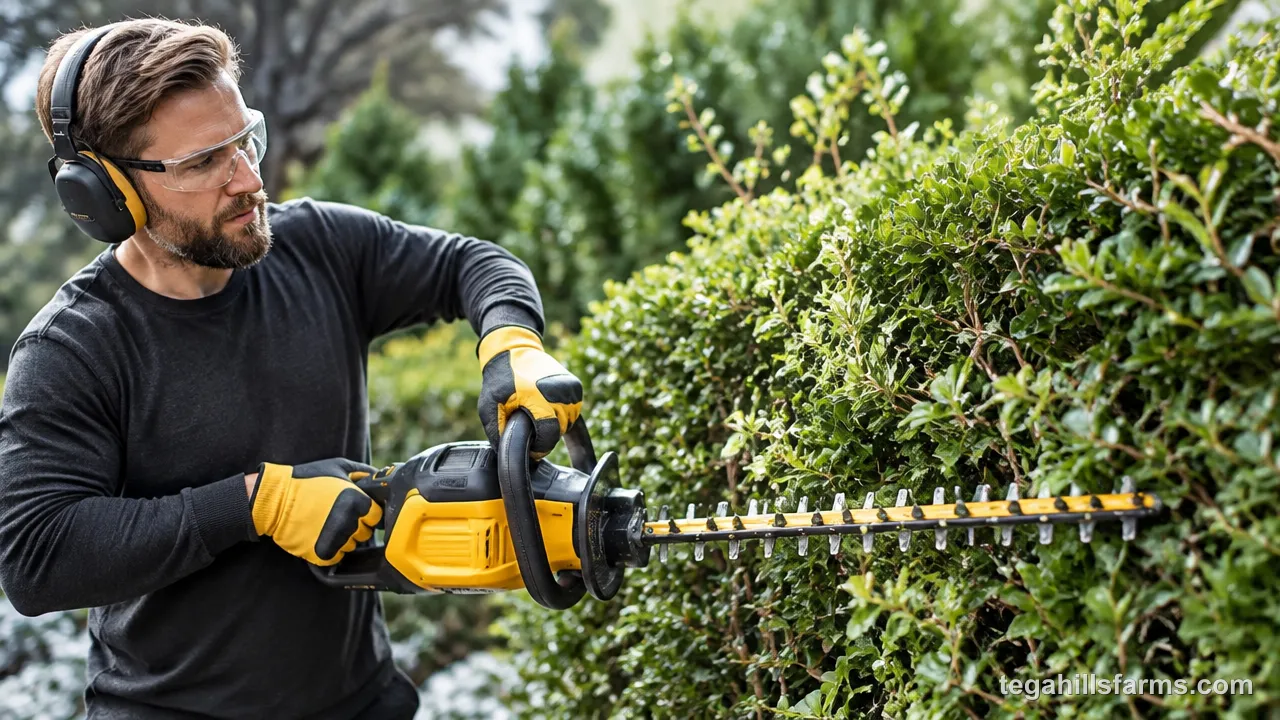
Plant your feet before each cut and don’t overreach. On a slick lawn or a bank, a slip puts a moving blade near your legs. On two-handled trimmers, keep both hands on the handles so the blade stays under control when it catches a thick stem.
Sweep the blade in a smooth arc, working up the sides from the bottom. Keep the tip from jabbing into thick wood or the ground, where it can snag and jerk back. Check the hedge for wire, cords and bird nests before you start.
When the blade jams, release the trigger and remove the battery before you clear the stem with gloved hands.
How Does DeWalt Compare With Other Hedge Trimmer Brands?
The battery system already in your garage usually settles this. A trimmer that takes your existing packs needs no second charger or set of batteries. DeWalt’s range covers a short shaping blade, full-length handheld models, a long brushless handheld and pole models with an articulating head. If you’re on DeWalt, you can stay on one platform for almost any hedge job.
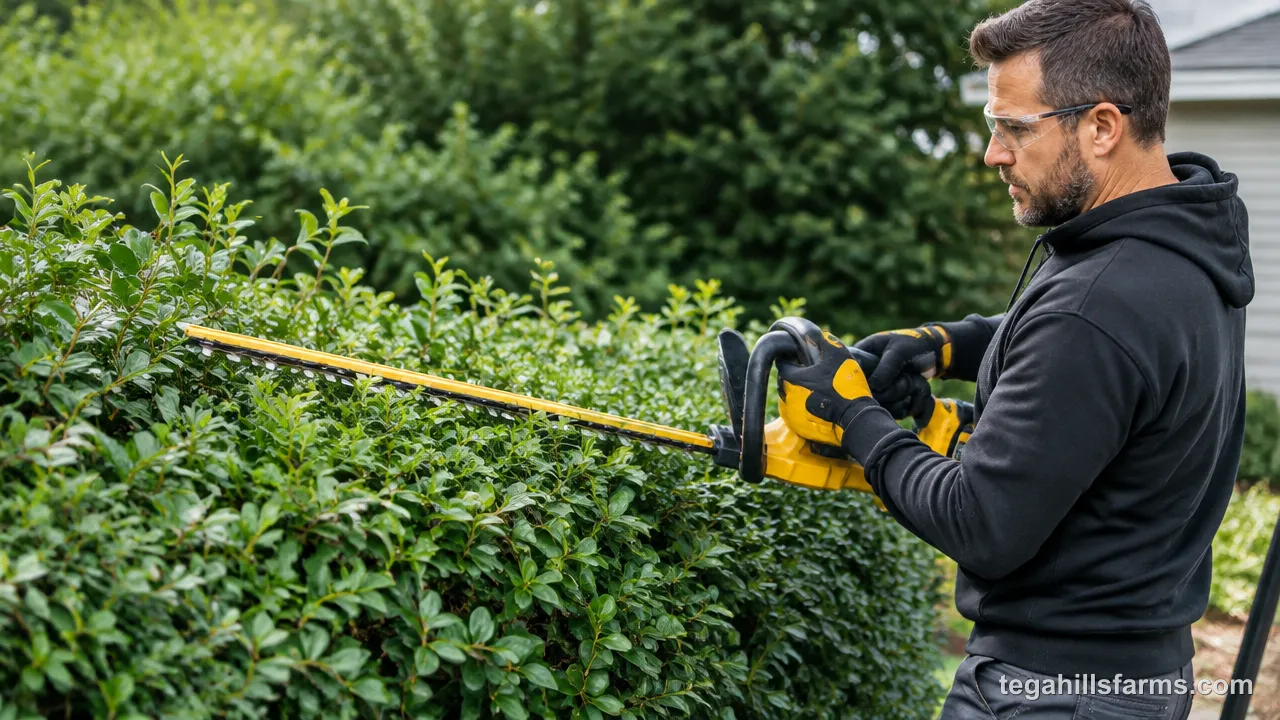
When you weigh another platform, compare the same attributes: blade length, branch capacity, weight with the pack attached, and runtime on the pack size you’d actually use. Comparing a tool-only weight against a kit weight, or runtime on different battery sizes, makes one trimmer look better than it is.
If your drills and impact drivers are Milwaukee M18 tools, the best Milwaukee hedge trimmers keep you on that platform. Ryobi ONE+ owners can do the same with the best Ryobi hedge trimmers. Either way, sticking with one battery system means you can swap a charged pack in from another tool when the trimmer runs flat.







Write Your Review
No reviews yet. Be the first to share your experience!