

Our top picks for the best pole saws under $200 in 2026 are the Seesii 2-in-1 Electric Pole Saws P6 Ace (Best Overall), Seesii 2-in-1 Electric Pole Saws P6 Plus (Runner Up), Seesii 6-in-1 Pole Saw & Hedge Trimmer (Editor’s Choice), CRAFTSMAN V20 CMCCSP20B Pole Saw (Also Great), TaskStar 2-in-1 Cordless Pole Saw 8in (Also Great), Seesii 10in 2-in-1 Pole Saw & Mini Chainsaw (Also Great) and WORX WG311 2-in-1 Pole Saw 10in (Best Ergonomic Design). Most of them split into a handheld mini chainsaw and a pole saw, so one tool covers both the overhead limb and the wood it drops on the lawn.
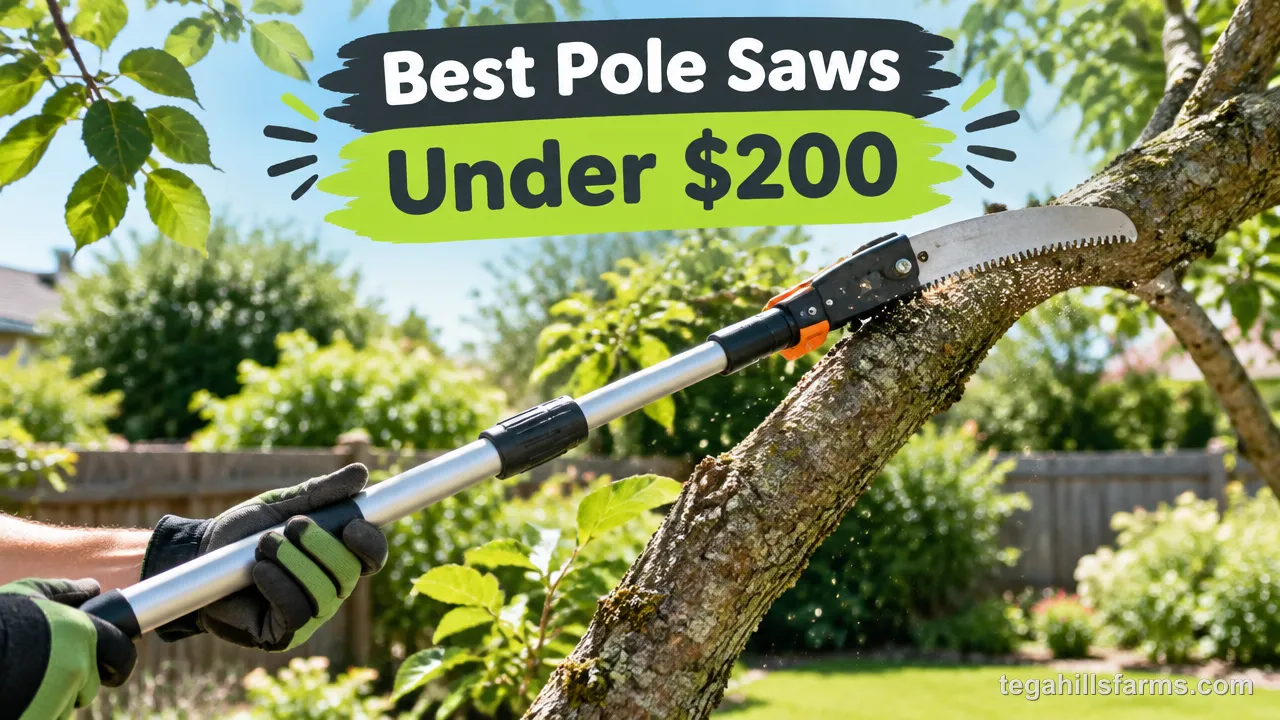
Bar length, real working reach and the weight you hold over your head separate these saws more than motor wattage does. The right mix depends on whether your trees mostly need shaping or your yard collects storm limbs every year.
The worry at this price is a saw that quits before the job does: a pack that runs flat with the limb half cut, or a pole that leaves the branch you bought it for just out of reach.


If you already own CRAFTSMAN V20 batteries, the tool-only CMCCSP20B runs on packs you have. If you don’t, a kit with two batteries and a charger in the box gets you cutting the day it arrives.
What Can You Realistically Expect From a Pole Saw Under $200?
This price mostly buys cordless 2-in-1 kits: a 6- to 10-inch mini chainsaw on a telescoping extension, often with a brushless motor and two batteries plus a charger in the box.
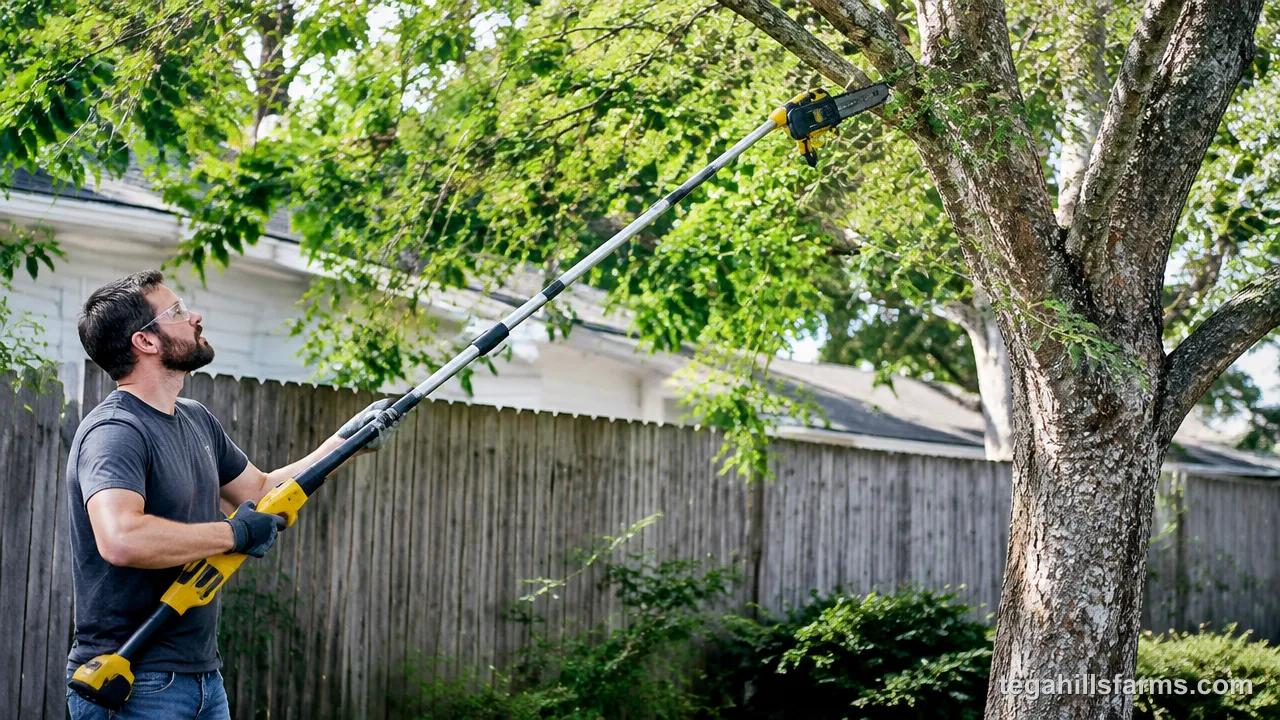
You get a handheld saw and overhead reach from one tool, which means one motor, one set of batteries and one chain to maintain. That suits a homeowner who prunes a few times a season and cuts up whatever comes down.
This tier adds better motors and a second battery pack, which are the main reasons to consider it over more basic tools. The bars are fairly short, the battery packs are compact, and the pole clamps and couplers are mostly plastic, so the head can flex a little at full extension. Drop down to pole saws under $100 and you tend to lose the brushless motor and the second battery. Move up to pole saws under $300 and you gain longer bars, larger packs and sturdier pole hardware.
These saws do well at pruning, small limbs and tidying up after a windy night. They run out of capacity on limbs close to the bar’s length, on cleanup days that outlast both packs, and on wood so high that every cut needs the pole fully extended.
If you have more room in the budget, or want to see how this price range compares with the tiers around it, our roundup of the best pole saws shows where it sits.
The 7 Best Pole Saws Under $200 of 2026
Our top picks for the best pole saws under $200 in 2026 are the Seesii 2-in-1 Electric Pole Saws P6 Ace, the Seesii 2-in-1 Electric Pole Saws P6 Plus, the Seesii 6-in-1 Pole Saw & Hedge Trimmer, the CRAFTSMAN V20 CMCCSP20B Pole Saw, the TaskStar 2-in-1 Cordless Pole Saw 8in, the Seesii 10in 2-in-1 Pole Saw & Mini Chainsaw and the WORX WG311 2-in-1 Pole Saw 10in. The Seesii P6 models keep the saw light with a short bar. The TaskStar, the Seesii 10in and the WORX carry more weight at the head in return for longer bars that take thicker limbs. The 6-in-1 adds a hedge trimmer head, and the CRAFTSMAN fits owners already on the V20 battery platform. These saws cover ornamental and fruit trees, occasional storm cleanup and ground-level cutting, which are the same needs behind the best pole saws for homeowners.
#1 Seesii 2-in-1 Electric Pole Saws P6 Ace — Best Overall
This kit suits a homeowner who prunes several trees in one afternoon, because two 4000mAh batteries and a brushless motor keep it cutting while a spent pack recharges. In handheld mode it weighs 3.4 lb, which is easy on your wrists at the woodpile.
Key Specs:
- Bar: 6-inch mini chainsaw
- Pole: telescopes from 4.6 to 9 ft, up to 16 ft of reach counting your height
- Motor: 20V brushless
- Batteries: 2 × 4000mAh, rated up to 120 minutes and 200 cuts
- Weight: 3.4 lb handheld, 6.9 lb as a pole saw
- Kit: fast charger, replacement chain, shoulder belt, gloves, safety goggles
Detailed Review:
The pole telescopes from 4.6 to 9 feet, and once your own height is added the reach comes to up to 16 feet. That puts the lower canopy of a typical yard tree within reach from the ground. The head adjusts to several cutting angles, so you can meet a branch square instead of tilting the whole pole.
A brushless motor runs on two 4000mAh packs, rated together for up to 120 minutes and 200 cuts. Those ratings assume easy wood. Still, the second pack means a flat battery costs you a quick swap instead of a break to recharge.
Assembled, the saw weighs 6.9 lb, and the shoulder belt in the kit moves part of that load onto your torso. The P6 Plus weighs a little less, but the Ace carries a bit more weight in return for its two 4000mAh batteries.
You can refill the oil and change the chain without tools, and a safety switch with protective baffles helps prevent accidental starts. I’d lean toward this kit when your job list mixes overhead pruning with cutting the fallen pieces to length.
Pros:
- Brushless motor runs cooler and quieter than a brushed design.
- Two 4000mAh batteries let you swap packs and keep cutting.
- Light 3.4 lb handheld mode suits ground-level cuts.
- Oil refills and chain changes need no tools.
Cons:
- Short 6-inch bar needs more passes on thicker limbs.
- Runtime rating assumes easy wood; green hardwood drains packs faster.
Who It’s For:
Homeowners with ornamental or fruit trees who also want a light handheld saw for cutting fallen limbs to length are the natural buyers here. The batteries and charger come in the box, so there is nothing else to buy before the first cut. If your limbs are routinely thick hardwood, a longer-bar saw will get through them in fewer passes.
Editor’s Verdict:
A well-balanced kit that pairs real overhead reach with a light handheld mode and enough battery for an afternoon of pruning.
#2 Seesii 2-in-1 Electric Pole Saws P6 Plus — Runner Up
Pick this one for light pruning on smaller trees, since the mini chainsaw weighs 3.2 lb and the multi-angle head gets to awkward branches over fences without twisting your arms. Auto-oiling keeps the chain lubricated by itself.
Key Specs:
- Bar: 6-inch mini chainsaw, rated for branches from ¾ to 6 inches
- Reach: up to 10 ft
- Motor: brush motor
- Batteries: 2 × 21V 2000mAh
- Weight: 3.2 lb handheld, 6.5 lb overall
- Kit: two chains, charger, adjustable shoulder strap, goggles, gloves, carry case
Detailed Review:
In handheld form the saw weighs 3.2 lb, light enough to steer with one hand at ground level. The multi-angle head lets you set the bar square to branches over a fence or tucked behind a trunk. On the pole, reach goes up to 10 feet, which covers the lower and middle limbs of ornamental trees.
Unlike the brushless P6 Ace, this saw uses a brush motor, so it runs warmer and pulls harder on the battery when you push it through thick wood. It is rated for branches from ¾ to 6 inches, and a brush motor is most comfortable on thin pruning cuts.
The two 21V packs are 2000mAh each, smaller than the Ace’s, so a long cleanup day means more swaps and more time waiting on the charger. For a short pruning session the pair is enough, and the second pack keeps you cutting while the first charges.
With automatic oiling, you only top up the reservoir. The kit ships with two chains, so you can swap a dull one on the spot. Everything packs into a carry case that keeps the chains, strap and batteries together on a garage shelf.
Pros:
- 3.2 lb handheld saw is easy to control one-handed.
- Multi-angle head reaches branches over fences and around corners.
- Automatic oiling keeps the chain lubricated without stopping.
- Two chains included for quick swaps when one dulls.
Cons:
- Brush motor runs warmer and drains packs faster in hardwood.
- 2000mAh batteries mean more swaps on long jobs.
- Reach of up to 10 feet limits high-canopy work.
Who It’s For:
If your pruning is mostly ornamental trees, shrubs and branches hanging over a fence, this lighter kit is easy on your arms and back. If you face long storm cleanups or thick hardwood limbs, a brushless saw with larger packs will serve you better.
Editor’s Verdict:
Light, simple and easy to handle, this saw makes sense for short pruning sessions rather than long cleanup days.
#3 Seesii 6-in-1 Pole Saw & Hedge Trimmer — Editor’s Choice
If your yard has hedges as well as trees, this kit puts a 12-inch hedge trimmer head on the same pole and batteries, so one storage spot covers both jobs. The saw head runs on a 1000W brushless motor.
Key Specs:
- Saw: 6-inch bar, rated for 6-inch branches
- Hedge trimmer: 12-inch dual-action blade for ¾-inch stems
- Motor: 1000W brushless, 26.2 ft/s chain speed
- Reach: up to 15 ft for a 6-ft user
- Head: pivots 180° with 5 lockable positions
Detailed Review:
The hedge trimmer head swaps onto the same pole with tool-free locking clamps, so you can do tall hedge tops and overhead limbs from the ground. The head pivots through 180° and locks in five positions, which lets you hold the cutter flat across a hedge top without bending your wrists. The trimmer blade cuts stems up to ¾ inch.
On the saw side, the brushless motor drives the chain at 26.2 ft/s, and the 6-inch bar is rated for branches up to 6 inches thick. Two 21V 4.0Ah packs are rated for up to 100 minutes, and a fast charger comes in the box.
The 15-foot reach figure assumes a 6-foot user, so the pole itself covers less than that number suggests. Take the pole away and the head works as a handheld mini chainsaw for firewood and storm debris on the ground.
Seesii backs the kit with a 3-year warranty. I’d choose it for the extra head only if you have hedges to keep. For tree work alone, a plain 2-in-1 does the same cutting with fewer parts to store.
Pros:
- Hedge trimmer head shares the pole and batteries.
- Head pivots 180° and locks in five positions.
- Brushless motor drives the chain at 26.2 ft/s.
- A 3-year warranty covers the kit.
Cons:
- Swapping heads adds a step when you switch jobs.
- The extra attachment goes unused if you have no hedges.
Who It’s For:
Keeping both hedges and trees in shape from one set of batteries is exactly the job this combo fits, and it saves you storing a separate trimmer system. If your yard has no hedges, the second head adds little, and a simpler saw-only kit will do the same cutting.
Editor’s Verdict:
The hedge trimmer head turns this into a two-job tool, and the brushless saw holds its own on hardwood.
#4 CRAFTSMAN V20 CMCCSP20B Pole Saw — Also Great
Owners who already have CRAFTSMAN V20 batteries should look here, since this tool-only saw runs on the packs already on their shelf. Reach goes up to 14 ft.
Key Specs:
- Battery platform: CRAFTSMAN V20, tool only
- Reach: up to 14 ft with the extension pole
- Runtime: up to 325 cuts per charge
- Head: angled head and blade
- Weight: 10 lb
- Storage: integrated hook for the VERSATRACK wall system
Detailed Review:
Buying tool-only makes sense once you’re on a battery platform, because the saw shares V20 packs and chargers with the drill or trimmer you already own. Without V20 packs at home, you need a battery and charger before the first cut, and a complete kit is the simpler place to start.
Treat the rating of up to 325 cuts per charge as a ceiling. The real cut count depends on which V20 pack you fit, the wood species and how sharp the chain is, so green hardwood and a small pack bring it down quickly.
The angled head and blade help you meet a limb at a cleaner angle from the ground, and the soft grip on the extension gives your forward hand a secure hold for steering. At 10 lb it is clearly heavier than the Seesii P6 Ace on the pole, and you feel that extra weight in your shoulders during overhead cuts.
With the extension pole, reach goes up to 14 feet. The integrated hook hangs the saw on a VERSATRACK wall system, which keeps a long tool out of the way in a tight garage.
Pros:
- Runs on CRAFTSMAN V20 batteries you may already own.
- Up to 14 ft of reach with the extension pole.
- Angled head and blade help line up cleaner cuts.
- Integrated hook hangs it on VERSATRACK wall storage.
Cons:
- 10 lb weight tires shoulders faster on overhead work.
- Tool-only purchase needs a V20 battery and charger.
Who It’s For:
Anyone already running CRAFTSMAN V20 tools gets a pole saw that drops straight into their battery rotation. If you don’t own that platform, or you want a light saw for long overhead sessions, a complete kit that ships with batteries will suit you better.
Editor’s Verdict:
For a CRAFTSMAN V20 household, this is a simple add-on: same batteries, solid reach and a hook that keeps it on the wall and out of the way.
#5 TaskStar 2-in-1 Cordless Pole Saw 8in — Also Great
Yards where limbs run thicker than routine pruning wood suit this kit, because its 8-inch bar on a 1000W brushless motor gives more cutting length than a 6-inch saw. Auto-oiling and tool-free chain tension keep upkeep short.
Key Specs:
- Bar: 8-inch guide bar
- Motor: 1000W brushless
- Pole: 4.6 to 8 ft, 15 ft max reach, 180° rotating head
- Batteries: 2 × 4.0Ah, 80–120 minutes total, 2–3 hours per charge
- Weight: 7.2 lb as a pole saw, 3.6 lb handheld
- Warranty: 3 years
Detailed Review:
A longer bar gets through thicker limbs in fewer passes than a 6-inch head, and the brushless motor keeps the chain driving through firewood and hardwood limbs. That makes this kit as useful on the ground as it is overhead.
On the pole and in the hand, it weighs only a little more than the 6-inch Seesii P6 Ace, so the longer bar asks less of your shoulders than you might expect. The pole runs from 4.6 to 8 feet with a head that rotates 180°, and the 15-foot maximum reach counts on your own height on top of that pole length.
That recharge time is why the second pack matters: you swap and keep cutting while the first one sits on the charger.
Automatic oiling, tool-free chain tension and a spare 8-inch chain in the box mean fewer stops during a long session. A 3-year warranty covers the kit.
Pros:
- Longer 8-inch bar gets through thick limbs in fewer cuts.
- Brushless 1000W motor delivers strong cutting power.
- Tool-free chain tension and auto-oiling simplify upkeep.
- Spare chain and two 4.0Ah batteries included.
Cons:
- Pole length of 8 ft limits reach on tall trees.
- Recharging a pack takes a couple of hours, so you wait between sessions if you run both down.
Who It’s For:
Owners who cut up firewood and storm limbs as often as they prune will like the longer bar, and it adds little weight. If you mainly shape small ornamental trees, a shorter, lighter saw is easier to steer through tight branches.
Editor’s Verdict:
A strong motor, a longer bar and a sensible kit make this a good pick when your branches are thicker than routine pruning wood.
#6 Seesii 10in 2-in-1 Pole Saw & Mini Chainsaw — Also Great
Choose this kit when thicker limbs and storm debris make up much of the work, because its 10-inch bar and 900W brushless motor cut deeper per pass than a short-bar saw. A dual-button start guards against accidental triggers.
Key Specs:
- Bar: 10-inch guide bar
- Motor: 900W brushless
- Reach: pole up to 10 ft, up to 16 ft counting your height
- Batteries: 2 × 21V 4000mAh, up to 120 minutes or about 200 cuts
- Weight: 4.6 lb handheld, 8 lb as a pole saw
- Safety: dual-button activation with safety lock
Detailed Review:
The 10-inch bar handles limbs that would take repeated passes with a smaller head, and the brushless motor delivers steady power with less vibration as the cut deepens. That suits fruit-tree limbs that have grown heavy and the broken wood a storm leaves hanging.
The extra bar length shows up as weight: 8 lb on the pole and 4.6 lb in the hand, both more than the Seesii P6 Ace. The shoulder strap and auxiliary handle in the kit spread the load, but long overhead sessions still tire your arms sooner than a 6-inch Seesii does.
Two 21V 4000mAh packs are rated for up to 120 minutes or roughly 200 cuts, and the fast charger refills a pack in about 2 hours. Automatic oiling feeds the chain continuously, which matters in thicker wood, where a dry chain heats up quickly.
The pole reaches up to 10 feet, or about 16 feet counting your height, and the cutting angle adjusts for limbs at odd positions. The dual-button start and safety lock keep the chain from running when the trigger gets bumped by accident.
Pros:
- 10-inch bar cuts deeper per pass on heavy limbs.
- 900W brushless motor runs with less vibration and noise.
- Dual-button start prevents accidental single-touch starts.
- Auxiliary handle and strap help steady the longer saw.
Cons:
- 8 lb pole weight tires arms on long overhead sessions.
- Heavier head is clumsier in tight ornamental canopies.
Who It’s For:
Yards with mature trees that shed heavy limbs, or old orchards where overgrown wood needs cutting back, are where this saw earns its space in the garage. If your trimming is mostly thin shoots on young trees, the extra weight works against you.
Editor’s Verdict:
Built for heavier wood, this saw gives up some comfort overhead for a bar that finishes thick cuts quickly.
#7 WORX WG311 2-in-1 Pole Saw 10in — Best Ergonomic Design
If you cut at awkward angles, you’ll appreciate how the 180-degree rotating rear handle turns the grip to match the bar, so your wrist stays straight whether you’re cutting overhead or along a fence line. A single knob handles chain tension.
Key Specs:
- Bar: 10-inch
- Motor: 8-amp electric
- Chain speed: 28 ft/s
- Reach: up to 10 ft
- Weight: 10 lb
- Handle: 180° rotating rear handle
Detailed Review:
Turning the rear handle changes the grip angle without changing the bar angle, so you can hold the saw comfortably whether the cut runs straight up, tilted or sideways. Over a long session, a straight wrist keeps your forearms from tiring as quickly.
Chain tension adjusts with the turn of a knob, and automatic lubrication keeps the bar and chain oiled, so routine upkeep needs no tools and no stops to pump oil. The telescopic pole adjusts to the height of each cut. With the pole removed, the head works as a regular chainsaw for ground-level jobs.
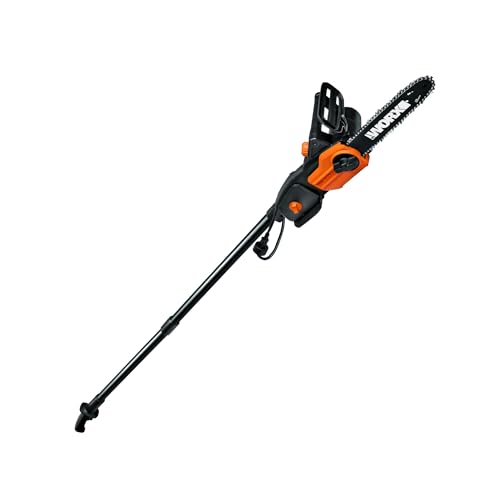
The 10-inch bar matches the Seesii 10in, and an 8-amp electric motor drives the chain at 28 ft/s. At 10 lb, though, it is heavier than that Seesii on the pole, and you feel the weight on every overhead cut.
Reach goes up to 10 feet. I’d point you toward the WORX when comfort at odd angles matters more than low weight, such as trimming along a fence or under the eaves.
Pros:
- 180° rotating rear handle keeps your wrist straight.
- Knob-style chain tensioning works without tools.
- Automatic lubrication extends bar and chain life.
- Pole removes for ground-level chainsaw cuts.
Cons:
- 10 lb weight wears on your shoulders overhead.
- Pole reach stops short of high canopy branches.
Who It’s For:
When your cuts come at awkward angles, along fence lines or around the house, the rotating handle keeps your hands comfortable through the session. If you mostly hold a saw overhead for long stretches, a lighter pole saw may suit you better, since this one’s weight shows up quickly in the shoulders.
Editor’s Verdict:
Comfortable to hold at almost any angle, the WG311 suits owners who value grip and easy chain care over a light pole.
Cordless, Corded, or Manual: Which Type Fits a Tight Budget?
Yard layout and how often you cut settle it: a plug-in saw stops where the extension cord runs out, a battery saw stops when its packs run flat, and a hand saw stops when your arms give out.
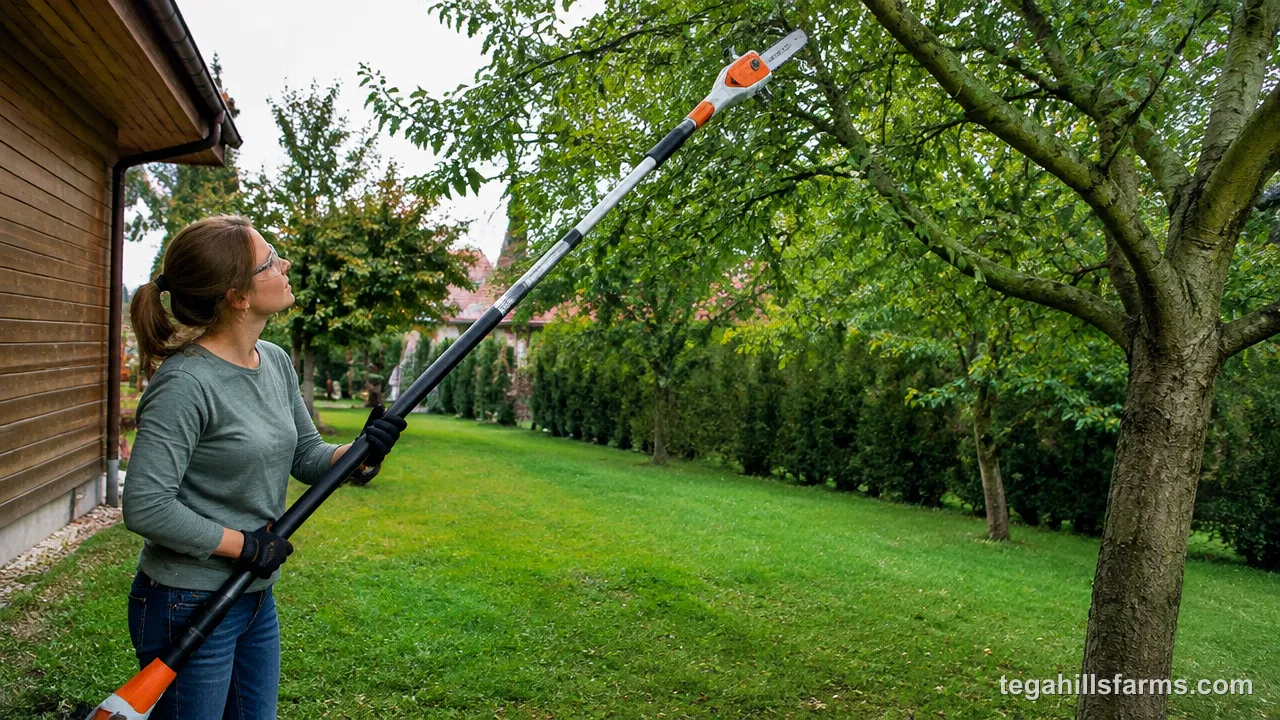
A small lot with an outlet near the trees rarely notices the cord. A yard with trees along the back fence turns that same cord into something you drag through the flower beds. Batteries let you go anywhere but turn a long cleanup into a charging schedule. Muscle power stays the cheapest choice only while the cuts stay few and thin.
How Do Cordless and Corded Pole Saws Compare?
Battery saws win on freedom of movement and plug-in saws win on continuous power. A cordless saw goes anywhere in the yard but stops when the pack runs down, while a corded saw runs as long as it stays plugged in and stops where the extension cord ends.
Runtime sets the ceiling on cordless work. Once both packs are flat, the job waits for the charger, which can push a storm cleanup into the next day. A corded saw never has that pause, and with no battery on board, the weight at the end of the pole comes down to the motor and bar.
Cords bring their own chores: you need an outdoor-rated extension cord, a GFCI outlet, and a plan to keep the cord out of the cutting path and the drop zone. Branch capacity depends on bar length and motor more than on the power source.
Large lots, trees far from the house and occasional storm work favor the best battery pole saws. A compact yard with trees near an outlet and long pruning sessions suits the best corded pole saws.
When Is a Manual Pole Saw Enough?
Hand power is enough when you make a handful of small cuts a year on thin live branches and want a tool that never needs charging, fuel or winter battery storage.
A sharp pruning blade on a pole cuts cleanly on live wood, stores in any corner and has nothing to wear out but the blade. The limits show up fast as the work grows. Every cut is your arms pushing and pulling over your head, so a thicker limb can take a long time and leave your shoulders burning, and the pace drops further in hardwood. If you face more than a few limbs per season, or anything thick, a powered saw saves real effort.
Is a 2-in-1 Mini Chainsaw Pole Saw Better Than a Traditional Pole Saw?
Yes, for most homeowners at this price, because a detachable head doubles as a handheld chainsaw for ground work and gives you overhead reach from one motor and one set of batteries.
That flexibility pays after a storm, when the limbs you cut from the canopy end up on the lawn and need cutting into pieces. The downside is in the build. Mini chainsaw heads use short bars, and the joint where the head locks onto the pole adds a point of flex, so a 2-in-1 can feel less steady at full extension than a dedicated pole saw. A dedicated head is also designed around the pole’s balance, which helps on long pruning sessions. If you will never use a handheld saw, a traditional pole saw puts the whole budget into the overhead tool.
Should You Buy a Complete Kit or a Tool-Only Pole Saw?
Buy the complete kit unless you already own batteries on the same platform. A kit puts the saw, batteries, charger and usually a spare chain and protective gear in one box, so you can cut the day it arrives without hunting for compatible parts.
A tool-only saw wins when your garage already holds packs that fit, as with the CRAFTSMAN V20 CMCCSP20B for anyone running V20 tools: you add only the saw and keep one charger on the bench. Starting a second battery platform just for a pole saw means buying packs and a charger that sit idle the rest of the year.
The bundled spare battery also matters on longer jobs. One pack rarely covers a full cleanup in green wood, and a second one lets you keep cutting while the first recharges.
What Should You Look for in a Budget Pole Saw?
Real working reach, bar length and weight at the end of the pole decide whether a saw fits your yard, and motor type decides how well it holds up in thicker wood.
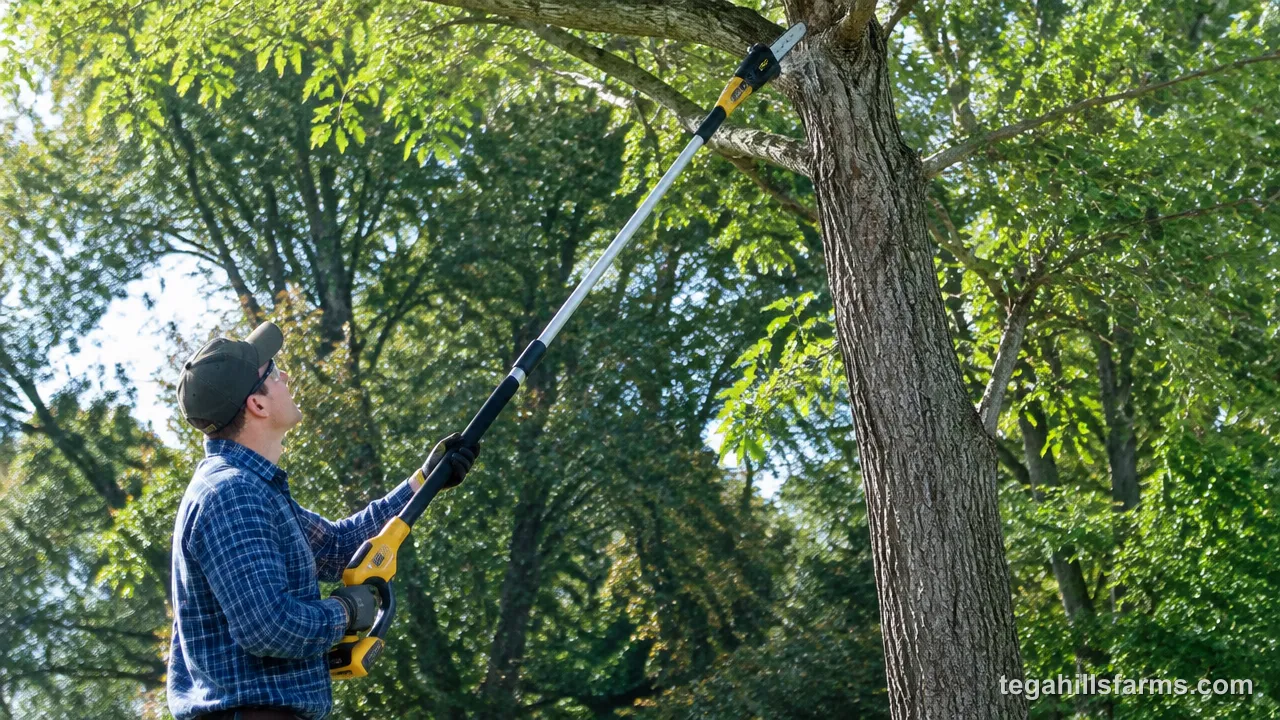
Each spec on the box needs reading against your own trees. A reach figure that sounds generous may still leave the top limbs out of range, and a bar sized for pruning will struggle through a storm-broken limb.
How Should You Read a Pole Saw’s Maximum Reach?
Listed reach figures usually add your standing height and arm stretch to the pole length, so the saw head sits several feet lower than the number on the box. The Seesii 6-in-1, for example, quotes its figure for a 6-foot user.
To match a saw to your trees, judge the height of the highest limb you plan to cut and compare it with the pole length plus your own reach, then leave some margin. You rarely cut straight overhead, and angling the pole out from the trunk eats into vertical reach.
A fully extended pole also feels less stable. The head sits at the far end of a longer lever, telescoping joints have a little play, and small movements of your hands become large swings at the bar. For limbs at the top of that range, the best pole saws for tall branches use longer, stiffer poles built for that height.
What Branch Size Can a Pole Saw Cut?
Guide bar length sets the limit. A saw cuts cleanly through branches that are noticeably thinner than its bar, so a 6-inch bar suits pruning-size wood and an 8- or 10-inch bar handles heavier limbs.
A branch close to bar length leaves the chain no room to clear chips at both ends of the cut. The saw binds, slows down and burns through battery, and the cut often ends in a pinched bar.
Motor type and chain speed decide how the cut feels in hardwood. A faster chain removes more wood per pass, so dense oak or maple goes quicker and the saw is less likely to stall. Softwood and dry dead wood are easier on any saw.
For ornamental pruning and fruit trees, a short bar keeps the weight down and does the job. For storm limbs and overgrown trees, the longer bars justify their extra weight.
How Much Do Weight and Balance Matter on a Pole Saw?
More than the spec sheet suggests. The saw head and battery sit at the far end of a long lever, so every extra pound at the head feels heavier in your arms and shoulders the farther the pole extends.
That’s why a saw that is only a little heavier on the scale can be noticeably more tiring over a run of overhead cuts. Handheld weight tells you how the saw feels at the woodpile. Assembled pole weight is what you hold overhead, and it is the figure to compare for pruning.
A shoulder strap moves part of the load onto your torso, and placing your forward hand farther up the pole shortens the lever, so both cut down on fatigue. Keep the pole only as long as the cut needs. If light weight decides your choice, the best lightweight pole saws focus on exactly that.
Does a Brushless Motor Matter on a Budget Pole Saw?
Yes, when you cut thicker wood or work long sessions. Without carbon brushes rubbing on a commutator, the motor runs cooler, gets more cutting from each charge and wears more slowly.
Less heat also means the motor holds its speed under load instead of bogging down halfway through a limb, and it runs a little quieter.
A brushed motor is fine for light pruning, because a few thin branches per session won’t heat the motor or drain the pack enough to notice. If your work is mostly shaping small trees, the brush-motor Seesii P6 Plus handles it. For storm cleanup and hardwood, I’d put a brushless motor near the top of the list.
Which Pole Saw Fits Your Trees and Yard Work?
Branch thickness and how high the cut sits decide the match, and both change as trees age and storms roll through.
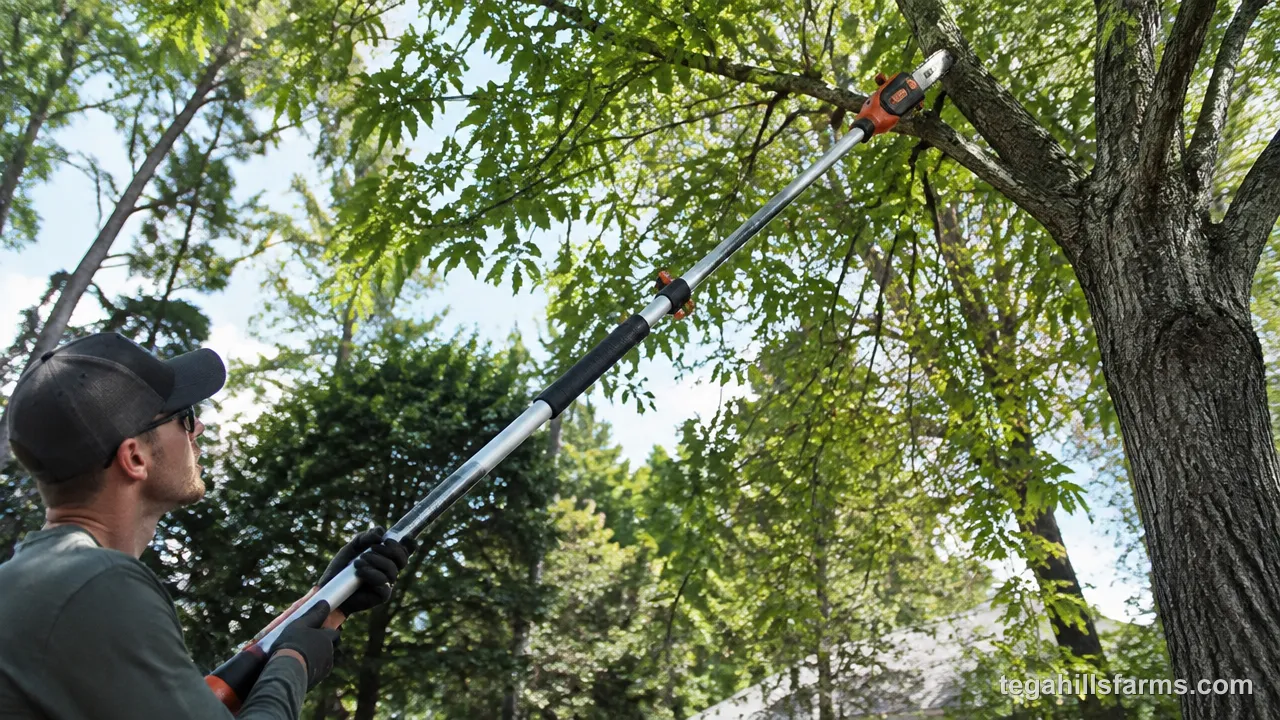
A young fruit tree and a storm-split maple ask very different things of the same saw. Some jobs also carry enough risk to the house, the wires or you that the saw stops being the right tool at all.
Which Pole Saw Suits Fruit Trees and Ornamental Pruning?
Small, crowded canopies reward a light saw with a short bar and an adjustable head angle over a high-power model, because most cuts are thin live branches where control matters more than speed.
A heavy head is hard to thread between branches without bruising the ones you want to keep. An adjustable angle lets you cut close to the branch collar from the ground instead of leaning a ladder into the tree.
Live wood also needs clean cuts. Keep the chain sharp so it slices instead of tearing, cut just outside the collar, and don’t leave stubs, which seal poorly and invite rot. The Seesii P6 Ace and P6 Plus fit this work well, and the best pole saws for pruning narrow the field further around this job.
What Works for Storm Cleanup and Thicker Limbs?
A longer bar, a brushless motor and a spare battery, because storm limbs are thicker, often under tension and rarely at a convenient angle.
A broken limb hanging in the canopy may be bent, twisted or resting on another branch, so the wood can pinch the bar or spring back when cut. Thick wood drains packs faster than routine pruning, and awkward angles slow every cut. The TaskStar 8in and the Seesii 10in handle this work better than a 6-inch head.
Once a limb is down, switch to handheld mode. Cutting a fallen limb at waist height lets you read the tension in the wood, plant your feet and keep the saw away from your body, which is far safer than reaching overhead at full extension. The best pole saws for storm cleanup lean toward longer bars and bigger packs for the same reason.
When Should You Skip the Pole Saw and Call an Arborist?
Call an arborist for large limbs over the house, any branch in or near power lines, and trees that need climbing to reach the cut.
A budget pole saw gives you no control over where a heavy limb falls. Once it lands on a roof, gutter, car or fence, the repair bill dwarfs whatever the saw saved you.
Power lines are a hard stop. A branch touching or close to a line can carry current through the wood and the pole, so call your utility first, since it can tell you who handles line clearance. Trees that need climbing, rigging or a bucket truck are beyond homeowner gear, and large leaning or decayed trees can fail unpredictably once cutting starts.
A listed runtime describes light cuts in easy conditions, not a storm-split oak limb. Green hardwood, a dull chain and awkward overhead angles pull a pack down much faster, so a cleanup planned around the label number can stall with limbs still hanging over the driveway.
How Far Can You Trust Runtime and Cuts-Per-Charge Claims?
Treat them as best-case ceilings. “Up to” runtime and cuts-per-charge figures reflect light cutting, and the real numbers fall with harder wood, wetter branches, a duller chain and thicker limbs.
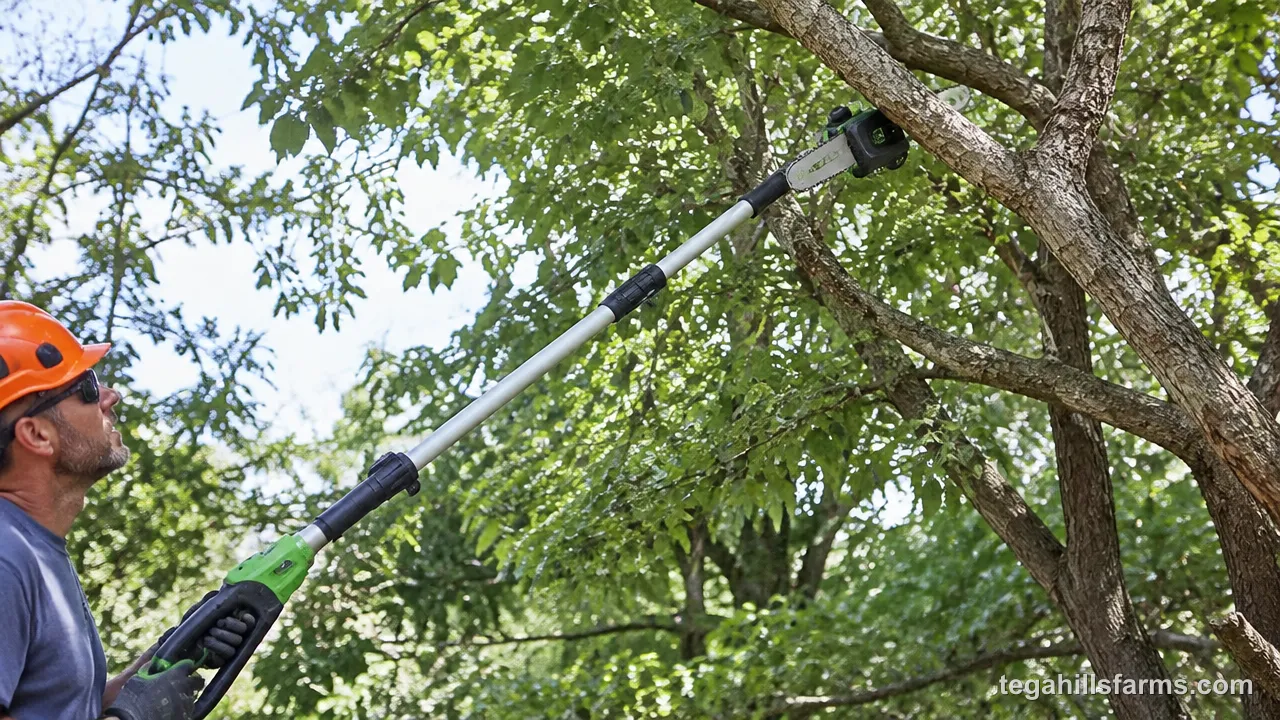
Dense green hardwood takes more energy per inch than dry softwood. A dull chain makes the motor grind instead of slice, which drains the pack and heats the motor. A cut through a thick limb uses far more energy than a thin pruning cut, so a cuts-per-charge number means little until you know the branch size behind it.
Watch how a runtime claim is built. Some kits quote total runtime for both batteries together, as the TaskStar’s combined figure does, so each pack covers only part of that number.
That’s why the second battery matters more than the headline figure: it turns a dead pack into a swap and keeps the job moving while the first one charges. Size your battery capacity to your biggest cleanup day, not to the label.
What Is the Difference Between a Pole Saw and a Pole Pruner?
Products sold as saws usually carry a motorized chain on the end of the pole. Pruners are typically manual tools with a lopper-style hook and blade worked by a pull cord, sometimes with a small pruning saw blade attached.
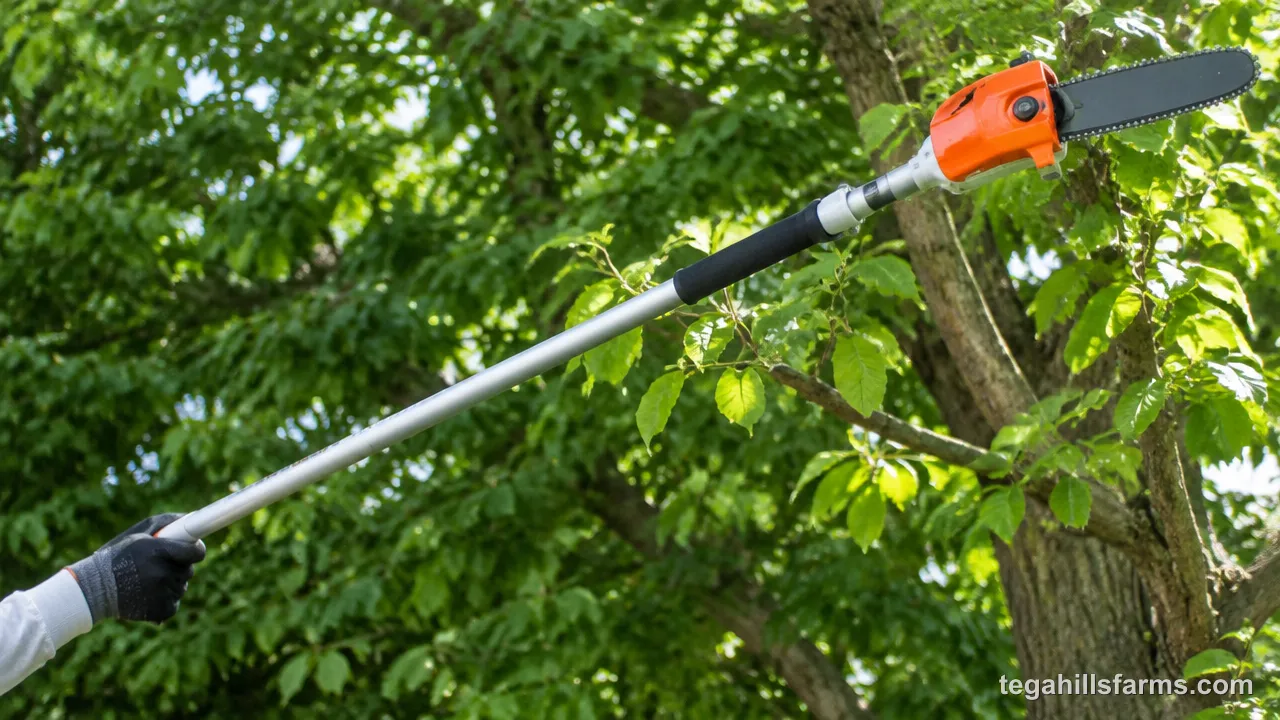
A pruner’s bypass blade makes a clean cut on live branches about as thick as a broom handle, which suits shaping fruit trees and ornamentals. Its limits arrive quickly with thicker or dead wood, where the jaws can’t open wide enough or your pull on the cord can’t close them.
A powered chain head cuts by removing wood continuously, so its capacity depends on bar length, not jaw opening or hand strength. That’s why storm limbs and overgrown trees call for a saw. Check the product photos and description before you buy, since the two names get mixed up often.
How Do You Cut a High Branch With a Pole Saw?
Cut it in three stages: an undercut, a top cut farther out, then a final cut just outside the branch collar.
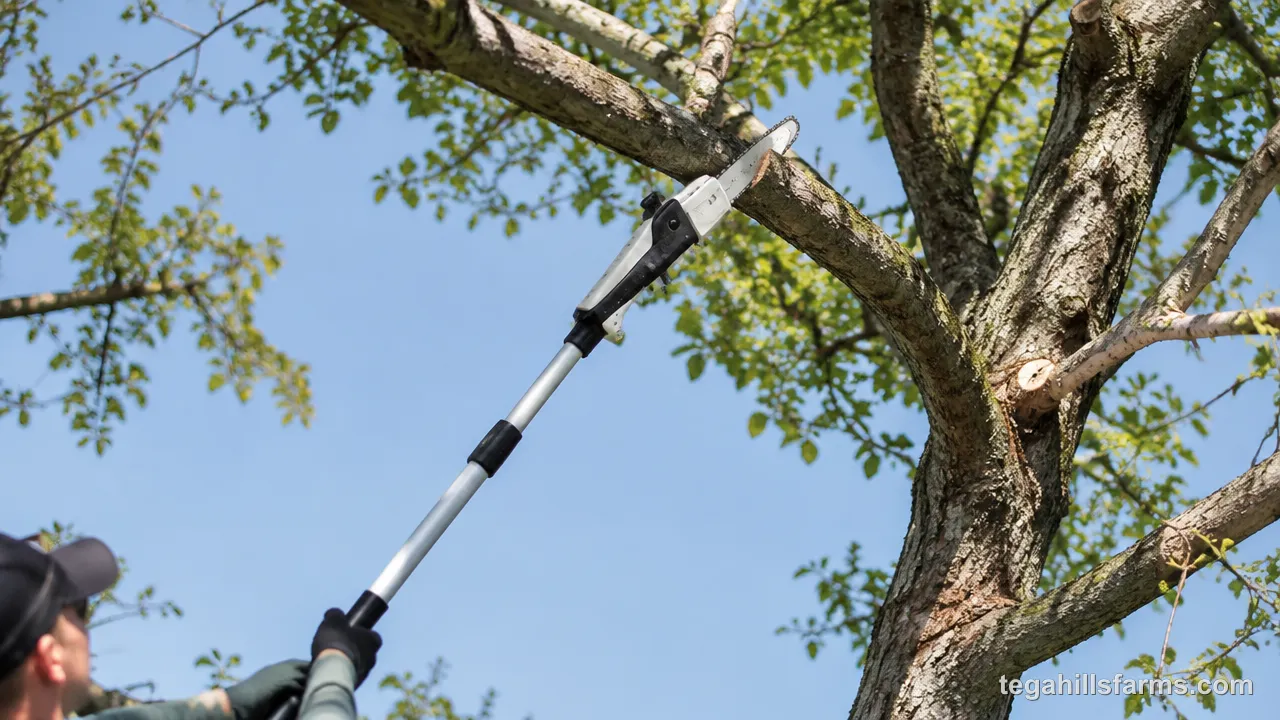
Start with an undercut on the underside of the limb, a short distance out from the trunk, going partway through. Then move a little farther out and cut down from the top until the limb drops. The undercut stops the bark from peeling, so the falling weight snaps the limb cleanly instead of tearing a strip of bark down the trunk.
With the weight gone, make the final cut just outside the collar, the slightly swollen ring where the branch meets the trunk, which leaves a wound the tree can seal. Cutting the short stub also keeps the bar from binding, since no heavy limb is sagging onto the chain.
Before any of this, clear the drop zone of people, pets, cars and anything you want to keep, and stand to the side of the limb, never under it. Let the chain do the work. Pushing hard on an extended pole makes the bar wander and pinch.
How Do You Use a Pole Saw Safely Near Overhead Wires and Falling Limbs?
Keep the saw, the pole and any branch you’re cutting at least 10 feet from power lines, and never stand on a ladder to gain reach.
Fiberglass and carbon poles are often described as non-conductive, but water, dirt, sap and grime on the surface can carry current, and a wet branch can conduct on its own. If a limb touches or hangs over a line, leave it to your utility or a line-clearance arborist.
A ladder raises your center of gravity while the pole swings weight far from your body. A falling limb can knock the ladder, or you, before you can react.
Plan the drop zone before the first cut. Keep everyone well clear of the area under and around the limb, stand to the side of the branch, and keep an escape path open behind you. Wear eye protection and a hard hat, since twigs and chips rain down with every overhead cut.
How Do You Keep a Budget Pole Saw Cutting Well Season After Season?
Keep the bar oil topped up, keep the chain tensioned and sharp, and store the batteries properly between seasons. Those habits decide whether a budget saw lasts.
Check the oil reservoir before every session. An auto-oiler feeds the chain from the reservoir as it runs, so you only refill it, while a manual oiler needs you to press a pump every few cuts. Either way, a dry chain wears out the bar and chain fast. Use bar and chain oil, not motor oil.
With the battery removed, the chain should sit snug against the bar yet still pull around by hand with gloves on. New chains stretch during their first sessions, so recheck tension often. Tool-free adjusters like those on the TaskStar and the WORX make that a quick job.
Sharpen or replace the chain when it throws fine sawdust instead of chips, smells of burning, or pulls to one side in the cut. A chain that keeps sagging after adjustment is stretched and has reached the end of its life.
Before winter, clean sap and sawdust from the bar and sprocket, oil the chain, and store the batteries partly charged in a cool, dry place indoors, not in a freezing shed.


Write Your Review
No reviews yet. Be the first to share your experience!