

My picks for the best hedge trimmers for thick branches are the BLACK+DECKER BEHT150 17in Hedge Trimmer (Best Overall), EGO Power+ HT2601 26in Hedge Trimmer (Best Battery Life), Greenworks 40V 24in Hedge Trimmer (Best Budget), SENIX 4QL 22in Gas Hedge Trimmer (Also Great), Husqvarna 320iHD60 Battery Hedge Trimmer (Also Great), Husqvarna 322HD60 Hedge Trimmer 24in (Best for Professionals), Echo 20in 21.2cc Gas Hedge Trimmer (Best Precision Cutting) and Sybrioka 26cc Gas Hedge Trimmer 24in (Also Great). They span corded, battery and gas power, from a light plug-in model for regular upkeep to gas machines built for long, woody hedge lines.
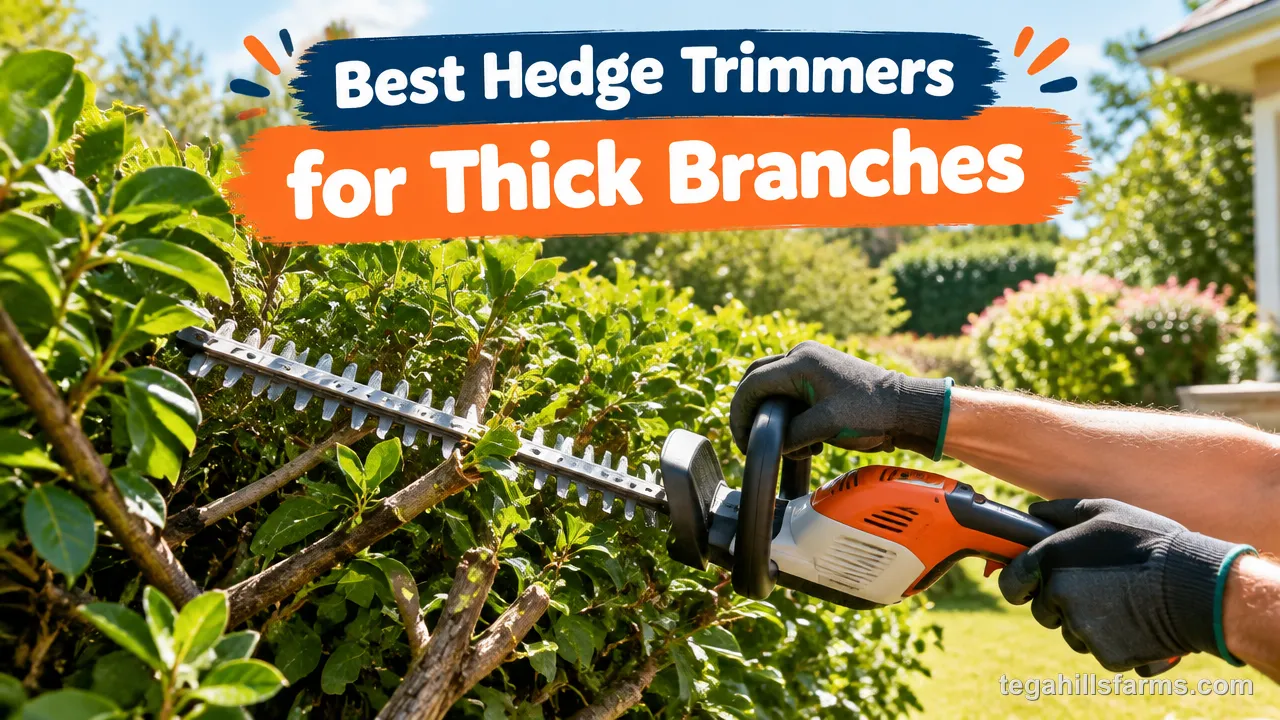
Whether a trimmer gets through woody stems or bounces off them comes down to its rated cutting capacity, whether both blades move, and the power source behind them. Capacity tells you how thick a stem the teeth shear cleanly, dual-action blades grip that stem instead of pushing it aside, and the motor or engine decides whether the blades keep their speed once they bite into wood.
On an overgrown hedge, the expensive mistakes come from forcing wood: a stem too thick for the teeth stalls the blades, strains the motor and can bend teeth or strip a gearbox. Knowing where a machine’s limit sits, and when to switch to loppers, protects the trimmer and leaves cleaner cuts on the plant.


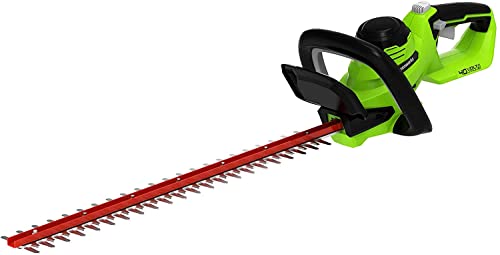


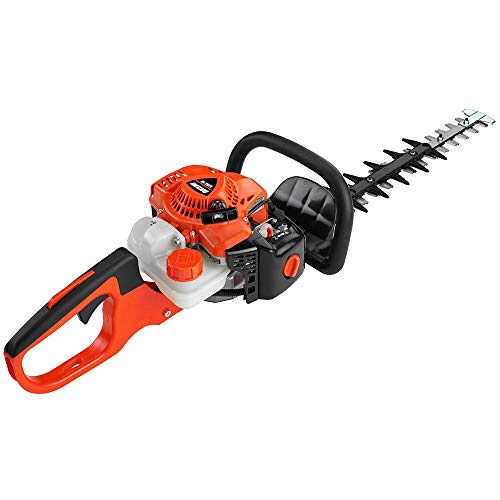

If you already own 40V or 56V batteries for a mower or blower, check the platform first, because a trimmer that takes those packs spares you buying another battery and charger.
What Branch Thickness Can a Hedge Trimmer Actually Cut?
Expect a clean shear only on stems up to the rated cutting capacity, which runs from 5/8 inch on a light corded model to 1.2 inches on a heavy-duty battery machine.
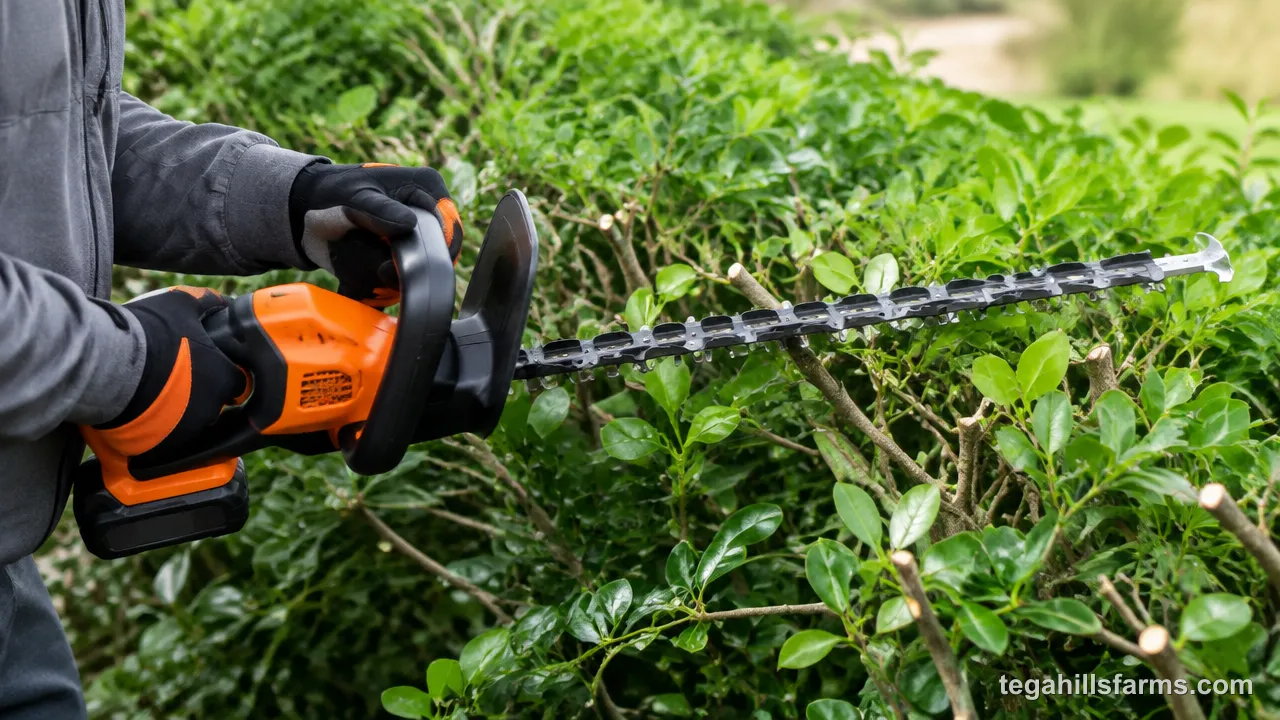
That rating is the diameter of a single stem where the blade meets it, measured on bare wood. A branch often looks thicker than it is because leaves, side shoots and a fork near the cut read as one heavy mass, so size up the stem you are about to sever, not the clump around it.
Tooth spacing decides whether the wood gets cut at all. A stem has to slide into the gap between teeth before the blades can close on it, and when it is wider than that gap, the teeth ride over it and push it away, so the trimmer bounces instead of biting.
Feeding a stem past the rating stalls the blades or leaves a ragged, crushed end that splits back into the plant. The motor strains the whole time, which heats a corded or battery motor and wears the gearbox on any type.
Thick also means something different by power source. A corded motor has a fixed, modest output, a battery trimmer’s strength depends on its motor and voltage and its runtime shrinks fast on dense wood, and a gas engine keeps pulling but adds weight you hold at arm’s length. If your hedges are mostly soft growth, start with the best hedge trimmers.
The 8 Best Hedge Trimmers for Thick Branches of 2026
BLACK+DECKER BEHT150 17in Hedge Trimmer, EGO Power+ HT2601 26in Hedge Trimmer, Greenworks 40V 24in Hedge Trimmer, SENIX 4QL 22in Gas Hedge Trimmer, Husqvarna 320iHD60 Battery Hedge Trimmer, Husqvarna 322HD60 Hedge Trimmer 24in, Echo 20in 21.2cc Gas Hedge Trimmer and Sybrioka 26cc Gas Hedge Trimmer 24in cover corded, battery and gas power for woody hedges. Blade action, rated capacity and power source split them: the dual-action battery and gas models with higher capacity ratings take on mature stems, the light corded trimmer suits regular shaping before growth turns woody, and the shorter Echo favors finish work. That spread fits homeowners facing overgrown hedges, owners committed to either cordless or gas, and part-time professionals who trim client hedges.
#1 BLACK+DECKER BEHT150 17in Hedge Trimmer — Best Overall
If your hedge is mostly leafy growth with some woody stems and sits within reach of an outlet, this corded trimmer handles it at 3.9 pounds, light enough to hold up through a long fence-line session. Branches past 5/8 inch go to loppers.
Key Specs:
- Blade: 17-inch dual-action hardened steel
- Motor: 3.2 amp, corded
- Cutting capacity: 5/8 inch
- Blade speed: 3,800 cuts per minute
- Weight: 3.9 lb
- Warranty: 2-year limited
Detailed Review:
The 17-inch dual-action blade is hardened steel, and its reduced-vibration action keeps your hands steady through a long trim. At 3,800 cuts per minute it leaves a clean face on leafy growth and young shoots. The built-in T-handle and full-length trigger let you hold the trimmer flat across the top or upright along the side without hunting for the switch.
Woody stems are where the 3.2-amp motor runs short. It is rated for branches up to 5/8 inch, so mature privet or the old wood at the base of an overgrown shrub will stall the blade or leave a chewed end. I would keep this trimmer on regular maintenance cuts and bring loppers for anything heavier.
Running on a cord means no fuel, no fumes, no charging and runtime that lasts as long as the outlet does. The cord retention system holds the extension cord in place, so a tug at the far end of the hedge does not unplug you mid-cut. Your working range is the length of that extension cord, which suits a hedge near the house far better than a back property line.
Pros:
- Weighs 3.9 pounds, so overhead passes stay comfortable.
- Dual-action blade keeps vibration low on long trims.
- Cord retention system stops accidental unplugging.
- No fuel, no charging and unlimited runtime.
- T-handle and full-length trigger work at any grip angle.
Cons:
- Rated for branches only up to 5/8 inch.
- Cord ties your working range to an outlet.
- 17-inch blade needs more passes on wide hedges.
Who It’s For:
Homeowners with a modest hedge near the house and an outdoor outlet close by will get the most from it, especially if they trim often enough that stems never harden into thick wood. It does not suit a neglected hedge full of mature wood or a property line far from power.
Editor’s Verdict:
Pick it for frequent, light-to-medium trimming close to an outlet, where low weight and steady corded power matter more than raw cutting capacity.
#2 EGO Power+ HT2601 26in Hedge Trimmer — Best Battery Life
Overgrown hedges with stems up to 1.2 inches thick are within reach of this battery trimmer, and its 26-inch dual-action blades cover a long hedge face in fewer passes. You get up to 60 minutes per charge.
Key Specs:
- Blade: 26-inch dual-action steel
- Cutting capacity: 1.2 inches
- Motor: brushless, up to 3,400 strokes per minute
- Battery: 56V 2.5Ah included, up to 60 minutes of runtime
- Weight: 6.92 lb
- Handle: five-position, 180-degree rotating
Detailed Review:
The 1.2-inch cut capacity gives this EGO a real margin over the BLACK+DECKER BEHT150’s 5/8-inch rating, so mature privet and older shrub stems shear instead of stalling the blades. You carry more for that capacity, 6.92 pounds against 3.9, and the extra mass sits out on a 26-inch blade you hold at shoulder height.
The brushless motor drives the blades at up to 3,400 strokes per minute, and the included 2.5Ah battery gives up to 60 minutes per charge. Dense wood draws harder on the pack than leafy growth, so a heavy cleanup ends sooner than a light shaping pass. The trimmer accepts any EGO 56V ARC Lithium battery, which means packs from other EGO tools in your garage extend the session.
If you have not committed to a battery system yet, weigh this one against the best cordless hedge trimmers before buying in. The five-position handle rotates through 180 degrees, so you can run the blade vertically down a hedge side while your wrist stays straight. The carbon fiber rail carries a lifetime warranty, and the fully serviceable gearbox makes blade sharpening a quick job at home rather than a reason to replace the blades.
Pros:
- Shears stems up to 1.2 inches thick.
- 26-inch blade covers more hedge per pass.
- Runs on any EGO 56V ARC Lithium battery.
- Rotating handle keeps wrists straight on vertical cuts.
- Serviceable gearbox makes blade sharpening simple.
Cons:
- Long blade adds leverage your arms feel at full reach.
- Included 2.5Ah battery limits heavy cleanups without a spare.
Who It’s For:
If you already own EGO 56V tools, this is the natural choice for a long, overgrown hedge, since your batteries carry over and the long blade reaches across wide tops. Anyone doing mainly light shaping near the house may find the BLACK+DECKER BEHT150 17in Hedge Trimmer easier to hold.
Editor’s Verdict:
Choose it when thick stems and long hedges are the job and you want cordless power that shares batteries with the rest of an EGO lineup.
#3 Greenworks 40V 24in Hedge Trimmer — Best Budget
Budget-minded owners get a 1-inch cutting capacity and 24-inch dual-action steel blades here, enough for most woody bushes and hedges at a budget-tier price. It runs on Greenworks 40V batteries.
Key Specs:
- Blade: 24-inch dual-action steel
- Cutting capacity: 1 inch
- Battery platform: 40V lithium-ion, sold tool-only
- Weight: 8.42 lb
- Handles: 3-sided wrap-around auxiliary, rotating rear
- Warranty: 3-year tool and battery
Detailed Review:
The 1-inch cutting capacity handles most bushes and hedges, so overgrown boxwood and privet stems go through the 24-inch blades without forcing. Next to the EGO HT2601’s 1.2-inch rating it gives up some margin on the oldest wood, which still calls for loppers. On hedges trimmed every season, that margin seldom comes into play.
The 3-sided wrap-around auxiliary handle has a cushioned overmold grip, so your front hand stays put whether the blade runs flat across the top or on edge along the side. The rotating rear handle turns with the cut, which keeps your back wrist straight on long side passes.
At 8.42 pounds it is heavier than a quick look suggests, and that weight shows up when you hold it overhead on a tall hedge. The 3-year warranty covers both the tool and the battery, which matters on a budget purchase because the pack is the part you least want to replace. It is sold as a bare tool, so you need a Greenworks 40V battery and charger if you do not already own them.
If your hedges are only soft growth, hedge trimmers under $100 handle that lighter work, but woody stems are where this model’s capacity pays off.
Pros:
- Capacity handles most woody bushes and hedges.
- Wrap-around handle gives a secure grip at any angle.
- Rotating rear handle eases long side cuts.
- Warranty covers both the tool and the battery.
- Budget-tier price for 24-inch dual-action blades.
Cons:
- 8.42 pounds tires arms on overhead work.
- Sold tool-only, so you need a 40V battery and charger.
Who It’s For:
Owners on a tight budget who already run Greenworks 40V batteries get capable woody-stem trimming for little extra outlay. If your hedge is old, trunk-thick growth or you trim overhead for long stretches, a stronger or lighter model will serve you better.
Editor’s Verdict:
Buy it if you want genuine woody-stem capacity and comfortable handles on a budget and can live with the extra weight.
#4 SENIX 4QL 22in Gas Hedge Trimmer — Also Great
Gas users who dislike mixing fuel get a 4-cycle engine here that needs no gas and oil mixing, paired with 22-inch laser-cut dual-action blades rated for stems up to 1-1/8 inches. It weighs 9.4 pounds.
Key Specs:
- Engine: 26.5cc 4QL 4-cycle full crank
- Blade: 22-inch laser-cut dual-action
- Cutting capacity: 1-1/8 inches
- Weight: 9.4 lb
- Included: blade cover, spark plug wrench, 2.0 oz (60 ml) engine oil
- Warranty: 3-year limited
Detailed Review:
The 1-1/8-inch rating is a step past the Greenworks 40V’s 1 inch, which gives you extra margin on mature shrub wood and heavy foliage. In exchange you take on an engine’s noise, fumes and upkeep, which the battery-powered Greenworks avoids.
The 26.5cc 4QL is a 4-cycle full crank engine, so you fill it with plain gas and never mix oil into the fuel. It stays lubricated in any direction, which means tipping the trimmer on its side for a vertical cut will not stall it or leak oil. The engine is also built for low vibration, low emissions and low fuel consumption.
The compact engine and rotating rear handle make it easier to steer than 9.4 pounds suggests, especially when you angle into the top and sides of a hedge. You still own an engine, with oil changes, a spark plug and fuel that should not sit in the tank over winter. The included blade cover, spark plug wrench and 2.0 oz (60 ml) bottle of engine oil cover the first round of that upkeep.
Pros:
- 4-cycle engine needs no gas and oil mixing.
- Laser-cut dual-action blades handle mature woody stems.
- Engine stays lubricated at any cutting angle.
- Rotating rear handle helps on hedge sides.
- Ships with blade cover, plug wrench and engine oil.
Cons:
- Engine still needs oil changes and spark plug checks.
- 9.4 pounds wears on arms during overhead cuts.
- Not for sale in California.
Who It’s For:
For a large, woody hedge far from any outlet, and for owners who would rather check oil than mix fuel, this is a sensible gas option. Readers in California will need a different trimmer, and anyone who wants quiet, fume-free trimming should stay with battery power.
Editor’s Verdict:
Expect strong, steady cutting on thick hedges without fuel mixing, as long as you accept routine engine upkeep and the extra weight.
#5 Husqvarna 320iHD60 Battery Hedge Trimmer — Also Great
Dense hedges full of crossing stems go easier with this trimmer, because an un-jam button clears stuck wood and the 24-inch knife handles branches up to 1 inch thick. The kit includes a 40V 4Ah battery and charger.
Key Specs:
- Blade: 24-inch knife
- Cutting capacity: 1 inch
- Motor: brushless, high torque-to-weight ratio
- Battery: 40V 4Ah lithium-ion, charger included
- Weight: 7.94 lb
- Handle: tri-handle grips
Detailed Review:
When a stem wedges between the teeth, the un-jam button frees the blades so you can back off instead of forcing the motor against the wood. On dense privet and crossing woody stems, that saves you from stopping, pulling the battery and prying the knife loose by hand.
The 24-inch knife is rated for heavy-duty clearing of branches up to 1 inch thick, which covers mature boxwood and privet, while anything heavier belongs to loppers. Behind it, the brushless motor has a high torque-to-weight ratio, so the knife holds its speed as it bites into wood instead of bogging on each stem. The motor also runs with reduced noise and is built for reliability and long life.
Tri-handle grips give you extra reach with better control, which helps when you lean across a wide hedge top or work the far side of a planting bed. At 7.94 pounds it stays manageable at waist height, though overhead passes still tire your shoulders. The kit ships with a 40V 4Ah battery and charger in the same package, so you can start trimming the day it arrives.
Pros:
- Un-jam button clears stuck stems quickly.
- Brushless motor holds speed in woody growth.
- Tri-handle grips add reach and control.
- Battery and charger come in the kit.
- Capacity covers mature boxwood and privet.
Cons:
- 1-inch capacity leaves the oldest stems for loppers.
- 7.94 pounds adds up during long overhead work.
Who It’s For:
Anyone fighting dense, tangled shrubs that keep catching in the blades will appreciate the jam clearing, and the included battery suits buyers starting fresh on a cordless platform. If you already own batteries from another brand, a trimmer on that platform keeps you from buying into a new one.
Editor’s Verdict:
Count on it for dense, jam-prone hedges where a quick blade release and steady brushless torque keep you cutting instead of stopping.
#6 Husqvarna 322HD60 Hedge Trimmer 24in — Best for Professionals
Part-time landscapers and owners of big properties get a gearbox built for demanding residential and part-time professional use, driven by a 21.7cc 2-cycle engine. The 24-inch stainless blade cuts in both directions.
Key Specs:
- Engine: 21.7cc 2-cycle
- Blade: 24-inch stainless steel, dual action
- Cutting capacity: 4/5 inch for twigs and shrubs
- Weight: 11.5 lb
- Handle: adjustable rear
- Gearbox: built for demanding residential or part-time professional use
Detailed Review:
The 24-inch stainless steel dual-action blade cuts in either direction, so you sweep back and forth along a hedge face without turning the trimmer at the end of each pass. The professional-grade knife blades hold their sharpness, and the gearbox behind them is built for demanding residential or part-time professional use. On a long hedge you trim often, that speed and durability add up across a season.
Stem capacity is rated at 4/5 inch for twigs and shrubs, below the SENIX 4QL’s 1-1/8 inches. That makes it a machine for keeping established hedges sharp quickly, not for cutting back neglected wood, which goes to loppers first.
At 11.5 pounds it is heavy to hold at shoulder height, and the adjustable rear handle helps by letting you set your grip for the sides or the top. The 21.7cc 2-cycle engine runs on mixed gas and oil, so you keep pre-mixed fuel on hand and drain or stabilize it before winter. Spark plug and air filter checks round out the routine.
Pros:
- Blade cuts in both directions for faster passes.
- Gearbox built for part-time professional use.
- Stainless knife blades hold their edge.
- Adjustable rear handle helps on tops and sides.
Cons:
- 2-cycle engine needs mixed fuel every fill.
- 11.5 pounds tires arms on long overhead cuts.
- 4/5-inch capacity limits work on neglected wood.
Who It’s For:
Landscapers who trim client hedges on weekends, or owners with long runs of established hedge, will put its durable gearbox and fast back-and-forth cutting to full use. Owners clearing heavily overgrown wood should look at the SENIX 4QL 22in Gas Hedge Trimmer, whose stem capacity is higher.
Editor’s Verdict:
Rely on it for frequent, long trimming sessions on maintained hedges, where the bidirectional blade and tough gearbox earn back the weight and fuel mixing.
#7 Echo 20in 21.2cc Gas Hedge Trimmer — Best Precision Cutting
Shaping a formal woody hedge calls for clean edges, and the 20-inch double-sided, double-reciprocating razor-edge blades leave a crisp finish on every pass. The shorter bar keeps control tight.
Key Specs:
- Engine: 21.2cc 2-stroke
- Blade length: 20 inches
- Blade type: double-sided, double-reciprocating razor edge
- Maintenance: zero-type grease fitting, tool-less air filter cover
- Model: HC-2020
Detailed Review:
The double-sided, double-reciprocating razor-edge blades put a dense row of cutting edges along the bar, giving the trimmer far more shearing points than a standard single-edge design. More edges along the bar put more shearing points on every stem you pass, so boxwood and privet come away with a smooth face instead of torn tips. On a woody hedge you shape by eye, that clean finish keeps corners and curves crisp.
The 20-inch blade is short next to the EGO HT2601’s 26 inches, and the shorter bar works in your favor on detail work. With less bar out front, there is less leverage pulling on your wrists, so you can follow a curve, square a corner or trim around a gate post. The EGO covers more hedge per pass, while the Echo gives you finer control.
The 21.2cc 2-stroke engine runs on mixed fuel, and ECHO fits the HC-2020 with professional-grade features aimed at dependability. The zero-type grease fitting takes a grease gun for gearbox lubrication, and the tool-less air filter cover comes off by hand, so routine upkeep needs no screwdriver.
Pros:
- Razor-edge double-sided blades leave a clean finish.
- 20-inch blade gives tight control on curves.
- Zero-type grease fitting simplifies gearbox lubrication.
- Tool-less air filter cover speeds routine cleaning.
Cons:
- Shorter blade needs more passes on long hedges.
- 2-stroke engine requires mixed fuel.
Who It’s For:
Gardeners who keep formal shapes, topiary or crisp hedge lines will value the clean cut and close control. If you mostly need reach across tall, wide hedges, the EGO Power+ HT2601 26in Hedge Trimmer covers more ground per pass.
Editor’s Verdict:
Reach for it when the finish matters as much as the cut, especially on woody hedges you shape by eye.
#8 Sybrioka 26cc Gas Hedge Trimmer 24in — Also Great
Medium to large yards with long, woody hedge runs suit this 26cc 2-cycle trimmer, whose 24-inch double-sided serrated blades cut a wide swath on each pass and keep a long job moving. It weighs 14 pounds.
Key Specs:
- Engine: 26cc 2-cycle, 0.9 hp (0.7 kW) at 7,500 RPM, recoil start
- Blade: 24-inch double-sided serrated, 33 teeth
- Weight: 14 lb
- Fuel tank: 22 fl oz (0.65 L)
- Overall dimensions: 43.3 x 8.7 x 11 in
Detailed Review:
The EPA-compliant 26cc 2-cycle engine makes 0.9 hp (0.7 kW) at 7,500 RPM and starts by recoil, giving the 24-inch blades steady power through long runs of woody growth. The double-sided serrated bar carries 33 teeth and cuts on either edge, so you sweep left and right along a hedge without flipping the tool.
The rating for limbs up to 1 foot in diameter needs a realistic reading. Any hedge trimmer shears only what fits between its teeth, so treat this as a tool for hedge stems and send real limbs to a chainsaw. Pushing thick wood into the bar risks bent teeth no matter how strong the engine is.
At 14 pounds and 43.3 inches long, it is a lot of machine to hold up for a full hedge, though the ergonomic, low-vibration handling eases the strain. Reduced noise output makes it easier to run in a residential neighborhood. The 22 fl oz (0.65 L) tank takes mixed fuel, which you should drain before winter storage.
Pros:
- 0.9 hp engine keeps blades moving through woody stems.
- Double-sided serrated blades cut in either direction.
- 24-inch swath covers long hedges in fewer passes.
- Reduced noise suits residential neighborhoods.
Cons:
- 14 pounds is heavy for overhead or extended work.
- 2-cycle engine means mixed fuel and pull starting.
- Thick limbs still need a chainsaw, not these blades.
Who It’s For:
Property owners maintaining long, woody hedge lines who are comfortable with mixed fuel and a pull cord will get steady gas power and wide coverage. Someone with a small hedge or limited arm strength will find it more machine than the job needs.
Editor’s Verdict:
Consider it for long hedge runs where a strong gas engine and wide double-sided blades matter more than light weight.
What Should You Look for in a Hedge Trimmer for Thick Branches?
Past the capacity rating, woody growth comes down to blade length, motor torque and handling features that keep the teeth square to the stem and let you free a jam without fighting the machine. Get those wrong and a trimmer with a good rating still wanders on a long hedge, slows in dense wood or locks up on the first stem that wedges between its teeth. Soft, leafy hedges put far less strain on all of this, and the general rules for how to choose a hedge trimmer apply there.
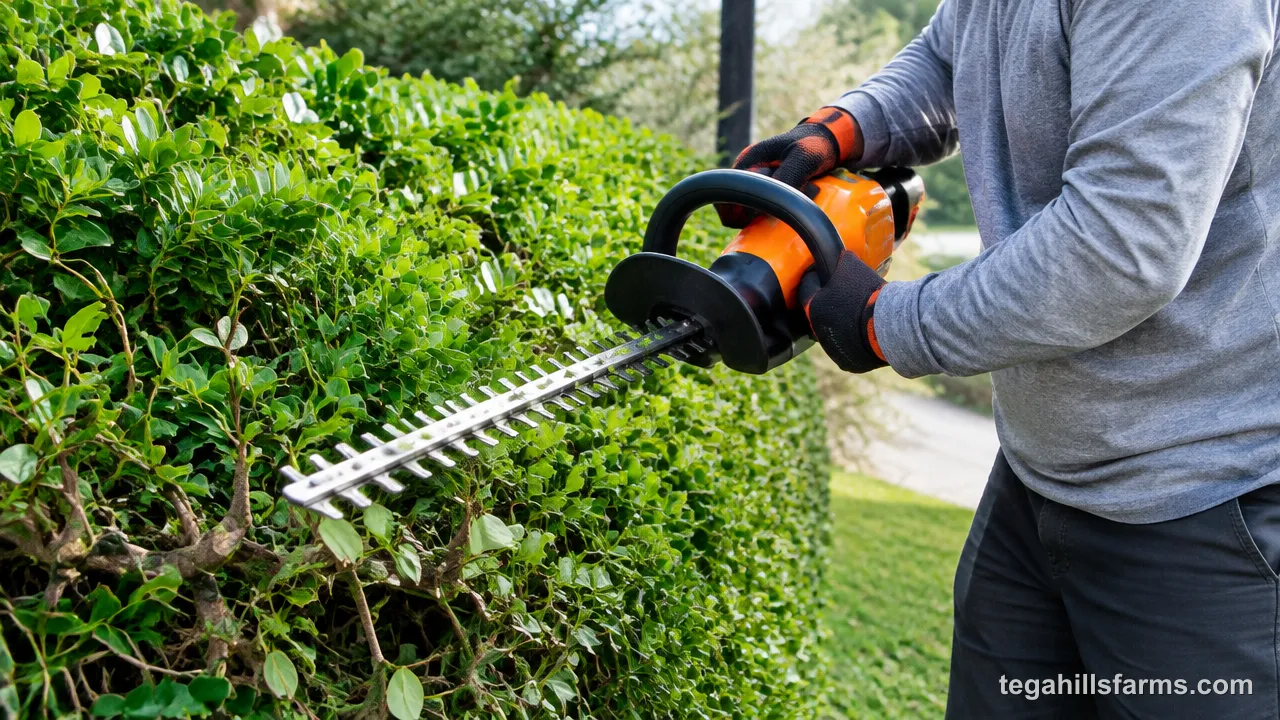
Which Blade Length Suits Hedges With Thick Branches?
A mid-length blade suits most woody hedges, a long blade pays off only on long, wide runs, and a short blade wins when you need control for shaping. The length you pick decides how much hedge you cover per pass and how steady you can hold the teeth against hard wood.
A long blade sweeps more of the hedge face with each stroke, which saves time on a property line or a wide top. The cost sits at the tip: every extra inch of bar adds weight out front, and that leverage multiplies at arm’s length, so the blade is harder to hold level when the teeth catch a stiff stem. On dense wood, that shows up as a bar that kicks or drifts instead of cutting straight.
A shorter blade keeps the weight close to your hands, so you can hold it still against a woody stem and follow curves without strain. It needs more passes on a big hedge, but your arms last longer. If you want a middle ground between reach and control, the best 22 inch hedge trimmers sit right in it.
How Much Do Motor Type and Strokes Per Minute Matter?
Torque matters more than stroke speed once the blades meet wood: strokes per minute decide how clean the cut looks on soft growth, while torque decides whether the blades keep moving through a woody stem at all. A fast blade with little torque behind it stalls on the first stiff branch.
Brushless motors use electronic control instead of carbon brushes, so they lose less energy to friction and heat. That lets more of the battery’s power reach the blades, and the motor holds its speed under load instead of slowing each time the teeth bite. Brushed motors are simpler, but they bog down sooner in dense wood and wear their brushes over time.
Strokes per minute still count on finish work, because more strokes per inch of travel mean more cuts on each leaf and shoot, which leaves a smoother face. On woody hedges, treat it as a secondary spec.
Battery voltage sets how much power the motor can draw, so a higher-voltage platform has more push in reserve for thick stems. Runtime is the other side of that: pushing through dense wood pulls more current, so a pack drains faster than it would on light shaping.
Do Rotating Handles and Reverse-Blade Features Help With Thick Branches?
Yes, both help, for different reasons. A rotating rear handle lets you turn the blade vertical for hedge sides or angle it across the top while your wrist stays straight, and an un-jam or reverse function backs the blades off a stuck stem instead of making the motor force it.
Without a rotating handle, cutting the side of a hedge means twisting the whole trimmer and your wrist with it. That awkward angle tires you quickly and makes the blade harder to hold steady, which matters most when the teeth meet a stiff stem and want to kick.
Jam clearing earns its place when branches sit near or past the comfortable cutting range, which is common in an overgrown hedge. A wedged stem keeps the motor pushing against a stalled blade, heating it and loading the gearbox. Reversing the blades opens the teeth and releases the wood, so you skip shutting down, disconnecting power and prying the stem out by hand.
Which Power Type Handles Thick Branches Best: Gas, Battery or Corded?
An engine holds torque through long sessions in dense wood, a cordless model trades some of that for quiet, low-upkeep work, and a plug-in trimmer suits light woody trimming near an outlet. The right choice depends on how much hedge you have, whether an outlet sits within reach of it, and how much engine maintenance you are willing to take on. Weight, noise and winter storage all follow from that decision, so a long, overgrown property line and a short hedge by the front door point to different machines even when the stems are equally thick.
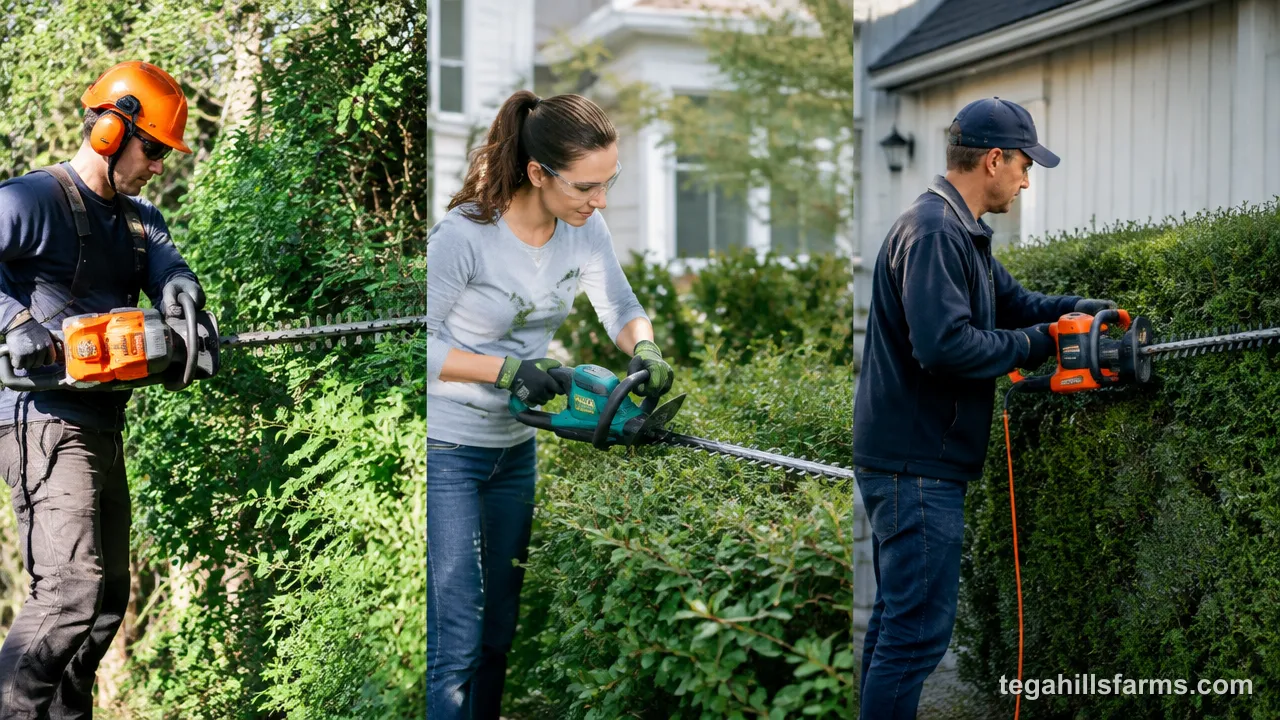
Is a Battery Hedge Trimmer Strong Enough for Thick Branches?
Yes, for most woody hedges. A good battery trimmer with dual-action blades shears mature boxwood and privet stems, though on old, dense wood it gives up runtime to gas and works harder to keep its speed stem after stem.
The everyday advantages are hard to beat. There is no cord to drag through the shrubs, the noise is low enough for a quiet street, and upkeep is little more than blade care and charging. If your mower or blower already runs on the same platform, the same packs move between tools, which keeps the cost of going cordless down.
The limits show up on heavy work. Dense wood pulls more current, so a pack that lasts through a light shaping job runs down sooner on a hard cleanup. Voltage and amp-hours shape this together: voltage sets how hard the motor can push through a stiff stem, while amp-hours set how long the pack lasts. A bigger pack buys more runtime but adds weight you hold at arm’s length.
Is a Gas Hedge Trimmer the Right Choice for the Toughest Growth?
For long sessions in dense, overgrown wood, yes. A gas engine keeps its torque steady from the first stem to the last, with no pack running down, and a refill takes moments, so a full day on a long hedge line is realistic.
You pay for that in weight, noise and upkeep. Gas trimmers are heavier to hold at shoulder height and loud enough that early-morning trimming bothers the neighbors. A 2-cycle engine needs gas and oil mixed for every fill, while a 4-cycle engine skips mixing but adds oil changes. Both need spark plug and air filter checks, and fuel left in the tank over winter goes stale and gums up the carburetor, so you drain it or treat it with stabilizer. Pull-starting takes effort, especially on a cold morning.
That upkeep makes sense on big properties, long hedge lines far from power, and part-time professional work where runtime matters more than convenience. If that describes your yard, compare the best gas hedge trimmers by engine type and weight before you buy.
Can a Corded Hedge Trimmer Handle Thick Branches?
Only up to a point. A plug-in model shears young woody stems and keeps a maintained hedge in shape, but its motor runs out of push on neglected, mature wood, and its capacity ratings sit at the modest end.
What you gain is simplicity. Runtime is unlimited as long as you are plugged in, the motor is light because it carries no battery or engine, and there is no fuel to mix or pack to charge. For a hedge you trim several times a season, that low weight and zero upkeep matter more than raw power.
The cord is the main limit. You need an outdoor GFCI outlet and an outdoor-rated extension cord long enough to reach the far end of the hedge, and the cord can snag on branches or end up in front of the blades. That suits small suburban lots and hedges along the house far better than a long property line. For more plug-in and battery options built around softer growth, look at the best electric hedge trimmers.
When Should You Use Loppers or a Chainsaw Instead of a Hedge Trimmer?
Switch tools as soon as a stem is wider than the rated capacity: long-handled pruners or a pruning saw for single woody branches, a powered saw for big limbs and old trunks, and the trimmer only for shaping afterward.
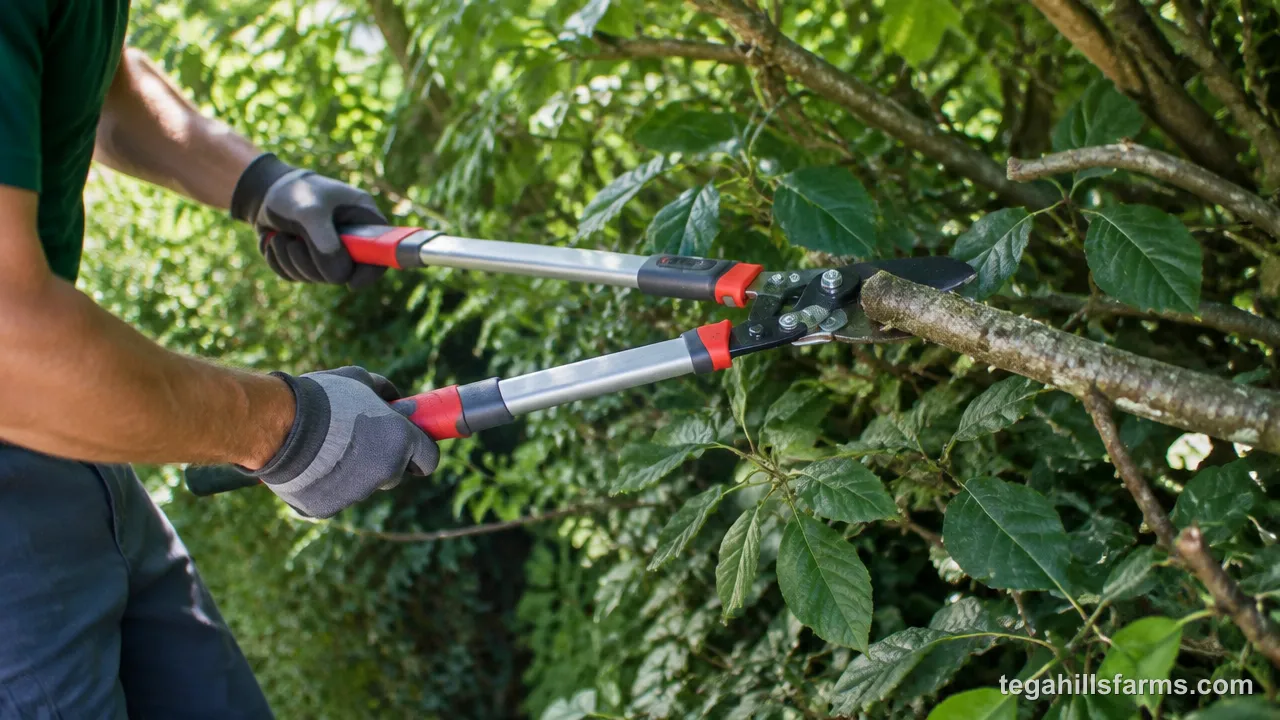
Forcing thick wood into trimmer blades is how a good machine gets ruined. A stem too wide for the teeth stalls the blades, and repeated stalls bend teeth, chip edges and strip the gears in the gearbox, while the motor heats up the whole time. Bent teeth then tear every stem they touch, so the damage carries over into every cut that follows.
Loppers fit the individual branches past the trimmer’s rating. Reach into the hedge and cut each one at its base, which gives a clean cut and opens the hedge so new growth fills in. A pruning saw takes over when a branch is too thick for the lopper jaws.
A chainsaw belongs to large limbs, overgrown trunks and a hard cutback on a hedge that has gone wild for years. Once the heavy wood is out, the hedge trimmer comes back to shape the face and top.
Here is how the tools divide the work on an overgrown hedge:
| Tool | Job it fits | Where it struggles |
|---|---|---|
| Hedge trimmer | Shaping and shearing stems within its rated capacity | Single branches past its rating |
| Loppers | Individual woody branches inside the hedge | Large limbs and trunks |
| Pruning saw | Branches too thick for loppers | Fast shaping of a hedge face |
| Chainsaw | Large limbs, overgrown trunks, hard cutbacks | Shaping and fine trimming |
| Pole hedge trimmer | Tops and tall growth from the ground | Heavy cutting at full extension |
When the problem is height rather than thickness, the best pole hedge trimmers put the blade on an extension so you shape the top from the ground instead of a ladder. If you are cutting a tall privacy screen every season, look at the best hedge trimmers for tall hedges rather than stretching a standard model overhead.
Two blades sliding past each other grip a woody stem from both sides, while a single moving blade over a fixed one tends to shove that same stem sideways before its edges ever close. That design detail is why a stem one trimmer slices through can stall another with the same blade length, and buying without checking the blade action leaves you fighting the stiffest stems in your hedge with a tool that pushes them away.
Why Do Dual-Action Blades Cut Thick Branches Better Than Single-Action Blades?
Opposing blades pinch a woody stem from both sides and shear it, much like scissors closing, because both bars move in opposite directions at once. On a single-action trimmer, one blade moves over a stationary one, so a thick stem can slip sideways or bend away before the edges meet.
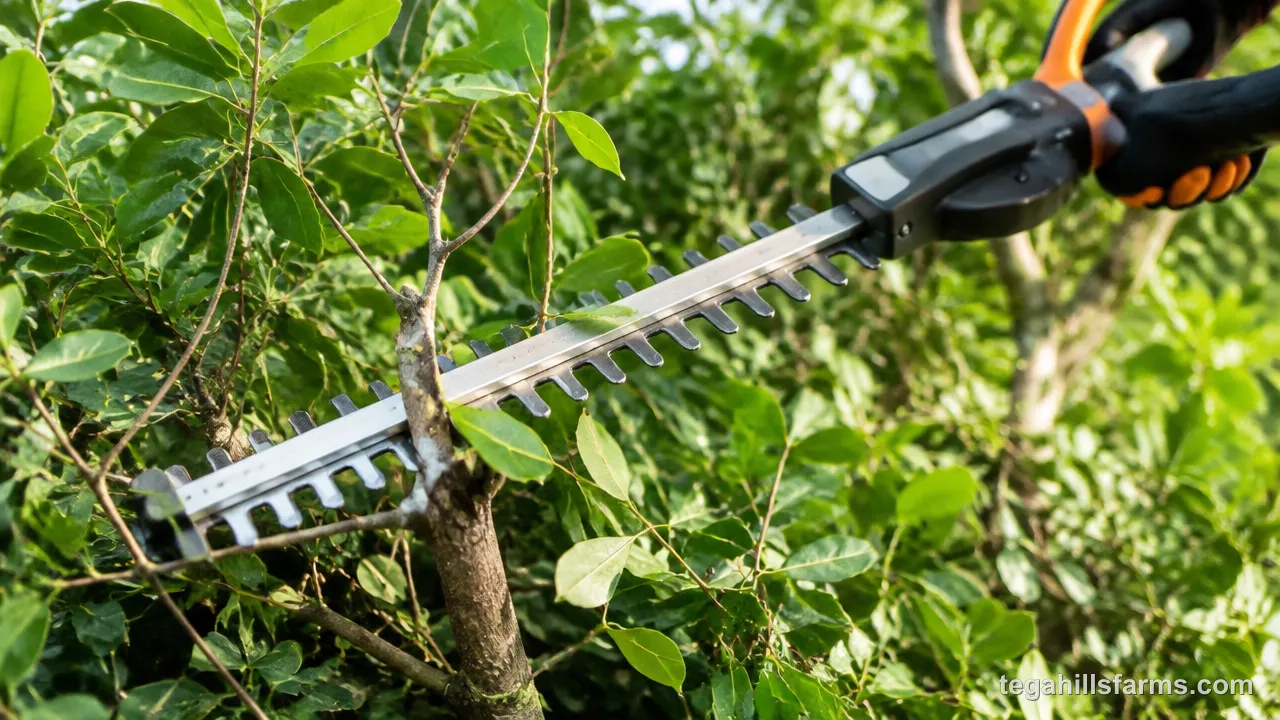
That difference changes how the trimmer feels in your hands. With both blades moving against each other, much of their momentum cancels out, so vibration drops and your hands tire more slowly. The trimmer also pulls itself along the hedge less, because the stem is gripped from both sides instead of dragged by one moving edge, which lets you hold a straight line across the top.
On a single-action blade, a stiff stem that slips away tends to snag in the fixed teeth, get chewed rather than cut, and hold the moving blade back. The motor works harder against that drag, and the cut end comes out ragged and split instead of clean. For soft, leafy growth, a single-action blade is fine; once a hedge has woody stems, dual action gives you cleaner cuts and less strain on the motor and gearbox.
What Is the Best Way to Cut Thick Hedge Branches Without Jamming the Blade?
Take the thickest stems out first with loppers, then let the blades reach full speed before they touch wood and feed each stem in near the base of the bar. That order keeps the trimmer working within its capacity and puts the strongest part of the blade on the toughest wood.
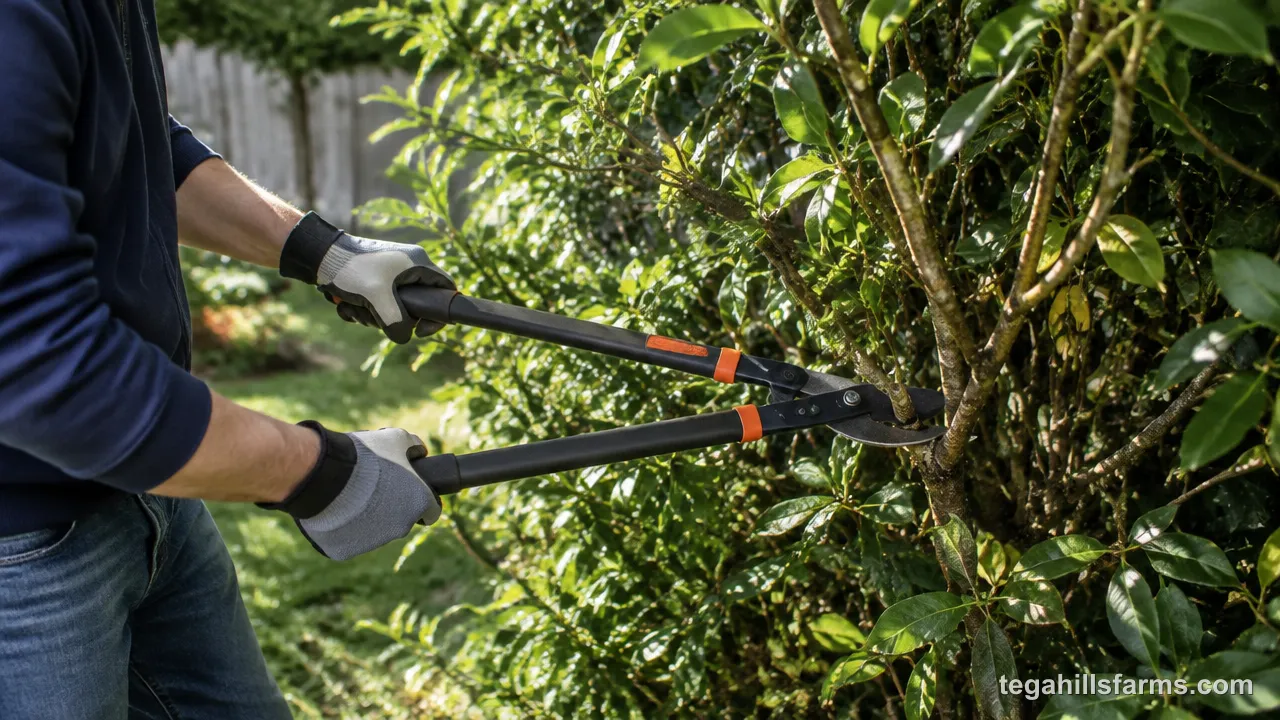
- Walk the hedge and lopper out any branch wider than your trimmer’s rated capacity, cutting at the base inside the hedge.
- Squeeze the trigger and let the blades come up to full speed before they meet the hedge, because a blade that starts against a stem has no momentum to shear it.
- Feed stiff stems into the section of blade closest to the housing, where leverage is best and the teeth flex least.
- Keep the bar moving in smooth, even sweeps and avoid twisting it, since twisting loads the blades sideways and bends teeth.
A jam happens when a stem wedges between the teeth and the blades stop while the motor keeps pushing. That loads the gearbox, can strip gear teeth and heats the motor, so stop the moment the blades stall.
Clear it with the power off: release the trigger, then unplug the cord, remove the battery or shut off the engine. Wearing gloves, work the stem free or cut it out with pruners, and check the teeth for bends before you start again. If your trimmer has an un-jam or reverse function, use it before touching the blades.
How Do You Care for Hedge Trimmer Blades After Cutting Thick, Sappy Branches?
Resin from conifers and sap from fresh growth dry into a tacky film on the teeth that adds drag to every stroke, so clean the blades after each session on sappy wood, give them a light coat of oil, and sharpen or replace them once they tear stems instead of cutting them.
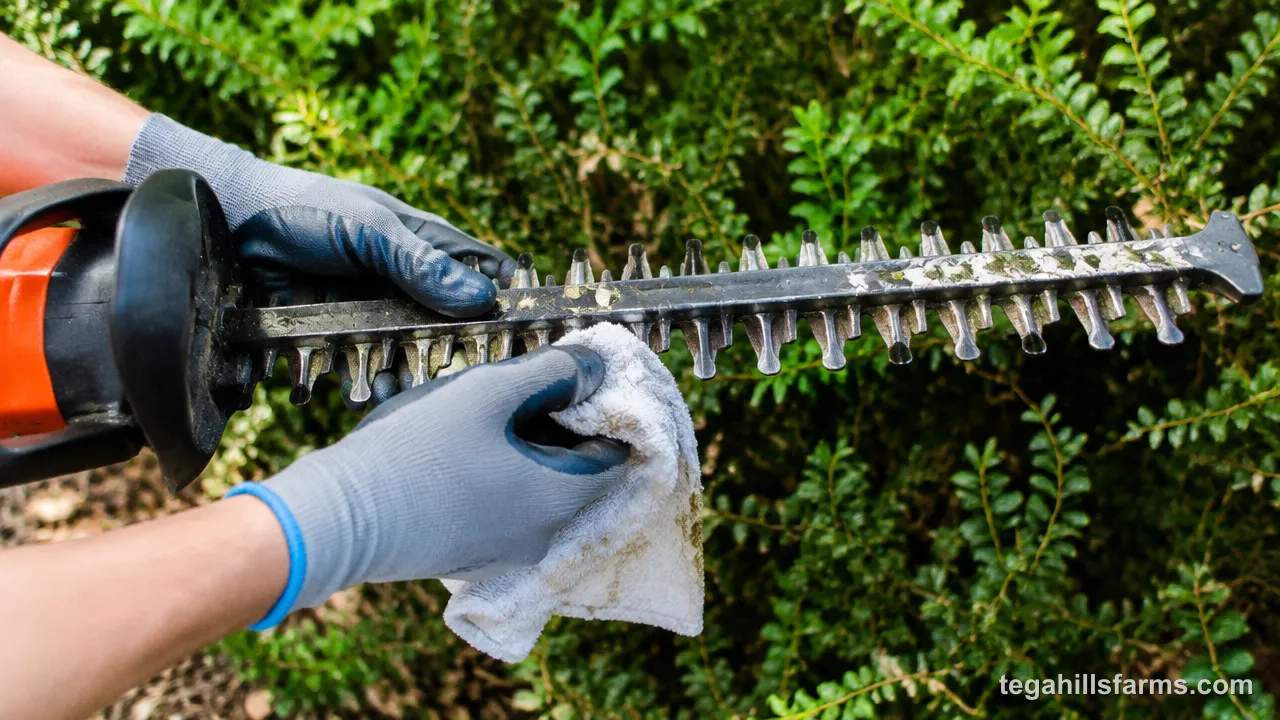
Start with the power off: unplug the cord, remove the battery or shut off the engine. Brush off leaves and debris, then wipe the blades with a resin solvent or blade cleaner to lift the dried sap, working along both sides of the bar. Dry the blades and apply a light coat of oil or blade lubricant spray, which keeps sap from sticking next time and stops rust during storage.
While the blades are clean, look for nicks, chipped edges and teeth that are bent or rounded over. A dull or nicked tooth pinches and tears a stem instead of shearing it, which leaves ragged ends on the plant. Small nicks can be filed out along the original bevel; bent, cracked or badly worn blades should be replaced. Grease the gearbox on the schedule in your owner’s manual.
Skipping this costs you in the motor. Gummed, dull blades take more force to move, so the motor runs hotter, the gearbox wears faster, and a battery trimmer gives you noticeably less runtime per charge.
Which Hedges and Shrubs Have Stiff Branches That Need Extra Cutting Capacity?
Stiff, fast-woody plants such as Leyland cypress, overgrown roses and old forsythia need a heavy-duty trimmer, medium woody shrubs such as boxwood and privet sit within a mid-range rating, and soft-growth hedges are fine with a light trimmer. The groups break down like this:
- Soft growth: young, leafy shoots and soft-stemmed shrubs trimmed often. Stems stay green and pliable, so a light corded or battery trimmer shears them cleanly.
- Medium woody shrubs: boxwood and privet form dense, twiggy wood that stiffens as it ages. A trimmer with dual-action blades and a solid capacity rating handles regular trims, while neglected privet produces stems that need loppers.
- Stiff or fast-woody plants: Leyland cypress grows quickly and turns woody fast, overgrown roses carry thick, thorny canes, and old forsythia builds up hard, crowded stems at the base. These call for heavy-duty capacity, and the oldest wood still goes to loppers or a pruning saw.
Timing keeps branches thin in every group. Trimming regularly during the growing season cuts shoots while they are still green, before they harden into wood that strains the blades. Skipping a season lets stems thicken past what a light trimmer can shear, and Leyland cypress in particular does not regrow well from old brown wood, so letting it get away from you leaves bare patches when you finally cut it back. Best trimming times vary by plant and region, so check local guidance for your area.








Write Your Review
No reviews yet. Be the first to share your experience!