

My picks for the best pole hedge trimmers in 2026 are TaskStar 20V Pole Hedge Trimmer 8.5ft (Best Overall), MZK 23in Cordless Hedge Trimmer 2-Pack (Best Budget), Greenworks 40V 8in Pole Saw Hedge Trimmer (Editor’s Choice), Alloyman 20V Pole Hedge Trimmer 2-Pack (Also Great), Seesii 2-in-1 Pole & Hedge Trimmer 20in (Best Lightweight), CRAFTSMAN V20 Pole Hedge Trimmer 18in (Also Great), BLACK+DECKER LPHT120 18in Pole Hedge Trimmer (Best Rust-Resistant), YDLawn 20V Cordless Pole Hedge Trimmer 2-Pack (Also Great) and GARCARE Corded Pole Hedge Trimmer 500W 18in (Also Great). Each one lets you cut the top of a tall hedge with both feet on the ground, but they get there with very different mixes of reach, blade, battery and weight.
The specs that matter on a pole are the ones that change how the tool feels at full extension: how far it reaches, how long the blade is and how thick a stem it can take, whether the head pivots, and what powers it. A strong-looking spec can still work against you if it adds weight where your arms feel it.
Most people buy one to get off the ladder. Leaning a ladder into a soft hedge on uneven ground is a poor setup, and a pole trimmer removes it, but only if the tool is light and balanced enough that you can hold a straight line along the top without your arms giving out.


Check your battery shelf before you shop. If you already own CRAFTSMAN V20 or BLACK+DECKER 20V MAX tools, a trimmer on the same platform saves you charging and storing another set of packs.
What Is a Pole Hedge Trimmer and When Does It Beat a Handheld?
It puts the cutting blades on a telescoping or fixed shaft, so you can cut tall screens and deep plantings from the ground instead of from a ladder. The shaft does the climbing for you, which matters on the jobs where a ladder is a bad idea: a privacy screen taller than your head, a hedge set behind a flower bed you can’t step into without crushing plants, and overhead growth hanging over a walkway or arbor. In each case a handheld trimmer would force you to lean, stretch or climb, and that is when cut lines wander and footing fails.
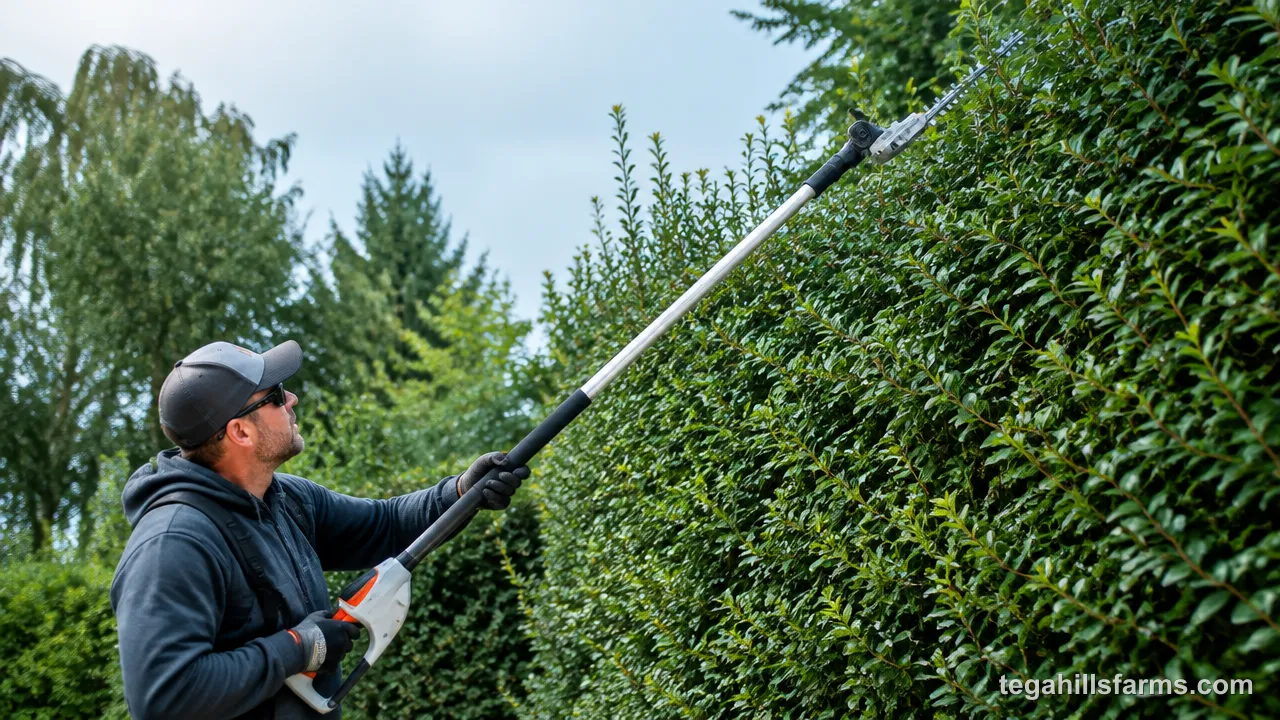
The shaft works against you on low, tight shaping. Rounding a boxwood or squaring a knee-high border needs the blade close to your hands, where small wrist movements turn into precise cuts; on a pole, the shaft exaggerates every movement and the head sways. If your hedges are low enough that a pole only adds weight, the best hedge trimmers cover handheld models that cut more precisely at waist height.
What Should You Look for in a Pole Hedge Trimmer?
Weight at the far end of a long shaft turns into arm and shoulder fatigue through leverage, and that fatigue is what makes you set a tool down halfway along a hedge. A heavier head, a longer blade or a longer pole each move weight further from your hands, so a spec that reads better can make the tool harder to finish a job with. Every feature is worth judging by how much it adds out front and what it gives back in reach, cut or runtime.
How Much Reach Do You Need?
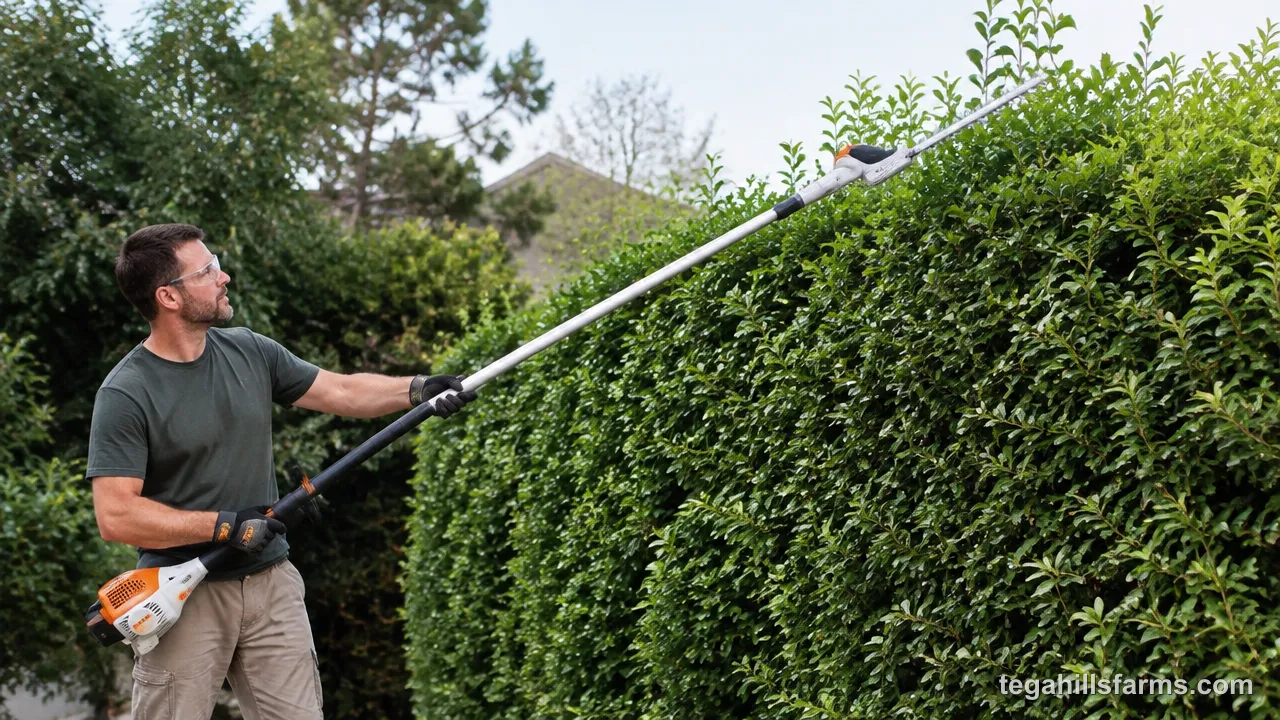
You need enough reach that the blade clears the top of your hedge while your hands stay in front of your chest, not above your head. The reach rating counts your own height and arm extension on top of the pole, so it runs well past the pole’s actual length; the YDLawn, for example, lists a reach far beyond its pole.
A telescoping pole lets you set that working height by locking the sections at the length the job needs, and shorter is better whenever the hedge allows it. Every extra foot of shaft acts as a longer lever, so the same head pulls harder on your wrists and shoulders, and fatigue shows up as a drooping, uneven top line. A detachable pole helps twice: the tool stores in a smaller corner of the shed, and the head alone handles low shrubs without the extra shaft.
Models built for maximum reach give up handling at full extension. The pole flexes more, the head sways with each stroke, and holding the blade on a straight top line takes more effort. For screens that outgrow an ordinary pole, the best hedge trimmers for tall hedges balance that reach against control.
What Blade Length and Cutting Capacity Make Sense?
Blade length decides how much hedge you clear in each pass, and cutting capacity decides how thick a stem the blades can bite before the motor stalls. On a pole, match the capacity to the thickest stems in your hedge, then pick the shortest blade that still covers the face without endless passes.
A longer blade shears a wider strip of the face with each sweep, which saves time on long, flat hedges. On a pole, that extra length sits at the far end of the lever, so it shifts the balance point outward and the tool feels heavier in your hands than its weight suggests. Dual-action blades, where the upper and lower blades move in opposite directions, cancel much of the shaking a single moving blade sends down the shaft, so your hands take less vibration over a long session.
Soft new growth, the green shoots a hedge puts out between trims, cuts cleanly at almost any capacity, so a long blade suits a hedge you keep up with every season. Woody stems from a hedge left to grow are a different job: they need a higher cutting capacity, and forcing a stem thicker than the rating jams the blades and tears the wood instead of slicing it. Anything beyond the rating belongs to loppers or a pole saw.
Articulating Head vs. Fixed Head: Which Do You Need?
A pivoting head that locks at several angles is the better choice for tall hedges with flat tops and for deep beds you can’t stand close to, while a fixed head is fine for sides at or below shoulder height. With the pivot, you lay the blade level over the top from the ground; with a fixed head, you have to raise the whole pole and bend your wrists back to get a similar angle.
The differences show up on the cuts you make above shoulder height and on the upkeep each design brings.
| Cut or factor | Articulating head | Fixed head |
|---|---|---|
| Hedge tops from the ground | Blade locks level over the top | Whole pole tilts; blade angle is a compromise |
| Sides and corners | Angle set to match the face | Fine on vertical faces at arm height |
| Wrist and shoulder strain on tall tops | Lower; wrists stay neutral | Higher; wrists bend back to level the blade |
| Upkeep | Pivot joint and lock to keep clean | Fewer moving parts |
| Weight at the head | Slightly more from the joint | Simpler, lighter head |
The pivot joint earns its place when your hedge is taller than you can comfortably reach, has a flat top, or sits behind a bed that keeps you at a distance. For an informal hedge you mostly trim on the sides, a fixed head keeps the tool simpler and leaves nothing to loosen.
Battery, Corded or Gas: Which Power Source Fits a Pole Trimmer?
Battery power fits most pole trimmers best, corded power works when the hedge sits within an extension cord’s reach of an outlet, and gas rarely makes sense on a tool you hold at arm’s length overhead.
On a battery tool, voltage sets how hard the motor can push through dense growth, and amp-hours set how long one pack lasts before it needs the charger. A kit with two batteries changes the rhythm of the job, because one pack charges while the other runs, so a long hedge doesn’t stop for a recharge. Before buying, check whether the trimmer shares a battery platform with tools you already own; a matching platform lets you buy the bare tool and skip another charger on the shelf. If you’d rather keep battery power and drop the pole, the best cordless hedge trimmers cover handheld models.
A cord removes runtime limits and battery weight, but it tethers you to an outlet and drags across beds, where it snags on shrubs and has to be kept clear of the blade. Use an outdoor-rated extension cord plugged into a GFCI outlet. Gas engines add weight, vibration and noise at the worst place on a pole, along with fuel mixing, spark plugs and winter fuel storage, which is more upkeep than a home hedge justifies.
The 9 Best Pole Hedge Trimmers of 2026
TaskStar 20V Pole Hedge Trimmer 8.5ft, MZK 23in Cordless Hedge Trimmer 2-Pack, Greenworks 40V 8in Pole Saw Hedge Trimmer, Alloyman 20V Pole Hedge Trimmer 2-Pack, Seesii 2-in-1 Pole & Hedge Trimmer 20in, CRAFTSMAN V20 Pole Hedge Trimmer 18in, BLACK+DECKER LPHT120 18in Pole Hedge Trimmer, YDLawn 20V Cordless Pole Hedge Trimmer 2-Pack and GARCARE Corded Pole Hedge Trimmer 500W 18in all cut from the ground. Reach, head weight and battery platform pull against each other, so a very long pole is not automatically the easiest to use: extra reach and a long blade both put more load on your arms. If you have a tall screen and want off the ladder, weigh reach and balance first; if you want spare batteries in the box, own a battery platform already or have an outdoor outlet near the hedge, a two-battery kit, a bare tool or a corded model may serve you better.
#1 TaskStar 20V Pole Hedge Trimmer 8.5ft — Best Overall
Pick this one if your hedge runs tall along a fence and you’d rather carry the load on your shoulder than your forearms, because its shoulder strap and second handle spread 8 lb across your body. Two 4.0Ah batteries come in the box, so you can swap one in when the first runs down.
Key Specs:
- Reach: telescopic pole extends up to 8.5 ft
- Blade: 16 in dual-action SK5 steel, 5/8 in cutting capacity
- Motor: 600W, up to 2,800 SPM
- Head: rotates through 6 positions, up to 135°
- Power: two 20V 4.0Ah batteries, fast charger (full charge in about 2 hours)
- Weight: 8 lb
Detailed Review:
The strap and the ergonomic handle change how this tool is held. The strap hangs the weight from your shoulder and the handle gives your front hand a fixed grip, so your arms steer the head instead of holding it up. On a long fence line, that keeps the top cut level late in the session, when tired arms tend to let the head drift down.
The rotating head tilts far enough to lay the blade over the top, then angles into the sides and corners without you leaning into the hedge. Pairing it with a 16-in blade keeps the head compact, so it doesn’t turn top-heavy at full extension the way a longer blade would.
Blade speed is high enough to shear leafy growth cleanly rather than push it aside, and the cutting capacity covers the ordinary branches a maintained hedge puts out. Older wood beyond that rating is a job for loppers.
Because the fast charger refills one pack while the other runs, an ordinary yard session rarely has to stop for power. The dual safety lock needs two inputs before the blades move, which I value on a tool you lift, lower and rest against your body all afternoon.
Pros:
- Shoulder strap and second handle take weight off your arms.
- Two 4.0Ah batteries and a fast charger keep downtime short.
- Six-position head reaches tops and corners from the ground.
- Dual safety lock guards against accidental starts.
Cons:
- Shorter 16-in blade needs more passes on wide hedge faces.
- Lower 5/8-in capacity than the 3/4-in models for woody stems.
Who It’s For:
Homeowners with a tall fence-line hedge who want to trim from the ground without stopping for a recharge are the right buyers here. It also suits anyone whose arms tire quickly holding a tool out front, since the strap shares the load. Hedges full of old, thick wood call for a trimmer with higher cutting capacity.
Editor’s Verdict:
The strap, handle and twin batteries solve the two things that cut pole sessions short, arm fatigue and dead packs, which makes this an easy recommendation for tall hedges.
#2 MZK 23in Cordless Hedge Trimmer 2-Pack — Best Budget
Wide hedge faces go faster under a 22.4-in dual-action blade, and this kit pairs that blade with an adjustable head that tilts from 0 to 120°. It comes with two 4.0Ah batteries.
Key Specs:
- Blade: 22.4 in dual-action steel
- Cutting capacity: 5/8 in
- Power: 20V, two 4.0Ah batteries
- Safety: double lock
- Model: ET1611
Detailed Review:
At a budget price, this kit gives you a lot of blade. Its long blade sweeps a much wider strip than the 16-in blade on the TaskStar, so long, flat faces take fewer passes. That extra length sits at the far end of the pole, though, so expect more pull on your arms at full extension.
The cutting capacity handles the current season’s growth and the thinner woody stems a maintained hedge carries. A hedge left to grow for several seasons will have thicker wood than that, and those stems need loppers.
The head adjusts through up to five positions, which lets you lay the blade flat over a hedge top or angle it into branches that would otherwise need a ladder. A double lock has to be engaged before the blades run, so a bumped trigger won’t start the tool while you carry it between beds.
With two 4.0Ah batteries included, you can swap packs mid-hedge instead of stopping for power. On a first pole trimmer bought to save money, that spare pack does more for the job than an extra feature would.
Pros:
- 22.4-in dual-action blade covers wide faces in fewer passes.
- Adjustable head reaches awkward branches from the ground.
- Two 4.0Ah batteries let you swap packs mid-job.
- Double lock prevents accidental starts.
Cons:
- Long blade adds pull on your arms at full extension.
- Head tilts only through a limited range, so it adjusts less than the wider-pivoting heads here.
Who It’s For:
Buyers who want a long blade and a spare battery without spending much will find this kit handles a typical home hedge. It fits owners shearing wide faces of mostly new growth each season. Old, overgrown hedges with thick wood need a trimmer with more cutting capacity, such as the CRAFTSMAN.
Editor’s Verdict:
Plenty of blade and a second battery at a modest price make this a sensible first pole trimmer for wide hedges of soft new growth.
#3 Greenworks 40V 8in Pole Saw Hedge Trimmer — Editor’s Choice
Owners who deal with both overgrown hedges and storm limbs get two tools on one 40V battery here: a 20-in pole hedge trimmer and a pole saw with an 8-in bar and chain. At 11 lb, it asks more of your arms overhead.
Key Specs:
- Power: 40V, 2.0Ah battery and charger included
- Hedge trimmer: 20 in dual-action blade, 7-position pivoting head
- Pole saw: 8 in bar and chain, automatic oiler
- Chain tension: easy-adjust tensioning
- Weight: 11 lb
Detailed Review:
On the hedge side, the seven-position pivoting head sets the blade level over the top or angled into the far face. The long blade covers a good stretch with each sweep, so tall hedges go quickly from the ground.
The pole saw adds limb work that no hedge blade should attempt, from storm damage to low branches over a driveway. An automatic oiler keeps the bar and chain lubricated as you cut, and the easy-adjust tensioning lets you take up chain stretch quickly.
Neither tool needs gas, fuel mixing or a pull cord; both start instantly and run quietly. For an owner tired of carburetor cleanup and stale fuel in a gas pole saw, that removes most of the seasonal upkeep and leaves chain tension and blade cleaning.
The combo carries noticeably more weight than the TaskStar, so long overhead hedge sessions tire you sooner. With a single 2.0Ah battery in the box, a full day of hedges plus limbs may need a charging break or a second 40V pack. I think that trade is worth it only if you have limbs to cut as well as hedges.
Pros:
- Pole saw and hedge trimmer run on one 40V battery.
- Seven-position pivoting head handles tops and far faces.
- Automatic oiler keeps the saw chain lubricated.
- No gas, fuel mixing or pull starts.
Cons:
- Heavier overhead than the TaskStar or Alloyman.
- Single 2.0Ah battery limits long combined sessions.
Who It’s For:
If you also cut back tree limbs after storms, this kit covers both jobs, and it is a natural add-on for anyone already running Greenworks 40V tools. Owners who only trim hedges and want a lighter tool overhead will be happier with a dedicated pole hedge trimmer.
Editor’s Verdict:
Worth the extra weight when hedges and limbs both need attention, because one battery and one kit handle both without any gas upkeep.
#4 Alloyman 20V Pole Hedge Trimmer 2-Pack — Also Great
If your hedge has gone woody, this one cuts branches up to 3/4 in thick and adds a rear handle that rotates 180°, so your wrist stays straight at odd angles. Two 4.0Ah batteries come with it.
Key Specs:
- Blade speed: 1,400 SPM
- Reach: up to 8 ft with the pole unfolded
- Handle: 180° rotating rear handle, shoulder strap
- Power: two 20V 4.0Ah batteries, charger included
- Weight: 8 lb
Detailed Review:
The rotating rear handle makes angled cuts easier on your body. Instead of twisting your wrist to tilt the blade for a top or a slanted face, you turn the grip and keep your forearm in line with the pole. The included shoulder strap takes the weight, so your hands only guide the tool.
The hardened steel blades take thicker stems than the TaskStar, which helps on a hedge that skipped a season. They run at a much lower blade speed than that model, though, so leafy new growth needs slower passes to leave a clean edge instead of a ragged one.
Each battery runs about 45 minutes, and the pair lets you alternate: one goes on the charger while the other trims. Overload and temperature protection in the packs guards the cells when you push into dense growth on a hot afternoon.
The telescopic pole folds up for storage, which helps when the tool shares wall space in a tight garage. I’d steer anyone with a mature, tougher hedge toward this one over a faster-cutting model.
Pros:
- Cuts branches up to 3/4 in thick.
- 180° rotating rear handle keeps your wrist straight.
- Pole folds up for compact storage.
- Two 4.0Ah batteries let you alternate and keep trimming.
Cons:
- Lower 1,400 SPM blade speed needs slower passes on leafy growth.
- Short blade covers less face per sweep.
Who It’s For:
Owners of mature hedges with tougher stems, and anyone who needs a tool that folds away in a small shed, will get good use from this kit. If you mostly shear soft new growth and want fast, clean passes, the higher blade speed of the TaskStar suits you better.
Editor’s Verdict:
Choose it for woody hedges and tight storage, where the higher cutting capacity and folding pole earn their place, as long as you accept a slower blade.
#5 Seesii 2-in-1 Pole & Hedge Trimmer 20in — Best Lightweight
Hedges that run from waist-high shrubs to a tall back screen suit this 2-in-1, because the 20-in dual-action head comes off its pole and works as a handheld trimmer. Low work gets much lighter without the shaft.
Key Specs:
- Blade: 20 in dual-action, cuts up to 0.71 in (18 mm)
- Pole: telescopic, 7 ft to 8.5 ft, detachable
- Head: 150° rotating
- Motor: 600W, up to 2,400 SPM
- Power: two 4.0Ah batteries, fast charger
- Weight: 8.4 lb with the pole
Detailed Review:
The detachable pole changes how you work a mixed yard. With it on, the blade reaches over a tall hedge from the ground; with it off, the same head trims foundation shrubs at waist height with far better control. It also breaks down for compact storage, which matters if the shed is already full.
The rotating head lets you set the blade angle for tops and hard-to-reach spots, and the shoulder strap shifts the load off your arms on long sessions. The strap and the carrying handle both adjust, so you can set them to fit how you hold the tool.
Its 600W motor gives the blades enough push for thicker stems, and its cutting capacity sits well above the BLACK+DECKER LPHT120’s, so it handles a hedge with some woody growth. The BLACK+DECKER’s head pivots further, though, so this one asks a little more wrist work on awkward overhead angles.
A safety lock, blade cover and safety guard come standard. The guard deflects leaf and branch chips, which matters more on a pole than on a handheld because overhead debris falls back toward your face.
Pros:
- Detachable pole turns it into a handheld for low shrubs.
- 20-in dual-action blade covers wide faces quickly.
- Strap and carrying handle adjust for comfort.
- Safety guard deflects falling leaf and branch chips.
Cons:
- Pole adjusts only between 7 ft and 8.5 ft.
- Head turns less than the 180° pivoting head on the Alloyman.
Who It’s For:
Mixed yards, with low foundation shrubs out front and a tall hedge at the back, are where this kit pays off, since one tool covers both heights and stores compactly. If you only trim tall screens and never need handheld mode, a dedicated pole model makes more sense.
Editor’s Verdict:
Two working heights, one tool: the detachable pole means you never carry the extra shaft on low shrubs, and the 20-in blade keeps tall work quick.
#6 CRAFTSMAN V20 Pole Hedge Trimmer 18in — Also Great
Owners already running CRAFTSMAN V20 tools can add this bare tool and get up to 11 ft of reach on batteries they already charge. Everyone else needs to buy a battery and charger too.
Key Specs:
- Reach: up to 11 ft
- Blade: 18 in dual-action, cuts up to 3/4 in
- Head: 180° pivoting, 5 positions
- Grip: padded grip on the pole extension
- Weight: 9.1 lb
- Power: CRAFTSMAN V20 battery and charger, sold separately
Detailed Review:
The pivoting head locks in several positions across its swing, so you can lay the blade flat across a tall top, angle it into the far face, or point it down at growth along the base. Paired with the long reach, that means the far side of a deep hedge gets cut from your side of the bed.
The dual-action blades have enough capacity for mature hedges with real wood in them. Next to the BLACK+DECKER LPHT120, which has the same blade length and a similar pivoting head, this one cuts much thicker stems; the BLACK+DECKER is lighter and comes with a battery in the box.
A padded grip on the pole extension is where your front hand stays for the whole job, and the padding spreads pressure that would otherwise build into sore palms. That counts on a tool built for long reach, because your forward hand carries more of the leverage the further the head goes out.
Sold as a bare tool, it makes sense for someone who already has V20 batteries and a charger on the shelf. Without them, you are buying into a platform, which is only worth it if more CRAFTSMAN V20 tools are on your list.
Pros:
- Up to 11 ft of reach handles tall screens.
- Takes branches up to 3/4 in thick.
- Five-position head pivots through 180°.
- Padded grip on the pole eases hand pressure.
Cons:
- Battery and charger sold separately for non-V20 owners.
- Heavier than the BLACK+DECKER with a similar head design.
Who It’s For:
V20 owners with CRAFTSMAN batteries already on the shelf are the natural buyers, since this runs on packs they keep charged. It also fits tall, woody hedges where reach and cutting capacity both matter. If you own no V20 gear, a kit with the battery in the box is a simpler start.
Editor’s Verdict:
For an existing V20 owner, this is a strong, long-reaching hedge tool that handles woody growth and needs nothing else added to the cart.
#7 BLACK+DECKER LPHT120 18in Pole Hedge Trimmer — Best Rust-Resistant
If your tools live in a damp shed or get put away wet, the rust-proof fiberglass pole sections make this one worth a look. It trims up to 11 ft high.
Key Specs:
- Reach: 6-1/2 ft adjustable length, trimming height up to 11 ft
- Blade: 18 in dual-action, cuts up to 7/16 in
- Head: 180° pivoting, 5 positions
- Pole: rust-proof fiberglass interlocking sections
- Weight: 7.7 lb
- Power: 20V MAX LBXR20 battery and LCS20 charger included
Detailed Review:
Fiberglass doesn’t rust, so the pole sections keep locking together cleanly after seasons in a humid garage or a shed that sweats. The interlocking sections give a strong, secure connection, which keeps the joint firm when you extend the pole to full height.
The pivoting head works for both high and low growth, so the same setup handles the top of a tall hedge and the base of a shrub border. Its light weight for the reach keeps overhead passes steady, and the soft-grip handle gives your rear hand a comfortable hold on longer jobs.
The included 20V MAX battery holds a charge for up to 18 months, which suits a hedge tool that sits for weeks between trims. Through the PowerConnect system, that same battery runs other BLACK+DECKER 20V MAX tools, so owners of the line can share packs.
Its blades are rated for thin stems, so it belongs on soft growth and hedges you keep trimmed; older wood needs loppers. With one battery in the box, a long hedge may need a charging break.
Pros:
- Rust-proof fiberglass sections suit damp storage.
- Battery holds its charge up to 18 months.
- PowerConnect battery runs other BLACK+DECKER 20V MAX tools.
- Five-position head handles high and low growth.
Cons:
- Low 7/16-in cutting capacity limits it to soft growth.
- Single battery means a charging break on long hedges.
Who It’s For:
Anyone storing tools in a damp shed or living somewhere humid gets real value from the fiberglass pole, and owners of BLACK+DECKER 20V MAX tools can share batteries. Occasional users who trim only now and then will appreciate a battery that stays ready. It is a poor match for overgrown hedges full of woody stems.
Editor’s Verdict:
Built for owners who want a pole that won’t corrode and a battery that stays ready between trims, provided the hedge is mostly soft growth.
#8 YDLawn 20V Cordless Pole Hedge Trimmer 2-Pack — Also Great
Tall screens you would otherwise climb a ladder for are the job here, with an 8 ft telescopic pole rated for up to 15 ft of reach. Two batteries back it up.
Key Specs:
- Reach: 8 ft telescopic pole, up to 15 ft of reach
- Blade: 22 in dual-action hardened steel, 5/8 in cutting capacity
- Motor: up to 3,000 RPM
- Head: 150° rotating, multiple locking positions
- Power: two 20V 4.0Ah batteries, fast charger
- Weight: 8.8 lb
Detailed Review:
Its reach rating sits well beyond the CRAFTSMAN’s, which puts the blade over taller screens from the ground. The CRAFTSMAN takes thicker branches in return, so choosing between them comes down to hedge height versus how woody the hedge is.
The long blade covers a wide strip of hedge per pass, and the rotating head locks at several angles for tops and slanted faces. That much blade far out on the shaft also adds leverage, so short breaks help keep the top line level on a long screen.
The pole folds and detaches, so the tool breaks down for storage and transport and goes back together for the next job. That helps if you trim at more than one property or keep tools in a small shed.
Two 4.0Ah batteries and a fast charger deliver up to 2 hours of runtime, enough to work a long screen in one session. I’d pick it for height first; its cutting capacity covers ordinary growth and dense shrubs, but old, thick wood is better left to loppers.
Pros:
- Long reach handles tall screens without a ladder.
- 22-in dual-action blade covers wide faces per pass.
- Two batteries and a fast charger support long sessions.
- Folds and detaches for storage and transport.
Cons:
- Long blade far out on the pole adds arm strain.
- Cutting capacity trails the CRAFTSMAN on woody stems.
Who It’s For:
Tall privacy screens along a property line, trimmed from the ground, are what this kit is built for, and the folding design helps if you haul tools between properties or store them in tight quarters. Hedges of thick, old wood are better served by a trimmer with more cutting capacity, such as the CRAFTSMAN.
Editor’s Verdict:
Reach is the reason to buy it, and two batteries give that reach enough runtime to finish a long screen in one session.
#9 GARCARE Corded Pole Hedge Trimmer 500W 18in — Also Great
A tall hedge close to the house and an outdoor outlet is the setup this corded model suits, since its 500W motor runs as long as you keep trimming and there’s no battery to charge. Assembly takes no tools.
Key Specs:
- Power: corded electric, 500W motor, 1,700 RPM
- Blade: 18 in, cuts up to 5/8 in
- Reach: pole extends to 9.1 ft, trims branches up to 12 ft
- Weight: 7.9 lb
- Safety: safety switch and blade guard
- Assembly: tool-free
Detailed Review:
Corded power removes runtime and charging from the job, so the motor keeps the same pace from the first cut to the last. Your range, though, ends where the extension cord does, and the cord has to stay behind you and clear of the blade.
The telescopic pole puts branches well above head height within reach, which covers tall hedges along the house, the side yard and a patio screen. Its light build keeps overhead passes steady and saves the setup time and wobble of a ladder.
Tool-free assembly suits an occasional user, because a trimmer that comes out only now and then goes together quickly without hunting for a wrench. There is also no battery to store over winter.
A safety switch prevents accidental starts, and the blade guard covers the teeth during use and storage. Its cutting capacity handles ordinary hedge growth and shrub pruning, and the motor keeps the blades moving steadily through it.
Pros:
- Corded power never stops for a recharge.
- Telescopic pole reaches high branches from the ground.
- Tool-free assembly gets it running quickly.
- Safety switch helps prevent accidental starts.
Cons:
- Extension cord limits range and snags on shrubs.
- Cord has to be kept clear of the blade overhead.
Who It’s For:
Homes with tall hedges near the house and a handy outdoor outlet suit this trimmer, and occasional users get a tool with no battery to keep charged through the off-season. If your hedges sit far out in the yard, a cordless model saves you from dragging cord across beds.
Editor’s Verdict:
Plug it in near the house and it trims as long as you do, which makes it a low-fuss choice for hedges within cord reach.
Which Pole Hedge Trimmer Should You Buy for Your Hedges?
For tall, dense screens far from an outlet, the YDLawn or the TaskStar fits; for a yard mixing low shrubs and tall growth, the Seesii; for plantings close to an outdoor outlet, the GARCARE. Tall, dense hedges need reach and a blade that covers the face, which is where the YDLawn’s long reach and the TaskStar’s strap-and-handle setup earn their place. Low shrubs need control more than reach, and a pole only gets in the way there.
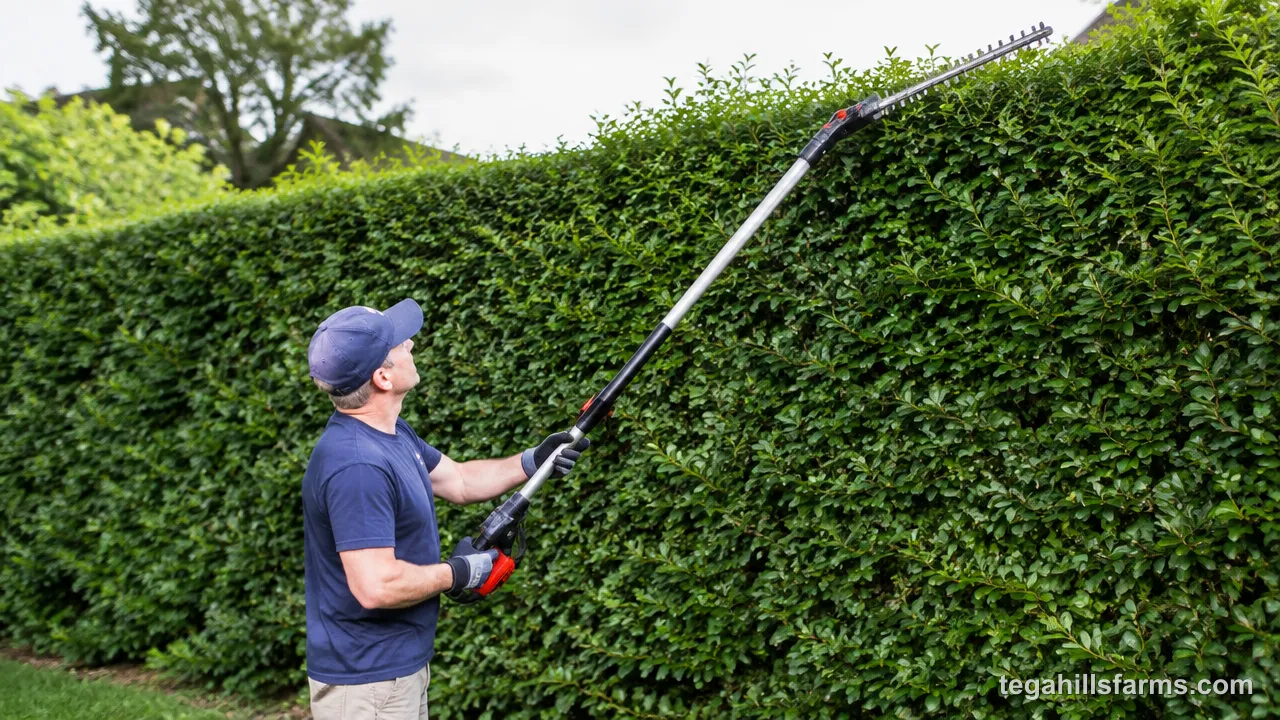
Soft new growth on a hedge you trim every season cuts cleanly with most of these, including the BLACK+DECKER LPHT120 and the long-bladed MZK. Woody stems from a hedge that went untrimmed for a while need the higher cutting capacity of the Alloyman or the CRAFTSMAN. If most of the hedge is old wood, the best hedge trimmers for thick branches are worth comparing before you settle on a pole model.
A yard with mixed heights is where the Seesii’s detachable pole pays off, because the head works handheld on low shrubs and on the pole for the tall hedge, so one tool covers the whole job. Your power setup narrows the rest:
- An outdoor outlet near the hedge points to the GARCARE, which gives you corded runtime with no batteries to manage.
- CRAFTSMAN V20 batteries already on the shelf make the bare CRAFTSMAN the sensible add.
- BLACK+DECKER 20V MAX owners get the same shared-battery benefit from the LPHT120.
- Storm limbs in your yard work justify the Greenworks, since its pole saw handles what no hedge blade should.
If you’re still deciding between a pole and a handheld or shafted tool, how to choose a hedge trimmer covers that broader decision.
Every overhead pass drops clippings, sap and twig ends toward your face and shoulders, and a heavy head on a long shaft starts to sag in your hands well before the hedge is done. Once your arms sag, the top line goes wavy and you start overreaching on uneven ground, which is how a routine trim ends with a gouged hedge or a twisted ankle.
How Do You Trim Tall Hedges Safely Without a Ladder?
Stand on firm, level ground beside the hedge, keep the cutting head below the line of your face, and work the top in short sections with the strap carrying the tool’s weight. That setup keeps you off a ladder and keeps tired arms from causing the mistakes that ruin a cut or your footing.
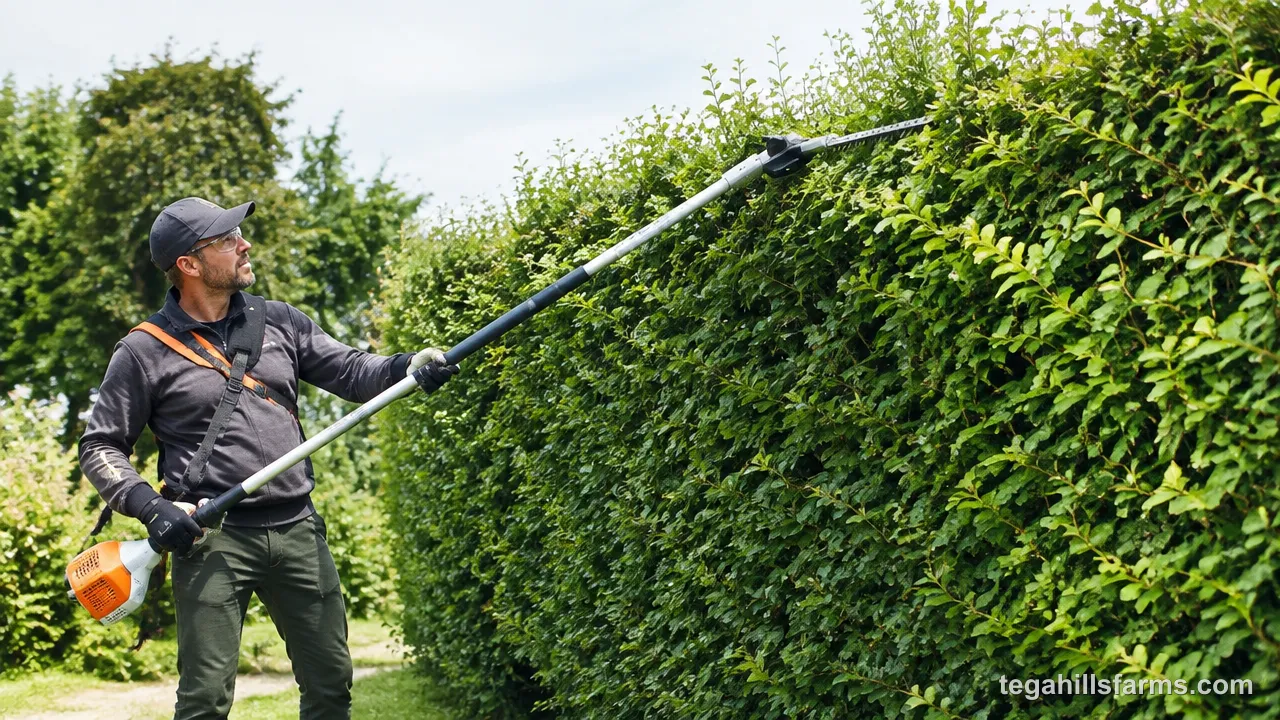
Set your feet apart and square to the hedge, and clear hoses, edging and fallen branches from where you will step. Hold the pole at an angle so the head sits off to the side rather than directly overhead; clippings and sap then fall beside you instead of onto your face, and safety glasses catch what gets through. Cut the sides upward in long, sweeping passes so the blade feeds into the new growth instead of pushing it down. On top, trim the stretch you can reach without leaning, then step along and overlap the last pass. A strap moves the load to your shoulders and hips, so your hands only steer.
Stop when you have to lean back to see the top at full extension, when overhead power lines are anywhere near, or when wet grass, mud or a slope makes your footing unreliable. Those hedges are a job for a pro, or for lowering in stages.
What’s the Difference Between a Pole Hedge Trimmer and a Shafted Hedge Trimmer?
A pole hedge trimmer uses a detachable or telescoping extension to lift the cutting head overhead, while a shafted hedge trimmer has a long fixed shaft with the engine or motor at your end and the blade at the other. Both put the blade out past your arms, which is why they get mixed up, but they balance and store very differently.
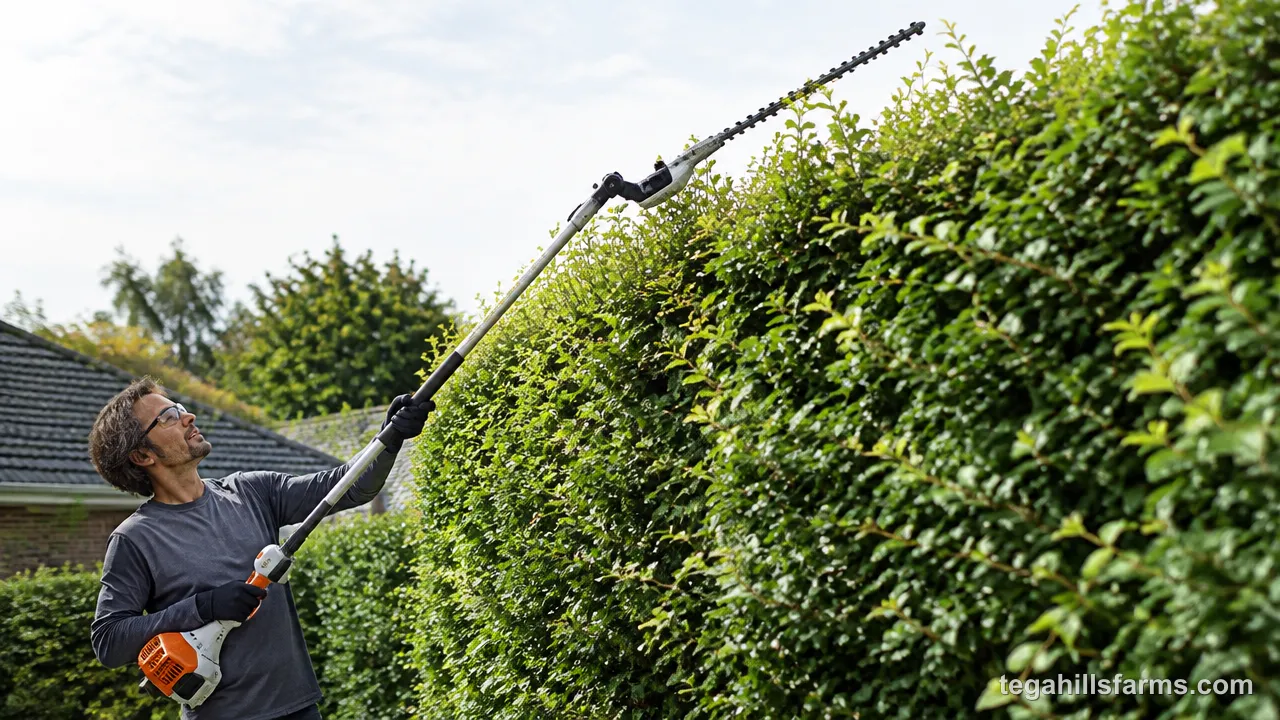
With the engine or motor near your hands, a shafted trimmer carries its heaviest part close to you, where it counterweights the head and steadies the tool at its set length. Its reach is fixed, though, so the tool either matches your hedge or it doesn’t. A pole trimmer adjusts its length to the job and often breaks down for storage, but that flexibility puts more of the weight out front at full extension.
A shafted trimmer suits a yard where the same tall hedges get cut at the same height every time. A pole trimmer fits hedges of different heights, and the detachable kind also works on low shrubs.
How Do You Keep Pole Trimmer Blades Sharp and Rust-Free?
Wipe sap and clippings off the blades after every use, put a light coat of lubricant on them, and store the head with its blade cover on in a dry spot. Sap left on the teeth hardens, catches more debris next time and holds moisture against the steel, which is where rust starts.
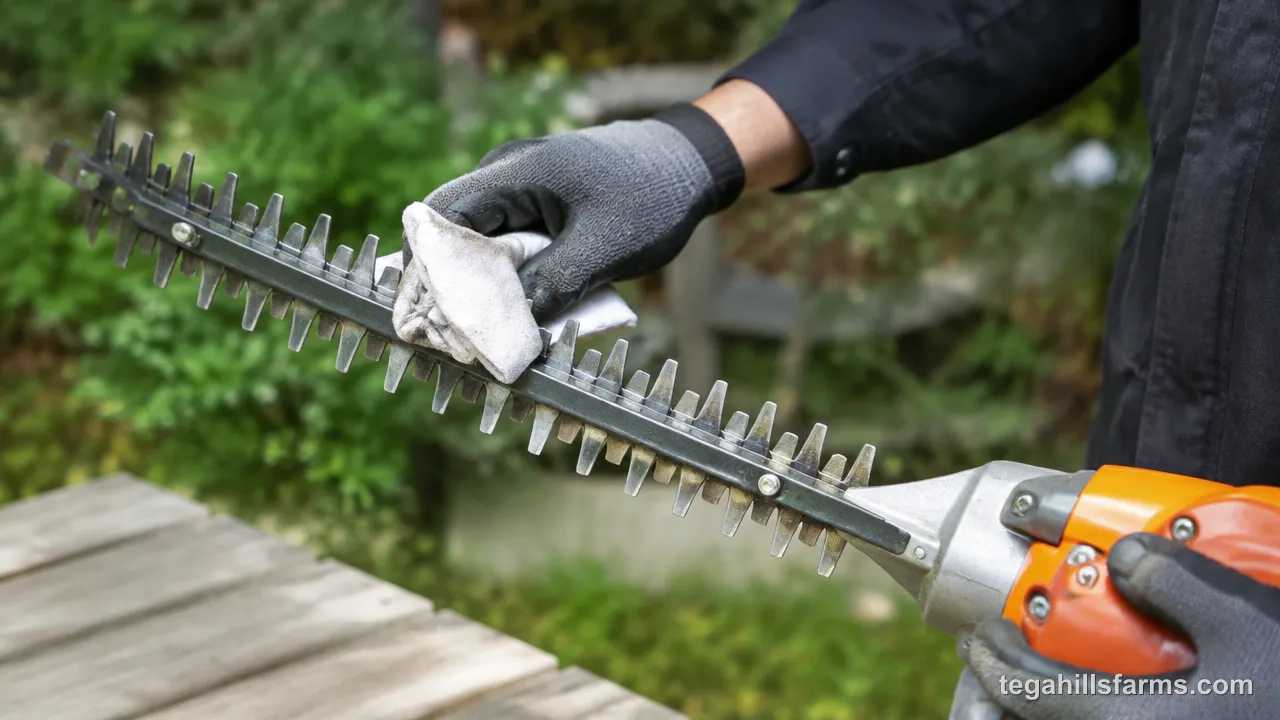
A stiff brush and a rag dampened with a sap or resin cleaner take off the buildup. Once the blades are dry, work a light oil along their full length so it gets between the cutting edges. Dry metal pole sections before storage, and wipe fiberglass sections down too, since moisture trapped in the joints can corrode the metal locks and fittings.
Dull blades tear leaves and stems instead of slicing them, leave brown, ragged edges soon after the trim, and make the motor bog or stall on growth it used to cut easily. A blade that is only dull can usually be touched up with a file along the original bevel. A blade with chipped or bent teeth, a cracked bar, or gaps that grab and jam is worth replacing, because sharpening won’t restore the alignment between the two blades.
What Hedge Trimmer Do Professionals Use?
Someone who trims for a living needs gas or high-capacity battery power, high cutting capacity, a durable build and enough comfort to run the tool all day. A consumer pole trimmer is built for home hedges, with occasional sessions through the season and storage between jobs.
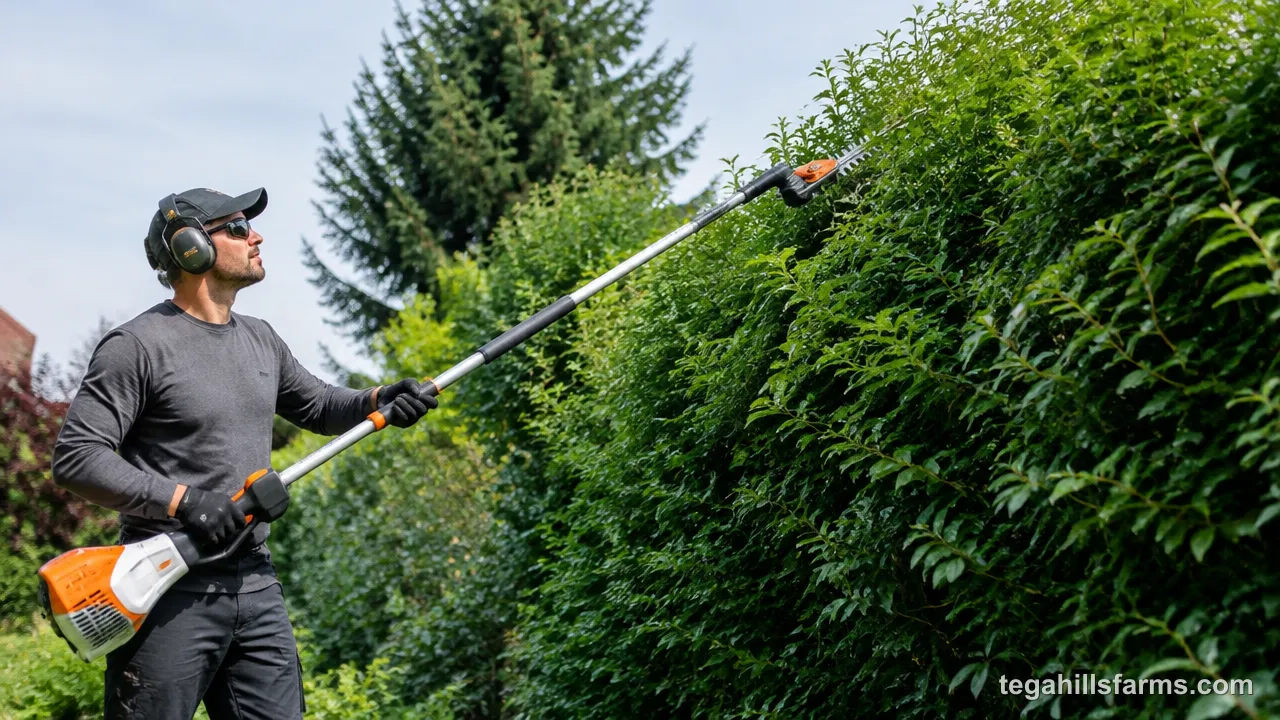
Daily commercial work runs the motor for hours, cycles batteries all day and knocks the tool around in a truck bed, which wears out lighter housings, pivot joints and small packs quickly. When trimming is the job, runtime has to come from a stack of large batteries or a gas engine, the blades have to take thicker wood without slowing down, and harnesses and anti-vibration handles matter more than light weight. Parts availability and service also count, because a tool that’s down for repairs costs a working day. For that level of use, the best commercial hedge trimmers are the place to look.






Write Your Review
No reviews yet. Be the first to share your experience!