

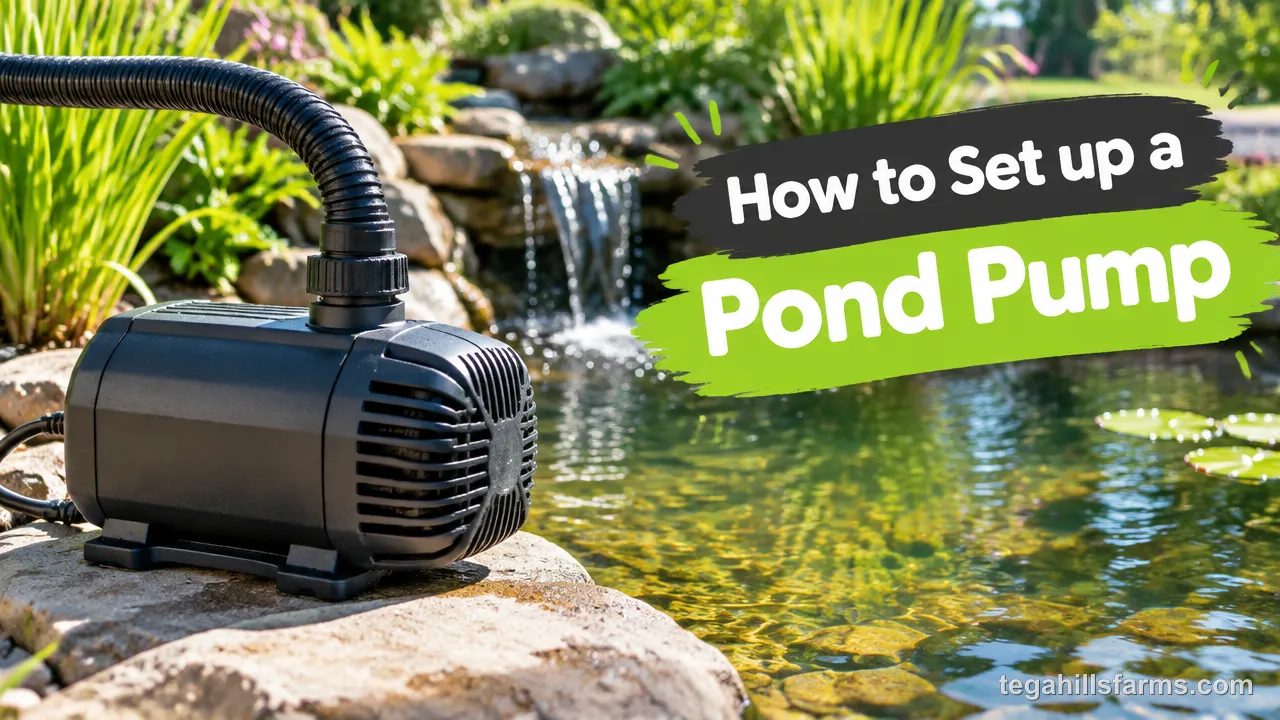
A pond pump setup comes down to four jobs: setting the pump at the pond’s deepest point, connecting a hose that matches its outlet, routing that hose to a filter, fountain or waterfall, and powering it from a GFCI-protected outdoor outlet. A short test run then confirms the water moves the way you planned.
How smoothly the job goes depends on matching each part to the next. The pump’s flow has to suit the job it feeds, the hose has to fit the pump outlet, and the filter type has to suit where it can physically sit in your yard. A box filter that relies on gravity, for instance, changes where the pump and hose run before you dig anything.
Electricity next to water and a pump that wears out early are the two real risks with any pond. Both trace back to install-day choices: a drip loop in the cord, a stand under the pump, and a plan for keeping the pump submerged when summer heat pulls the water level down.
What Does Setting Up a Pond Pump Involve?
The job covers four connected parts: the pump, the hose, the filter or water feature, and the power supply. Each one has to fit the next.
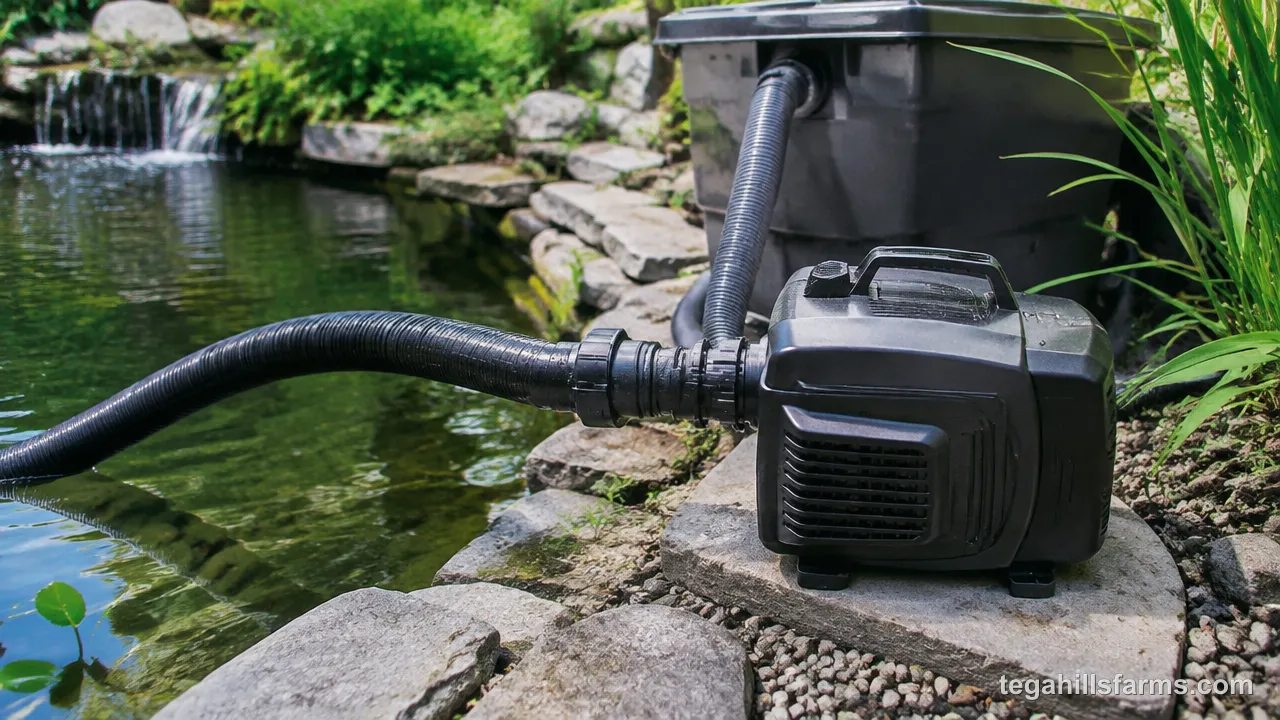
The pump pushes water through the hose, so the hose diameter has to suit the pump outlet. The filter or feature decides where that hose ends, and the outdoor outlet decides where the cord can safely reach. If the pump is still on your shopping list, settle how to choose a pond pump first, because its flow rate and outlet size dictate every fitting that follows.
Sizing matters just as much as fit. A pump too small for the pond leaves water stagnant at the far edge, so check what size pond pump you need against your pond’s volume and the height your water has to climb.
What Do You Need to Prepare Before Installing a Pond Pump?
Confirming the pump suits its job and having a GFCI-protected outlet within reach come before anything goes in the water. A pump bought for a fountain may not push enough water through a filter, and the job it does decides which fittings you need. Sorting out parts and power on dry ground is far easier than fixing a mismatch after the pump is sitting at the bottom of the pond with rocks stacked over the hose.
Which Hoses, Clips and Fittings Does a Pond Pump Need?
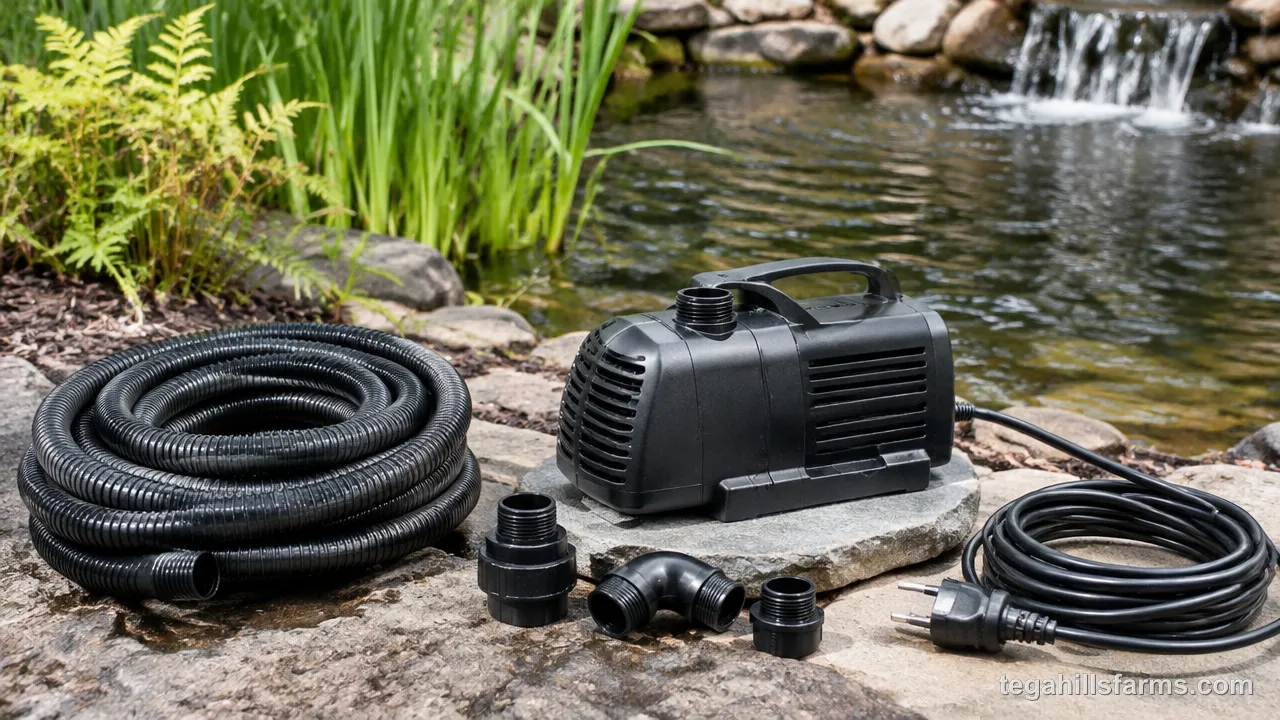
Every pond pump needs a length of flexible pond hose, a hosetail that screws or pushes onto the pump outlet, a stainless hose clip for each joint, and a pump stand or flat stone to sit on. Add a T connector if one pump will feed both a filter and a fountain.
Hose diameter matters most. The hose’s inside diameter should match the hosetail, and the hosetail should suit the pump outlet, because a hose narrower than the outlet chokes the flow the pump was rated for. A hose that is too loose on the hosetail leaks at the clip instead. Stepped hosetails can be cut at the ring that matches your hose so it slides on snugly.
Choose ribbed pond hose over a garden hose for longer runs. Its thicker wall resists kinking where it bends around rocks, which keeps flow steady once the hose is buried out of sight.
How Should You Power a Pond Pump Safely?
Plug the pump only into an outdoor outlet with GFCI protection, either a GFCI receptacle or a GFCI circuit breaker, so power cuts the instant current leaks into the water. Press the GFCI’s test button before connecting the pump, and fit a weatherproof in-use cover so the plug stays dry while it’s plugged in.
Leave a drip loop in the cord by letting it dip below the outlet before it rises to the plug. Water running along the cable then drips off at the low point instead of following the cord into the connection. Keep plugs and connections off wet ground and out of planting beds.
A typical pump cord runs about 32 feet (10 m). If it falls short, have an electrician add an outlet closer to the pond rather than running extension cords across the lawn, and never cut the pump cord to shorten it. Local electrical codes set requirements for outdoor outlets near water, so check them before adding a circuit.
Where Should You Place a Pond Pump?
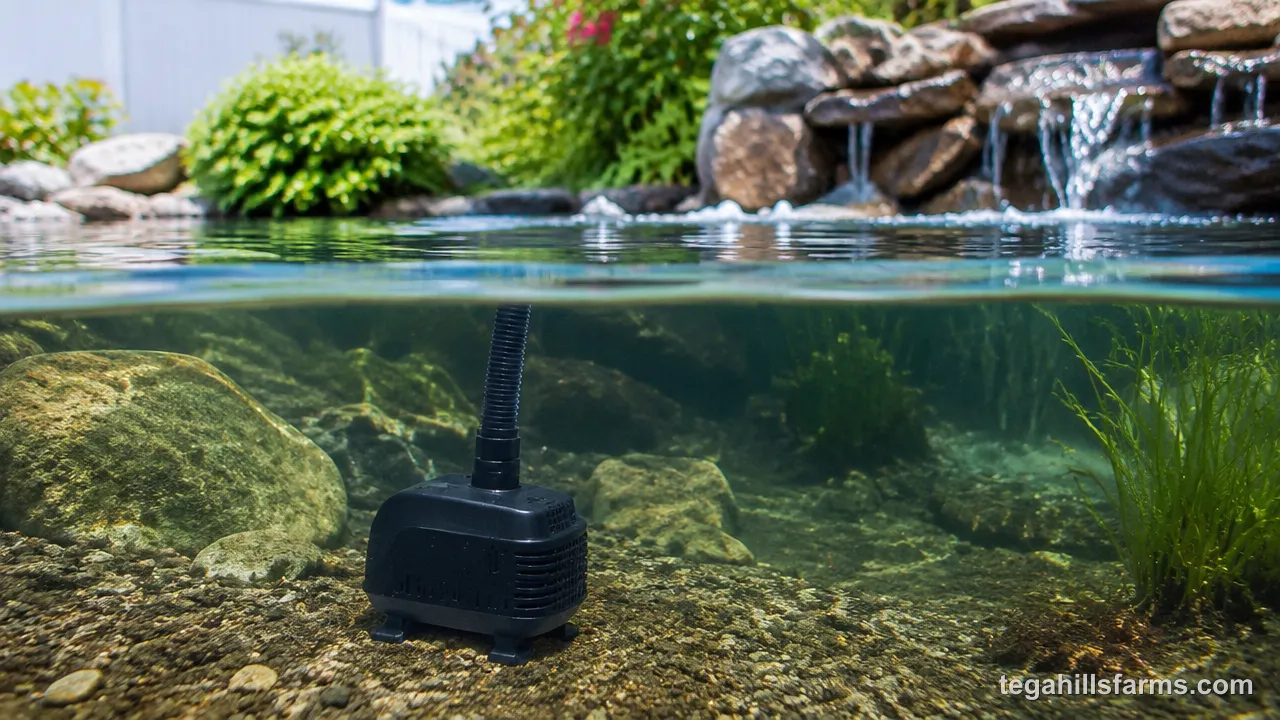
Set the pump at the pond’s deepest point and keep it fully submerged, so the heavy debris and sludge that settle on the bottom get pulled toward the filter instead of building up. Depth also keeps the intake covered when evaporation lowers the water in hot weather, which protects a submersible pond pump from running dry.
Position matters as much as depth. Water should travel the whole width of the pond between the intake and the return, otherwise stagnant pockets form where nothing moves. These rules assume a pump that sits in the water. If you’re still weighing a submersible vs an external pond pump, an external model sits beside the pond and draws water through a pipe, which changes the plumbing but not the circulation goal.
Should a Pond Pump Sit on the Bottom of the Pond?
No. The pump belongs near the bottom but not directly on it. Raising it slightly on a pump stand or a flat stone keeps the intake above the layer of silt and leaf litter on the floor, so it draws debris as it settles rather than sitting buried in sludge that clogs the strainer.
The pump still has to sit low enough to stay fully underwater when the level drops in summer. A stand gives you that balance without lifting the intake toward the surface.
A level base matters too. A pump tilted on uneven rocks vibrates, which adds noise and wear. Stack flat stones or use a purpose-made stand, then check that the intake cage isn’t pressed against a liner fold or plant basket where it could pull material in.
How Far Should the Pump Be From the Waterfall or Fountain?
Put the pump on the opposite side of the pond from the waterfall return, as far away as the layout allows. Water drawn from one end and returned at the other has to cross the whole pond, which pulls oxygenated water through every section and keeps algae and debris from collecting in still corners. A pump set right under its own waterfall only recirculates the same patch of water.
Route the hose around the pond edge, tucked under coping stones or laid in a shallow trench, so it reaches the far side without crossing open water or creating a trip hazard. Fountains work differently: the fountain head usually sits on the pump in the middle of the pond, so circulation there depends on the separate filter loop.
How Do You Connect a Pond Pump Step by Step?
Every joint gets clipped and the pump goes underwater before it is ever plugged in, because a pump started dry or with an open joint can be damaged before you notice the problem. Lay out every part beside the pond first so nothing gets improvised halfway through. A leak or kink found during the first run is a quick fix at the pond’s edge, while the same problem found after rocks and plants cover the hose means pulling the edge apart.
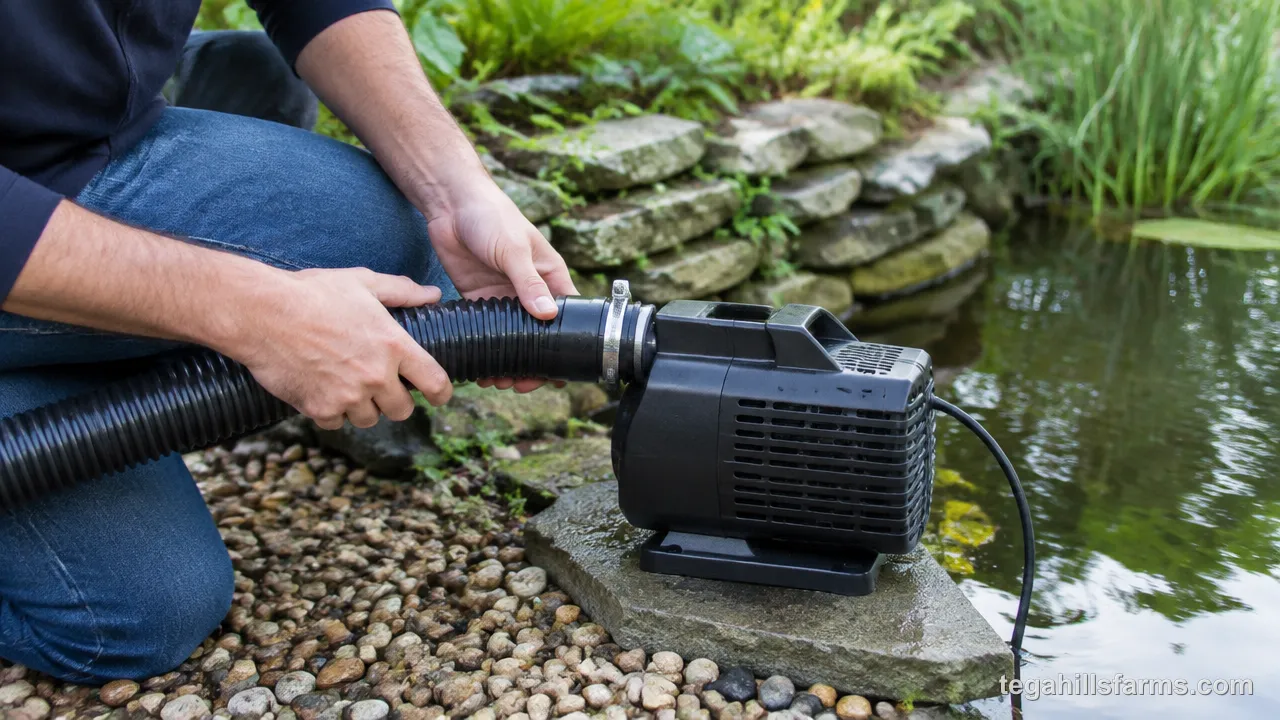
How Do You Attach the Hose to the Pump Outlet?
Fit the hosetail to the pump outlet first, using the O-ring or washer supplied with the pump so the threads seal. If the hosetail is stepped, trim it at the step that matches your hose’s inside diameter.
Slide a hose clip onto the hose before anything else, then push the hose fully over the hosetail. Stiff pond hose goes on easier after its end soaks briefly in a bucket of hot water, which softens it. Set the clip over the hosetail ridges and tighten it until the hose won’t twist by hand, without crushing the hose.
Check the first stretch of hose before moving on. It should leave the pump in a gentle curve, because a sharp bend right at the outlet chokes flow and forces the pump to work against pressure it wasn’t built for.
How Do You Connect the Pump to a Pond Filter?
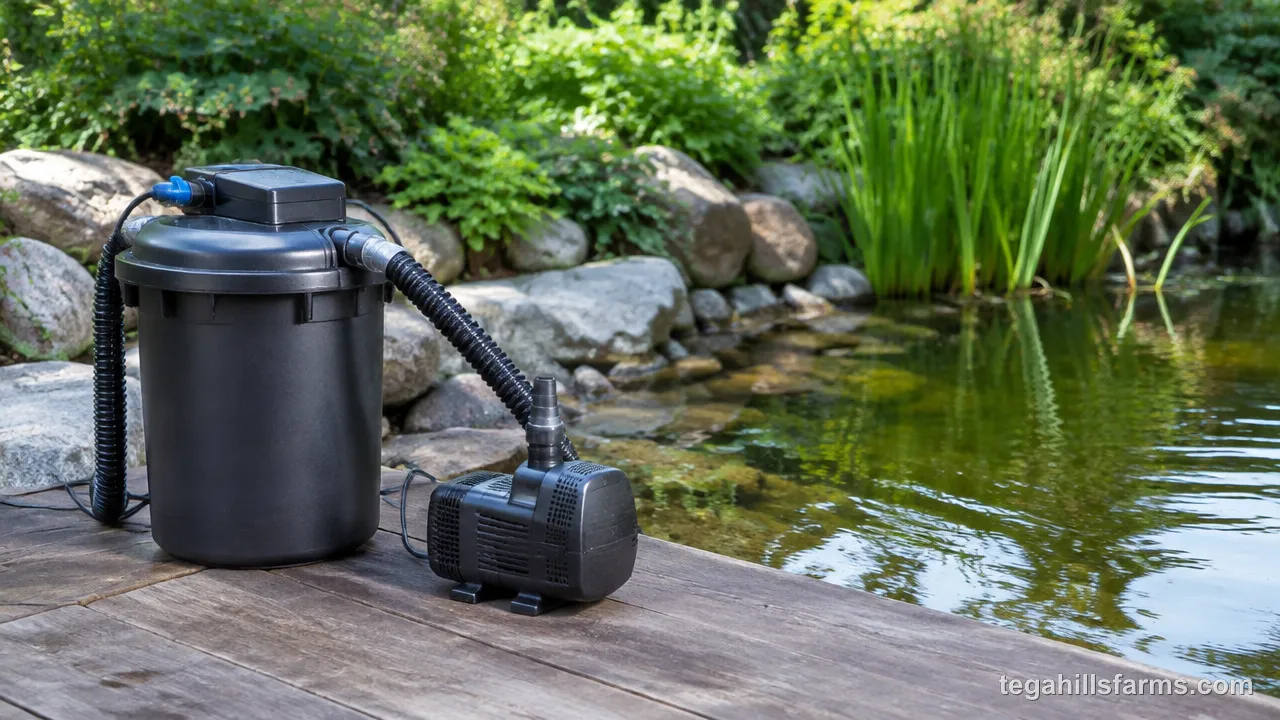
Run the hose from the pump to the filter inlet, fit a hosetail sized to the same hose, and secure it with a clip just as at the pump end. If the system includes a UV clarifier, it usually sits ahead of the filter, so the pump feeds the clarifier first.
The rest of the setup depends on the filter type:
- Box filter: Place it above the pond’s water level, at the highest point of the system, because it relies on gravity to send water back to the pond through its outlet pipe or a waterfall.
- Pressurized filter: It can sit almost anywhere, including buried up to its lid in the ground for a discreet look, since pump pressure pushes water through it and back to the return.
- In-pond filter: It sits underwater with the pump connected directly, so the hose run is short and nothing shows above the surface.
- All-in-one unit: The pump, filter and often a fountain come as one piece, so you place it in the pond and route only the power cord.
- Koi filter: These larger multi-chamber systems handle heavy fish loads and are often gravity-fed like a box filter, so plan their height and pipe runs before you dig.
How Do You Test Run and Check a New Pond Pump?
Lower the pump into the water and tilt it gently so trapped air escapes from the housing. Most submersible pumps prime themselves once fully underwater, but a bubble caught inside can leave the impeller spinning without water.
Switch on at the outlet and watch the hose end. Water should arrive as a steady stream shortly after startup, and brief sputtering usually means air still in the line, which clears as the pump runs. While it runs, walk the full hose route and check every clip and fitting for drips, tightening any that weep.
Listen at the pump too. A smooth hum is normal, while rattling or grinding points to gravel or debris in the impeller housing, so unplug the pump before reaching in. Check the flow again the next day, once the filter has filled and settled.
How Do You Add a Fountain or Waterfall to Your Pond Pump Setup?
A second pump or a T connector that splits one pump’s flow are the two ways to feed a decorative feature, and the choice depends on how much water the feature needs compared with the filter. A filter wants full flow without interruption, so sharing one pump means any change to the feature also changes filtration. Splitting works when the pump has flow to spare, and a valve on the feature branch lets you set the split without starving the filter. Running your numbers through a pond pump gph calculator before buying fittings shows whether one pump can handle both jobs.
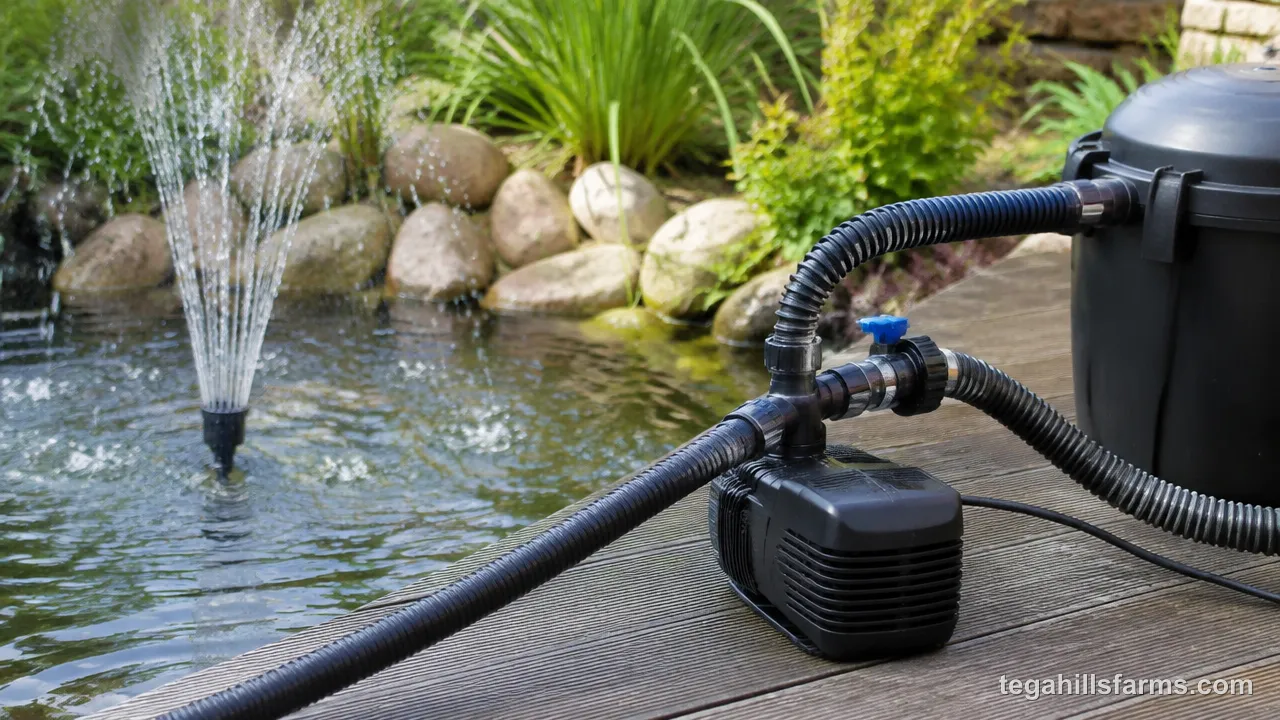
How Do You Install a Fountain Head?
Most fountain heads push onto the pump outlet or a short riser pipe, often with an extension stem that sets the nozzle just above the surface. Fit the riser first, then the head, and adjust the stem so the jets clear the water without spraying sideways.
Match the spray pattern to the pond’s size. A bell jet forms a smooth dome of water that falls close to the nozzle, which suits small ponds and keeps water inside the liner on a breezy day. Multi-tier and spray heads throw water higher and wider, so they need a pond broad enough to catch the drift.
If water lands outside the pond, lower the height or switch to a tighter pattern. Spray lost over the edge drains the pond steadily and can drop the level toward the pump’s intake.
How Do You Set Up a Pump for a Waterfall?
Run the hose from the pump up to the waterfall header or spillway box at the top of the falls, clip it to the inlet, and hide the hose under rocks along the way. Flow at the top depends on lift and hose length, since every foot of climb and every extra length of hose with bends reduces what arrives.
Pump flow ratings are typically measured at about 3 feet (1 m) above the pond surface. A taller waterfall gets less than the box suggests, so check the pump’s flow chart at your actual height.
Ledge width then sets the flow needed for water to spill as a thin, smooth sheet. These are common guide figures for that effect:
| Waterfall width | Flow for a thin sheet (gallons per hour) |
|---|---|
| 6 in (15 cm) | 300 GPH (1,400 L/h) |
| 12 in (30 cm) | 900 GPH (4,000 L/h) |
| 16 in (40 cm) | 1,300 GPH (6,000 L/h) |
| 20 in (50 cm) | 1,650 GPH (7,500 L/h) |
| 24 in (60 cm) | 2,850 GPH (13,000 L/h) |
Too little flow for the ledge breaks the water into separate trickles, while too much turns the sheet into a splashing torrent.
Does a Pond Pump Need to Run 24/7?
Yes, any pump feeding a filter needs to run 24 hours a day, 7 days a week, because the beneficial bacteria in the filter need a constant supply of oxygenated water. Those bacteria break down fish waste and ammonia. When flow stops for long, the colony runs out of oxygen and starts dying, and the filter goes from cleaning the water to fouling it when the pump restarts.
A pump that only drives a fountain or waterfall is different. It doesn’t supply the filter, so you can switch it off at night or run it on an outdoor timer without harming water quality.
Running costs stay modest either way. A small fountain pump draws around 10 watts, while a large waterfall pump uses closer to 60 watts. To see what continuous running adds to your bill, work out how much electricity a pond pump uses at your local rate.
Should You Use a Mains-Powered or Solar Pond Pump?
A plug-in electric pump is the right choice for any pond with a filter or fish, while a solar pond pump suits small decorative features where water only needs to move in daylight.
Reliability is the difference. A corded pump runs around the clock regardless of weather, which the filter’s bacteria depend on. A solar pump runs only while its panel gets direct sun, slows under clouds and stops at dusk unless it has a battery backup, so it can’t keep a biological filter alive. Solar fountains are usually small as well, with sprays up to about 20 inches (50 cm) tall.
Panel placement decides how well solar performs. The panel needs full sun for most of the day, clear of tree shade, and its cord limits how far it can sit from the water. Where no outlet is nearby, solar avoids trenching a new circuit. When weighing a solar vs an electric pond pump for a new feature, I’d keep solar for birdbath-scale fountains and small container ponds where nothing depends on constant flow.
A pump that pushed a full sheet over the waterfall in spring can be dribbling by midsummer with nothing visibly broken. Leaves packed against the intake, a hose crushed behind a rock, or a water level that has crept down toward the pump all cut flow quietly, and a pump left struggling under those conditions overheats and fails long before it should.
What Are the Most Common Pond Pump Problems and How Do You Fix Them?
Most pump faults trace back to water blocked on the way in, water restricted on the way out, or the pump drawing air instead of water. A quick check of the intake, hose and water level solves the majority without new parts.
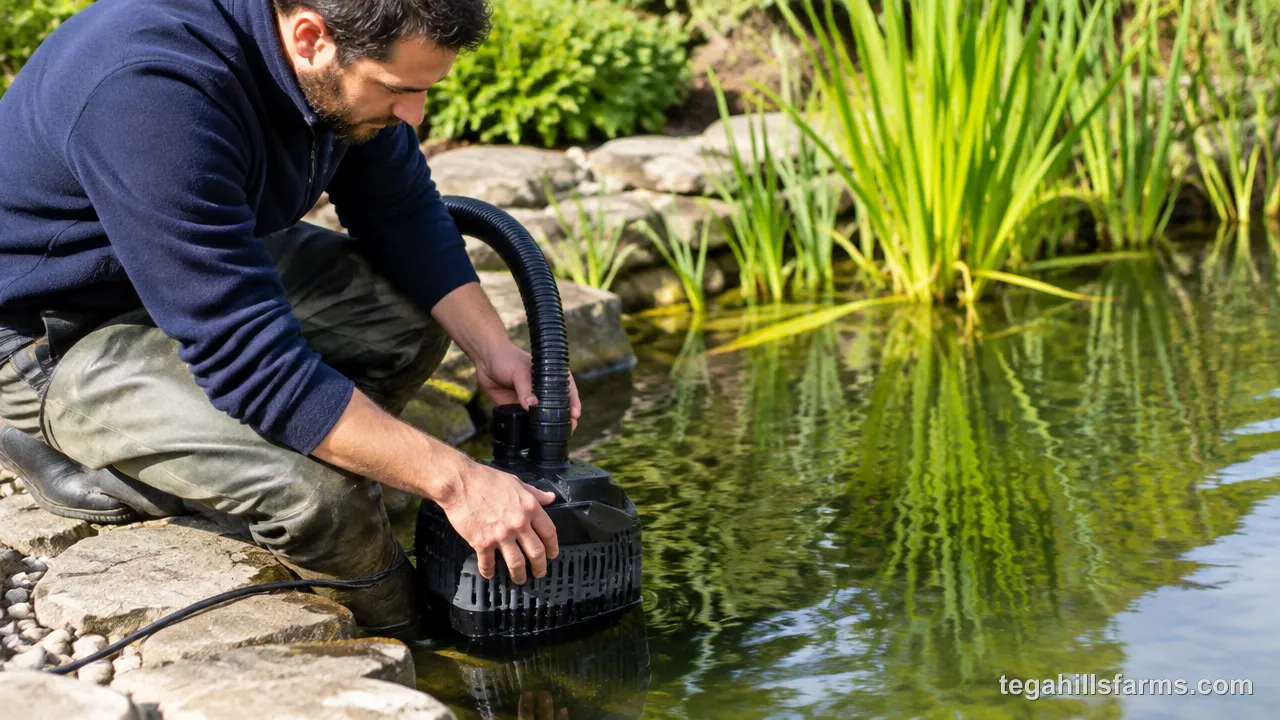
A healthy pump keeps a consistent outflow day after day. A failing one shows flow that drops again soon after cleaning, a hum that grows louder over time, or a GFCI that trips repeatedly. Those signs point to worn internals rather than a blockage, and knowing how long pond pumps last helps you decide between repair and replacement.
Why Is My Pond Pump Losing Flow?
A clogged pump intake is the usual cause: leaves, string algae and silt wrap the strainer cage and starve the impeller. Unplug the pump, lift it out, rinse the cage with pond water, and check the impeller chamber for debris.
If the intake is clean, follow the water path outward. A hose kinked or crushed behind rocks restricts flow, and so do filter sponges packed with sludge. Rinse filter media in a bucket of pond water rather than tap water, because chlorine in tap water kills the beneficial bacteria.
Excess lift is the last suspect. If the waterfall was built higher or the hose lengthened after installation, the pump may be working above the height where it still delivers useful flow.
Why Is My Pond Pump Noisy or Running Dry?
Rattling or grinding usually means gravel or debris lodged around the impeller, while gurgling or sputtering points to air in the line. Air often gets in when the water level drops close to the intake and the pump starts pulling from the surface. Clear debris with the pump unplugged, then make sure the pump sits fully underwater.
Running dry is the more serious problem. Submersible pumps rely on the surrounding water to cool the motor and lubricate the impeller, so a pump left exposed overheats and can fail permanently. Evaporation in summer heat and leaks in the liner or waterfall are the usual reasons the level falls. Some pumps have thermal protection that shuts them off before burnout, but repeated shutdowns still shorten their working life.
How Do You Care for a Pond Pump Through Winter and Routine Cleaning?
Routine care means keeping the intake and impeller clean and adjusting the setup to your winter. Rinse the intake cage whenever flow drops noticeably, and check it more often in fall, when leaves land in the pond daily. Each spring, and again before any winter storage, open the housing and clean the impeller and its chamber, since scale and debris make the motor work harder.
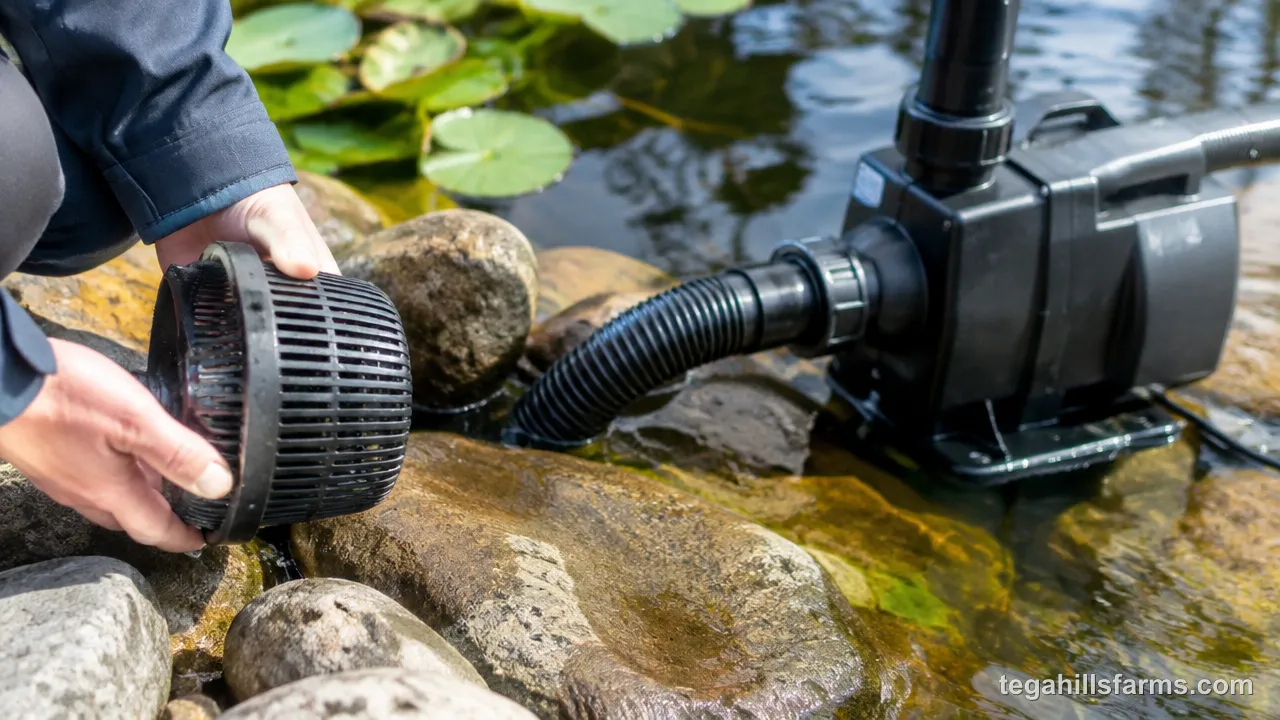
Winter care depends on your region. Where ponds freeze over, the filter’s bacteria slow down in cold water, so the filter pump can be shut down and lifted out. Clean it and store it submerged in a bucket of water in a frost-free spot so its seals don’t dry out. If fish overwinter, keep a hole open in the ice with a de-icer or aerator, and raise any pump left running so it doesn’t churn the warmer water near the bottom.
In milder Southern and coastal climates where the pond stays open, the pump can keep running year-round on its normal cleaning routine.
Pond Pump Setup FAQs
Can I run a pond pump without a filter?
Yes, a pump without a filter still circulates and oxygenates the water, which keeps a small fishless pond or fountain fresher. It won’t remove fish waste or suspended debris, though, so any pond with fish needs a filter to stop ammonia from building up and clouding the water.
What affects the price of a pond pump?
Flow rate and build quality drive how much a pond pump costs more than anything else. Small fountain pumps sit at the budget end, while high-flow waterfall pumps and energy-efficient models built for continuous running cost more up front, though efficient models can save on electricity over years of round-the-clock use.
What is the difference between a pond pump and a fountain pump?
A fountain pump is built to push a modest flow straight up through a nozzle and often comes with fountain heads included. A pond pump moves more water and is designed to feed a filter or waterfall, usually with a strainer that handles debris better during continuous running.
Can I install a pond pump myself?
Yes, placing the pump, connecting hoses and fitting a filter are all homeowner jobs needing only basic tools. The exception is power: if there’s no GFCI-protected outdoor outlet within reach of the pump cord, have a licensed electrician install one rather than improvising with extension cords.
Is a pond pump safe for fish?
A correctly installed pump is safe for fish and improves their environment by circulating oxygenated water. Use a pump with an intake strainer so small fish and fry can’t be drawn in, and keep the flow gentle enough that fish have calm water to rest in away from the return.
Write Your Review
No reviews yet. Be the first to share your experience!