

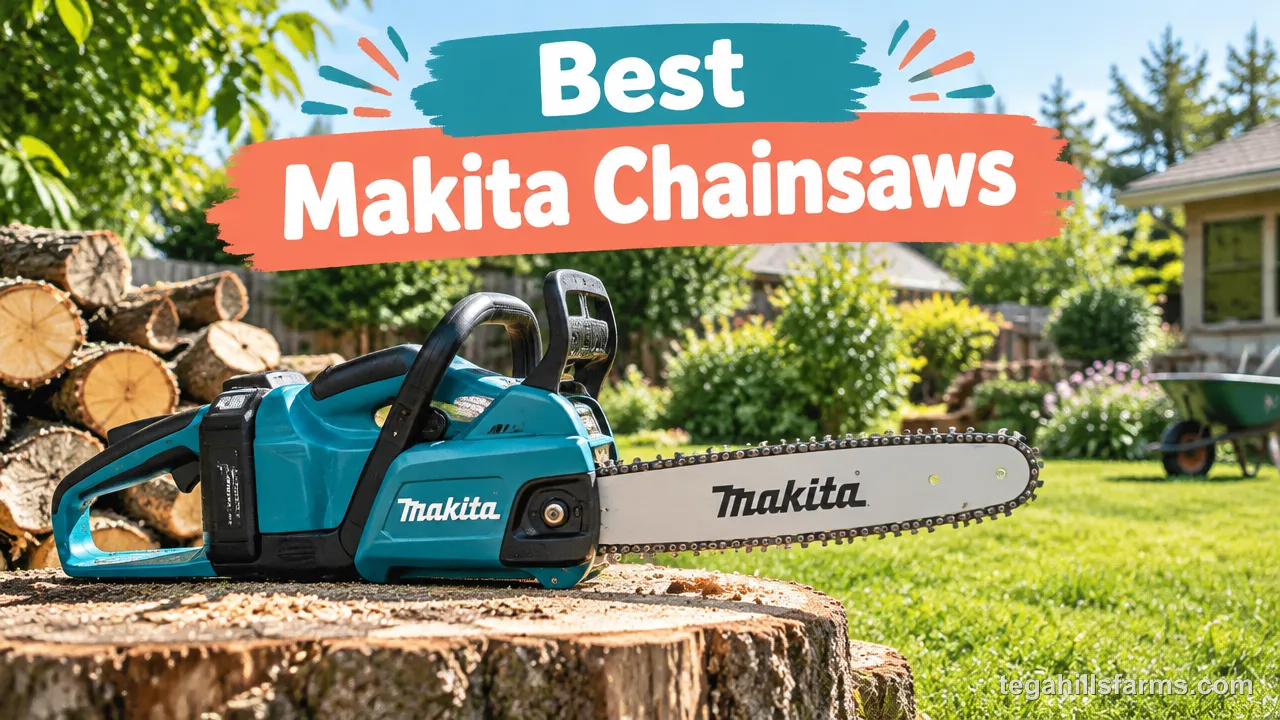
Our top picks for the best Makita chainsaws in 2026 are the Makita XCU14Z 18V LXT 6in Pruning Saw (Best Overall), Makita XCU04PT1 16in Chain Saw Kit (Runner Up), Makita XCU04Z 18V X2 16in (Editor’s Choice), Makita XCU11Z 14in Chain Saw (Also Great), Makita XCU06Z 18V LXT 10in (Also Great), Makita XCU06SM1 10in Top Handle Chain Saw (Best Performance), Makita XCU04CM 16in Chain Saw Kit (Also Great), Makita XCU04PT 16in Chain Saw Kit (Also Great), and Makita XCU07PT 14in Chain Saw Kit (Also Great). Every one of them runs on Makita’s 18V LXT batteries. Some take one pack and some take two working together, so the same packs move between your saw and the rest of your Makita tools.
What separates them is bar length, handle layout and how many batteries the saw runs on. A 6-inch or 10-inch bar keeps a saw light and easy to steer for pruning and limbing. The 14-inch and 16-inch saws take on storm limbs and firewood rounds that a short bar would need several passes to get through.
If you’re coming from gas, the real question is whether a battery saw keeps cutting once a job grows past a few branches. The two-battery saws close most of that gap in power. Runtime still depends on how many charged packs you have on hand, and a dull chain drains them faster than anything else.


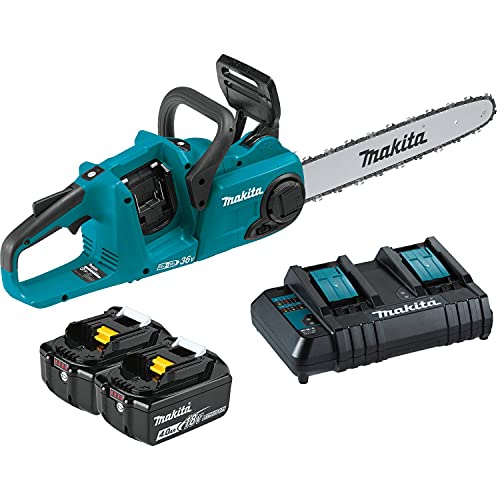

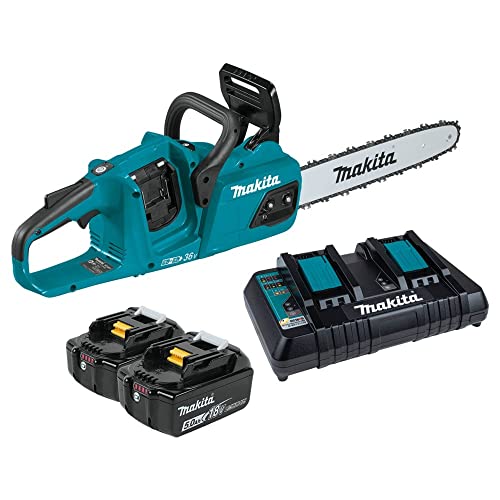
Check which Makita batteries are already on your shelf before you pick between a tool-only saw and a kit, because a two-battery saw won’t run with a single pack.
What Should You Look for in a Makita Chainsaw?
Start with how many 18V LXT batteries the saw runs on, then match bar length and handle layout to the wood you actually cut, because those two calls set the saw’s weight, its power and where you can safely use it. The safety and chain-adjustment hardware matters less on the shelf than in the yard, where it decides how often you fight the saw instead of cutting with it. Battery count also shapes the purchase, since a tool-only saw that needs two packs is a different buy from one that needs a single pack. If you haven’t settled on Makita yet, see how it stacks up against the best chainsaw brands before you buy into its battery platform.
Which Makita Battery Platform Do You Need?
Single-battery saws run on one 18V LXT pack. The 18V X2 models take two 18V LXT packs at once and combine them for 36V. Both kinds use the same batteries that slide into Makita’s drills, impact drivers and other LXT tools, so neither one puts you on a separate battery line.
The two-battery saws exist for power. Doubling the voltage lets the motor hold chain speed when a 16-inch or 14-inch bar is buried in a round, which is why Makita rates those saws against small gas saws. The cost is two packs on the saw for every cut. That means more weight in your hands, and batteries you buy, charge and store in pairs.
A single-battery saw fits pruning, limbing and cleanup of smaller branches. It stays lighter, runs on the same pack as your drill, and skips the bulk of a second battery you’d otherwise hold overhead. I’d step up to an X2 saw only when firewood or storm cleanup is a regular job rather than an occasional one.
How Do Bar Length and Handle Layout Match the Job?
Short bars of 6 or 10 inches suit pruning and limbing, a 14-inch bar handles storm cleanup and smaller firewood, and a 16-inch bar gives you reach for thicker trunks and bigger rounds. A short bar is lighter out front and easier to steer through a crowded canopy. A longer bar puts more weight ahead of your hands, and you feel it in your wrists by the end of an afternoon.
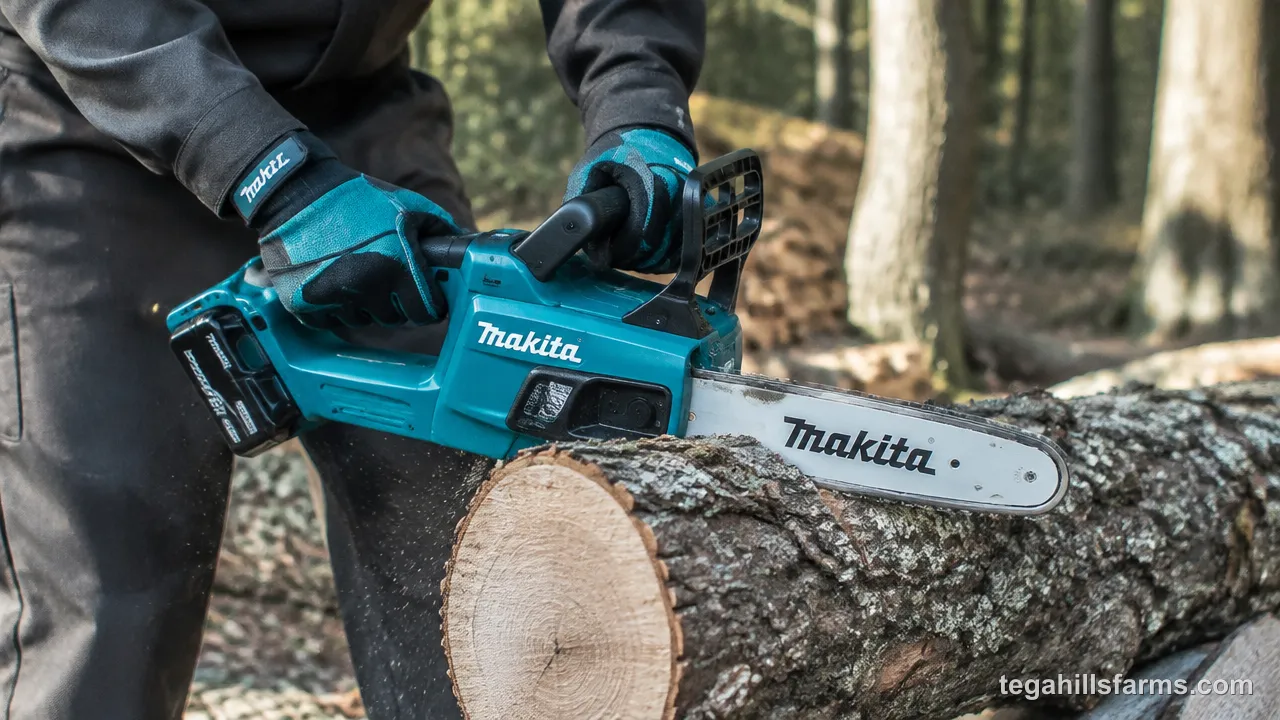
Handle layout changes how you hold the saw. A top-handle saw puts the grip above the motor so it balances in one hand, which is what a tree worker needs when the other hand is on a rope or a branch. A rear-handle saw puts one hand behind the motor and the other on the front handle, so both hands steer the bar. That gives you steadier control and less fatigue when a log pinches or the saw kicks back on the ground.
Makita builds its top-handle saws for work in trees. At waist height, two hands on a rear-handle saw is the safer setup. If your garage is already full of red batteries, weigh the same handle choice among the best Milwaukee chainsaws before you start a second platform.
Which Safety and Maintenance Features Matter on a Battery Saw?
A lock-off lever and auto power-off keep a battery saw from running when you don’t mean it to. A retractable guard or chain brake keeps the chain covered or stopped, and tool-less or lateral tensioning turns chain adjustment into a quick job instead of a hunt for a wrench. A battery saw is silent until the trigger moves, so these features take the place of the idle noise that tells you a gas saw is live.
- Lock-off lever: you press it before the trigger will work, so a branch or your leg brushing the trigger doesn’t spin the chain.
- Auto power-off: the saw switches itself off after sitting unused, which saves charge and keeps a forgotten saw from staying armed.
- Retractable guard or chain brake: on a small pruning saw, a guard covers the chain until it meets the wood. On a larger saw, a chain brake stops the chain when the front hand guard is pushed forward in a kickback.
- Tool-less or lateral tensioning: tool-less adjustment lets you tighten the chain by hand. Lateral tensioning puts the screw on the side of the saw, and a captured bar nut stays in the cover instead of dropping into the grass. New chains stretch as they warm up, so you’ll use this more than you expect.
The 9 Best Makita Chainsaws of 2026
Our top picks are the Makita XCU14Z, Makita XCU04PT1, Makita XCU04Z, Makita XCU11Z, Makita XCU06Z, Makita XCU06SM1, Makita XCU04CM, Makita XCU04PT and Makita XCU07PT. The real split is between the light single-battery saws, from the handheld XCU14Z to the XCU06Z top handle, and the two-battery 16-inch and 14-inch saws that pull through storm limbs and firewood rounds. The XCU06SM1 is a top-handle saw built for professional tree care. It makes sense if you work off the ground and is more saw than you need if every cut is at waist height. The rear-handle XCU11Z covers lighter ground work on a single pack.
#1 Makita XCU14Z 18V LXT 6in Pruning Saw — Best Overall
If most of your cutting is overhead pruning and clearing limbs along a fence line, this saw handles it one-handed at 2.11 lb, light enough to hold out at arm’s length without wearing out your wrist. It runs on a single 18V LXT pack.
Key Specs:
- Bar length: 6 in
- Weight: 2.11 lb
- Battery: 18V LXT (tool only)
- Runtime: up to 140 cuts in 2-inch cedar with an 18V LXT 2.0Ah battery
- Chain adjustment: tool-free
- Safety: retractable chain guard
Detailed Review:
Makita built this as a compact handheld saw for pruning and light limbing, not as a shrunken felling saw, and its weight is what makes that work. You can steady a branch with one hand and cut with the other, which is how pruning a fruit tree or a hedge row actually goes.
The brushless motor earns its place on a tool this small, because it turns more of a small battery’s charge into chain movement instead of heat. Makita’s cut count comes from a compact 2.0Ah pack, so a larger LXT battery borrowed from your drill stretches a pruning session well past it.
The retractable guard covers the chain until the saw meets the wood. That matters on a tool you set down in the grass and pick back up all afternoon. Tool-free chain adjustment lets you take up slack on the spot without going back to the bench.
Next to the XCU06Z, it gives up bar length and cutting depth for a much lighter tool. I’d still steer most homeowners here first, because a saw this easy to grab gets used for the small jobs that a heavier saw turns into a chore.
Pros:
- Light enough to control with one hand overhead.
- Retractable guard covers the chain between cuts.
- Tool-free chain adjustment needs no wrench.
- Brushless motor gets more cuts from a small pack.
Cons:
- Short bar can’t handle trunks or firewood rounds.
- Sold as a bare tool without battery or charger.
Who It’s For:
Homeowners who spend more time shaping fruit trees, clearing fence lines and cutting back overgrown shrubs than splitting firewood will reach for it often, especially with 18V LXT batteries already on the charger. If storm cleanup with thick limbs is your main job, you need a saw with a longer bar.
Editor’s Verdict:
Buy it as the everyday pruning tool. It’s light, guarded and quick to adjust, and it handles the small cutting jobs that come up every week.
#2 Makita XCU04PT1 16in Chain Saw Kit — Runner Up
This kit suits owners who cut firewood and storm limbs and want no gas can in the garage. It ships with four 5.0Ah batteries for a saw that runs on two at a time, so you can charge one pair while cutting with the other and keep working through a long cleanup.
Key Specs:
- Bar length: 16 in
- Power: two 18V LXT batteries (36V), rated equal to a 32cc gas chain saw
- Motor: outer rotor brushless, direct drive
- Chain speed: 0–3,940 FPM, variable speed trigger
- Batteries: four 5.0Ah 18V LXT
- Chain adjustment: tool-less
Detailed Review:
The outer rotor brushless motor drives the chain directly, with no belt or gearbox between them, so more of the batteries’ output reaches the chain when it’s buried in a round. Makita’s gas rating puts it in the firewood and storm-cleanup class, which is exactly the work a homeowner with a woodpile gives it.
The variable speed trigger lets you feather the chain into bark so it bites instead of skating, then open it up once the cut is started. With no pull cord, choke or fuel mix, it starts the instant you squeeze the trigger, which makes a real difference on a cold morning after a storm. It also runs quietly enough that early cleanup doesn’t wake the street.
The four 5.0Ah packs are the reason to buy this kit over the bare saw. Next to the XCU04CM kit, which comes with a single pair of smaller packs, you get a spare pair at a larger capacity, so one set charges while the other cuts.
Tool-less chain adjustment handles the upkeep side. When a new chain stretches in its first few cuts, you take up the slack by hand and keep going.
Pros:
- Four batteries let one pair charge while another cuts.
- Two-battery power handles firewood rounds and storm limbs.
- Starts instantly with no pull cord or oil mixing.
- Tool-less chain adjustment works with gloves on.
- Variable trigger gives a controlled start to each cut.
Cons:
- Running two batteries at once adds bulk to every cut.
- Four-battery kit duplicates packs if you already own LXT batteries.
Who It’s For:
If you heat with a wood stove or clear storm limbs every season and have no Makita batteries yet, this kit gets you cutting with spare packs on hand. Owners who already keep 18V LXT batteries charged can skip the extra packs with the tool-only XCU04Z.
Editor’s Verdict:
Choose this kit if you want a two-battery saw ready to work out of the box, with enough packs to keep cutting through a long day.
#3 Makita XCU04Z 18V X2 16in — Editor’s Choice
Owners already invested in 18V LXT tools get two-battery 16-inch cutting here without adding packs they don’t need. A built-in lock-off lever keeps the chain from engaging while you carry the saw between brush piles, and auto power-off shuts it down if you leave it switched on and sitting on the tailgate.
Key Specs:
- Bar length: 16 in
- Weight: 10 lb
- Power: two 18V LXT batteries (36V, not included), rated equal to a 32cc gas chain saw
- Safety: built-in lock-off lever
- Switch: LED on/off with auto power-off
Detailed Review:
This is the bare-tool version of Makita’s two-battery 16-inch saw, built around an outer rotor brushless motor that drives the chain directly. At 10 lb, it’s still a saw you can run with both hands through an afternoon of bucking limbs.
It has both the built-in lock-off lever and the LED switch with auto power-off. The lever keeps a brushed trigger from spinning the chain while you walk the saw between piles. The auto shutoff means a saw left switched on in the truck bed isn’t quietly draining two packs.
The XCU11Z weighs the same on one battery, but this saw runs its chain far faster, so it moves through firewood rounds noticeably quicker. That speed depends on a second battery on board, which only matters if your shelf is short on packs. This is the saw I’d steer an existing Makita owner toward for firewood, because the batteries already charging in the garage become its fuel.
The variable speed trigger rounds it out. You can ease the chain into bark at low speed, then open it up once the cut is started.
Pros:
- Lock-off lever stops accidental chain starts.
- Auto power-off saves charge when the saw sits idle.
- Two-battery power runs on packs you already own.
- Variable speed trigger eases the chain into each cut.
Cons:
- Needs two batteries before it will run at all.
- Batteries and charger are sold separately.
Who It’s For:
Anyone with a drill, blower or impact driver on the 18V LXT platform and a steady supply of firewood or storm limbs should look here first. Buyers starting without LXT batteries will be better served by a kit that includes them.
Editor’s Verdict:
Pick this saw when the batteries are already on your shelf. It puts full two-battery cutting power behind a lock-off lever and auto shutoff.
#4 Makita XCU11Z 14in Chain Saw — Also Great
A single 18V LXT battery runs this 14-inch rear-handle saw, which makes it a good fit for lighter ground work like trimming storm limbs and cutting small firewood when you’d rather not carry two packs. Its brushless motor favors torque at 1,520 FPM.
Key Specs:
- Bar length: 14 in
- Weight: 10 lb
- Battery: 18V LXT (tool only)
- Chain speed: 1,520 FPM, high torque
- Handle: compact body, rear handle
- Motor: Makita brushless
Detailed Review:
The compact body and rear handle put both hands on the saw, which keeps it steady when a limb shifts or the bar pinches in a downed branch. That layout belongs at waist height on wood that’s already on the ground, not overhead.
Running on one 18V LXT pack keeps the setup simple, and the brushless motor is tuned for torque rather than raw chain speed. Next to the XCU07PT, which shares its bar size but runs two batteries, this saw moves its chain much slower. It cuts steadily but takes longer through thick rounds, and in exchange you only have one pack to keep charged.
With no gas, oil mixing or pull cord, it starts on the trigger. Its low noise lets you clear a fallen branch early on a weekend without announcing it to the whole street.
I’d point a homeowner here when staying on a single battery matters more than cutting speed. For regular firewood work, the extra chain speed of a two-battery saw is worth carrying the second pack.
Pros:
- Runs on a single 18V LXT battery.
- Rear handle gives two-handed control on the ground.
- No pull cord, gas mixing or choke to deal with.
- Low noise suits early or neighborhood cutting.
Cons:
- Slower chain speed makes thick hardwood cuts take longer.
- Rear-handle body isn’t suited to work up in trees.
- Sold as a bare tool without battery or charger.
Who It’s For:
Suburban owners who clean up after windstorms, cut the occasional small round for a fire pit and want to keep using the 18V LXT packs they already have fit this saw well. If firewood is a regular chore, the XCU07PT runs its chain faster on the same bar size and suits that work better.
Editor’s Verdict:
Expect steady, quiet cutting on downed limbs from a saw that asks for nothing more than the battery your other tools already use.
#5 Makita XCU06Z 18V LXT 10in — Also Great
With a 10-inch bar on a top-handle body, this saw suits pruning, trimming and limbing jobs that need more reach than a handheld pruner but not the bulk of a two-battery saw. It weighs 7.22 lb.
Key Specs:
- Bar length: 10 in
- Power: 18V LXT battery (tool only), rated equal to a 22cc gas chain saw
- Runtime: up to 175 cuts in 2×2 cedar with an 18V LXT 5.0Ah battery
- Torque boost mode for dense material
- Chain tensioning: captured bar nut, lateral tensioning
- Handle: compact top handle
Detailed Review:
The outer rotor brushless motor drives the chain directly, and its gas-equivalent rating puts it in the limbing-saw class, not the firewood class. Torque boost mode gives you extra pulling power when the chain meets dense hardwood or a knot that would otherwise bog down the cut.
Makita’s cut count with a 5.0Ah pack comes from small cedar stock. Read it as a sign of how far one battery goes on pruning work, not as a firewood figure. A larger pack means fewer stops on a long limbing job along a property line.
The captured bar nut stays in the side cover and the tensioning screw sits on the side, so a chain adjustment in the yard doesn’t end with you hunting for a dropped nut in the grass. The top handle balances the saw for limbing, but when you’re on the ground, keep both hands on it.
For a homeowner who prunes from the ground, I’d take this tool-only saw over the pro top-handle kit. The packs you already own run it, and the tree-care focus of the pro saw pays off mostly for work aloft.
Pros:
- Top handle balances well for limbing and pruning.
- Torque boost mode helps in dense or knotty wood.
- Captured bar nut can’t drop into the grass.
- Single 18V LXT pack keeps the setup simple.
Cons:
- Short bar limits it on firewood rounds.
- Battery and charger are sold separately.
Who It’s For:
If your yard has mature trees that need limbing and you want more bar than a handheld pruner without stepping up to a bigger, heavier saw, this one fits, and it runs on LXT batteries you may already own. Firewood and storm-felled trunks call for a longer rear-handle saw instead.
Editor’s Verdict:
Count on it for limbing and pruning jobs that outgrow a handheld saw, with torque boost in reserve for the knotty cuts.
#6 Makita XCU06SM1 10in Top Handle Chain Saw — Best Performance
Built for the professional tree care industry, this top-handle kit spins its chain at up to 4,720 FPM, which suits climbers and anyone who regularly cuts limbs while working up in a tree. A 4.0Ah battery comes with it.
Key Specs:
- Bar length: 10 in
- Weight: 10.54 lb
- Chain speed: 0–4,720 FPM, variable speed trigger
- Battery: 18V LXT 4.0Ah (kit)
- Torque boost mode for dense material
- Chain tensioning: captured bar nut, lateral tensioning
Detailed Review:
The outer rotor brushless motor drives the chain directly, and top chain speed is what this saw is about. A faster chain clears chips quicker and needs less push from you, which matters when you’re holding the saw at an awkward angle in a canopy.
Its chain runs faster than the 16-inch XCU04Z’s, but on a much shorter bar, so the speed buys quick, clean limb cuts rather than reach through big rounds. Torque boost mode backs that speed up in dense wood, so a knot or a hardwood limb doesn’t stall the chain halfway through.
The captured bar nut and lateral tensioning let you adjust the chain without setting the saw on a stump and digging out a wrench. That counts when the saw spends its day on a climbing line. The kit’s 4.0Ah battery gets you started, though a full day aloft calls for spares.
Makita built this layout for tree work, and on the ground it gives up the two-handed control of a rear-handle saw. I wouldn’t buy it for waist-height firewood work, because its design only pays off when you’re actually in a tree.
Pros:
- Variable speed trigger runs the chain up to 4,720 FPM.
- Kit includes a 4.0Ah 18V LXT battery.
- Torque boost mode helps on dense limbs.
- Lateral tensioning makes chain adjustment quick.
Cons:
- Top-handle layout gives less control for ground cutting.
- Short bar limits it on trunks and firewood.
- Pro tree-care design is more saw than a typical yard needs.
Who It’s For:
Climbers, arborists and owners with wooded property that needs regular work aloft will put its chain speed and balance to use. For pruning from the ground on a home lot, the tool-only XCU06Z skips the included battery and runs on 18V LXT packs you already have.
Editor’s Verdict:
Reach for this saw if you often work up in trees. Its chain speed and top-handle balance are wasted at waist height.
#7 Makita XCU04CM 16in Chain Saw Kit — Also Great
Starting from zero Makita batteries, you get a ready-to-run 16-inch two-battery saw with this kit, since it includes both 4.0Ah packs the saw needs. Makita rates that pair at up to 150 cuts in 4×4 cedar.
Key Specs:
- Bar length: 16 in
- Power: two 18V LXT batteries (36V), rated equal to a 32cc gas chain saw
- Batteries: two 4.0Ah 18V LXT
- Runtime: up to 150 cuts in 4×4 cedar
- Motor: outer rotor brushless, direct drive
- Chain adjustment: tool-less
Detailed Review:
The outer rotor brushless motor drives the chain directly and carries Makita’s small-gas-saw rating, which puts firewood rounds and downed limbs squarely in its range. Because the kit includes both packs the saw needs, you don’t have to hunt for a pair of batteries before the first cut.
Makita’s cut count for this kit comes from 4×4 cedar, which is closer to storm-limb work than the small stock behind pruning-saw figures. That makes it a more useful guide to what one charge of the pair gets you on a cleanup day.
With one pair of packs, the saw stops when both run down, so a long day means a pause at the charger. If you later add LXT packs for other tools, they slot in as backups and cover that pause.
Tool-less chain adjustment and the lack of gas, oil mixing or pull starts keep the rest of the upkeep simple. What’s left is the chain, the bar oil and charging.
Pros:
- Includes both batteries the saw needs to run.
- Brushless direct drive handles firewood and storm limbs.
- Tool-less chain adjustment needs no wrench.
- No gas, emissions or pull starts.
Cons:
- One pair of packs means recharging breaks on long jobs.
- Smaller packs run down sooner than higher-capacity batteries.
Who It’s For:
New Makita owners who want a firewood-capable saw without piecing together batteries will find everything the saw needs to run in this box. If long cutting days are the norm, a kit with spare packs like the XCU04PT1 keeps the saw running while batteries charge.
Editor’s Verdict:
Treat it as a complete starter setup for firewood and storm cleanup. The included pair of packs gets you cutting the day it arrives.
#8 Makita XCU04PT 16in Chain Saw Kit — Also Great
Safety-minded owners who cut firewood get a 16-inch saw here with both a lock-off lever and auto power-off, plus 5.0Ah battery power in the box. Chain adjustment is tool-less.
Key Specs:
- Bar length: 16 in
- Power: rated equal to a 32cc gas chain saw
- Safety: built-in lock-off lever, LED on/off switch with auto power-off
- Chain adjustment: tool-less
Detailed Review:
This kit pairs the safety hardware of the XCU04Z, a built-in lock-off lever and an LED switch with auto power-off, with battery power in the box. That makes it the ready-to-run route if those safety features matter more to you than a stack of spare packs.
The lock-off lever means a brushed trigger won’t start the chain while you carry the saw from the truck to the brush pile. Auto power-off matters more on a kit used for long sessions, because a saw left switched on between cuts drains packs you’ll need for the next stretch.
The variable speed trigger lets you start each cut slowly so the chain bites instead of bouncing across bark, then open it up to full speed. Its outer rotor brushless motor drives the chain directly, so power holds as the cut goes deeper into a round.
Tool-less chain adjustment handles the slack a new chain develops in its first sessions. I’d lean toward this kit if you want the lock-off and auto shutoff and don’t plan on cutting long enough to need a rotation of spare packs.
Pros:
- Lock-off lever prevents accidental chain engagement.
- Auto power-off saves charge between cuts.
- Kit includes 5.0Ah LXT battery power.
- Tool-less chain adjustment works in the field.
Cons:
- Kit batteries duplicate packs you may already own.
- Long bar is too much saw for overhead pruning.
Who It’s For:
Buyers who want the lock-off lever and auto power-off of the XCU04Z but have no 18V LXT batteries yet get those features with battery power included. If your shelf already holds 18V LXT packs, the tool-only XCU04Z gives you the same safety hardware without duplicate batteries.
Editor’s Verdict:
Go with this kit when a lock-off lever and auto shutoff matter to you and you need battery power included from day one.
#9 Makita XCU07PT 14in Chain Saw Kit — Also Great
On a 14-inch bar, this kit pairs two 18V LXT batteries for 36V, which gives storm cleanup and limb-wood firewood a full-speed chain in a shorter saw that’s easier to steer around fences and shrubs. It ships with 5.0Ah packs.
Key Specs:
- Bar length: 14 in
- Power: two 18V LXT batteries (36V), rated equal to a 32cc gas chain saw
- Battery: 18V LXT 5.0Ah (kit)
- Chain tensioning: captured bar nuts, lateral tensioning
- Switch: LED on/off with auto power-off
Detailed Review:
A 14-inch bar on two-battery power is a practical size for suburban storm cleanup. It’s long enough for downed limbs and short enough to steer around a fence or shrub without the tip catching. Tip contact is what causes kickback, so a bar you can see and place easily matters as much as reach.
The single-battery XCU11Z has the same bar size, but this saw runs its chain far faster, so it gets through firewood rounds quicker. In exchange, it carries a second battery, which means two packs to keep charged instead of one.
Captured bar nuts and lateral chain tensioning keep adjustments simple in the field. Auto power-off shuts the saw down if you leave it idle between piles, and the variable speed trigger gives you a slow start to each cut before full speed.
I’d pick this over a longer-bar saw for most suburban cleanup. Its chain speed matches the XCU04Z, and the shorter bar is easier to place in tight spots.
Pros:
- Two-battery power on a handier 14-inch bar.
- Variable speed trigger gives controlled starts.
- Captured bar nuts can’t get lost during chain changes.
- Auto power-off saves charge between cuts.
Cons:
- Shorter bar limits it on thicker trunks.
- Needs two charged batteries to run at all.
Who It’s For:
For storm cleanup on a typical suburban lot and firewood that’s mostly limb wood, this kit hits a practical middle ground, and it runs on the 18V LXT batteries you may already use. If big rounds from a downed trunk are common in your yard, the longer bar of the XCU04Z handles them better.
Editor’s Verdict:
Take this kit if you want two-battery chain speed in a saw short enough to handle easily around fences, shrubs and tight corners of the yard.
Which Makita Chainsaw Should You Choose?
Pick by job: a compact pruning or top-handle saw for work in trees and light limbing, a two-battery 16-inch saw for storm cleanup and firewood, and a 14-inch rear-handle saw for lighter ground work. The batteries already on your shelf can shift that call, because a saw that needs packs you don’t own changes what you end up buying. The length of your cutting days decides whether battery power covers the work at all.
Should You Buy a Tool-Only Saw or a Kit?
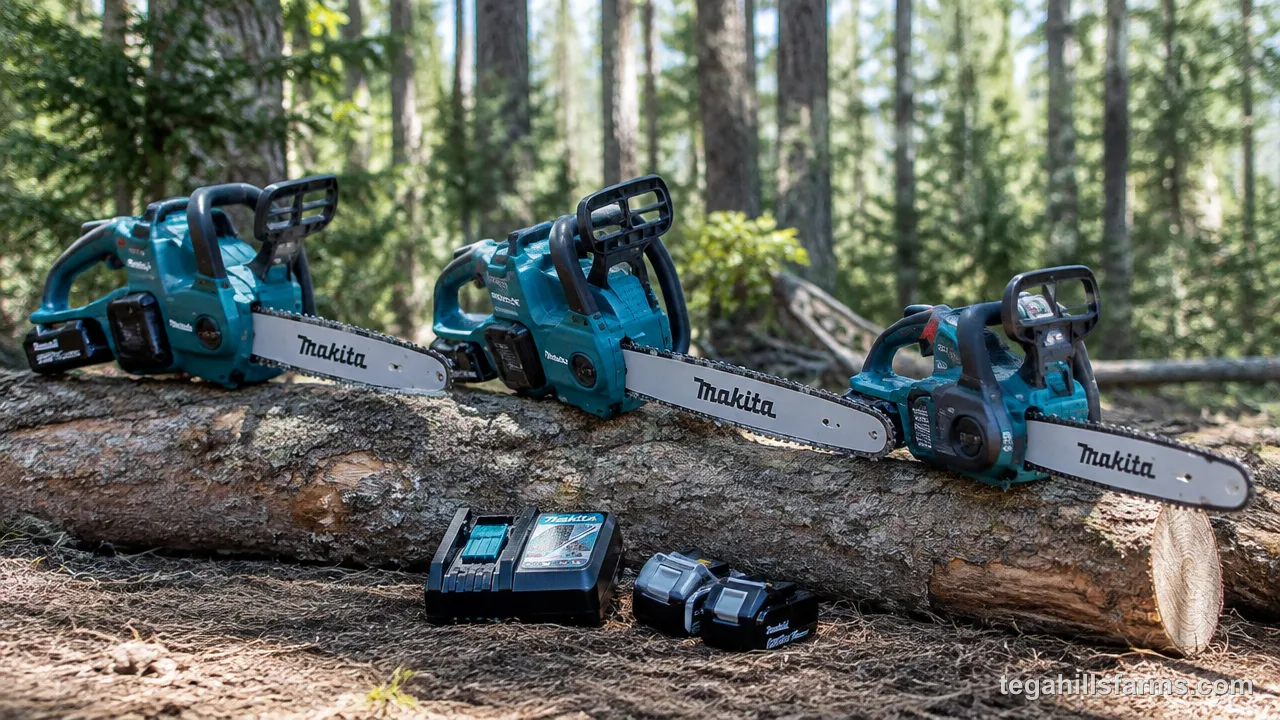
If 18V LXT batteries and a charger already sit in your garage, the bare tool makes more sense, because the packs from your drill or blower become the saw’s power. A kit fits when you’re starting from scratch, since it bundles the saw with batteries and a charger.
Battery count changes what you end up needing. A single-battery saw like the XCU06Z or XCU11Z runs on one pack, so even a small collection covers it. A two-battery saw like the XCU04Z needs a pair of packs on board before it will start. Small compact packs from a drill kit also empty quickly under a saw’s load, which is why the kits pair the saw with larger packs. If you’d be buying batteries anyway, I’d go straight to a kit rather than piecing together packs and a charger on your own.
Can a Makita Battery Chainsaw Replace a Gas Saw?
Yes, for most yard work. A two-battery model handles pruning, storm cleanup and firewood from downed limbs, and it starts on a trigger instead of a pull cord. Sustained heavy cutting, such as bucking a large trunk into rounds or cutting firewood all day, still points toward gas. A battery saw stops when its packs run down, while a gas saw refuels from a can and keeps going.
Makita rates its two-battery saws against a 32cc gas saw and the XCU06Z against a 22cc saw. Read those figures as a power comparison with small gas saws. A 32cc engine sits at the light end of gas saws sold for firewood, and the rating says nothing about how long the battery saw runs before you swap packs.
On a long day, runtime comes down to how many charged packs you have and how quickly your charger turns them around. A kit with spare packs lets one pair charge while the other cuts. With a single pair, you cut in stretches and wait between them. If big timber is a regular job, the best Husqvarna chainsaws include gas models built for that kind of all-day cutting.
A battery saw has no carburetor to clean, but its chain still dulls on every cut and its bar still runs dry when the oil tank empties. Push a dull or dry chain through a pile of storm limbs and the motor works harder for every inch, so the packs that should finish the job go flat halfway through while the bar and chain heat up and wear faster.
How Do You Keep a Makita Chainsaw Cutting Well Over Time?
A sharp chain, a bar that never runs dry, correct tension and batteries stored indoors through the off-season are what separate a saw that cuts cleanly from one that chews through wood and drains packs. A healthy chain pulls itself into the cut and throws long chips. A dull one makes fine dust, needs you to push, and starts cutting crooked.
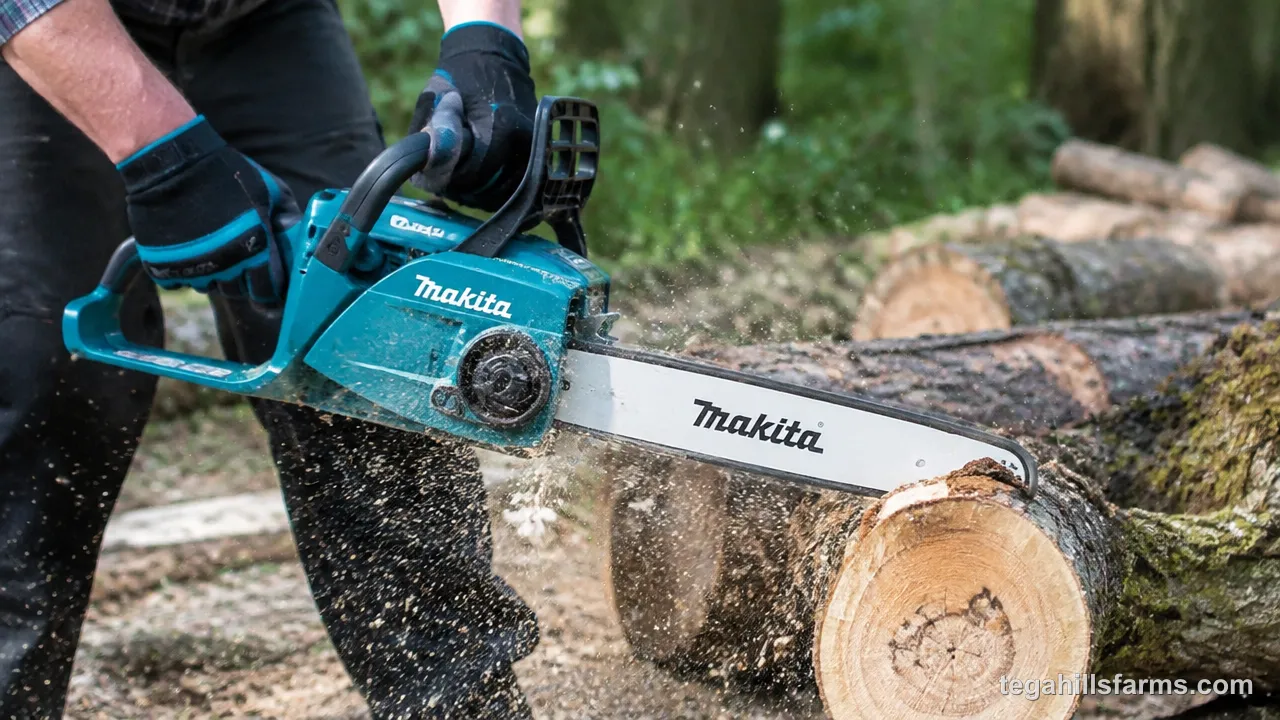
Touch up the cutters with a file when dust replaces chips. Replace the chain once the cutters are filed back to their wear marks or a tooth is chipped, and replace the bar when its rails wear uneven or the groove spreads enough that the chain wobbles. Check the bar oil every time you swap packs. Check tension before each session and again after the first few cuts, because a warm chain stretches. The chain should sit snug against the bar but still pull around by hand with gloves on.
In the off-season, store packs indoors away from freezing cold and high heat, partly charged rather than full or empty. A pack that runs noticeably shorter than it used to, or gets hot fast, is near the end of its life. These habits hold for any battery saw, including the best DeWalt chainsaws, since chain wear and battery storage don’t depend on the brand.
Makita Chainsaw FAQ
Which Makita battery chainsaw is the best?
For owners whose cutting is mostly pruning and limbing, the XCU14Z pruning saw is the best Makita battery chainsaw, because it handles that work one-handed at just over two pounds. If firewood and storm cleanup are regular jobs, the two-battery XCU04PT1 kit is the better fit, with spare packs that keep the saw cutting while the others charge.
How good are Makita chainsaws?
Makita’s battery chainsaws are solid choices for homeowners who want a saw that starts on a trigger and shares batteries with other 18V LXT tools. The two-battery models use brushless direct-drive motors rated against a small gas saw. Features like lock-off levers, auto power-off and tool-less or lateral chain tensioning cut down on accidental starts and fiddly upkeep.


Write Your Review
No reviews yet. Be the first to share your experience!